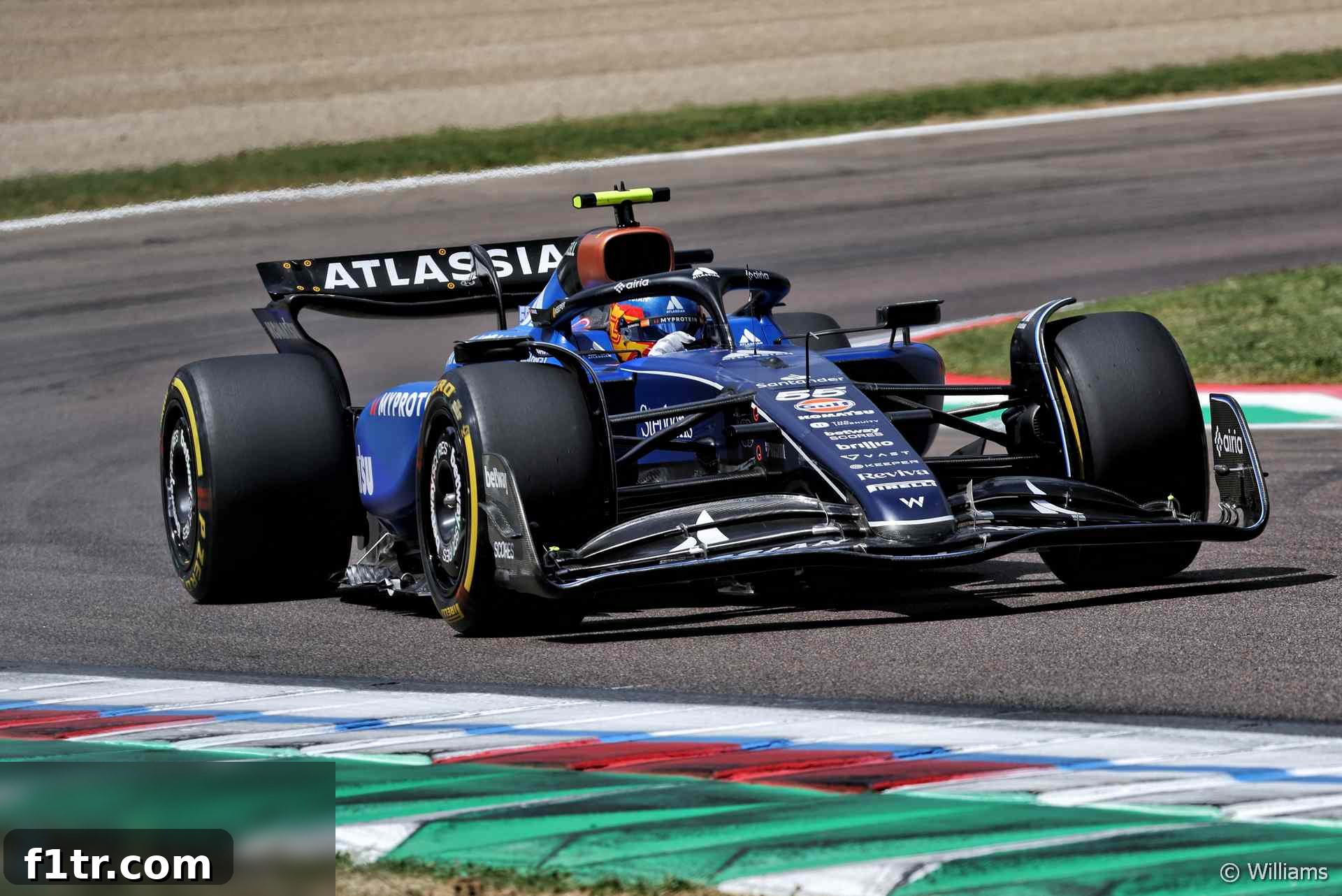
Sainz Expresses Concerns Over Williams’ Strategy After Emilia-Romagna Grand Prix
IMOLA, Italy – Carlos Sainz Jnr, a pivotal driver for Williams Racing, publicly voiced his significant concerns regarding the team’s strategic decisions during the recent Emilia-Romagna Grand Prix. The Spanish driver’s frustration stemmed primarily from an early pit stop that, in his view, severely compromised his race and prevented him from achieving a stronger finish, despite what he believed was highly competitive car pace.
The pivotal moment of contention occurred on Lap 12 when Sainz was called into the pits for his first tire change, an exceptionally early stop in comparison to many of his rivals. This decision placed him among the very first drivers to make a strategic halt, closely following George Russell. While an early pit stop can sometimes offer a strategic advantage, in this instance, it appeared to backfire, leaving Sainz in a vulnerable position as the race unfolded and others managed their tires for significantly longer stints.
The Pit Stop Predicament: A Strategy Under Scrutiny
Sainz’s early pit call initiated a cascade of events that ultimately defined his race outcome. With a substantial portion of the grid opting for a longer initial stint on their starting tires, Sainz found himself pushing hard on fresh rubber while others had the flexibility to extend their first run. This disparity in strategy became increasingly evident as the race progressed, with drivers like his own teammate, Alexander Albon, benefiting from a more delayed pit stop. Albon, who ran just behind Sainz in the early stages, held out much longer before pitting, a move that proved instrumental in his impressive fifth-place finish.
The contrast between the two Williams drivers’ fortunes was stark. While Albon celebrated his third top-five finish of the season, a testament to effective strategy and strong driving, Sainz was left to lament a P8 finish, far below his perceived potential. “I’m a bit unhappy right now after another weekend where we have good pace,” Sainz openly stated to the official F1 channel after the race. His conviction was clear: his car possessed the inherent speed and performance to contend for a much higher position, possibly even a top-five spot.
Untapped Potential: “Quicker Than Mercedes, Quicker Than Ferrari”
Sainz’s post-race analysis underscored a deeper sense of missed opportunity. He firmly believed in the raw performance of his Williams car throughout the Emilia-Romagna weekend. “We were quicker than Mercedes, quicker than Ferrari,” he declared, a bold statement that highlights the team’s significant strides in car development. This assertion of superior pace against formidable rivals like Mercedes and Ferrari suggests a level of competitiveness that Williams has not consistently enjoyed in recent seasons, making the strategic misstep even more frustrating for the driver.
The Spanish ace felt genuinely comfortable and confident behind the wheel. “I honestly felt really good out there the whole weekend,” he added, indicating a strong connection with his machinery and an optimal personal performance. However, this promising foundation was seemingly undermined by the execution of the race strategy. “But for some reason, we don’t seem to catch a break on Sundays with the race execution. We pitted really early, it felt too early at the time, and obviously, it was too early in the end.” This sentiment encapsulates the core of his dissatisfaction: excellent preparation and inherent speed going unrewarded due to strategic miscalculation.
The Communication Conundrum: A Recurring Challenge
This strategic misfire at Imola wasn’t an isolated incident, according to Sainz. It followed a similar misunderstanding regarding strategy instructions at the previous race in Miami. These recurring issues point towards a critical area for improvement within the team: communication. As a relatively new driver within the Williams setup, Sainz highlighted the ongoing need for both parties to better understand each other during the high-pressure environment of a race weekend.
“We just need to keep making steps forward on understanding each other on Sundays because at the moment it’s costing us a lot of points,” Sainz explained. This candid admission sheds light on the complex dynamics of modern Formula 1, where split-second decisions and precise information exchange between driver and pit wall can make or break a race. The stakes are particularly high when a team demonstrates the kind of pace Williams showed in Imola, where every lost point carries significant weight in the competitive Constructors’ Championship.
Developing seamless communication is paramount for any successful F1 team, especially when vying for crucial championship points against established top-tier teams. It requires not only clear verbal exchanges but also an intuitive grasp of each other’s thought processes under pressure. Sainz’s experience suggests that while the individual components—driver skill and car performance—are rapidly converging with the best, the integration and synergistic execution still require fine-tuning.
Maintaining Positivity Amidst Frustration: A Glimpse into the Future
Despite the palpable frustration, Sainz maintained a positive outlook, emphasizing his belief in the team’s trajectory and potential. “But if at race [seven] I’m showing the level that I’m showing in terms of speed with the car and the way I feel, I know we can only go forward,” he asserted. This resilience is a hallmark of top-tier athletes, who can identify shortcomings while simultaneously drawing strength from their underlying performance.
His determination to push for improvement within the team is unwavering. “So I will remain positive and keep pushing each other to keep improving as a team.” This dedication speaks volumes about Sainz’s commitment to Williams and his vision for their future success. He acknowledges the collective effort required, recognizing that improvement is a shared responsibility, not solely dependent on individual performance.
Sainz also reflected on the significant progress Williams has made, noting the shift in his own expectations. He admitted that just “a few races ago, even a year ago,” he would never have anticipated fighting head-to-head with Mercedes and Ferrari on sheer pace, let alone feeling disappointed with an eighth-place finish. This transformation underscores the rapid evolution of the Williams car and its competitive standing in the field.
However, this newfound competitiveness brings its own set of challenges and heightened expectations. “But right now, the reality is that we had a car the last two weekends to beat them, and we haven’t. This obviously doesn’t make me very happy because I know we have the potential and the speed to beat these teams at these sort of tracks but we don’t seem to execute well on Sundays.” The emphasis here is on execution, translating raw potential into tangible results.
The Road Ahead: Simplification and Collective Improvement
The path forward, as Sainz sees it, involves streamlining processes and enhancing mutual understanding within the team. “So it just means as a team we need to improve, we need to keep making our understanding with each other a bit better to make sure on Sundays we don’t over-complicate things.” The goal is clear: simplify strategies, reduce ambiguity, and ensure that the team’s undeniable pace is consistently converted into optimal race results.
His Imola race itself was a testament to his fighting spirit, as he recounted: “Today I didn’t expect to have to fight back from P15 to P8, which made my life difficult, but we managed to do it.” This demonstrates his ability to recover and gain positions even when starting from a disadvantaged strategic position, further validating his claim of the car’s strong performance and his own driving prowess.
Ultimately, Carlos Sainz Jnr’s reflections from the Emilia-Romagna Grand Prix serve as a crucial barometer for Williams Racing. While the team has clearly made significant strides in car development, evidenced by their ability to challenge front-running teams, the next frontier for improvement lies in the intricate art of race strategy and seamless driver-team communication. The potential is undeniable, and with focused effort on these operational aspects, Williams and Sainz could soon translate their impressive pace into consistently higher finishes and a stronger presence at the forefront of Formula 1.