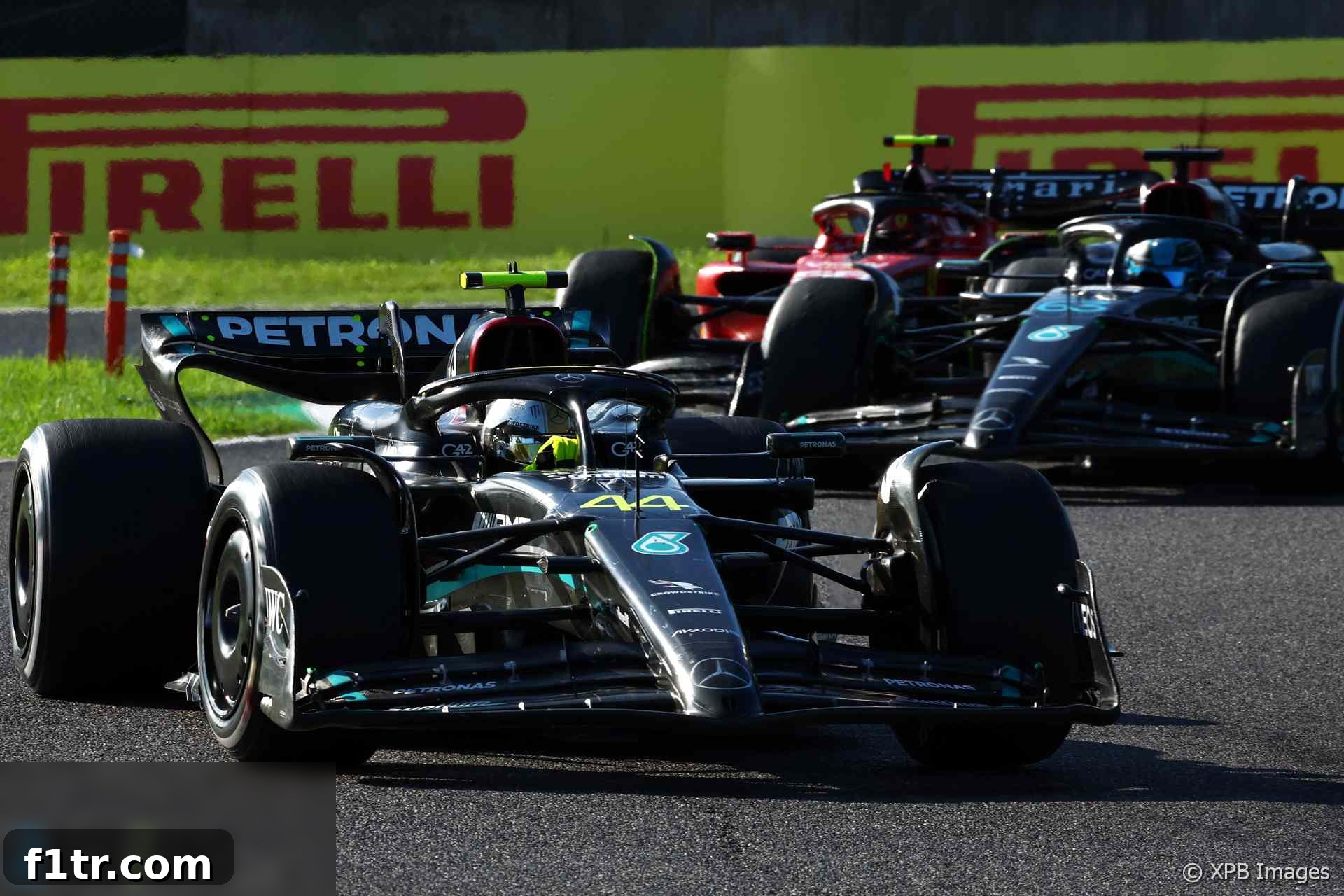
In the thrilling world of Formula 1, where strategic prowess often dictates victory as much as raw speed, Ferrari’s Carlos Sainz Jnr found himself at the center of a curious turn of events at the 2023 Japanese Grand Prix. Just a week after his ingenious DRS strategy secured a remarkable win at the Singapore Grand Prix, Sainz observed with amusement as his Mercedes rivals appeared to mimic his tactics at Suzuka. This fascinating display of strategic one-upmanship underscored the high-stakes chess match that unfolds on the track, where drivers and teams are constantly seeking an edge.
Advert | Become a Supporter & go ad-free
Sainz’s original masterstroke in Singapore was a testament to his tactical intelligence. While skillfully leading the race, he deliberately managed his pace to keep McLaren’s Lando Norris within the DRS (Drag Reduction System) activation window. This intentional slowdown allowed Norris to benefit from DRS on the straights, thereby giving him a crucial advantage against the faster Mercedes cars of Lewis Hamilton and George Russell, who were relentlessly closing in behind the leading duo. The strategy worked flawlessly, creating a protective buffer for both Sainz and Norris and ultimately denying Mercedes an opportunity to challenge for the win. It was a move hailed by many as one of the smartest strategic plays of the season, showcasing a deep understanding of race dynamics and teamwork.
Fast forward to the iconic Suzuka circuit, a track renowned for its high-speed corners and demanding layout. It was here that the Mercedes drivers, perhaps inspired by Sainz’s Singapore success, attempted to employ a similar tactic. In the nail-biting closing stages of the Japanese Grand Prix, Sainz was aggressively hunting down George Russell and Lewis Hamilton. Russell, who had only pitted once and was on considerably more worn tyres, was struggling to maintain pace, while Hamilton was positioned ahead of him. The stage was set for a direct confrontation.
The strategic play unfolded over several laps as Hamilton, initially behind Russell, took five laps to finally clear his teammate. Once Hamilton successfully made the pass, a clear instruction came over the team radio: he was to intentionally slow down. The objective was transparent – to keep Russell within DRS range, thereby aiding his teammate in defending against the charging Ferrari of Carlos Sainz. Mercedes’ aim was to replicate the Singapore effect, hoping that Russell, bolstered by the DRS assistance from Hamilton, could fend off Sainz and secure a better team result. However, despite this concerted effort by Mercedes, Sainz, demonstrating exceptional skill and determination, managed to expertly pick off Russell and seize sixth place.
Reflecting on the incident after the race, Sainz couldn’t help but crack a smile. “I found it [funny], actually,” he admitted with a chuckle. “I was laughing in the car because I could see Lewis backing off in 130R to give the DRS to George.” This candid remark highlighted Sainz’s keen observational skills and his ability to quickly interpret his rivals’ strategies in real-time. The 130R corner at Suzuka is one of the most fearsome and fastest turns in Formula 1, and for Hamilton to deliberately lift off there was a clear signal of his intention to create a DRS train for Russell. Sainz, having pioneered this very tactic, was perfectly positioned to anticipate and counter it.
Sainz immediately recognized the implications of Mercedes’ strategy and formulated his counter-attack on the fly. “I need to make sure I attack George into the chicane. If not, I don’t throw him off-line, it’s going to be impossible to pass them,” he recounted, detailing his thought process. His decision was crucial: to disrupt the DRS chain by forcing Russell into a defensive error or compromising his line. The execution of this plan was as precise as it was audacious. Sainz committed to a very deep braking point into the final chicane, pushing the limits of his Ferrari and his own ability. This aggressive maneuver enabled him to gain a critical advantage, creating a ‘switchback’ opportunity. A switchback involves deliberately going wide on corner entry to get a tighter, faster exit, often allowing a driver to regain momentum and overtake. Capitalizing on this, Sainz then utilized his own DRS, combined with the slipstream effect from Russell’s car, to execute a clean and decisive pass. “It was good fun, and it nearly cost me my own position with my own tricks,” he concluded, acknowledging the irony of almost being caught out by his own innovative tactic.
Advert | Become a RaceFans supporter andgo ad-free
Following his successful overtake on Russell, Sainz wasted no time in demonstrating the true pace of his Ferrari. In less than four laps, he rapidly built a substantial gap of 7.4 seconds to Russell, leaving his rival firmly behind. He then swiftly closed in on Hamilton, finishing the race within a mere second of the seven-time world champion. Despite this impressive charge, Sainz acknowledged the inherent difficulty of overtaking Hamilton, especially given that both drivers were on the same two-stop tyre strategy. This parity in tyre compounds and strategy meant that any delta (speed difference) needed for a successful overtake had to be considerable, a challenge amplified by the nature of the Suzuka circuit.
Sainz elaborated on the unique overtaking challenges presented by the Suzuka International Racing Course. “I think today Suzuka proved to be quite a tricky track to overtake and track position was fundamental,” he stated. He further explained that even when he was demonstrably quicker than Hamilton, the margin wasn’t enough to force a pass. “I was four or five tenths quicker than Lewis, closing in on him, and I don’t think that’s enough delta to pass. You could see the last two laps I was quicker, but it gets to a point where if you’re not one second quicker, you’re not passing.” This highlights a critical aspect of modern Formula 1: while being faster is essential, the degree of that speed advantage needed to overcome aerodynamic turbulence and effectively execute a pass can be immense on certain circuits. The close proximity of cars through high-speed sections makes it incredibly difficult to follow, let alone find the necessary advantage to pass safely and effectively.
To underscore his point about the difficulty of overtaking at Suzuka, Sainz referenced his teammate’s experience. He pointed out that Charles Leclerc “took quite a long time to pass George, on very worn hards for George.” This observation further solidified Sainz’s argument that Suzuka is a track where track position is king, and even a significant tyre advantage isn’t always sufficient to guarantee a swift overtake. Leclerc’s struggle against Russell, who was on severely degraded hard tyres, provided concrete evidence of the circuit’s challenging characteristics and the premium placed on starting position and strategic placement throughout the race.
Despite his strong finish and commendable charge, the Ferrari driver felt that his “better pace than the results showed” was ultimately undermined by the timing of his pit stop, which he believes cost him a crucial position to Hamilton. This sentiment encapsulates the frustration many drivers feel when their on-track performance isn’t fully reflected in the final standings due to strategic or operational decisions. The delicate balance between outright speed and optimal pit stop timing is a constant source of tension and debate within F1 teams.
Sainz elaborated on the pivotal moment that derailed his potential for an even higher finish. “It just proved to me that here today it was all about track position, which is what we lost at the pit stop,” he asserted. He detailed the exact cost: “We were four seconds in front of Lewis, we exited eight behind.” This twelve-second swing, a direct consequence of the pit stop sequence, dramatically altered his race trajectory. From a position of advantage, Sainz found himself having to fight through the field again, a monumental task on a circuit as unforgiving as Suzuka. This illustrates the razor-thin margins in F1, where even a seemingly minor strategic misstep or a slightly slower pit-stop can have profound consequences.
Recalling the initial phases of the race, Sainz expressed satisfaction with his early performance. “I got a very good start and then the first stint I felt like I had a bit more pace than the guys in front and managed all my tyres,” he explained. His ability to manage his tyres effectively while maintaining a competitive pace in the initial stint was a positive sign, indicating strong car performance and driver control. However, he quickly reiterated the overarching challenge: “But obviously being behind in track position is always going to cost you, especially in a difficult and hot Suzuka to overtake.” The hot conditions further exacerbated tyre degradation and made following other cars even harder, adding another layer of complexity to overtaking maneuvers.
Even when his rivals ahead were peeling into the pits, Sainz showcased his underlying speed. “Even when everyone was boxing in front, I could lower my lap times two or three tenths. So I was quite pleased with that,” he noted. This ability to extract more performance from his tyres when given clear air highlighted his excellent race management and the car’s potential. Despite these positives, the cold reality of Suzuka’s demands remained. “Obviously, in the end, the most important in a track like this is qualifying. So track position, and I paid the price for yesterday, but I’m glad that today I could find my rhythm back and I had a strong pace.” This candid admission underscores the paramount importance of qualifying at circuits where overtaking is inherently difficult. While his Sunday pace was strong, his qualifying performance ultimately set the parameters for his race outcome. Yet, his satisfaction in recovering his rhythm and demonstrating strong pace speaks volumes about his resilience and determination.
The 2023 Japanese Grand Prix served as a compelling demonstration of strategic depth in Formula 1, echoing the previous race’s tactical battles. Carlos Sainz’s unique approach in Singapore and his astute observation and counter-strategy in Suzuka highlight the ever-evolving mental game alongside the physical demands of racing. While the outcome wasn’t what he might have hoped for due to the pit stop, his performance underlined his growing stature as one of the most intelligent and adaptable drivers on the grid. These high-level strategic duels, where drivers anticipate, react, and innovate, are what make Formula 1 an endlessly captivating spectacle, pushing the boundaries of human and machine performance in a thrilling display of speed, skill, and cunning.
Advert | Become a RaceFans supporter andgo ad-free
Become a RaceFans Supporter
RaceFans is run thanks in part to the generous support of its readers. By contributing £1 per month or £12 per year (or the same in whichever currency you use) you can help cover the costs of creating, hosting and developing RaceFans today and in the future.
Become a RaceFans Supporter today and browse the site ad-free. Sign up or find out more via the links below:
- Become a RaceFans Supporter
- RaceFans Supporter FAQ
2023 Japanese Grand Prix
- Norris: Red Bull’s dominance down to ‘small things which make a big difference’
- Mercedes must halve deficit to Red Bull before 2024 season starts – Hamilton
- Mercedes expect “tight” fight for second in championship after Ferrari gains
- Norris breaks Hulkenberg’s record for most points without a win in F1
- Transcript: What Alonso really meant by being “thrown to the lions” at Suzuka
Browse all 2023 Japanese Grand Prix articles