Carlos Sainz Unpacks Hungarian GP Qualifying Crash: Understanding the Tailwind’s Impact
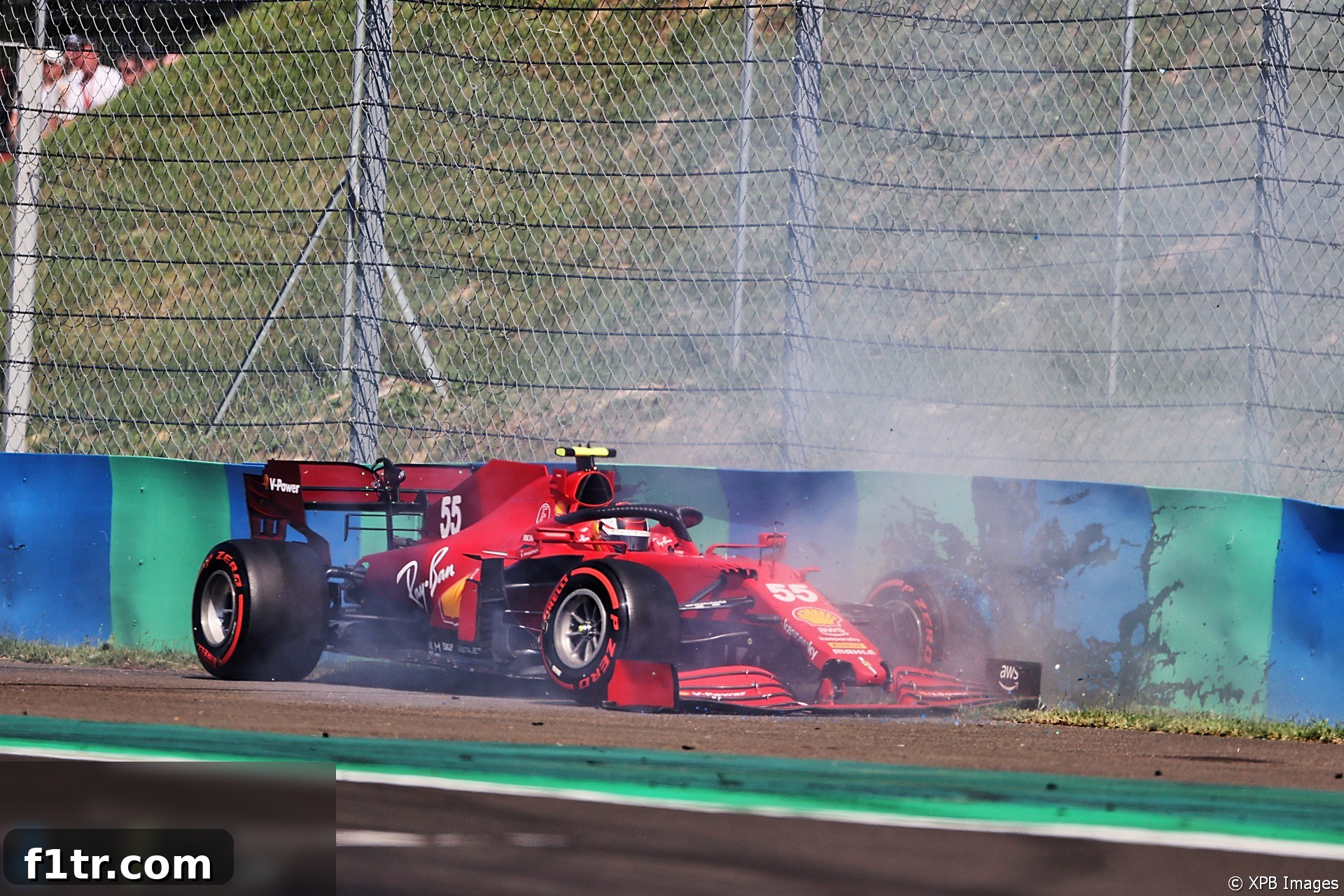
Carlos Sainz Jnr, the Scuderia Ferrari driver, has candidly offered his apologies to his team following a significant qualifying crash that prematurely ended his bid for a strong grid position at the Hungarian Grand Prix. Despite the initial frustration, Sainz has expressed a newfound sense of calm after a detailed review of telemetry data provided crucial insights into the precise causes of the incident, transforming what seemed like a perplexing error into an understandable racing event.
The Unexpected Turn: Sainz’s Q2 Exit at Hungaroring
The incident unfolded during the high-pressure second qualifying session (Q2), a critical phase where drivers push their machinery to the absolute limit in pursuit of a coveted spot in Q3. Sainz’s Ferrari SF21 abruptly spun and made contact with the barrier at the challenging final corner of the Hungaroring circuit, preventing him from completing his opening flying lap. This abrupt end to his qualifying run was, in his own words, “very frustrating and, to be honest, also very surprising.” Such an uncharacteristic mistake from a driver known for his consistency and precision immediately prompted questions and an intensive data analysis session.
“It’s not a mistake that I’ve done in a long time and obviously I was very surprised with it,” Sainz shared, underscoring the rarity of such an incident in his recent career. His immediate priority after returning to the pit lane was to dissect the data. “I went straight away to our garage to see what had happened on the data and what I could have done differently.” This rapid, data-driven response is a hallmark of modern Formula 1, where every millisecond and every degree of steering input is meticulously recorded and analyzed.
Telemetry Reveals the Key Factor: A Sudden Tailwind Gust
What initially felt like an inexplicable loss of control soon became clear through the objective lens of telemetry. Sainz and his engineering team identified a significant and sudden change in wind strength at the exact moment he navigated the final corner. This environmental variable proved to be the decisive factor. “After having a look at it, to be honest, I’m more calm about it,” Sainz admitted, highlighting the relief that understanding can bring to a driver under immense pressure.
The data demonstrated that Sainz had, in fact, approached the corner with greater caution than before. “I saw that I actually entered the corner 5kph slower than in the previous run,” he explained. This intentional reduction in entry speed suggests a driver actively managing risk. However, this prudent approach was nullified by an external force: “but there’s a 35-40kph gust of tail wind compared to a 10kph tail wind on Q1, and this probably just sent me on a massive oversteer.” The more than threefold increase in tailwind strength drastically altered the car’s aerodynamic balance, particularly at the rear, leading to an uncontrollable slide. A tailwind reduces the effective airflow over the rear wing, diminishing the crucial downforce that plants the car to the track, especially through high-speed corners.
This technical explanation underscores the razor-thin margins in Formula 1. Even a minor fluctuation in wind speed can have profound effects on a car’s handling, particularly when drivers are pushing the absolute limits of grip and downforce. For Sainz, it wasn’t a question of misjudgment of speed or line, but rather an unpredictable external element catching him out, highlighting the inherent challenges of real-time adaptation in an ever-changing environment.
Sainz’s Professional Response: Apology and Forward Focus
Despite the clear data-driven explanation, Sainz was resolute in taking responsibility and offering an apology to his Ferrari team. “It’s unfortunate, but at the same time I don’t want to use it as an excuse. I think I owe an apology to the team, but at the same time, it’s not something that I’m going to dwell too much on because I’ve seen the data and it has left me a bit more calm about it.” This reflects a mature approach, acknowledging the impact of the incident on the team’s resources and performance while pragmatically accepting the situation.
The refusal to “dwell too much on it” is a key psychological trait for successful F1 drivers. Dwelling on mistakes can erode confidence and hinder future performance. By thoroughly understanding the mechanics of the crash, Sainz can compartmentalize it, learn the lesson, and shift his focus entirely to the upcoming race. He reiterated that once the car snapped, corrective action was impossible: “Once I saw that I had entered the corner slower than in the previous run, I said okay, I didn’t try anything crazy or anything stupid and I just lost it. It’s how it goes sometimes, it’s how motorsport works and we learn from it.” This pragmatic outlook is essential for a career in motorsport, where the fine line between heroics and errors is constantly tested.
Implications for Ferrari and the Hungarian Grand Prix Race
The immediate and most significant consequence of Sainz’s Q2 exit is his starting position for Sunday’s Hungarian Grand Prix. While his teammate, Charles Leclerc, successfully navigated qualifying to secure a competitive seventh place, Sainz will face the daunting task of starting the race from 15th on the grid. This is particularly challenging given the nature of the Hungaroring circuit, which is often likened to a karting track due to its tight, twisty layout and notoriously limited overtaking opportunities. Progressing through the midfield here demands a flawless drive and astute strategy.
“It’s unfortunate because today I felt on top of the car in Q1 and in FP3, so I feel like there was a good result there on the table,” Sainz expressed, highlighting the missed opportunity. His strong performance in earlier sessions suggested that a top-tier qualifying result was well within reach for him. The loss of a second car in the upper echelons of the grid represents a strategic disadvantage for Ferrari, impacting their ability to challenge rival teams with a multi-pronged attack.
The Learning Process with a New Team and Car
This incident, though frustrating, also serves as a poignant reminder of the continuous learning curve faced by any driver, particularly in their inaugural season with a new team and car. Carlos Sainz is still adapting to the nuances of the Ferrari SF21, understanding its characteristics across various track conditions and setups. Every lap, every session, and indeed every incident, provides invaluable data and experience that contributes to this adaptation.
“But it’s part of the learning process also I guess with this car and part of going through these kind of experiences to keep learning and to come back stronger in the second half of the season,” Sainz reflected. This forward-thinking perspective is crucial. Rather than being defined by the setback, Sainz views it as an integral part of his development and a building block for future success. Such detailed analysis of incidents allows both driver and engineers to refine the car’s setup, understand its limits better, and anticipate how it might react under extreme, variable conditions.
Race Day Outlook: Strategy and Recovery from P15
Starting from P15 on a circuit like the Hungaroring necessitates a meticulously planned race strategy and an exceptional driving performance. Overtaking is difficult, often requiring significant tire degradation or audacious moves. Ferrari’s strategists will be working overtime to explore every potential advantage, from alternative tire compounds and staggered pit stop windows to capitalizing on potential safety car periods or any unforeseen weather changes that could shake up the order.
Carlos Sainz is renowned for his intelligent race craft, excellent tire management, and ability to score points consistently. His primary objective will be to navigate the congested midfield safely, avoid any early-race contact, and systematically climb through the field into the points-paying positions. While a podium finish from 15th would be an extraordinary feat, a strong recovery drive, potentially into the top ten, is certainly within his capabilities and would be crucial for Ferrari’s constructors’ championship aspirations.
The Hungarian Grand Prix will undoubtedly be a true test of character and resilience for Carlos Sainz. His ability to quickly process, learn from, and move beyond this qualifying setback will be paramount. Armed with a clear understanding of what caused the crash and a determined mindset, Sainz will be focused on delivering a robust performance on Sunday, aiming to demonstrate the competitive spirit and strategic acumen that defines a top Formula 1 driver.
Explore more articles about the 2021 Hungarian Grand Prix