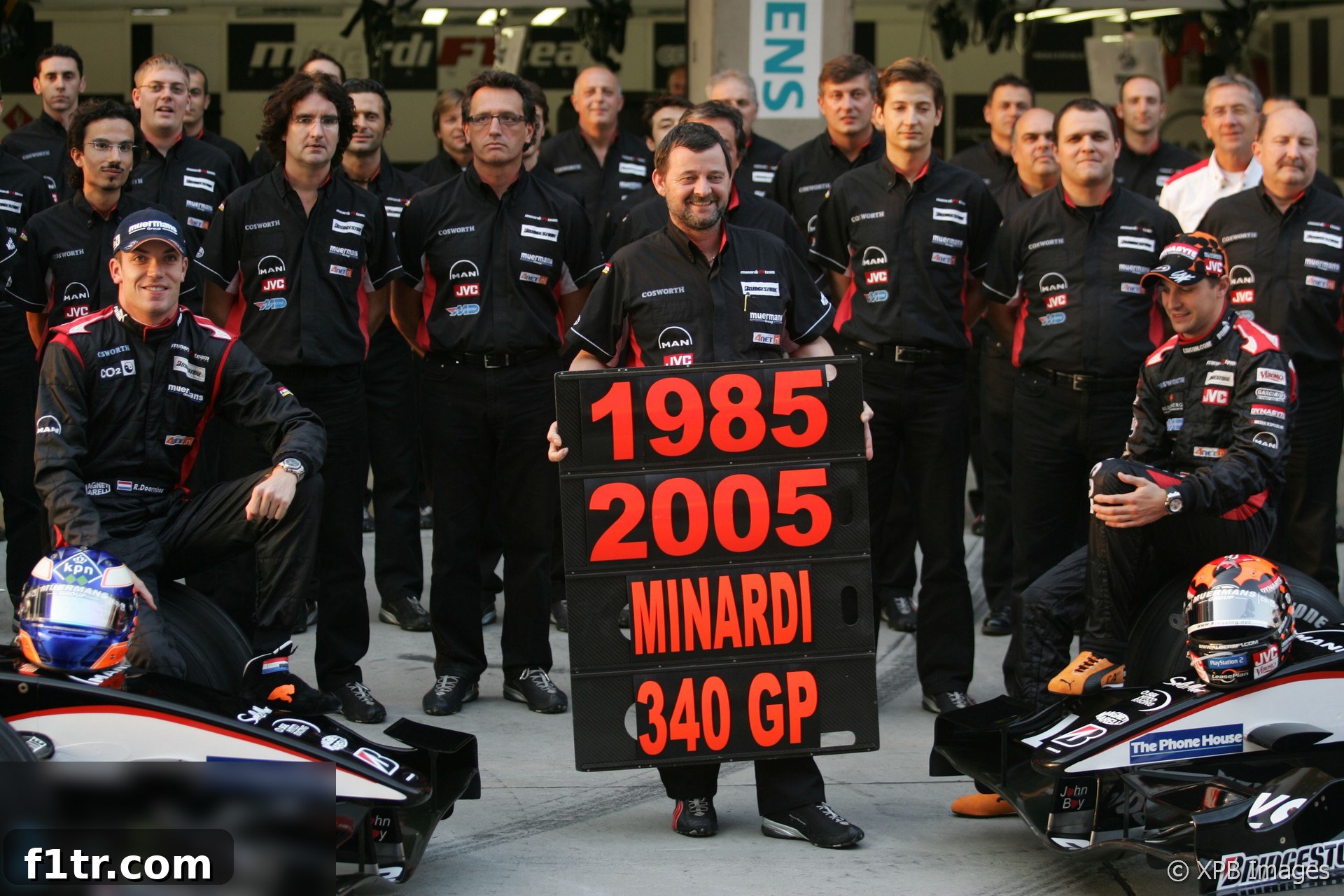
Paul Stoddart and the Enduring Spirit of Minardi: F1’s Ultimate Underdog
Exactly fifteen years after the Minardi team last roared onto a Grand Prix circuit, a planned brief conversation with its former owner, Paul Stoddart, unfolded into a captivating journey through Formula 1 history. What started as a simple request for recollections — the highs, the lows — was met with a moment of silence, then that unmistakably familiar Aussie twang: “Is it really? Fuck, where has the time gone? Fifteen years? Sure!” This spontaneous agreement set the stage for a seventy-minute barrel of laughs, a flurry of candid insights, and a profound dive into the heart of motorsport’s most cherished underdog story.
Advertisement | Support us and enjoy an ad-free experience
The Indomitable Entrepreneur: Paul Stoddart’s Remarkable Journey
When Paul Stoddart eventually called, excusing a brief delay, his reason was quintessentially Stoddart: a global logistics firm had just leased a Boeing. “It’s PPE, mate, the world has gone crazy for air freight,” he explained. It’s hardly surprising that this born entrepreneur found himself at the epicenter of personal protective equipment transportation during the Covid-19 crisis. His entire life story is a testament to opportunism, sharpened by an acute business sense and an unwavering Australian ‘can-do’ attitude.
Stoddart’s rise is nothing short of remarkable. Having left school at 15 from the working-class north Melbournian suburb of Coburg, he navigated through diverse ventures. From car franchising, notably with Yugo, to detailing ex-rental vehicles, his entrepreneurial spirit eventually led him to found European Aviation. This powerhouse company blossomed into an aircraft leasing, sales, and spares entity boasting its own formidable fleet. Such a trajectory exemplifies his ability to spot opportunities and tirelessly build empires from the ground up.
Minardi: The Underdog Who Captured Hearts
The enduring appeal of Minardi, a team that never won a race and never even reached a podium during Stoddart’s tenure, is a phenomenon that continues to fascinate. When I mentioned my conversation with Stoddart on social media, my feeds immediately lit up with enthusiastic responses. This begs the question: why does a team, fifteen years after its last competition, still resonate so deeply with Formula 1 fans?
Stoddart’s answer is simple yet profound: “It’s the underdog, at the end of the day. Everybody loves the underdog.” He explains that the true extent of Minardi’s shoestring budgets has never been fully reported, often overshadowed by the monumental spending of the sport’s giants. To illustrate this stark disparity, Stoddart recounted a staggering comparison from 2002: “In 2002 I ran on a budget of $28 million for the whole year, against Toyota’s $1.1 billion. Yet we beat them, you know, we beat them genuinely.”
That year, Minardi scored arguably the most famous two points in F1 history, courtesy of Australian hero Mark Webber at his home Grand Prix in Albert Park. Stoddart recalled that Sunday with a palpable quiver in his voice, describing it as “probably the proudest day of my life, certainly from a business and sporting point of view.”
Advertisement | Become a RaceFans supporter and enjoy an ad-free experience
The Unforgettable Melbourne Podium Moment
Mark Webber, in his autobiography “Aussie Grit,” vividly describes the unprecedented events that followed that race. Race promoter Ron Walker and media manager Geoff Harris made their way to the humble Minardi garage, personally escorting Webber and Stoddart to the podium ceremony. This move, a highly irregular breach of protocol, was driven by a desire to celebrate the local hero in front of his home crowd. Webber acknowledged it was a risk that “might have cost us those two precious points if the authorities hadn’t shown a human touch on the day.”
For Stoddart, however, it remains a cherished memory: “to stand on that podium, the only time that’s ever happened in the history of F1 [for a non-podium finisher].” The celebrations didn’t end there. He recounts how F1 legends like Michael Schumacher, Jean Todt, and Rubens Barrichello invited the Minardi team into Ferrari’s opulent hospitality suite to offer their personal congratulations. Soon after, rival team bosses arrived, each bearing their own celebratory champagne. Stoddart, with a chuckle, admitted, “We didn’t have any of our own, no need to have stocks of it.” The bubbly, indeed, was seldom needed.
Battling Giants: Minardi’s Fight for Survival
Minardi’s existence was a relentless struggle against the formidable might of manufacturer-backed teams, wealthy independent outfits, and often, the very authorities governing the sport. Paul Stoddart, with his sheer force of will, managed to keep the minnow team alive for five tumultuous years. This incredible feat culminated in 2005 when he finally accepted an offer from Red Bull’s visionary boss, Dietrich Mateschitz, a deal discreetly massaged into existence by the sport’s commercial supremo, Bernie Ecclestone. Today, that very team operates as AlphaTauri, having previously competed as Toro Rosso.
To truly appreciate Minardi’s David-and-Goliath battle, consider the economics. The $28 million budget Stoddart mentioned for 2002, when adjusted for inflation, would equate to approximately $100 million in today’s currency. Even this figure is around 30% less than what current backmarker teams operate on. Moreover, twenty years ago, Formula 1 was an entirely different beast; there were no budget caps, no long-life, price-capped engines and gearboxes, no testing restrictions, and no curfews. F1 was an endless money pit, as dramatically illustrated by Toyota’s multi-billion-dollar spending, a figure that doesn’t even account for their immense capital expenditure.
Stoddart’s F1 Ambitions Before Minardi
Before acquiring the struggling Minardi outfit – a deal Stoddart estimates cost around $10 million, though the exact figure is hazy due to some bartering – his ambitions had led him down several other paths. He initially attempted to buy Tyrrell, a team he had sponsored in 1997 through European Aviation. While he successfully acquired the cars and equipment, the entrant’s license and company registration were ultimately sold to Craig Pollock, who used them to form BAR – the very team that would eventually evolve into the dominant Mercedes force of modern F1.
‘Stoddie’ also harbored an interest in acquiring a stake in Jordan. “Eddie’s a good mate,” he shared, but due diligence quickly revealed it “wasn’t feasible.” His interest in Arrows also waned. This came after team boss Tom Walkinshaw – whom Stoddart affectionately referred to as “Walking Shark” – grew cold on a deal that would have given Stoddart’s protégé and compatriot, Mark Webber, a crucial test drive.
Advertisement | Become a RaceFans supporter and enjoy an ad-free experience
Reflecting on Arrows, Stoddart candidly admitted, “I tried to buy the whole team. We went in with the due diligence and quickly found that you wouldn’t touch it with a barge pole. So, we didn’t, and of course it [eventually] went bankrupt in 2002.” These pre-Minardi endeavors underscore Stoddart’s persistent drive to enter Formula 1 and his pragmatic approach to business, meticulously evaluating risks before making significant commitments.
The Birth of an Alliance: How Stoddart Acquired Minardi
The story of how this improbable alliance came to be – a no-nonsense Australian entrepreneur joining forces with a racing team nestled in Faenza, a quaint industrial town in the foothills of Italy’s Apennines – is a tale of serendipity and swift decision-making. Flavio Briatore, then the charismatic team boss of Renault F1 and mentor to Fernando Alonso (who raced for Minardi in 2001), played a key role in connecting the dots. Briatore tipped off F1 designer Mike Gascoyne, who knew of Stoddart’s interest in purchasing a team, having previously collaborated on a two-seater F1 program.
Stoddart recalls the pivotal moment: “I was on a boat in Nice at the time, looking to buy a boat.” Gascoyne’s call cut straight to the chase: “Paul, there’s a team for sale, you need to be in Faenza.” A town Stoddart had never even heard of. Without hesitation, he grabbed a plane, flew straight to Faenza, and met Giancarlo Minardi, the team founder. Despite a previous acquaintance, Stoddart was taken aback by the state of the factory, which was “pretty depleted of everything.”
In fact, the team’s most valuable asset at that juncture was Fernando Alonso’s driver contract. Stoddart, ever the decisive businessman, needed only “a few hours” before making up his mind. Renault, under Briatore, had previously explored acquiring Minardi but ultimately pulled out, leaving the opportunity ripe for the taking. Stoddart first struck a deal with Giancarlo Minardi, and subsequently with Gabriele Rumi, Minardi’s business partner and wheel magnate, who was tragically battling a serious illness and passed away in May 2001.
“What we bought was virtually nothing, a wooden mock-up,” Stoddart revealed, painting a vivid picture of the challenge ahead. With no time to waste, he eschewed his well-equipped factory in the UK. “We needed to actually do it in Faenza,” he decided. A dedicated crew of 17 people was flown from Ledbury to Italy, housed in a local hotel that couldn’t even accommodate them individually, necessitating shared rooms. They worked tirelessly, “24/seven; when you got too tired to work you went back to the hotel, found an empty room and crashed.” This gritty determination defined the early days of Stoddart’s Minardi.
The Ingenious Engine Deal
Next on Stoddart’s formidable to-do list was securing an engine supply. He approached Bernard Ferguson, another esteemed figure in Formula 1, who greeted him in his characteristic blunt northern style: “What the fuck do you want from me?” Stoddart’s response was ingenious: “I said, ‘I want to buy the engine’… he said, ‘You want to buy engines?’ and I said ‘No, I want to buy THAT engine, the rights to manufacture the engine. I want to do it myself.’” Ferguson, initially skeptical, retorted, “You won’t make that work.” But Stoddart, against all odds, did. “And the rest is history. That was how I got into Minardi.”
The engine Stoddart acquired rights to was the 1998 V10 Cosworth-built Ford Zetec-R, originally supplied to Stewart and later rebadged as Fondmetal by Gabriele Rumi. By the time Stoddart got his hands on it, this power unit, which he rebadged ‘European,’ was already three seasons old. Undeterred, he set about upgrading it with Magneti Marelli electronics, showcasing his resourcefulness and commitment to maximizing every available asset.
Bernie Ecclestone: The Unexpected Ally
In the grand pantheon of F1 history, Minardi often appears as little more than an “also-ran,” a team that occasionally sparkled when the stars aligned, but rarely enough to escape the constant fight for survival. This battle was not just against competitors on track, but against mounting bills and a financially draining sport. Twice, in crucial moments, Bernie Ecclestone, Formula 1’s enigmatic supremo, rode to Minardi’s rescue. It’s easy to see why these two men connected: both short in stature, both fiercely tenacious self-made individuals from modest backgrounds, both deeply passionate about the sport, and both possessing a distinct anti-establishment streak.
By June 2005, Minardi was once again in deep trouble. A promised “fighting fund” for independent teams had failed to materialize, and bills were rapidly accumulating. Ecclestone summoned Stoddart and directly asked how much money he needed. Stoddart gave him a figure, to which Bernie, in typical fashion, declared, “Right, I’m going to buy half your team, I’m going to give you the money and just get on with life.”
Stoddart is effusive in his praise for Ecclestone, calling him “a true gentleman” and “the greatest person that’s ever been in Formula 1.” The announcement that Bernie had bought half the team had an immediate, if unexpected, effect on Minardi’s creditors. “I couldn’t even pay any fucking bills you know, people like Bridgestone and Magneti Marelli and all the rest of them that were hounding me for money, I couldn’t even give them a cheque once they knew Bernie was involved,” Stoddart chuckled. Creditors, knowing Bernie’s involvement meant solvency, ceased their relentless demands.
However, the deal took an even more dramatic turn. In August, Stoddart went with his accountant to Princes Gate, then the F1 Group headquarters, to finalize the paperwork. Bernie looked at him and asked, “Stoddart, are you out of the shit now?” When Stoddart confessed, “Of course I am Bernie, I can’t even fucking pay anybody now,” Ecclestone’s response was legendary: “I don’t want your shares, keep your shares.” With that, he effectively gifted Stoddart the money, withdrawing his offer to buy half the team, a gesture that allowed Minardi to stay afloat a little longer without losing its independence.
The Final Act: Selling to Red Bull
Despite Bernie’s extraordinary generosity, the writing was on the wall. Paul Stoddart recognized he ultimately needed to sell. The Formula 1 landscape was being overwhelmed by manufacturer teams. By 2005, there were, or had recently been, no fewer than seven major automotive brands with significant backing in the sport: BMW, Fiat (Ferrari), Honda, Jaguar (Ford), Mercedes, Renault, and Toyota. Red Bull was also making its ambitious entry as a team owner, having acquired Jaguar Racing.
Over the years, Stoddart had been approached with 51 offers to buy the team, most of which he dismisses as coming from “time wasters.” He famously received one rubberized $10 million cheque, which now adorns his office wall as a humorous souvenir. Out of those 51, he estimates only about five – roughly 10% – had the genuine financial means and wherewithal to complete a deal. “The other 45 were just total toss pots and time wasters and wannabees. I’m afraid F1 attracts these like bees to honey,” he quipped.
The 52nd offer, however, was the one that materialized, sealing Minardi’s fate and forging its future. The deal with Dietrich Mateschitz took shape in Turkey. Stoddart vividly remembers Bernie Ecclestone calling him into his motorhome, where Mateschitz was present. “We talked and Bernie said to Dietrich, ‘You should buy this because it’ll give you a lot of advantages having two teams.’” A consultant was swiftly dispatched to assess the team, and incredibly, by the time the F1 circus arrived in Spa just a month later, the deal was done.
Stoddart recalls a memorable toast. “I was told that Mr. Mateschitz doesn’t drink champagne, he only toasts deals with Red Bull.” His initial reaction was unfiltered: those energy drinks “taste like aliens’ piss.” The response he received was equally direct: “Paul, for the amount of money you’re being paid, just drink it.” And he did. “And it’s got a lovely taste to it. Been drinking it ever since…” Stoddart remains bound by a non-disclosure agreement regarding the sale price, but it’s safe to assume that Paul Gerard Stoddart, the shrewd entrepreneur, emerged from the overall deal financially sound, having paid approximately $10 million for the team five years prior.
The Enduring Legacy of Minardi: From Underdog to F1 Powerhouse Nursery
The team that was once Minardi has, of course, gone on to achieve remarkable successes under its new ownership. It has celebrated two Grand Prix victories – the first with Sebastian Vettel and the more recent one, in September, via Pierre Gasly – both fittingly achieved at the historic Monza circuit in Italy. More profoundly, the team has established itself as Red Bull’s vital F1 finishing school, nurturing an illustrious roll call of drivers who have soared to great heights. Names like Max Verstappen, Daniel Ricciardo, and Carlos Sainz Jnr are just three examples, and no doubt many more will pass through the hallowed halls of Faenza on their paths to sporting greatness.
Tellingly, Paul Stoddart still affectionately refers to the team by its former name. “When Minardi won those two races and scored a few podiums, every time I felt as though it’s still part of me, part of my DNA.” His journey with Minardi was a testament to perseverance: “Did I have enough money? No. Did we get through? Yes. But we had to fight for things. The fighting, the fighting…”
Those legendary fights – against formidable figures like Ron Dennis, Max Mosley, Jean Todt, and virtually the entire F1 community at one stage or another – form another chapter of Paul Stoddart’s compelling recollections. These stories, told in his inimitable style, promise to be unveiled in future installments, further solidifying Minardi’s place not just as an F1 team, but as a symbol of unwavering spirit and the ultimate underdog success story in motorsport.
Join Our Community!
If you’ve enjoyed our motorsport coverage, please consider supporting us. We aim to welcome new Supporters to help fund independent motorsport journalism so we can continue to produce quality, original content. Here’s how you can sign up:
- Become a RaceFans Supporter!
More from RacingLines
- The year of sprints, ‘the show’ – and rising stock: A political review of the 2021 F1 season
- The problems of perception the FIA must address after the Abu Dhabi row
- Why the budget cap could be F1’s next battleground between Mercedes and Red Bull
- Todt defied expectations as president – now he plans to “disappear” from FIA
- Sir Frank Williams: A personal appreciation of a true racer
Browse all RacingLines columns