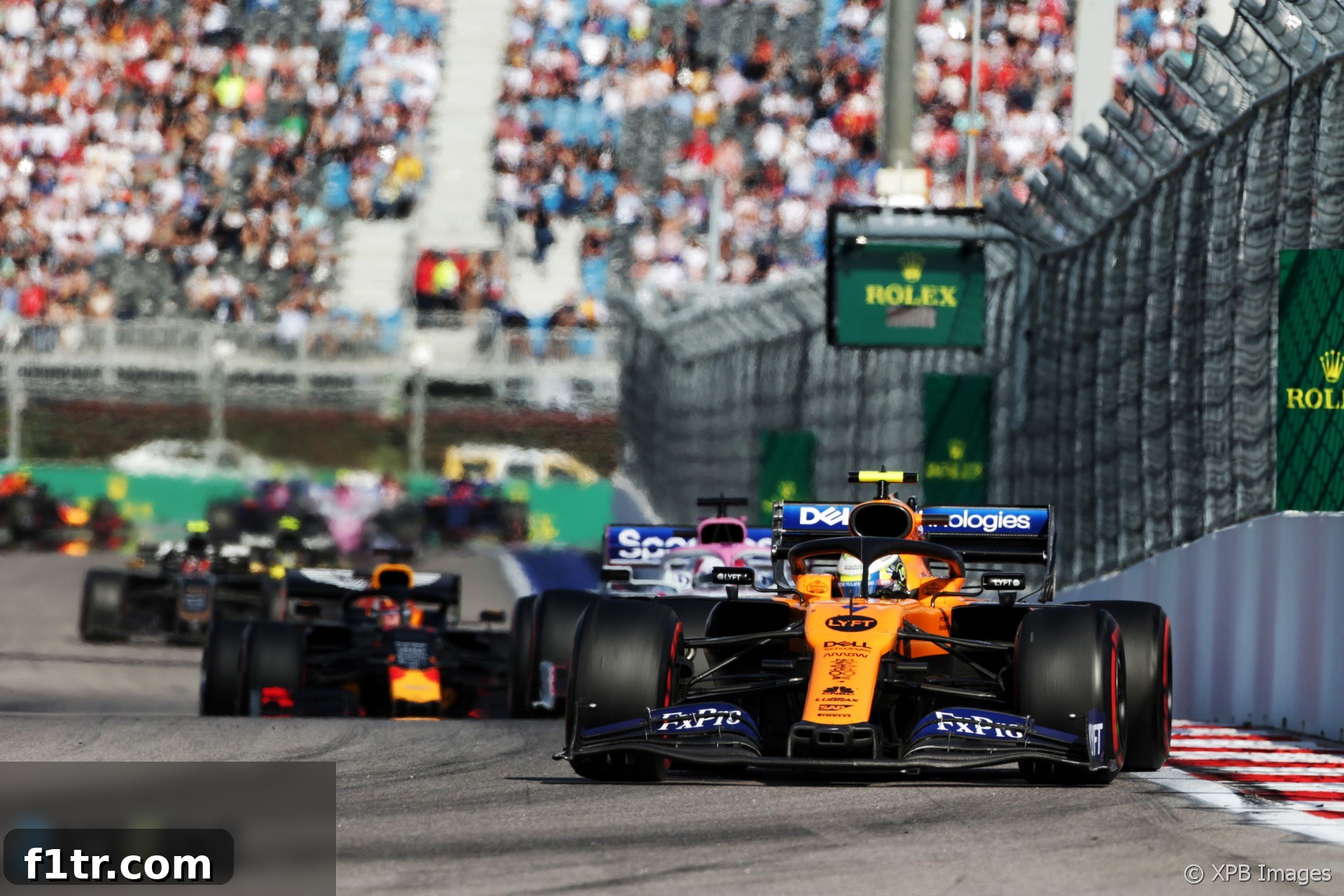
In the high-stakes world of Formula 1, every strategic decision, every on-track incident, and even the smallest safety intervention can dramatically alter a race’s outcome. Following the intense action at the Russian Grand Prix, Andreas Seidl, the discerning team principal of McLaren, articulated a sentiment shared by many in the paddock: a race of what-ifs. Seidl firmly believed that caution periods during the event had directly thwarted McLaren’s opportunity to secure even stronger results, specifically by denying them the chance to outmaneuver one of their closest rivals, Red Bull Racing.
The sentiment from the McLaren garage was clear: a meticulously executed strategy and strong driver performances from both Carlos Sainz Jnr and Lando Norris were undermined by circumstances beyond their control. Seidl highlighted that without the neutralization of the race, his drivers were on track for an exemplary performance, confidently asserting that both Sainz and Norris would have comfortably finished ahead of Alexander Albon, then driving for Red Bull. This would have represented a significant victory in the midfield battle, pushing McLaren closer to the top tier of the sport.
The impact of Safety Car and Virtual Safety Car periods in Formula 1 is often a double-edged sword. While they are crucial for driver safety and track clearance, they also serve to reset the competitive landscape, effectively erasing any hard-won time advantages that drivers and teams might have painstakingly built. For McLaren at the Russian Grand Prix, this proved to be a source of considerable frustration. “I think without the Safety Cars, we were in good shape to do a P5 and P6 because I think it would have kept Albon far away,” Seidl elaborated, underlining the significant gap McLaren had established before the interruptions. He further noted that had Kevin Magnussen maintained a normal race rhythm, he too would have fallen behind McLaren’s positions post-pit stops, cementing a P5 and P6 finish for the Woking-based outfit.
However, the race unfolded differently. The repeated deployments of safety cars and virtual safety cars meant that gaps were repeatedly closed, bringing competitors back into contention. This dynamic particularly affected Carlos Sainz Jnr’s race. Despite a stellar drive, the Spanish driver couldn’t surpass a P6 finish once Alexander Albon, in the inherently quicker Red Bull machine, closed the distance. “Carlos couldn’t have done more than P6 because Albon got close and Albon simply has a better, quicker car,” Seidl acknowledged, praising Sainz’s efforts despite the car’s comparative speed deficit against the Red Bull. It was a stark reminder that even with superior race management and driver skill, the raw pace advantage of a competitor can be decisive, especially when strategic advantages are neutralized.
Lando Norris faced similar challenges, exacerbated by the safety periods. What would have been a comfortable position became a tough battle for defense. Drivers like Sergio Perez and Kevin Magnussen, benefiting from the bunched-up field and potentially fresher tyres, were able to mount strong challenges against the young Briton. “On Lando’s side also with Perez and Magnussen, they got just too close with the Safety Cars and then he couldn’t hold them behind,” Seidl explained. He pinpointed a key factor: “I think they had fresher tyres [by] some laps.” This highlights the critical role of tyre strategy and management, where even a few laps’ difference in tyre age can provide a significant performance edge in close combat, especially after a safety car allows rivals to cool and reset their rubber.
Despite the palpable frustration regarding the lost opportunities, Seidl was quick to emphasize the broader, positive implications of the Russian Grand Prix for McLaren. The team secured a solid points haul, crucially extending their lead over their constructors’ championship rivals, Renault. “It was good, obviously scoring 12 points, another 11 points on Renault,” Seidl stated, highlighting the strategic significance of every point in the tightly contested midfield battle. This consistent performance was vital for McLaren’s aspirations to consolidate their ‘best of the rest’ position in the championship standings, a critical step in their ongoing recovery and rebuilding phase within Formula 1.
One of the most heartening statistics for the team was the milestone achievement of surpassing 100 points in the Constructors’ Championship for the first time since 2014. This benchmark was not just a numerical achievement but a powerful symbol of McLaren’s resurgence. After several challenging seasons marked by fluctuating performances and internal restructuring, reaching this points tally underscored the significant progress made under Seidl’s leadership and the collaborative efforts of the entire team. It signaled a clear trajectory upwards, rebuilding confidence and momentum within the historic racing outfit, and re-establishing their presence as a strong force in the sport.
Beyond the championship points, the race provided further evidence of McLaren’s growing competence and resilience. Seidl singled out the exceptional performance of both drivers during restart situations, a critical skill in modern F1 racing. “Great restarts from both [drivers],” he commended, recognizing the immense pressure and precise timing required to gain positions or defend against rivals immediately after a safety car withdrawal. These moments are often pivotal, and the ability of Sainz and Norris to consistently execute strong restarts spoke volumes about their growing experience and confidence behind the wheel.
Another area of significant improvement that brought immense satisfaction to Seidl was the team’s performance in the pit lane. After experiencing some struggles in previous races, the Russian Grand Prix saw McLaren deliver “two good pit stops again.” This might seem like a minor detail to an outsider, but for an F1 team, flawless pit stops are the cornerstone of competitive performance. They are a testament to the synchronized precision of the pit crew, the reliability of the equipment, and the robust training protocols in place. “Which was important for the team to build up the confidence again,” Seidl noted, highlighting how these perfect executions contributed to the overall morale and belief within the team, reinforcing their commitment to excellence in every aspect of race operations.
Perhaps one of the most compelling narratives from the Russian Grand Prix was the team’s ability to bounce back from a challenging start to the weekend. “So I’m very happy especially after a difficult Friday that the team here together with the drivers and together with the team back home, pulled together and analysed really in detail what they wanted to do for Saturday, made the right calls and have then a competitive car,” Seidl expressed. This demonstrated McLaren’s formidable analytical capabilities, their adaptability, and their unwavering determination. A difficult Friday can often set a negative tone for the entire race weekend, but McLaren’s ability to meticulously dissect data, identify issues, implement effective solutions, and transform a struggling car into a competitive one for qualifying and the race spoke volumes about the engineering prowess and collaborative spirit ingrained within the team. This resilience is a hallmark of truly competitive outfits, proving McLaren’s readiness to tackle future challenges head-on.
In summation, despite the lingering frustration over the safety car periods potentially robbing them of a P5 finish, McLaren departed the Russian Grand Prix with a reinforced sense of achievement and optimism. Seidl’s concluding remark encapsulated this feeling: “I think we clearly had the fourth quickest car again today.” This statement not only confirmed their status as the dominant force in the midfield but also underscored their continuous push to bridge the gap to the front-running teams. The Russian Grand Prix was a race of missed opportunities, certainly, but it was also a powerful affirmation of McLaren’s resurgence, their strategic acumen, and the unwavering dedication of every member of the team, from the drivers to the engineers and the pit crew. This momentum was crucial as the 2019 F1 season progressed, setting the stage for future battles and continued growth for the iconic British racing team.
2019 F1 season
- Crying in the Melbourne car park at 2019 grand prix was my career low – Ocon
- McLaren Racing reports reduced £71 million loss in 2019
- Kvyat: Hockenheim podium last year was “my biggest achievement” so far
- How the FIA’s new encrypted fuel flow meter targets Ferrari’s suspected ‘aliasing’ trick
- “He smashed my office door”: 23 must-see moments from ‘Drive to Survive’ season two
Browse all 2019 F1 season articles