Albon Stripped of Miami Sprint P4 After Safety Car Infraction, Sparking Penalty Debate
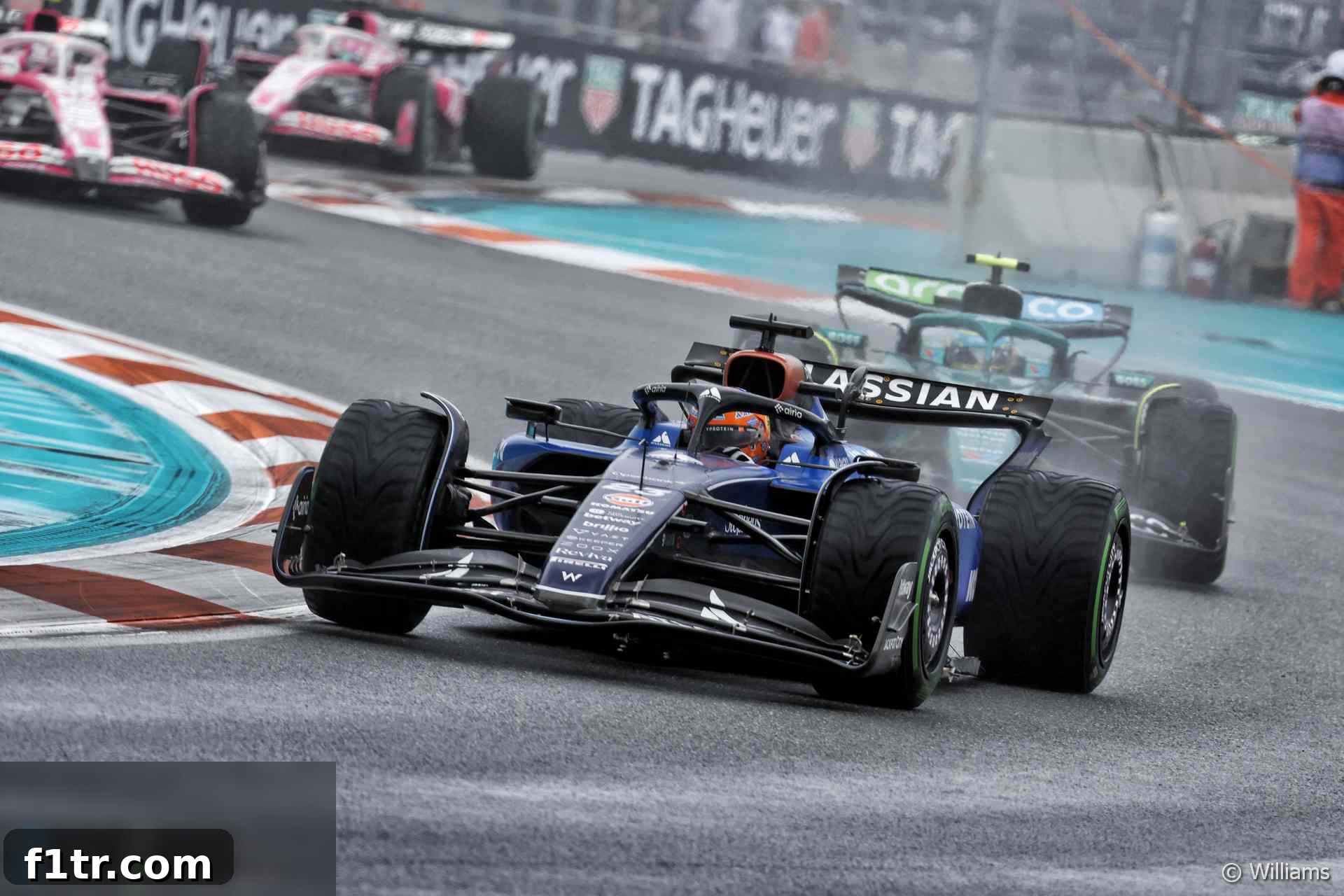
A commendable fourth-place finish for Alexander Albon in the Miami Sprint Race was tragically overturned following a five-second time penalty. The Williams driver was found to have breached Formula 1’s stringent Safety Car regulations, failing to maintain the minimum required speed during a crucial period of the race. This incident not only dashed Albon’s hopes of securing significant points but also ignited a fresh debate about the application and severity of penalties in sprint events.
Advert | Become a Supporter & go ad-free
Support independent F1 journalism!
The Incident Unfolds: Safety Car Delta Time Breach
The penalty stemmed from Albon’s actions during a Safety Car period, where stewards meticulously observed his telemetry. Their findings revealed that Albon had lapped above the minimum time specified in the ECU for three consecutive sectors at the commencement of the Safety Car deployment. This constitutes a clear violation of Article 55.7 of the FIA Sporting Regulations, which mandates that drivers adhere to a delta time – a pre-determined minimum lap time – during Safety Car conditions to ensure safety and prevent drivers from gaining an unfair advantage.
The Safety Car procedure is one of the most critical safety protocols in Formula 1. When an incident occurs that necessitates a reduction in track speed and the neutralization of the race, the Safety Car is deployed. Drivers are then required to reduce their speed, often to a specific “delta time,” which is communicated to them via their car’s dashboard display and the team radio. Adhering to this delta time is paramount, as it prevents high-speed incidents under yellow flags and ensures an even playing field, stopping drivers from pushing unnecessarily or attempting to “catch up” to the Safety Car too quickly. The FIA takes these regulations very seriously, as any deviation can compromise safety for marshals and other competitors on track.
For Albon, the breach was identified in three successive sectors, indicating a sustained period where his pace exceeded the stipulated minimum. While the stewards deemed the infraction worthy of a five-second time penalty, they notably refrained from issuing any penalty points on his Super Licence. This distinction often suggests that while a rule was technically broken, the context and lack of overt danger played a role in moderating the severity of the supplementary sanctions.
Stewards’ Verdict and Regulatory Framework
In their official bulletin, the stewards articulated their decision: “The driver of car 23 [Albon] was below the minimum time set in the ECU in three consecutive sectors at the beginning of the Safety Car period which is in breach of Art. 55.7 of the Sporting Regulations. Therefore, the standard penalty is applied.” This statement clarifies the specific regulation violated and the direct consequence as per the rulebook.
However, the stewards also provided crucial context for their decision not to impose penalty points, a measure that can contribute to a race ban if a driver accumulates too many within a 12-month period. They noted, “The stewards note that the track conditions were not ideal and that no unsafe or dangerous situation was created by the driver and therefore do not issue any penalty points.” This acknowledgment suggests a degree of leniency, recognizing the challenging circumstances Albon faced on track. “Not ideal track conditions” could refer to a variety of factors, such as debris, standing water, or even the general chaos that can sometimes accompany the initial moments of a Safety Car deployment as drivers scramble to react.
The balance between strict adherence to regulations and consideration for mitigating circumstances is a perpetual challenge for F1 stewards. In this instance, while the objective measurement of delta time was not met, the subjective assessment of danger or intent led to a slightly less severe overall punishment. This approach aims to uphold the integrity of the rules while also avoiding overly punitive outcomes for minor, non-malicious infractions.
A Costly Outcome: Repercussions on Race Results
The impact of Albon’s penalty was immediate and significant. Originally celebrating a phenomenal fourth-place finish for Williams – a rare and valuable points haul for the team in a sprint event – Albon’s adjusted position plummeted to twelfth. This dramatic drop meant a complete loss of all points earned from what had been a superb performance. The effect was compounded by the fact that Oliver Bearman also received a penalty for a separate incident, further shuffling the midfield order.
The cascade effect of Albon’s penalty directly benefited other drivers. George Russell, who had finished behind Albon, was promoted to fourth place, inheriting a significant points boost for Mercedes. Perhaps most notably, Andrea Kimi Antonelli, a rising star, inherited the final point for eighth place, marking a significant milestone in his nascent F1 career. Such shifts underscore how pivotal even minor penalties can be, especially in the condensed format of a sprint race where opportunities to gain positions are limited and every point is fiercely contested.
For Williams, the loss of these points is a bitter pill to swallow. In the highly competitive Constructors’ Championship, every single point can make a crucial difference, especially for teams battling in the midfield or lower down the grid. A fourth-place finish in a sprint race would have provided a much-needed morale boost and a tangible reward for the team’s efforts. Instead, they walked away from the sprint race empty-handed, despite Albon’s on-track prowess.
Advert | Become a RaceFans supporter andgo ad-free
Your support makes our content possible!
Team Williams’ Perspective: James Vowles Weighs In
Williams team principal James Vowles, while accepting the team’s operational error, voiced strong reservations about the disproportionate nature of the penalty. “I think we have to acknowledge what we did wrong in that we were a second-and-a-half unsafe [to the delta time],” Vowles conceded, demonstrating a pragmatic acceptance of the data. The team recognized that Albon’s car indeed exceeded the minimum time set, indicating a technical breach of the regulations.
However, Vowles was quick to highlight the mitigating circumstances that, in his view, made the five-second penalty overly severe. He explained, “The reason why, the mitigating circumstance, is he was braking into [Turn] 17 with George [Russell] about four metres behind him in his gearbox. So he was just very cautious about braking a little bit too aggressively.” This paints a vivid picture of the real-time dilemma Albon faced: maintaining the delta time while also ensuring driver safety and avoiding a potential collision with a closely following competitor.
Faced with Russell in such close proximity, Albon’s instinct was to brake cautiously to prevent a rear-end collision, a sensible decision from a safety perspective. While he did manage to “roll the speed in the corner,” Vowles admitted there was still a small window after that to correct the delta time. Yet, the core of Vowles’ argument lay in the outcome: “But for a small incident, to lose all your points, effectively that’s what happened in the sprint race, I think isn’t the right penalty.” He believes that losing all the hard-earned points for what he perceives as a minor, non-dangerous infringement is an excessive punishment, especially given the immediate safety considerations Albon was juggling.
The Broader Debate: Penalties, Sprint Races, and Consistency
This incident reignites a recurring debate within Formula 1 regarding the application of penalties, particularly in the context of sprint races. Sprint events, by their very nature, are shorter, more intense, and offer fewer opportunities for drivers to recover from setbacks. A five-second penalty in a traditional Grand Prix might allow a driver to fight back through the field, but in a sprint, it can mean the difference between points and no points, often leading to a much more dramatic drop in position.
The Williams case also highlights the tension between objective rule-following and subjective judgment. While the delta time is a clear, measurable metric, the human element of racing, the split-second decisions under immense pressure, and the dynamic track conditions often add layers of complexity that fixed rules may not fully capture. Vowles’ argument that the penalty magnitude was disproportionate speaks to a wider desire for greater consistency and perhaps a more nuanced approach to sanctioning, especially when safety is an immediate concern for the driver.
Formula 1 has seen numerous instances where Safety Car infringements have led to penalties, each sparking discussion about what constitutes a fair and just outcome. The sport strives for absolute safety and fairness, but achieving both simultaneously, especially in the heat of battle, remains a formidable challenge. This incident with Alexander Albon serves as a potent reminder of how quickly fortunes can change and how closely every aspect of a driver’s performance, even under safety conditions, is scrutinized.
Miss nothing from RaceFans
Get a daily email with all our latest stories – and nothing else. No marketing, no ads. Sign up here:
Related Articles: 2025 Miami Grand Prix Analysis
Stay informed with more insights from the Miami Grand Prix weekend:
- Vasseur: Nothing for Ferrari to Learn from Miami Team Orders Episode
- Hamilton Proud of Ferrari Amidst Public Scrutiny
- Piastri: McLaren Legality Never in Doubt After FIA Check
- Vowles Defends Albon Against Miami Team Order Allegations
- McLaren’s Most Emphatic Win Since Hamilton’s 2008 Silverstone Triumph
Browse all 2025 Miami Grand Prix articles