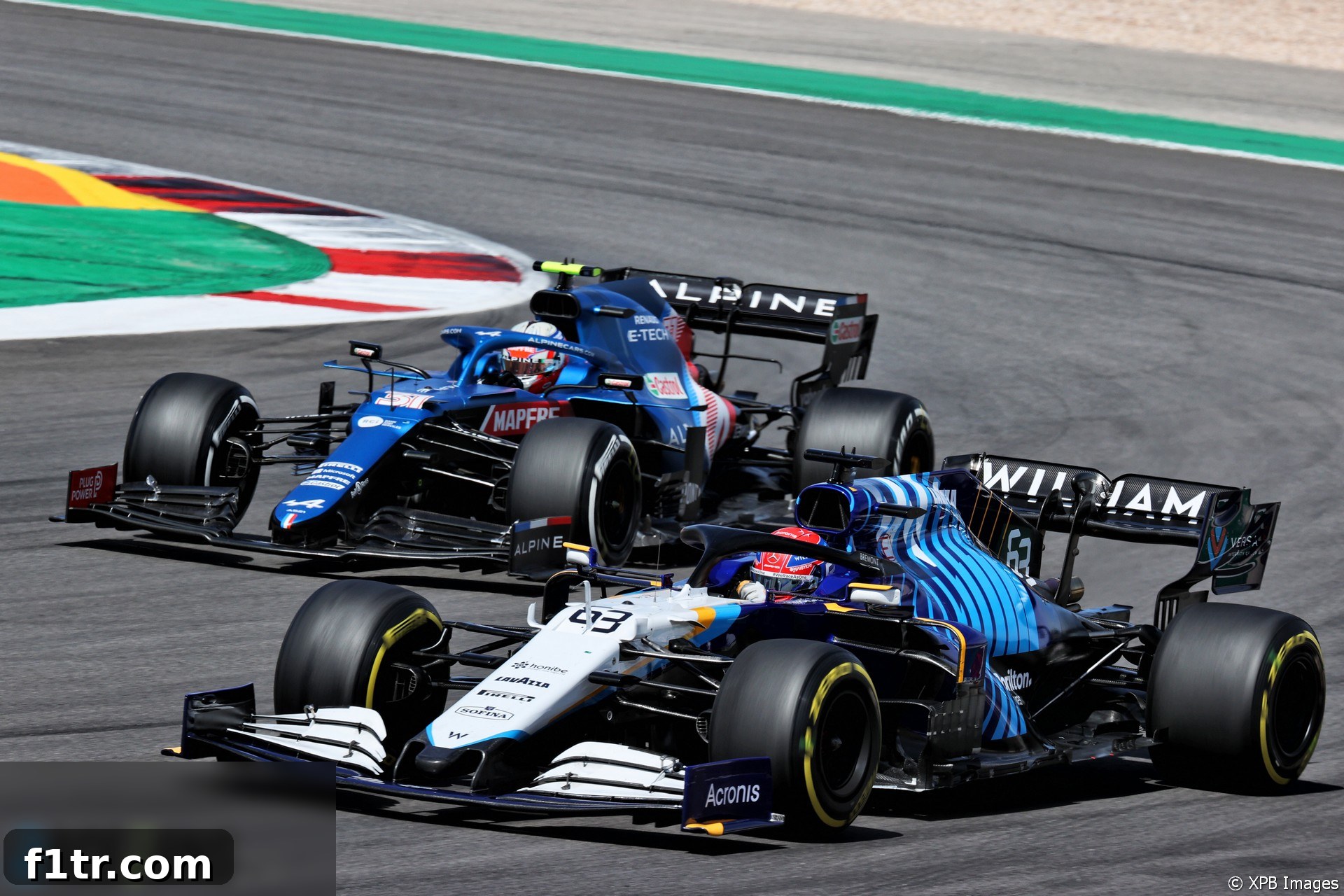
George Russell’s Portuguese GP Struggle: Williams F1’s Aerodynamic Achilles’ Heel
George Russell, often hailed for his qualifying prowess, found himself in a familiar and frustrating position at the Portuguese Grand Prix. Despite delivering his best qualifying performance for Williams this season, securing an impressive 11th place on the grid, race day saw him finish a distant 16th. Russell candidly described the race as “an incredible struggle,” highlighting the fundamental challenges posed by the Williams FW43B’s highly sensitive aerodynamic characteristics, especially in adverse conditions.
The Promise of a Strong Qualifying Performance
The eleventh position on the grid was a significant achievement for Williams, narrowly missing out on a spot in Q3 by less than a tenth of a second. This strong showing during qualifying ignited genuine hopes within the team of challenging for a points finish – a rare commodity for the Grove-based squad in recent seasons. Russell’s ability to extract maximum performance from the car over a single lap has consistently impressed, often placing the Williams far higher than its inherent pace would suggest. The relatively calmer conditions experienced during Q2 played directly into the car’s strengths, allowing Russell to showcase its potential and demonstrating that, under specific circumstances, the FW43B possesses respectable speed.
The anticipation within the team and among fans was palpable. A strong grid slot on a circuit like Portimao, which offers good overtaking opportunities, could have been the perfect scenario for Russell to finally break into the top ten. However, the optimism proved short-lived as the fickle nature of the circuit and the car’s inherent weaknesses became glaringly apparent once the race commenced.
Race Day Reality: An “Incredible Struggle”
From the moment the lights went out, the Portuguese Grand Prix became a race of damage limitation for Russell. His strong starting position quickly unraveled as the car struggled significantly in the challenging race conditions. Russell’s post-race comments painted a vivid picture of the difficulties faced, stating, “It was probably the most difficult race we’ve had since 2019.” This poignant comparison harks back to his grueling rookie season, where the Williams car was undeniably the slowest on the grid, offering little hope of competitive racing. For a driver who consistently pushes the limits in qualifying, such a dramatic drop-off in race performance is undoubtedly disheartening.
The “incredible struggle” wasn’t merely about a lack of pace; it was about a fundamental inability to control the car effectively, especially when battling in traffic. Russell elaborated on this, explaining that the aerodynamic sensitivity of the FW43B meant there was “no confidence in myself or Nicholas to attack on those first laps. We’re constantly on the back foot, battling from behind.” This lack of confidence in crucial moments, particularly in the opening laps when positions are often gained or lost, severely compromised any chance of maintaining his qualifying advantage or making progress through the field.
Unpacking Aerodynamic Sensitivity: The Williams’ Achilles’ Heel
The core issue plaguing the Williams FW43B, as highlighted by Russell, is its extreme aerodynamic sensitivity. In Formula 1, aerodynamics are paramount, dictating how a car generates downforce and cuts through the air. A car described as “incredibly sensitive aerodynamically” implies that its performance is highly susceptible to external factors like wind gusts and the disturbed air (dirty air) created by cars running ahead. When racing in traffic, the turbulent air flow over the car disrupts the carefully designed aerodynamic surfaces, leading to a significant loss of downforce. This loss translates directly into reduced grip, making the car difficult to handle, prone to oversteer or understeer, and incredibly unpredictable for the driver.
Portimao, known for its undulating terrain and exposure to Atlantic winds, proved to be particularly unforgiving. “Today it was nowhere,” Russell lamented, contrasting it with moments of strong performance in calmer conditions, such as at Imola or during Friday practice and qualifying in Portugal itself. In still air, the car’s aerodynamics function as intended, allowing its true pace to emerge. However, in gusty, exposed environments, the consistent buffeting by crosswinds causes unpredictable shifts in downforce and balance, forcing drivers into a defensive “survival” mode rather than an attacking one. This fundamental characteristic means that the car’s performance can swing wildly from competitive to challenging, depending almost entirely on the prevailing weather conditions, a situation few teams aspire to be in.
A Grueling Echo of 2019, Yet Progress Made
Russell’s comparison of the Portuguese Grand Prix to the “most difficult race we’ve had since 2019” is a stark reminder of the long and arduous journey Williams has undertaken. His rookie season in 2019 saw the team at its absolute nadir, with a car that was fundamentally uncompetitive. While significant strides have been made since then, bringing Williams closer to the midfield pack and making Q2 appearances more frequent, the aerodynamic Achilles’ heel persists. This suggests that despite improvements in other areas, the fundamental design philosophy or inherent characteristics of the car continue to present challenges in specific conditions.
The psychological impact on a driver of Russell’s caliber cannot be understated. Consistently delivering qualifying heroics, only to see those efforts negated by an uncooperative car on race day, can be incredibly frustrating. It becomes a test of mental fortitude, requiring drivers to constantly adapt and manage expectations, rather than unleashing their full potential in pursuit of points.
The Impact on Driver Confidence and Team Performance
The lack of confidence in the car’s behavior, particularly in the crucial early stages of a race, fundamentally dictates the team’s strategy and the drivers’ approach. “It was a race of survival, keeping the car on the track as opposed to actually racing,” Russell stated, perfectly encapsulating the mindset required. This shift from an aggressive, attacking stance to a defensive, conservative one means that tire management, fuel conservation, and simply maintaining control become the primary objectives, rather than engaging in wheel-to-wheel battles.
The struggles were not limited to Russell alone. His team mate, Nicholas Latifi, also slipped down the order to finish 18th. Crucially, Latifi took the checkered flag behind Mick Schumacher of Haas, marking the first time a Haas car had beaten a running rival this year. This fact further underscored the extent of Williams’s difficulties on the day, as Haas is widely regarded as the slowest car on the grid in 2021. For a team striving for recovery and consistency, being outperformed by a direct rival, especially one facing its own significant challenges, is a concerning metric.
Exposed Circuits and Future Hopes
Russell remains cautiously optimistic that the team will be able to perform better in calmer conditions as the season progresses. He highlighted that “we have been at now two races out of three very gusty, very windy [conditions], everyone up and down the pit lane is talking about it. Bahrain and Portimao are very exposed.” This observation suggests that circuits with more sheltered layouts, perhaps street circuits or those nestled among hills, could potentially mask the FW43B’s aerodynamic sensitivity to some degree. Less turbulent air would allow the car’s design to function more effectively, granting drivers greater confidence and enabling them to extract more consistent performance throughout a race stint.
The hope within the Williams garage is that the remainder of the F1 calendar will feature a more balanced mix of circuit types, offering more opportunities for the car to shine. Should conditions align, Russell firmly believes that “there is pace in the car.” This belief, however, comes with a significant caveat: the “stars have to be aligned for us, or else we are just going to be nowhere really as we were today.”
The “Stars Align” Scenario: A Challenging Path Forward
The reliance on external factors for competitive performance presents a significant hurdle for any Formula 1 team. While every car has its strengths and weaknesses depending on track characteristics and weather, Williams’s extreme sensitivity to wind introduces an added layer of unpredictability that can dramatically alter their race prospects from one weekend to the next, or even from qualifying to the race. This makes consistent points scoring incredibly challenging, as the team cannot reliably predict when conditions will favor them.
For Williams, the path forward involves not only continuous development to mitigate these inherent weaknesses but also strategic planning to maximize results when conditions are favorable. It’s a delicate balancing act, constantly seeking to find the sweet spot where the car’s underlying pace can be unleashed without being undermined by its Achilles’ heel. Russell’s exceptional talent, while capable of masking some deficiencies, cannot entirely overcome a fundamental aerodynamic limitation when the elements conspire against the team.
Conclusion: Awaiting the Calm in a Season of Promise and Frustration
George Russell’s Portuguese Grand Prix was a microcosm of the Williams team’s current journey: flashes of undeniable potential, particularly in qualifying, overshadowed by persistent struggles on race day due to a deeply ingrained aerodynamic sensitivity. His description of an “incredible struggle” vividly captures the frustration of battling a car that fundamentally resists being pushed to its limits in challenging conditions.
While the team has clearly made progress since the dire days of 2019, the FW43B’s vulnerability to wind and dirty air remains a significant obstacle to consistent performance. The hope now rests on future races held in calmer, less exposed environments, where the “stars” might just align for Russell and Williams. Until then, the focus will remain on managing expectations, extracting whatever is possible under the circumstances, and relentlessly working to develop a car that offers its drivers the confidence to truly race, rather than merely survive.
Related Articles
- Masi ‘basically gifted the championship’ to Verstappen says 2021 FIA steward Sullivan
- Las Vegas race backers looking to extend F1 deal beyond 2025
- Why Mercedes put ‘a reminder of joy and pain’ on display in their factory lobby
- Verdict on error in GT race suggests Mercedes would have lost 2021 Abu Dhabi GP appeal
- Title ‘stolen’ from Mercedes made us ‘underdogs people cheer for’ – Wolff
Browse all 2021 F1 season articles