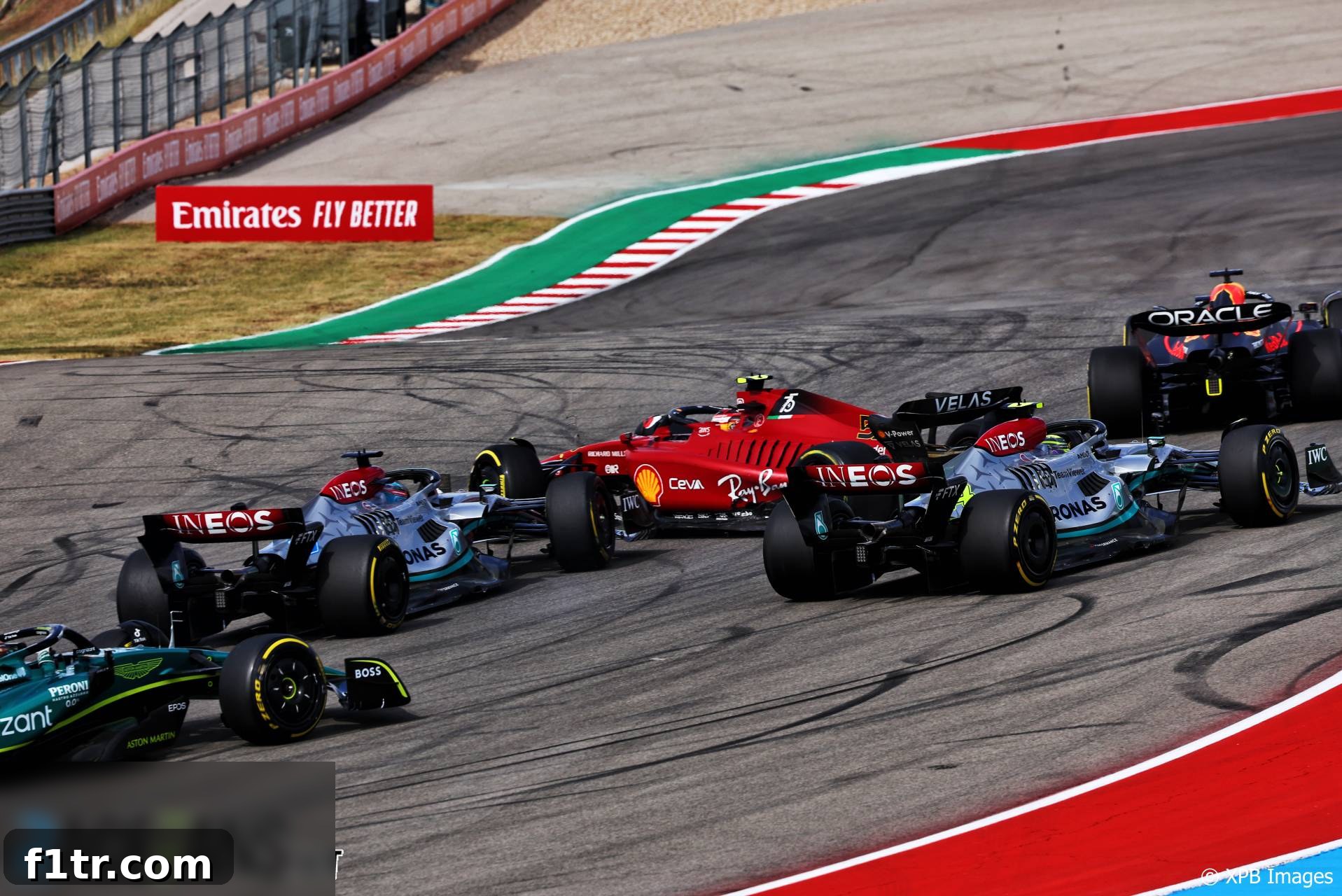
The 2022 United States Grand Prix at the Circuit of the Americas (COTA) was marred by a contentious incident on the very first lap, involving Mercedes driver George Russell and Ferrari’s pole-sitter Carlos Sainz Jnr. This early-race clash resulted in a five-second time penalty for Russell and, crucially, forced Sainz into an immediate retirement, dramatically reshaping the complexion of the race for both competitors. The incident ignited a fierce debate among fans, pundits, and drivers alike: was the stewards’ decision to penalize Russell the correct call?
The Tumultuous Start and the Incident Unfolds
The Austin Grand Prix promised high drama, and it delivered almost instantly. From pole position, Carlos Sainz Jnr had earned the coveted lead, but his hopes of capitalizing on it quickly dissolved. As the lights went out, Sainz suffered a noticeably sluggish getaway, a critical misstep that immediately put him on the defensive. Red Bull’s Max Verstappen, starting alongside him in second, capitalized with a blistering start, sweeping around the outside of Turn 1 to seize the lead.
Behind this intense battle for the lead, the field condensed rapidly. Russell, starting from sixth on the grid, had a strong initial launch, placing him in close proximity to the leading pack. As Verstappen pulled clear, Sainz, now second, found himself under immediate pressure from the Mercedes duo of Lewis Hamilton and Russell. In a critical move, Sainz transitioned from the outside racing line to the inside, attempting to cover any potential attacks and regain momentum against Verstappen. Simultaneously, Russell, observing the rapidly closing gap and the shifting dynamics ahead, also committed to the inside of Turn 1, aiming to make up positions.
The convergence was inevitable. As Russell aggressively sought the apex, his front-right tire made unavoidable contact with Sainz’s left-rear. The impact was significant enough to unsettle the Ferrari, sending it into an uncontrolled spin. Sainz’s race, which had begun with such promise, ended abruptly as his car limped back to the pits, retirement confirmed shortly after due to a loss of water pressure stemming from the collision.
Russell, despite the contact, was able to continue the race. However, the stewards were swift to act, issuing him a five-second time penalty. This penalty was served during his subsequent pit stop, adding another layer of challenge to his race. The incident not only dictated the immediate fortunes of both drivers but also set a precedent for how the race officials interpreted aggressive opening lap maneuvers.
Dissecting the Dynamics: A Frame-by-Frame Analysis
To fully understand the stewards’ decision and the differing perspectives, a closer look at the sequence of events is crucial. The opening lap of any Formula 1 Grand Prix is a maelstrom of activity, where fractions of a second and inches of track space can determine success or disaster. At COTA’s Turn 1, a wide, uphill hairpin, the stakes are particularly high.
Sainz’s slow start immediately put him in a reactive rather than proactive position. After losing out to Verstappen, his instinct was to regain ground or at least consolidate his position against the rapidly approaching field. His decision to move towards the inside was a natural defensive reaction to the cars behind him, but it also placed him on a converging trajectory with Russell.
Russell, on the other hand, saw an opportunity. With Sainz seemingly preoccupied with Verstappen and potentially covering the outside, Russell attacked the inside. His braking point and turn-in demonstrate a commitment to that line, a common strategy in the opening corners where drivers aim to gain several positions in one aggressive move. The visibility in a pack of cars, especially with multiple cars abreast, is notoriously challenging, and drivers must make split-second decisions based on incomplete information.
As Sainz continued his defensive/offensive arc towards the inside, the space Russell was attempting to exploit rapidly diminished. The moment of impact shows Russell having applied full steering lock, a clear indication that he was trying to navigate the corner as tightly as possible, but by then, the two cars were on an unavoidable collision course.
This sequence highlights the inherent risks of aggressive first-lap driving. While both drivers were pushing the limits, the onus often falls on the car behind to avoid contact, especially when the car ahead has established a position. However, Sainz’s trajectory change, combined with Russell’s deep dive, created a complex scenario for the stewards to unpick.
Driver Reactions: Raw Emotions and Measured Statements
The immediate aftermath of a collision in Formula 1 is often characterized by raw emotion, both from within the cockpit and among the team personnel. The COTA incident was no exception.
In the Cars
From the cockpit, George Russell’s immediate radio call reflected his perspective: “He just cut across me!” This suggests Russell felt Sainz had moved unpredictably or without sufficient awareness of his presence on the inside. Such an exclamation is typical of a driver reacting in the heat of the moment, believing they were left with no room. Meanwhile, a visibly dejected Carlos Sainz, knowing his race was effectively over, simply uttered, “Come on, what happened there?” His tone conveyed frustration, disbelief, and a sense of injustice, implying he felt he had done little wrong.
After the Crash
Post-race, with the benefit of replay analysis and time to process the events, both drivers offered more elaborated, though still distinct, viewpoints.
Sainz was unequivocal in placing the blame squarely on Russell. “I was in the middle of a fight with Max and suddenly came someone that wasn’t even in that fight and bumped into me,” he stated, emphasizing that Russell’s involvement felt external and disruptive to his primary battle. Sainz added, “So I don’t think it needs too much explanation and images,” indicating his belief that the evidence was clear and self-explanatory, and the penalty entirely deserved.
Russell, while acknowledging the unfortunate outcome, presented a more nuanced perspective. He described it as “very unfortunate how things unfolded at the start” and stressed, “I don’t want to be in a position where I contribute to another driver having to retire.” This suggests a degree of regret for the consequence, but not necessarily a full admission of sole culpability. He likely felt it was a racing incident, a consequence of the tight, aggressive nature of a Grand Prix start, rather than a clear-cut error on his part.
The Incident in Pictures: A Visual Timeline
These photographic captures from the Grand Prix illustrate the critical moments of the chaotic race start, from the initial formation to the pivotal contact.
The Official Verdict: Stewards’ Rationale and Implications
The FIA stewards are tasked with enforcing the sporting regulations, and their decisions are often subject to intense scrutiny. In this instance, they issued George Russell a five-second time penalty along with two penalty points on his Super Licence. Their official ruling was concise and clear: “The driver of car 63 [Russell] braked late into Turn 1 and collided with car 55 [Sainz], and was therefore wholly to blame for the collision.”
This verdict highlights a fundamental principle in racing regulations: the responsibility of the overtaking car to make a safe pass. By stating Russell was “wholly to blame,” the stewards concluded that Sainz’s actions, while perhaps contributing to the tight space, did not absolve Russell of his primary responsibility to avoid contact. “Braked late” implies that Russell either misjudged his braking point for the available space or was overly optimistic in his attempt to seize a position, leading to an unavoidable collision with a car that had established its position.
The penalty itself – five seconds – is a standard sanction for such incidents, designed to be a deterrent without being overly punitive for a racing incident that might not have been malicious. However, the consequence for Sainz, an immediate retirement, was far more severe than the penalty incurred by Russell, raising questions about whether the punishment truly fit the impact of the offense. These situations invariably spark debate about whether time penalties adequately compensate for race-ending incidents.
Fan Verdict: A Divided Opinion
The immediate reaction from the Formula 1 community, particularly among fans, was split. Such incidents rarely have a universally agreed-upon interpretation, and the COTA collision was a perfect example of differing opinions on racing etiquette and responsibility.
Was the stewards’ penalty for Russell correct?
- No opinion (1%)
- Far too lenient (22%)
- Slightly too lenient (15%)
- Correct (31%)
- Slightly too harsh (18%)
- Far too harsh (13%)
Total Voters: 140
As the poll results illustrate, opinion was highly polarized. A significant portion of voters (37% combined) felt the penalty was too lenient, arguing that Russell’s actions warranted a more severe punishment given Sainz’s retirement. Conversely, a substantial number (31%) believed the penalty was “Correct,” aligning with the stewards’ decision. A further 31% (18% slightly too harsh, 13% far too harsh) felt Russell had been treated too harshly, suggesting they viewed it more as a racing incident where blame couldn’t be solely attributed.
This wide range of opinions underscores the complexity of interpreting racing incidents, where intentions, track position, and the unpredictable nature of close-quarters racing all play a role. The debate continued in comments sections and on social media, reflecting the passionate engagement of Formula 1 fans with such high-stakes decisions.
A RaceFans account is required in order to vote in certain polls. If you do not have one, register an account here or read more about registering here. When a poll is closed the result will be displayed instead of the voting form.
Conclusion: A Controversial Call in a High-Stakes Race
The collision between George Russell and Carlos Sainz Jnr at the start of the 2022 United States Grand Prix served as a potent reminder of the fine margins in Formula 1. While the stewards’ decision to penalize Russell was consistent with the long-standing principle of holding the overtaking driver primarily responsible for safe execution, the severity of the outcome for Sainz — an immediate retirement from pole position — undeniably cast a long shadow over the incident. The debate over whether a five-second penalty was truly proportionate to the damage inflicted highlights the ongoing challenge for race officials to balance firm enforcement with the inherent dynamism of racing.
Ultimately, the incident was a racing incident with severe consequences, born from a confluence of a slow start, aggressive overtaking, and converging lines in a high-pressure opening corner. While the official verdict assigned blame, the divided public opinion reflects the nuanced reality that, in the heat of battle, clear-cut right and wrong can often be elusive.
2022 United States Grand Prix: Further Insights
- Steiner annoyed by lack of apology from race director over COTA protest error: Discover how Haas team principal Guenther Steiner reacted to procedural errors in subsequent races stemming from COTA.
- How many victory chances did Hamilton have in his first winless F1 season?: An in-depth look at Lewis Hamilton’s challenging 2022 season, including his performance at COTA.
- Income from new title sponsor will bring Haas up to cost cap level – Steiner: Insights into the financial landscape of F1 teams, with updates from Guenther Steiner post-COTA.
- Mexico’s first home win or Verstappen’s record 14th? Six Mexican GP talking points: A preview of the race immediately following the US Grand Prix, highlighting key storylines.
- Mercedes doubt tyre strategy cost Hamilton chance to beat Verstappen to win: An analysis of Mercedes’ strategic choices at COTA and their impact on Hamilton’s bid for victory.
Browse all 2022 United States Grand Prix articles