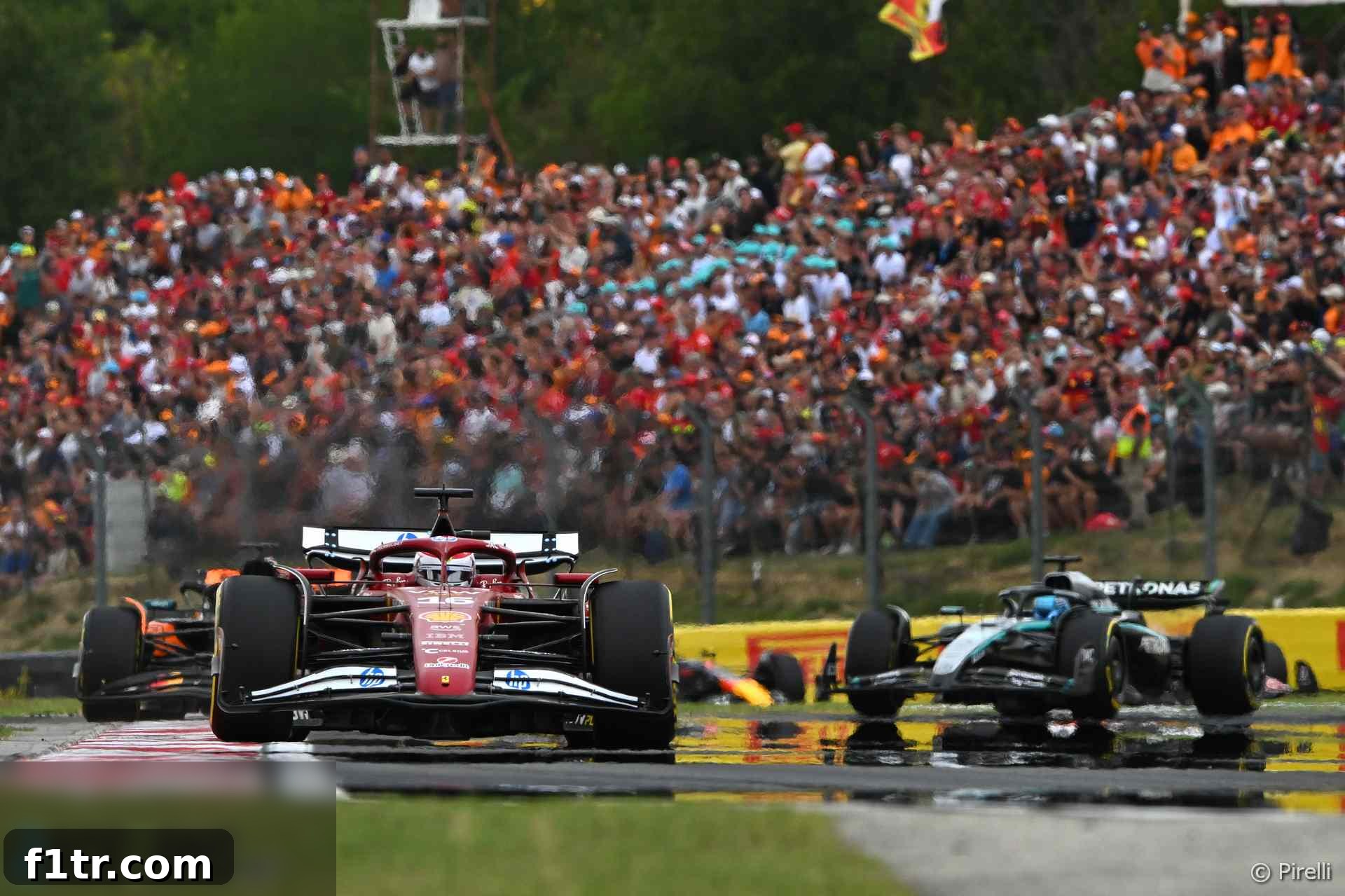
George Russell, the astute Mercedes driver, has put forward a compelling theory regarding Charles Leclerc’s unexpected loss of pace towards the conclusion of the Hungarian Grand Prix. Russell suspects that Ferrari, Leclerc’s team, may have been grappling with serious concerns about the legality plank wear on the underside of Leclerc’s car, leading them to implement strategic changes that ultimately compromised his performance.
Advert | Become a Supporter & go ad-free
George Russell Pinpoints Ferrari’s Legality Plank Concerns as Key to Leclerc’s Hungarian GP Pace Decline
The Hungarian Grand Prix, a race often characterized by strategic battles and fluctuating fortunes, delivered another layer of intrigue as George Russell, after making a decisive overtake, observed a noticeable drop in Charles Leclerc’s speed. “I saw how slow he was, so I presumed something was not right,” Russell candidly told Sky Sports, his suspicion quickly evolving into a detailed technical hypothesis.
The Mystery of Leclerc’s Fading Performance
Charles Leclerc started the race from pole position, demonstrating impressive pace and control in the early stages. He confidently led during both his first and second stints, appearing to be a strong contender for victory. However, as the race progressed into its crucial third stint, a dramatic shift occurred. Leclerc’s lap times began to fall away, and the once-dominant Ferrari driver found himself increasingly vulnerable to the chasing pack. This sudden decline, particularly after such a promising start, immediately raised eyebrows within the Formula 1 paddock and among fans.
The unexpected nature of Leclerc’s performance dip prompted intense speculation. While a driver losing pace can be attributed to various factors – tyre degradation, damage, or strategic missteps – Russell’s analysis pointed towards a more fundamental, and potentially regulatory, issue that Ferrari might have been desperately trying to manage. His theory revolves around the crucial concept of the legality plank, a component that has historically been a focal point of technical scrutiny in Formula 1.
Understanding the Legality Plank in Formula 1
To fully grasp Russell’s theory, it’s essential to understand the role and significance of the legality plank in Formula 1 cars. The plank is a mandatory wooden or composite strip fitted longitudinally to the underside of the car’s floor. Introduced by the FIA (Fédération Internationale de l’Automobile) in 1994, its primary purpose is to regulate the minimum ride height of the cars. By limiting how low a car can run, the plank helps prevent teams from exploiting extreme ground effect aerodynamics to an unsafe degree, which could lead to unpredictable handling and potential for dangerous incidents if the car bottoms out too frequently.
FIA regulations stipulate a maximum allowable amount of wear on this plank throughout a race. If, after post-race scrutineering, a car’s plank is found to have worn beyond the permissible thickness, the car is deemed illegal and the driver is subject to disqualification. This rule puts immense pressure on teams to manage their car’s ride height and suspension setup meticulously, balancing aerodynamic performance with the imperative of legality. Running a car very low to the ground generally enhances aerodynamic efficiency, particularly in generating downforce through ground effect, but it simultaneously increases the risk of excessive plank wear, especially over bumpy tracks or during hard compressions. The Hungarian Grand Prix circuit, with its challenging mix of corners and braking zones, can certainly test a car’s underbody.
Ferrari’s Alleged Response: Increased Tyre Pressures
Russell’s central hypothesis is that Ferrari, fearing they might be nearing the limits of acceptable plank wear on Leclerc’s car, took proactive measures during his final pit stop on lap 41. He suggested they may have increased his tyre pressures. The logic behind this move is straightforward yet impactful: increasing tyre pressure effectively raises the car’s ride height. Higher tyre pressures make the tyre sidewalls stiffer, slightly increasing the overall diameter and, consequently, lifting the car further off the ground.
While this would serve to reduce the amount of contact between the legality plank and the track surface, thereby mitigating wear and ensuring compliance with regulations, it comes at a significant cost to performance. Higher tyre pressures typically lead to a reduced contact patch with the road, diminishing grip, particularly through corners. This can make the car feel less stable, less responsive, and generally harder to drive at the limit. It also tends to make the car more prone to sliding and can accelerate tyre degradation, further compounding performance issues.
Leclerc’s subsequent comments about experiencing a “chassis problem” from around lap 40 align strikingly with Russell’s theory. A change in tyre pressure mid-race, especially one designed to alter ride height, could profoundly affect the car’s balance and handling characteristics, manifesting as what a driver might perceive as a “chassis problem” due to the sudden shift in the car’s dynamic behavior. Russell’s interpretation suggests that Leclerc was likely unaware of the precise technical rationale behind the change, only feeling the detrimental effects on his car’s setup.
Russell’s Forensic Observations
Beyond the circumstantial evidence, Russell highlighted specific observations that bolstered his conviction. He noted that when he began to close in on Leclerc, he detected Ferrari using an unusual engine mode. This particular mode, according to Russell, was “making the engine slower at the end of the straight, which is where you have the most amount of plank wear.” This insight is particularly telling.
During the heavy braking phase at the end of a high-speed straight, Formula 1 cars experience significant downforce and aerodynamic load, compressing the suspension and pushing the car closest to the ground. This is precisely the moment when the legality plank is most susceptible to making contact with the track surface and incurring wear. By running a lower power engine mode at this specific point, Ferrari might have been trying to reduce the car’s top speed, and consequently, the aerodynamic forces acting upon it. A slightly lower top speed means slightly less downforce at the end of the straight, which in turn could lead to less compression of the suspension and a marginally higher ride height, thereby safeguarding the plank. This micro-management of engine settings further underscores the lengths teams go to in order to navigate the tightrope walk between performance and regulatory compliance.
Advert | Become a RaceFans supporter andgo ad-free
“That’s the only thing we can think of based upon the lap times and the engine mode they were running and stuff like that,” Russell affirmed, reinforcing that his analysis wasn’t mere conjecture but rooted in empirical observations of race data and competitor behavior. This level of detailed technical analysis from a rival driver illustrates the intricate understanding F1 competitors possess of each other’s operations.
Russell’s Own Performance and the “Strange Weekend”
Despite the unfolding drama with Leclerc, George Russell himself had a commendable Hungarian Grand Prix, securing a well-deserved podium finish. He expressed his immense satisfaction, stating he was “really pleased” to achieve his first podium since his victory at the Canadian Grand Prix in June. This result was a significant boost for Mercedes, reaffirming their progress and competitive spirit.
However, Russell also candidly admitted that it had been “a strange weekend” in terms of performance across the entire field. He elaborated on this by pointing out the unusual fluctuations in team competitiveness: “If you exclude McLaren and you look at the order of P3 to P13, it’s quite odd. You wouldn’t expect Max [Verstappen] to be so far down. Aston had an amazing weekend. So we’ll take the positives and we won’t get carried away with it.”
His observations highlight the unpredictable nature of modern Formula 1, where track characteristics, weather conditions, and car setup can dramatically alter the pecking order. Max Verstappen, usually a dominant force, faced an unexpected challenge. Aston Martin, on the other hand, enjoyed a particularly strong showing, defying some pre-race expectations. This variability underscores the constant development battle in F1 and how finely balanced the performance windows of the cars are. For Mercedes, securing a podium amidst such a fluctuating competitive landscape was indeed a positive outcome, signaling their ability to capitalize on opportunities even when the overall picture remains somewhat unclear.
Implications and the Future Outlook for Ferrari
George Russell’s insightful theory casts a spotlight on the perennial challenge faced by Formula 1 teams: pushing the technical boundaries for performance while strictly adhering to regulatory limits. For Ferrari, if Russell’s suspicions are accurate, it implies a delicate balance they need to strike with their car’s setup, particularly concerning ride height and aerodynamic philosophy. Managing plank wear without excessively compromising performance will be a critical engineering and strategic objective moving forward. Such adjustments might involve tweaks to suspension stiffness, aero rake, or even the design of the floor itself, all aimed at achieving optimal performance while ensuring legality.
The incident at the Hungarian Grand Prix serves as a reminder that every millimeter, every psi of pressure, and every engine mode choice can have profound implications on a car’s race-day performance and its standing with the FIA. As the season progresses, rival teams, now armed with Russell’s observations, will undoubtedly pay closer attention to Ferrari’s car setup and in-race strategy. The relentless pursuit of performance in F1 is a continuous technical arms race, and insights like Russell’s provide crucial intelligence in this high-stakes competition.
Miss nothing from RaceFans
Get a daily email with all our latest stories – and nothing else. No marketing, no ads. Sign up here:
2025 Hungarian Grand Prix Related Articles
- Leclerc admits problem which struck Ferrari in Hungary is likely to recur
- Permane impressed by Lawson’s progress after “breakthrough” in Austria
- Albon expects “dogfight” as Williams aim to hold fifth place
- Mercedes eye more wins post-break after dropping revised rear suspension
- McLaren pair equal Senna and Prost’s run in second-fastest ever Hungarian GP
Browse all 2025 Hungarian Grand Prix articles