George Russell, the talented British driver for Mercedes-AMG Petronas F1 Team, has vocally expressed his strong belief that his esteemed teammate Lewis Hamilton faced a distinct and unfair disadvantage during the recent Mexican Grand Prix. Russell’s concerns stem from what he perceives as a critical oversight by race control regarding drivers who notably cut the opening corner sequence without facing immediate penalties, profoundly influencing the early stages of the race for several competitors, particularly Hamilton.
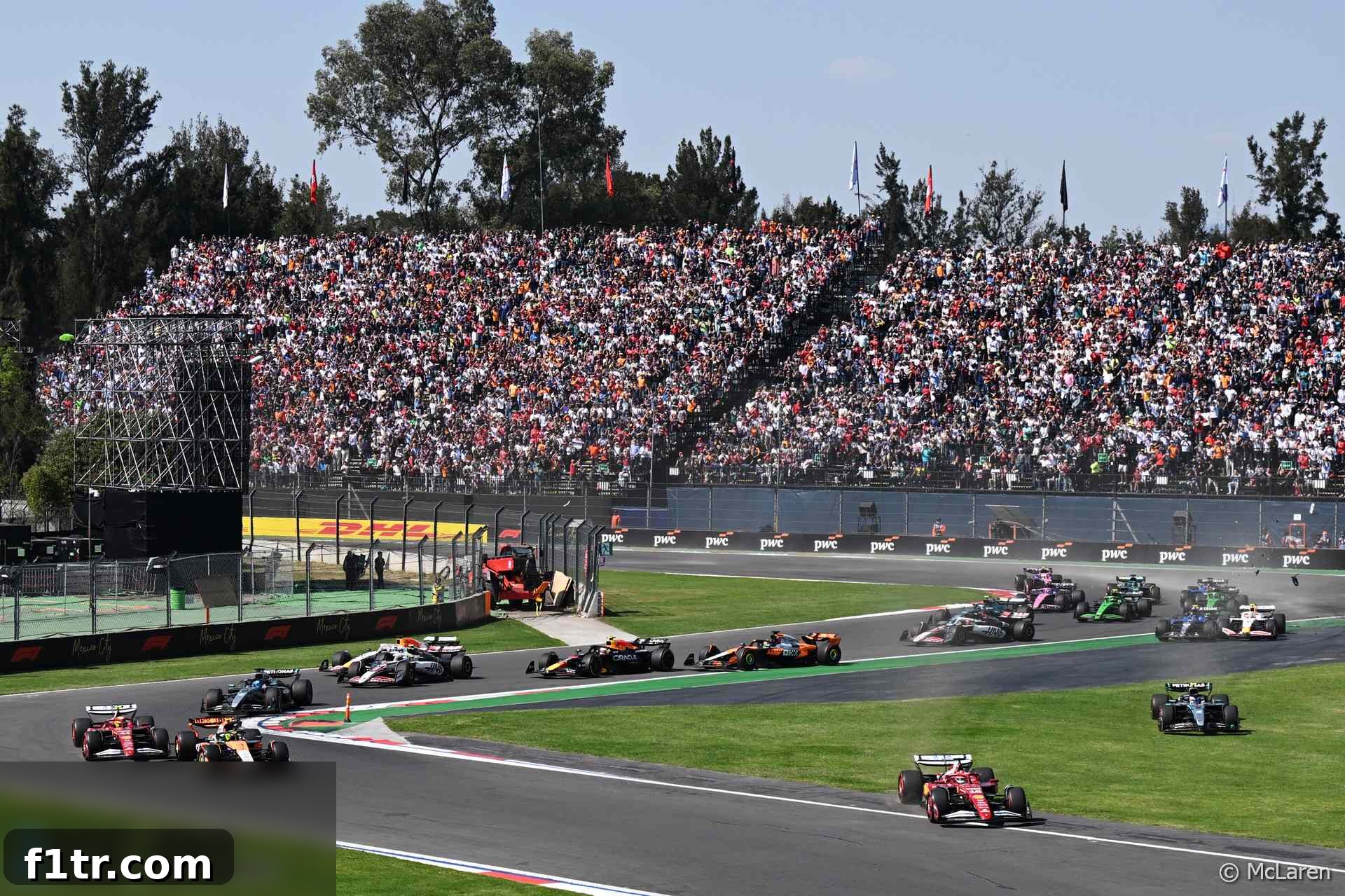
The controversy ignited during the chaotic opening lap of the Mexican Grand Prix, where a number of drivers were observed cutting across the track between turns one and three. This maneuver allowed them to gain a significant advantage by bypassing a critical section of the circuit. Both Russell and Hamilton were among the most prominent voices complaining vehemently to their respective teams about the lack of decisive action against these infringements. Their frustration was palpable, echoing a sentiment that the integrity of the race was compromised by the perceived leniency of the stewards. Among those who went off track in this manner were prominent rivals such as Charles Leclerc of Ferrari and Red Bull’s reigning champion, Max Verstappen.
The Controversial First Lap at the Mexican Grand Prix
The first lap of any Formula 1 Grand Prix is often a hotbed of intense action, tight maneuvers, and strategic positioning. However, at the Mexican Grand Prix, the opening moments quickly descended into a debate over track limits and fairness. As the lights went out, the pack surged towards Turn 1, a notorious braking zone that frequently sees drivers pushing the absolute limits. What followed was a series of incidents where several cars, under pressure and fighting for track position, elected to cut the corner sequence from Turn 1 to Turn 3, running wide and rejoining the track further ahead than they would have been if they had stayed within the prescribed boundaries. This shortcut, if unpunished, offers an undeniable time and positional advantage.
Throughout the race, both Russell and Hamilton repeatedly queried their teams, anxious to know if any penalties had been issued to the drivers who had demonstrably gained an advantage by cutting the corners. The prolonged silence and subsequent inaction from race control only served to amplify their dismay. Russell, in particular, highlighted the severe impact this had on Hamilton’s race, noting how his teammate found himself unjustly behind Leclerc due to these unpenalized infringements.
The Unjust Disadvantage for Lewis Hamilton
Speaking to the official Formula 1 channel post-race, George Russell did not mince words regarding his frustrations. “I was obviously very angry after lap one because I didn’t think what happened was fair at all, for a number of drivers, especially Lewis,” he stated emphatically. “I thought it was extremely unfair what happened in terms of his race.” Russell’s anger stemmed from the clear understanding that Hamilton, having stayed within the track limits, was effectively punished for adhering to the rules, while others benefited from breaking them without consequence. This perceived disparity in stewarding decisions created a ripple effect that undermined Hamilton’s initial race position and trajectory.
The immediate consequence of the unpenalized corner-cutting was significant. While Charles Leclerc managed to finish the race in a commendable second place, Lewis Hamilton’s race unravelled considerably. He ultimately fell to eighth position after being embroiled in a separate racing incident with Max Verstappen shortly after the chaotic first lap. Russell himself was caught up in the very same incident, which saw him drop behind his future Mercedes teammate, Andrea Kimi Antonelli, who was then making his F1 debut.
Race Control’s Inaction and its Ripple Effect
The lack of prompt and decisive penalties from race control raised significant questions about the consistency of stewarding in Formula 1. The rules regarding track limits and gaining an advantage are generally well-defined, and previous races have seen drivers handed time penalties or warnings for similar infringements. The Mexican Grand Prix’s first lap, however, seemed to deviate from this established precedent, leaving drivers and teams alike bewildered and frustrated. This inaction allowed several drivers to escape consequences, fundamentally altering the natural order and fairness of the race’s opening stages.
For a driver like Lewis Hamilton, who relies heavily on a clean and fair start to execute his race strategy, this was particularly damaging. Being placed at an unwarranted disadvantage so early in the race meant he had to fight harder to recover positions, expending tire life and risking further incidents. This cascade of events not only affected his final standing but also had a psychological impact, as drivers naturally expect a level playing field from the outset. The debate surrounding race control’s decisions highlighted a broader call for greater clarity and consistency in applying penalties across all Grand Prix events.
Mercedes’ Internal Battle: Team Orders and Strategy
The chaos of the first lap at Mexico City did not just impact the broader field; it also spilled over into Mercedes’ internal team dynamics. Russell’s unexpected drop behind Andrea Kimi Antonelli, following the incident involving Hamilton and Verstappen, led to a tense situation within the Mercedes garage. For several laps, Russell, who felt he had superior pace and was in a position he “shouldn’t have been in the first place” due to the earlier events, lobbied his team to be allowed past Antonelli. This request initiated a period of intense deliberation within Mercedes’ strategy room, underscoring the complexities of managing two competitive drivers in real-time under high-pressure scenarios.
Mercedes eventually conceded to Russell’s plea, issuing the team order to allow him to pass. However, the decision was not made promptly. The delay in green-lighting the team order became a point of contention and was later openly acknowledged by the team. Mercedes admitted they had taken too long to make the decision, a candid reflection on the immense pressure and the difficult balance they strive to maintain between supporting individual driver ambitions and optimizing overall team performance. This admission highlighted the fine line teams walk in critical race moments, where split-second decisions can significantly alter outcomes.
The Pressure Cooker: Driver and Team Perspectives
Reflecting on the team orders situation and the broader events of the Mexican Grand Prix, George Russell offered an insightful perspective on the immense pressure faced by both drivers and the team during a race. “Of course we analyse every single race and you conclude after many races you could have done things better and differently,” Russell explained. He acknowledged the human element involved, particularly the surge of adrenaline that affects decision-making in the heat of the moment. “When you’re in that moment the adrenaline from my side, the adrenaline for the team, you’re trying to be fair to both drivers, it’s never straightforward to make a decision in the moment. It’s always easy to say ‘we should have done this’.”
Russell’s comments shed light on the intricate challenges faced by F1 teams. Balancing individual driver performance, championship aspirations, and overall team points in a rapidly evolving race environment requires not just strategic acumen but also an understanding of the psychological state of those involved. The difficulty of making a ‘fair’ decision when faced with two highly competitive drivers, each striving for their best result, is a constant tightrope walk for team principals and strategists. Ultimately, Russell concluded with a personal commitment: “So the truth is I just need to make sure I don’t find myself in a position where that needs to be a worry.” This statement underscores his determination to avoid such compromising situations through improved performance and strategic positioning on track.
Fairness in Formula 1: A Recurring Debate
The incident at the Mexican Grand Prix, particularly the lack of penalties for corner-cutting and its subsequent impact on drivers like Lewis Hamilton, reignited the perennial debate surrounding fairness and consistency in Formula 1 stewarding. Fans, pundits, and drivers frequently call for clearer guidelines and more consistent application of rules regarding track limits, racing incidents, and gaining an advantage off-track. The perception of unfairness can significantly affect driver morale, team strategies, and the overall credibility of the sport. When key moments, especially early in a race, are influenced by unpenalized infringements, it can lead to frustration and a feeling that hard-fought battles on track are being undermined.
Maintaining a level playing field is paramount for a sport as competitive and high-stakes as Formula 1. Incidents like those witnessed in Mexico highlight the constant challenge faced by race control and the FIA in interpreting rules in real-time and applying them justly. The dialogue initiated by drivers like George Russell serves as a crucial feedback mechanism, prompting discussions within the sport’s governing bodies on how to ensure that every driver has an equitable opportunity to compete without being disadvantaged by the actions of others going unpunished.
Looking Ahead: Lessons Learned from Mexico
The Mexican Grand Prix provided a stark reminder of the complexities inherent in Formula 1 racing, from the initial scramble for position to intricate team dynamics and the critical role of race control. George Russell’s passionate advocacy for Lewis Hamilton and his reflections on the team order situation offer valuable insights into the pressures and challenges faced by drivers and teams at the pinnacle of motorsport. Moving forward, the hope is that lessons from such events will contribute to even greater clarity and consistency in officiating, ensuring that the spirit of fair competition remains at the core of every Grand Prix. For Mercedes, the experience also serves as an important learning curve in managing driver expectations and making timely, impactful strategic decisions under immense pressure.
The events in Mexico underscore that beyond the sheer speed and engineering marvels, Formula 1 is a sport deeply influenced by human decisions, split-second judgments, and the constant quest for fairness, both on the track and in the steward’s room. As the season progresses, the F1 community will undoubtedly continue to scrutinize how such incidents are handled, striving for an environment where every driver feels confident that adhering to the rules will not put them at an undue disadvantage.
2025 Mexican Grand Prix News & Analysis
- F1 fans shocked as ferry company screens “adult film” by mistake
- Russell: Lack of penalties over corner-cutting was ‘especially unfair for Lewis’
- Williams aim to give Albon more “consistent” car after consecutive Q1 exits
- Lawson “not at fault” for marshal incident says FIA following criticism from Mexico’s OMDAI
- Stats: Norris takes F1’s biggest win for two years as Ferrari go win-less for 12 months
Browse all 2025 Mexican Grand Prix articles