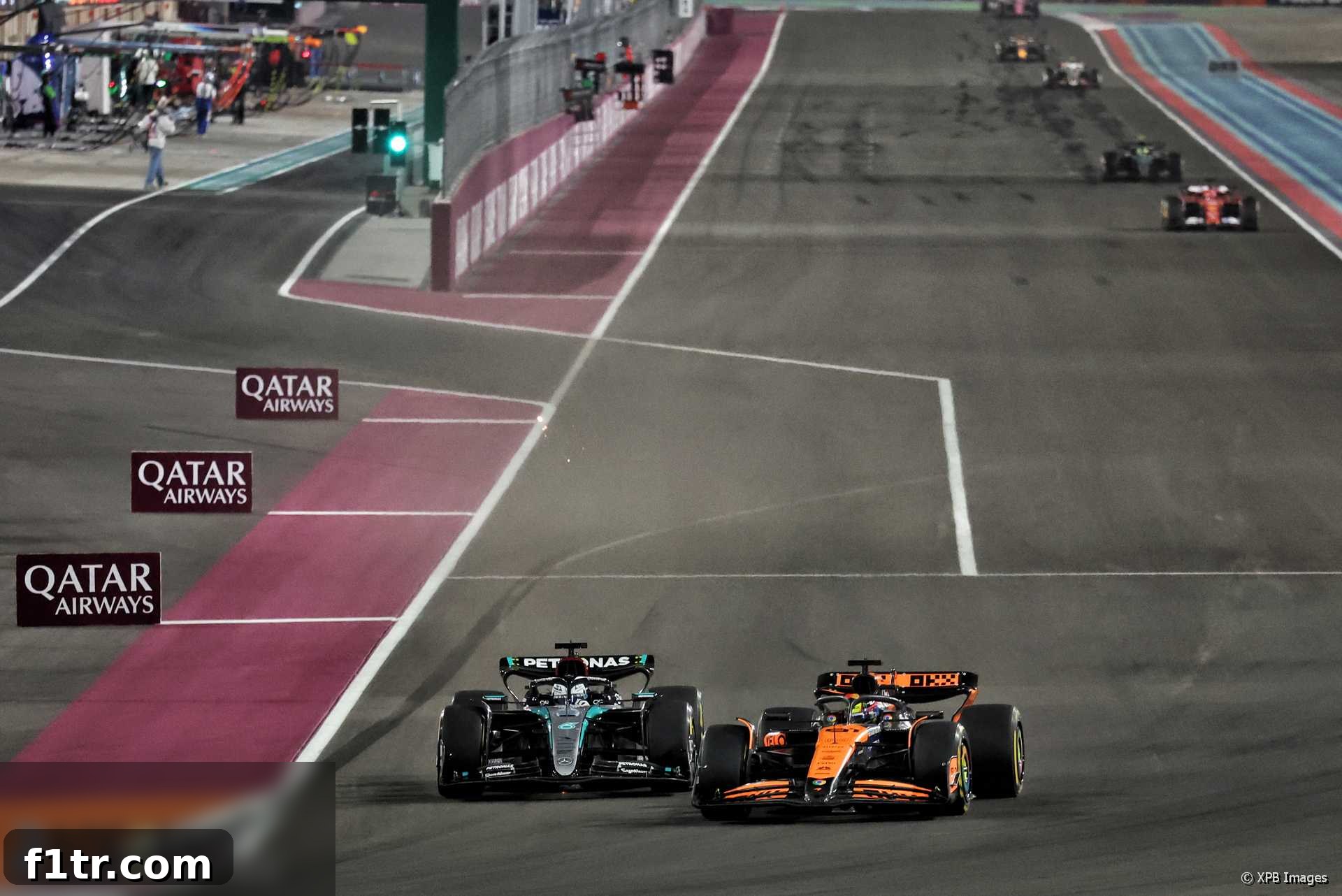
The exhilarating atmosphere of the Losail International Circuit often promises high-octane drama, and the recent Formula 1 Sprint Race in Qatar certainly delivered, albeit with a strategic twist that left Mercedes driver George Russell visibly frustrated. Russell expressed his strong disapproval of the tactics employed by the McLaren drivers, Lando Norris and Oscar Piastri, believing their coordinated efforts effectively sabotaged his chances of challenging for a memorable victory.
Advert | Become a Supporter & go ad-free
The sprint race unfolded with Lando Norris, starting from pole position, initially holding a commanding lead. However, it was his McLaren teammate, Oscar Piastri, who swiftly moved past Norris at the start, seizing the crucial P1 spot. What followed was a masterclass in strategic team driving, meticulously orchestrated by the McLaren pit wall. For the majority of the 19-lap race, Norris was instructed to deliberately rein in his pace, meticulously ensuring that Piastri remained within the vital one-second DRS (Drag Reduction System) window. This allowed Piastri to continuously activate his DRS, effectively creating a high-speed barrier that proved impenetrable for Russell and any other chasing cars.
Despite this formidable defensive alliance, George Russell, driving with characteristic aggression and skill, mounted several determined attacks on Piastri. The Mercedes W14 demonstrated competitive pace, allowing Russell to close the gap repeatedly and position himself for potential overtakes. Yet, each attempt was met with the unwavering defense facilitated by Piastri’s sustained DRS advantage, a direct consequence of Norris’s strategic positioning. Ultimately, Russell was unable to break through McLaren’s defensive wall, crossing the finish line in a respectable third place, behind the two McLarens.
The race concluded with a poignant moment of team collaboration. Lando Norris, having dutifully played his part in protecting Piastri, then allowed his teammate to pass him for the win on the final lap. This gesture was not merely spontaneous; it was a pre-arranged repayment for a similar position swap that occurred between the two drivers during the sprint race in Interlagos. While understanding the strategic logic, Russell openly admitted his personal dislike for such overt team orders in Formula 1, echoing a sentiment shared by many purist fans of the sport.
“It is incredibly frustrating when you find yourself in a situation with team orders being played out right in front of you, creating a scenario where it’s essentially two against one,” Russell articulated after the race, his disappointment palpable. “We all know in this sport, especially on tracks like Losail with its long straights, that overtaking without the aid of DRS is an exceptionally difficult, if not impossible, task. Lando clearly had a significant amount of pace in hand, and frankly, I felt I did too. But they executed their team strategy flawlessly, working together in perfect synchronicity.”
Russell’s commentary extended beyond his personal frustration, touching upon the broader implications for the sport and its fanbase. “This isn’t how I envision Formula 1 should be,” he declared. “If I were a fan watching at home, glued to my screen, that’s definitely not what I would want to witness. I crave genuine on-track battles, raw competition, where the best driver, on that given day, emerges victorious purely through merit and skill. And of course, the ending of the race, with the position swap, only compounded that feeling.” His words highlight a fundamental tension in F1: the conflict between team objectives, often driven by championship points, and the desire for unadulterated sporting spectacle.
The deployment of team orders, while a legitimate strategic tool for teams, frequently ignites passionate debate among fans and pundits alike. Historically, Formula 1 has seen numerous instances where team directives have influenced race outcomes, from the controversial “Fernando is faster than you” message at Hockenheim in 2010 to Rubens Barrichello’s notorious concession to Michael Schumacher at the 2002 Austrian Grand Prix. While crucial for a team’s championship aspirations, such interventions often leave a sour taste for those who champion pure racing integrity. McLaren’s strategy at Losail, while perfectly legal and strategically sound from their perspective, squarely falls into this contentious category, prioritizing the constructors’ championship over individual driver glory in that specific sprint event.
The immediate consequence of McLaren’s calculated one-two finish was a significant boost to their Constructors’ Championship campaign. This strong showing put them in an excellent position to potentially clinch the prestigious team title in the forthcoming Grand Prix. Russell, despite his personal feelings, acknowledged the overarching goal. “You have to respect their dedication to chasing their ultimate objective, which is to win the Constructors’ Championship,” he conceded, demonstrating an understanding of the bigger picture, even while disagreeing with the methods. This admission underscores the inherent conflict that drivers often face, caught between their individual competitive instincts and the strategic imperatives of their respective teams.
Russell also pondered the ‘what if’ scenario, firmly believing that the race outcome could have been drastically different had Norris not been instructed to support Piastri. “If Lando had simply pulled away and driven off into the distance, I am supremely confident that I would have been able to pass Piastri,” he asserted. “And that, crucially, would have meant one less point for McLaren in their championship fight.” This sentiment reflects not only Russell’s confidence in his own abilities and the pace of his Mercedes but also highlights the fine margins that define championship battles. Every point gained or lost can have significant ramifications, making strategic maneuvers like McLaren’s intensely scrutinized.
Despite the frustration, George Russell chose to extract the positives from the Qatar Sprint Race. His Mercedes W14 demonstrated strong performance throughout the event, indicating promising potential for the main Grand Prix. “Frustration in the moment is natural, but I’ll definitely take the positives from this weekend,” he concluded. “The car felt quick, and that’s a crucial foundation as we look ahead to tomorrow’s main race. We know we have the pace to compete, and we’ll be pushing hard for a stronger result in the Grand Prix.” This forward-looking perspective is vital in the demanding world of Formula 1, where every session offers new opportunities to learn, adapt, and improve.
The Qatar Sprint Race served as a stark reminder of the multifaceted nature of Formula 1, a sport where individual brilliance often intertwines with intricate team strategies. While McLaren’s tactics undoubtedly helped them achieve a crucial one-two finish and strengthened their championship bid, it also reignited the perennial debate about the role of team orders and their impact on the purity of racing. George Russell’s outspoken comments not only provided insight into a driver’s perspective but also amplified the voice of fans who yearn for unbridled competition. As the season progresses, the balance between team success and sporting spectacle will undoubtedly continue to be a central theme.
Advert | Become a RaceFans supporter andgo ad-free
Miss nothing from RaceFans
Get a daily email with all our latest stories – and nothing else. No marketing, no ads. Sign up here:
More from the 2024 Qatar Grand Prix
- Horner ‘believes 100%’ Verstappen did not threaten to crash into Russell
- Russell and Verstappen cast new light on clash which triggered explosive row
- Hamilton’s puncture not caused by mirror debris – Mercedes
- Another start-to-finish win shows Qatar GP could be F1’s most processional race
- “Am I dead last now?” Unheard radio from Hamilton’s disastrous Qatar GP
Browse all 2024 Qatar Grand Prix articles