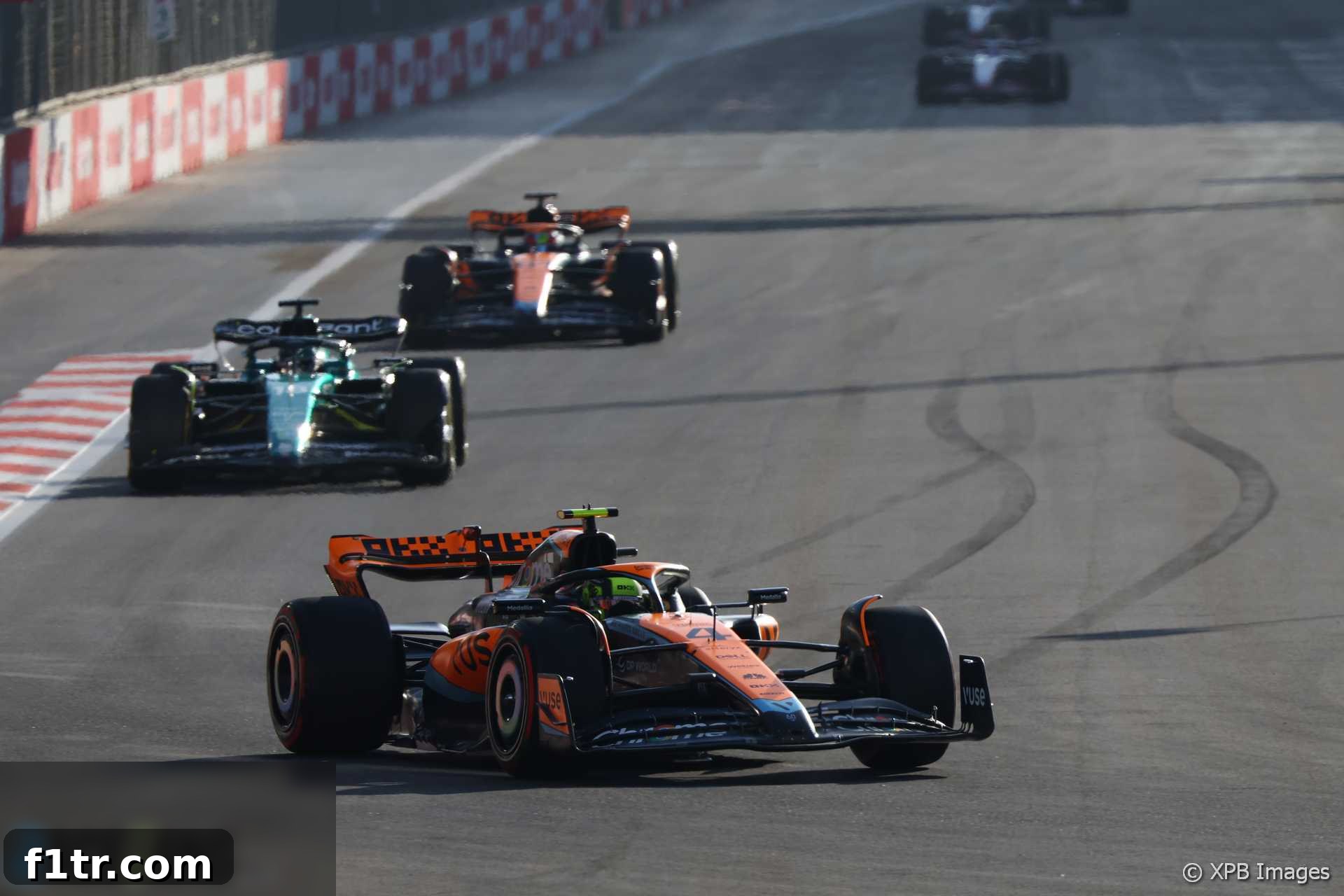
McLaren Defends Aggressive Soft Tyre Strategy for Lando Norris in Baku Sprint Race
McLaren has provided a detailed justification for their controversial decision to equip Lando Norris with a set of soft tyres for yesterday’s high-stakes sprint race at the Azerbaijan Grand Prix. While the strategy ultimately failed to deliver the desired outcome, the team emphasizes the calculated risks and valuable data gathered from their ambitious approach.
Advert | Become a Supporter & go ad-free
The majority of the grid opted for the more durable medium tyre compound for the demanding 17-lap contest. However, Norris, starting from 10th position, embarked on his race with the softer Pirelli compound. This choice initially appeared to pay dividends, allowing him to gain a place from Lance Stroll in the opening laps. Yet, the aggressive compound’s inherent characteristics quickly surfaced. Following a Safety Car restart, Norris’s lap times began to rise dramatically as he succumbed to severe tyre graining, forcing him into an unscheduled pit stop that effectively ended his chances of scoring points.
A Calculated Risk: McLaren’s Pursuit of Points and Data
Team principal Andrea Stella explained the thought process behind the bold tyre call, highlighting McLaren’s strategic imperative in a fiercely competitive midfield. “We knew that we had eight quicker cars ahead of us and points are given from P1 to P8,” Stella told media outlets, including RaceFans. “So we needed to do something in order to score points. That’s the first point of view.”
Despite the strategic ambition, the severe tyre degradation caught the team off guard. “In all honesty, we didn’t [expect] the soft to behave like that. We thought that they would degrade, but we didn’t think they would grain so heavily. So this is something that manifested itself during the sprint and it was beyond our expectation,” Stella admitted. Tyre graining, a phenomenon where rubber peels off the tyre surface due to sliding, is particularly detrimental to performance and longevity, and its intensity in Baku proved to be a critical factor.
Mitigating Risk with a Split Strategy
McLaren also implemented a prudent risk-management approach by splitting strategies between Norris and his team mate Oscar Piastri, who started just behind Norris in 11th. Piastri ran the medium compound, providing the team with a comparative dataset and ensuring they weren’t entirely reliant on the soft tyre’s unpredictable performance. “We had one car on soft, one car on medium. So we thought we can split the risk because if we have a very eventful sprint with a Safety Car, Virtual Safety Cars and so on, there might be an advantage in being on the soft. But if it’s high degradation on the soft, we have the other car on medium. So I think you have to see this also from a team point of view where you cover all the options,” Stella elaborated, underscoring the team’s comprehensive strategic thinking.
Advert | Become a RaceFans supporter andgo ad-free
Gathering Crucial Data in the New Sprint Format
Beyond the immediate pursuit of points, Stella revealed another significant motivator for Norris’s soft tyre run: data acquisition for the main Grand Prix. The new F1 sprint format, designed to maximize competitive action, inadvertently reduces crucial track time for long-run tyre analysis. “It was important for us to learn a little bit for tomorrow because with the new format – which is exciting, you are always competing for something – we lost what was the P2 in the past in which you could do a long run,” Stella explained. This reduction in practice means teams must often use the sprint race as a de facto testing session, especially for understanding tyre behaviour over an extended period.
“So you would have learned these things on Saturday morning, which you can’t [now]. It was also important for us to understand the degradation on the soft and now we have this bit of information,” he added. While acknowledging that, in hindsight, the medium tyre would have been preferable for the sprint race itself, Stella reiterated the broader strategic value. “I think overall while, yes, now I would do the sprint on medium, there was quite a lot to look at from a team point of view and also in terms of learning for tomorrow.”
Lando Norris’ Perspective: Learning from an Aggressive Call
Lando Norris himself mirrored his team principal’s defense of the aggressive strategy. He emphasized that the decision was not a blind gamble but a considered move based on certain expectations and potential race scenarios. “We knew it was a little bit of a gamble,” Norris stated. “We didn’t go in and just think ‘oh, it’s the biggest gamble ever’. We thought it would not be a bad thing to do, have a better launch, a better first couple of laps, try to get into a good position knowing that there’s a good chance there could be some safety cars and VSCs and things, and being on a softer tyre at that point might not be too bad.”
Drivers often factor in the potential for Safety Car periods or Virtual Safety Cars (VSCs) when considering aggressive tyre strategies. Such interventions can effectively reset tyre life, negating some of the degradation concerns and potentially allowing a softer compound to last longer than it otherwise would. However, the Baku sprint proved to be a stern test for anyone venturing onto the softs.
“I think everyone who did do the soft, or made a similar mistake, everyone struggled a lot with the degradation. So it was definitely a lot more than we thought,” Norris conceded, highlighting that McLaren’s miscalculation on tyre wear was not isolated. This collective struggle underscored the unique challenges of the Baku street circuit and perhaps the unseasonably cool track temperatures at the time.
The Impact of Limited Practice on Tyre Understanding
Norris also pointed to the inherent difficulties posed by the revised weekend structure. “I guess it’s one of the challenges with this structure of weekend, not getting to do any long running on the softs,” he reflected. Without the customary free practice sessions dedicated to extensive long runs, teams and drivers have a reduced opportunity to truly understand how different tyre compounds will perform over race distance. This necessitates a greater reliance on simulation data and, as seen in Baku, sometimes a bold in-race experiment.
He admitted, “But we also maybe just didn’t do the best job of trying to understand it and things. It’s tough when you haven’t run it until then more than three laps. So it’s not purely a gamble but just what we thought was best and obviously wasn’t.” The candid assessment from Norris demonstrates the continuous learning curve in Formula 1, especially with new formats and evolving car characteristics. The rapid and unexpected graining provided a harsh but undeniable lesson for the team.
Consequently, Norris confirmed his intentions for the main Grand Prix. Having experienced the limitations of the soft compound firsthand, he stated it is “a tyre I’ll probably stay away from” in today’s longer race, indicating a strategic shift based on the sprint race’s findings.
The Evolving Landscape of F1 Sprint Weekends
McLaren’s experience in Baku serves as a prime example of the strategic complexities introduced by Formula 1’s sprint weekend format. While designed to inject more competitive action, it undeniably compresses the schedule, reducing opportunities for extensive data collection and long-run simulations. Teams are forced to make high-stakes decisions with less empirical evidence, turning the sprint race itself into a crucial learning exercise for the main event.
The delicate balance between competing for immediate sprint points and gathering vital information for Sunday’s Grand Prix is a challenge every team faces. McLaren, in this instance, prioritized both, opting for a strategy that, while unsuccessful in the short term, provided invaluable insights into tyre behaviour on a unique street circuit. This blend of aggressive ambition and pragmatic data gathering highlights the dynamic nature of modern F1 strategy, where every session, even a short sprint, holds strategic weight for the weekend’s ultimate goal.
Bringing the F1 news from the source
RaceFans strives to bring its readers news directly from the key players in Formula 1. We are able to do this thanks in part to the generous backing of our RaceFans Supporters.
By contributing £1 per month or £12 per year (or the equivalent in other currencies) you can help cover the costs involved in producing original journalism: Travelling, writing, creating, hosting, contacting and developing.
We have been proudly supported by our readers for over 10 years. If you enjoy our independent coverage, please consider becoming a RaceFans Supporter today. As a bonus, all our Supporters can also browse the site ad-free. Sign up or find out more via the links below:
- Become a RaceFans Supporter
- RaceFans Supporter FAQ
Advert | Become a RaceFans supporter andgo ad-free
2023 Azerbaijan Grand Prix Related Articles
- Aston Martin radio messages reveal how “older brother” Alonso helps Stroll
- How slashing practice to a single hour in Baku tripped up F1 teams
- Bottas: “Rapid improvement needed” at Alfa Romeo
- Red Bull could become first team to score 1,000 points in a season
- Aston Martin hoping DRS fix works in Miami after Stroll manages fault in race
Browse all 2023 Azerbaijan Grand Prix articles