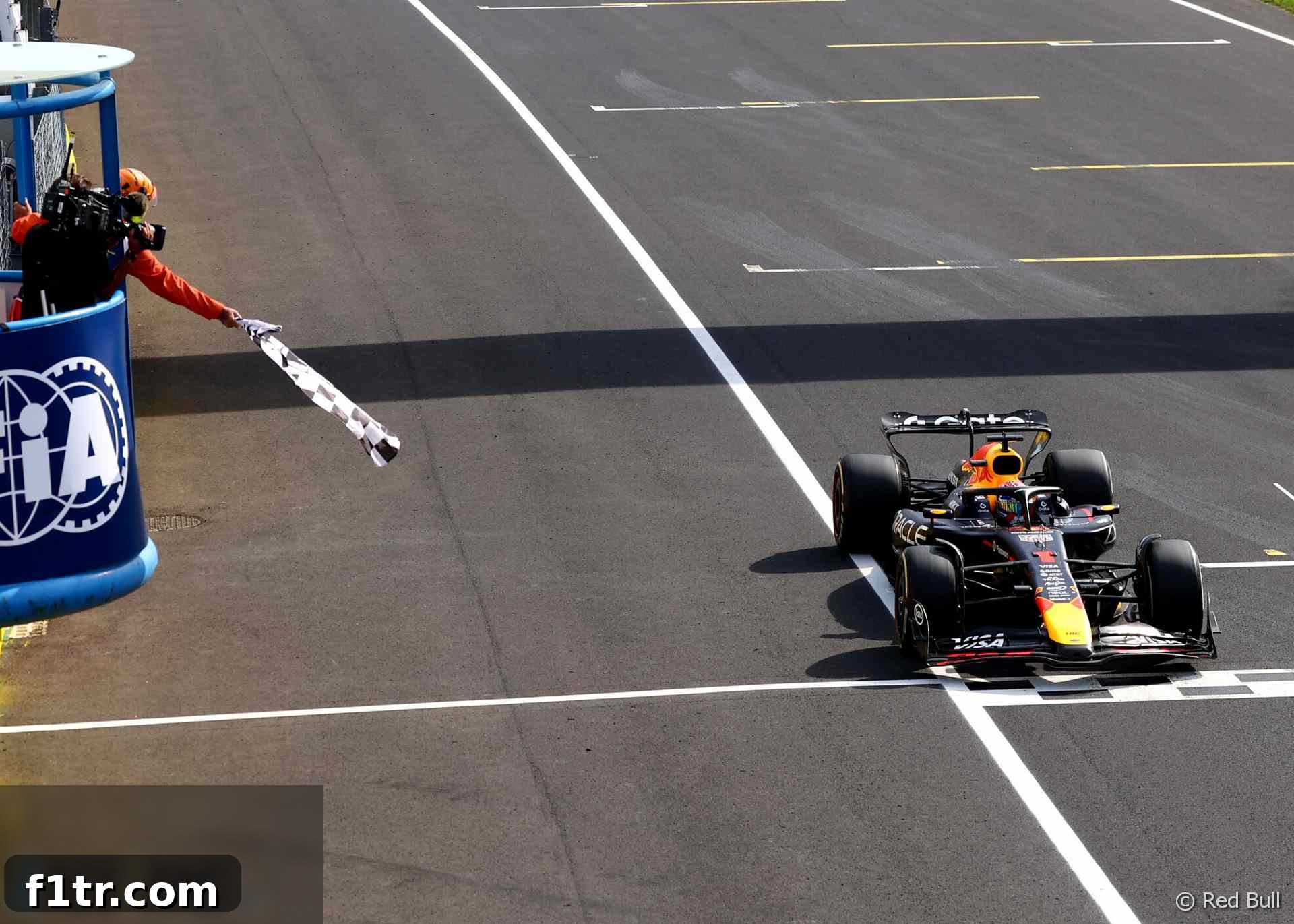
In a display of unwavering control and strategic brilliance, Max Verstappen secured his third victory of the 2025 Formula 1 season at the iconic Monza circuit, the Italian Grand Prix. Starting from pole position, the Red Bull Racing driver delivered a commanding performance that, despite two brief challenges from Lando Norris, saw him cross the finish line first. This triumph marked a significant milestone for Verstappen, ending a four-month winless streak and reaffirming his championship aspirations in the high-stakes world of F1. The ‘Temple of Speed’ once again bore witness to a masterclass in grand prix racing, a perfect blend of raw pace and tactical acumen.
Verstappen’s Monza Masterclass: A Resounding Victory
The 2025 Italian Grand Prix unfolded under clear skies, setting the stage for what promised to be a thrilling contest at one of Formula 1’s most historic venues. Max Verstappen, starting from pole position, was under immense pressure to convert his qualifying advantage into a race win, especially given the fierce competition in the current season. His victory at Monza wasn’t just another notch on his belt; it was a statement. After a period without a win since earlier in the season, this dominant performance from start to finish, albeit with moments of intense pressure, demonstrated the formidable package of the Red Bull car and Verstappen’s unparalleled driving skill. The Monza circuit, with its long straights and fast chicanes, demands absolute precision and courage, qualities Verstappen showcased in abundance.
Qualifying Prowess and Pre-Race Expectations
The build-up to the Italian Grand Prix was charged with anticipation, especially after a highly competitive qualifying session. Max Verstappen’s pole position underscored Red Bull’s raw speed and efficient aerodynamic package, which proved crucial on a track where slipstreaming and top-end performance are paramount. However, the close margins in qualifying suggested that the race would be anything but a walk in the park. McLaren, with their strong form, were expected to be a formidable challenger, especially given the aerodynamic characteristics of the Monza layout. Ferrari, racing on home soil, carried the hopes of the Tifosi, eager to see Charles Leclerc and Carlos Sainz battle at the front. Mercedes, too, were looking to capitalize on any opportunity to challenge the front-runners, setting the stage for a strategic and exciting race day.
The Thrilling Start: Norris Challenges Verstappen Early
As the lights went out, the roar of the engines at Monza was deafening, signaling the start of a dramatic Italian Grand Prix. Max Verstappen, from pole, faced an immediate and aggressive challenge from Lando Norris. The McLaren driver made an exceptional start, swiftly moving to the inside line and seizing the lead into the notorious first chicane, Variante del Rettifilo. In a move reminiscent of his tactics at Jeddah, Verstappen briefly cut the first corner. However, recognizing the sporting regulations and the futility of an illegal advantage, he judiciously relinquished the position to Norris. This proved to be a masterful decision. With the position restored, Verstappen wasted little time in demonstrating the superior pace of his Red Bull, effortlessly re-passing Norris a few laps later. This early exchange set a thrilling tone for the race, highlighting the competitive spirit and strategic thinking at play, even in the opening moments.
Strategic Chess Match: Red Bull vs. McLaren
Verstappen’s Conventional Approach Pays Dividends
Throughout the 2025 Italian Grand Prix, the battle for victory was not just about raw speed but also about strategic execution. Max Verstappen and Red Bull Racing opted for a relatively conventional one-stop strategy, a proven method for success on many circuits, including Monza. Starting on the Medium compound tires, Verstappen managed them expertly through his initial stint, building a comfortable gap to his pursuers. His pit stop for Hard tires was executed flawlessly, showcasing the efficiency and precision that has become a hallmark of the Red Bull pit crew. Despite a slightly shortened final stint on the Hard tires, Verstappen maintained blistering pace, demonstrating the car’s balanced performance and his ability to extract maximum performance without excessive tire degradation. This straightforward yet perfectly executed strategy minimized risks and allowed Verstappen to control the race from the front for the majority of the Grand Prix.
McLaren’s Daring Alternative Strategy Unravels
In contrast to Red Bull’s conventional wisdom, McLaren pursued a bolder, alternative strategy for both Lando Norris and Oscar Piastri, hoping to capitalize on any opportunities for an undercut or a late-race performance advantage. The plan involved a longer first stint, preserving their initial set of tires, before making a late switch to the faster Soft compound tires. The intention was clear: to unleash a surge of pace in the closing laps, potentially challenging Verstappen or at least securing a comfortable one-two finish. This high-risk, high-reward approach aimed to exploit tire degradation on other cars or any potential Safety Car periods that could compress the field. McLaren’s strategic gamble added an intriguing layer to the race, illustrating the intense cerebral battle that complements the on-track action in Formula 1.
The Pit Stop Drama: McLaren’s Internal Battle
The strategic divergence between Red Bull and McLaren reached its peak during the pit stop phase, which ultimately led to an unforeseen internal battle for McLaren. The team’s meticulously planned alternative strategy, intended to maximize their drivers’ positions, inadvertently triggered a change in the order between Norris and Piastri. McLaren decided to call Oscar Piastri into the pits first, a move often used to attempt an ‘undercut’ on a rival. While the team reassured Lando Norris that they would not allow Piastri to pass him through this maneuver, fate intervened. A slow pit stop for Norris, losing precious seconds, meant he rejoined the track unexpectedly behind his younger teammate. Recognizing the critical importance of championship points and maintaining the pecking order, McLaren swiftly instructed Piastri to yield second place to Norris. Piastri, ever the team player, albeit with visible reluctance, complied, allowing Norris to reclaim P2 and securing third place for himself. This incident highlighted the fine margins in Formula 1 strategy and the complex dynamics of team orders.
Midfield Mayhem and Recovery Drives
Ferrari’s Challenge and Leclerc’s Battle
While the top two teams battled for supremacy, the midfield at the 2025 Italian Grand Prix was a hive of intense competition and tactical maneuvering. Charles Leclerc, carrying the hopes of the Tifosi, put up a strong fight in the early laps. After trading places with Oscar Piastri during the first two tours of the circuit, Leclerc initially held his ground. However, Piastri eventually found a way past, and from that point, Ferrari struggled to maintain pace with the front-running Red Bull and McLarens. Leclerc ultimately finished in a respectable fourth place, a solid points haul for the Scuderia but not the podium finish the passionate Italian fans had hoped for. The performance underscored Ferrari’s ongoing efforts to close the gap to the absolute pace-setters, demonstrating their commitment to fighting at the sharp end of the grid.
Hamilton’s Charge Through the Field
One of the standout performances in the midfield came from Lewis Hamilton. Starting from a challenging tenth position on the grid, the veteran Mercedes driver embarked on a methodical and determined recovery drive. Utilizing his vast experience and race craft, Hamilton deftly navigated through the pack, making several crucial overtakes throughout the race. His ability to manage tires while pushing hard allowed him to steadily climb up the order. By the chequered flag, Hamilton had skillfully recovered to finish sixth, just behind his former teammate George Russell. This impressive climb through the field demonstrated Hamilton’s enduring talent and Mercedes’ capability to extract strong performances even when starting from a compromised grid position, securing valuable points for their championship campaign.
Meanwhile, George Russell maintained a consistent and strong pace throughout the race, expertly managing his tires and fending off challenges from behind. His fifth-place finish meant a strong points haul for Mercedes, showcasing the team’s solid performance and strategic execution, ensuring both cars finished within the top six positions, a crucial outcome in the constructors’ battle.
Late Race Incidents and Points Shake-Up
The closing stages of the Italian Grand Prix were not without their drama, as several incidents and penalties reshaped the final points standings. Alexander Albon delivered another commendable performance for Williams, crossing the line in a strong seventh position. However, just behind him, Andrea Kimi Antonelli, the second Mercedes driver, found himself in hot water. He was handed a five-second time penalty for driving erratically, a decision that dropped him from eighth to ninth place. This penalty had a direct impact on the distribution of points in the lower end of the top ten.
Benefiting significantly from Antonelli’s penalty was Gabriel Bortoleto, who inherited a hard-fought eighth place. Bortoleto’s race was already eventful; he had lost a position earlier to Fernando Alonso but regained it when the Aston Martin veteran was forced to retire due to a suspension failure, a disappointing end to what had been a promising run for Alonso. These late-race developments underscored the unpredictable nature of Formula 1, where fortunes can change in an instant due to mechanical failures or stewards’ decisions.
The final point of the race went to Isack Hadjar, who completed an impressive drive from starting in the pit lane. His ability to navigate the challenges of Monza and capitalize on the misfortunes of others highlighted his determination and potential. Further down the order, the race saw more clashes and penalties. Carlos Sainz found his race compromised when he was knocked into a spin by Oliver Bearman at the Roggia chicane. The Haas driver, Bearman, was subsequently given a penalty for the incident. His teammate, Esteban Ocon, also received a penalty for crowding Lance Stroll off the road on the approach to the very same corner, adding to a challenging day for the Haas team and illustrating the tight, unforgiving racing at Monza.
Race Conclusion and Championship Implications
Max Verstappen’s victory at the 2025 Italian Grand Prix was a defining moment in the season, solidifying his position as a formidable contender and demonstrating Red Bull’s continued dominance. While McLaren’s aggressive strategy didn’t quite pay off in the way they hoped, their car’s pace and Lando Norris’s second-place finish, along with Oscar Piastri’s third, proved their strong challenge at the front. The race at Monza was a testament to Formula 1’s blend of high-speed action, strategic depth, and unexpected twists, from thrilling overtakes to critical pit stop errors and late-race penalties. As the season progresses, every point and every strategic decision will be vital in the intensely competitive 2025 championship battle, with teams and drivers pushing the limits at every circuit.
2025 Italian Grand Prix Coverage
- No change to McLaren’s team orders after Monza review – Stella
- Bearman did not deserve penalty for Sainz collision at Monza, says Vowles
- Transcript: Hamilton seeking final tenths as he closes gap to Leclerc
- McLaren can clinch F1’s earliest title win since 1988 with as little as fifth place
- How did Verstappen know about Norris’ slow stop in Italy? Red Bull told him
Browse all 2025 Italian Grand Prix articles