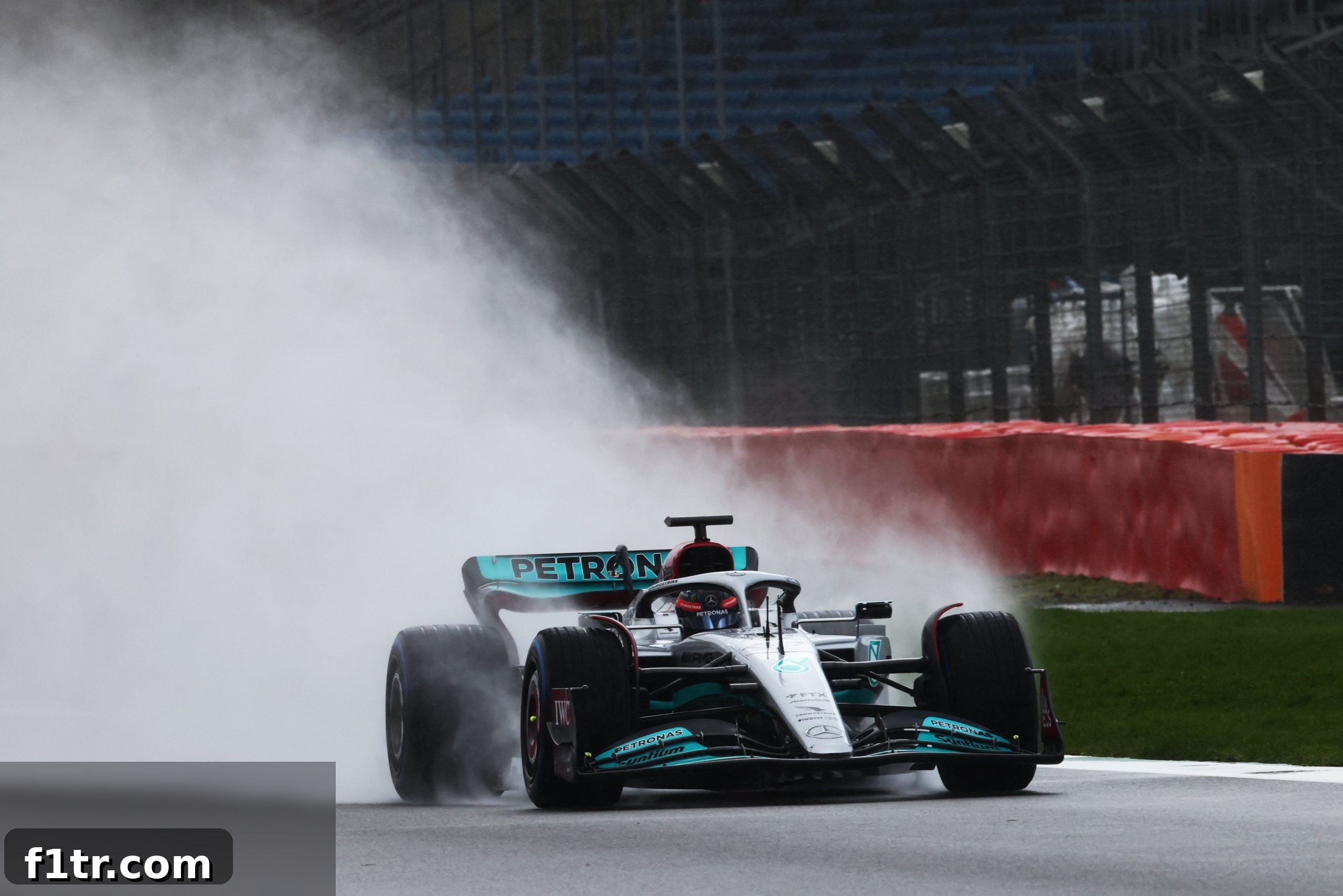
George Russell’s Thrilling Mercedes W13 Debut: A New Era Dawns for Formula 1
The dawn of a new Formula 1 season is always met with immense anticipation, but for 2022, the excitement was palpable. Radical new technical regulations promised a shake-up, and at the heart of this evolving landscape stood George Russell, poised to embark on his highly-anticipated career as a Mercedes-AMG Petronas F1 Team factory driver. The moment the potent W13 roared to life for the very first time at Silverstone Circuit, it wasn’t just another engine firing up; it was the symbolic ignition of a fresh chapter in both Russell’s journey and Mercedes’ relentless pursuit of F1 supremacy. The young British talent candidly admitted to experiencing “goosebumps,” a sentiment that perfectly encapsulated the significance of the occasion.
Russell’s path to Mercedes has been meticulously sculpted since he joined the prestigious Mercedes junior driver programme in 2017. His tenure at Williams Racing honed his skills, transforming him into a formidable talent consistently punching above his car’s weight. Over three seasons, he demonstrated exceptional qualifying prowess and a mature racecraft, earning him the coveted seat alongside seven-time World Champion Lewis Hamilton. This promotion wasn’t merely a step up; it was the culmination of years of dedication, simulator work, and a relentless pursuit of perfection. Driving the W13, Mercedes’ ground-breaking 2022 challenger, as a full-fledged factory driver, was the realization of a lifelong dream, marking a pivotal moment in his burgeoning Formula 1 career.
The W13 Unveiled: A Glimpse into Mercedes’ 2022 Contender
The eight-time reigning constructors’ champions unveiled their revolutionary 2022 car, the W13 E Performance, in a highly anticipated launch event earlier that day. This wasn’t just a cosmetic refresh; the W13 was engineered from the ground up to comply with Formula 1’s most significant technical overhaul in decades. Following the official unveiling, both Russell and his legendary team mate Lewis Hamilton wasted no time in taking the new machine for its inaugural run, a crucial “shakedown” session at the iconic Silverstone Circuit. The shakedown serves as a vital first step in any new car’s life, primarily focused on checking basic system functionalities, ensuring all components operate as designed, and confirming driver comfort and ergonomics within the cockpit. It’s not about outright performance or lap times; it’s about meticulous checks and initial data gathering, laying the foundation for intensive pre-season testing.
Braving the Elements: Shakedown Amidst Storm Eunice
The initial track session, however, presented an immediate and formidable challenge: the unforgiving wrath of Storm Eunice. As the United Kingdom battled one of its most severe weather events in years, the Meteorological Office had issued grave weather warnings across parts of southern England, including Silverstone. The circuit was buffeted by extraordinarily strong winds, creating a perilous environment for any high-performance vehicle, let alone a brand-new Formula 1 car undergoing its maiden voyage. Despite these daunting conditions, the team meticulously assessed the risks, deeming it safe enough to proceed with the essential shakedown program. The fortitude displayed by both the drivers and the team in navigating such adverse conditions underscored their commitment to preparing for the rigorous demands of the upcoming 2022 F1 season.
Russell openly acknowledged the profound impact of the storm on the car’s initial handling. “The facts are if you take the exact same car when there’s no wind and then you put it in 100kph winds – I think it was – today, it’s going to feel very difficult to drive,” he observed. These extreme winds would undoubtedly destabilize any aerodynamic structure, making precise control an arduous task. The W13, designed with intricate aerodynamic surfaces to generate downforce, would have been particularly susceptible to these unpredictable gusts. Yet, Russell’s comments hinted at a deeper understanding, noting that despite the struggle, the car’s behavior was “very much in line with what we saw in the simulator.” This initial correlation, even in challenging circumstances, offers early confidence in the team’s simulation tools and design predictions.
George Russell’s Emotional Connection: From Simulator to Silver Arrow
For Russell, the sensation of driving the Mercedes F1 car for the first time as a factory race driver was uniquely profound. While he had extensively tested Mercedes F1 cars in previous years as part of his development program, the W13 represented a different league altogether. “This morning it gave me goosebumps when the car was fired up for the first time,” he recounted, his voice betraying a mix of excitement and awe. This powerful emotional response stemmed from years of anticipation and meticulous preparation. He elaborated, “I’ve driven so many laps in the simulator, I’ve seen so many drawings of it, I’ve had so many meetings about it, but there’s nothing like going to a race track.” This statement beautifully encapsulates the transition from the virtual realm of simulation to the raw, visceral reality of a Formula 1 machine. The roar of the engine, the vibrations through the chassis, the G-forces, and the sheer speed are experiences that no simulator can perfectly replicate, making the first real drive an unforgettable milestone.
Russell further reflected on the experience, drawing a nostalgic parallel: “It almost brings me back to my roots – a cold, wet, windy day at Silverstone, but here with the Mercedes Formula 1 team.” This poignant comparison to his early racing days underscores the purity of the moment, stripped of the usual glamour and fanfare, focusing solely on the fundamental act of driving. It highlights a humility and passion that has been a hallmark of his career, connecting his journey from humble beginnings to the pinnacle of motorsport. This blend of professional focus and personal emotion marks a significant moment for the young driver, solidifying his place within the elite Mercedes outfit.
Driver Feedback and Data Correlation: The Foundation for Development
The shakedown’s primary objective extends beyond mere system checks; it’s a critical opportunity for the drivers to provide their initial feedback on the car’s handling characteristics. Even in the face of Storm Eunice, Russell and Hamilton were tasked with evaluating how the W13 responded, how comfortable they felt in the cockpit, and if there were any immediate concerns. This qualitative feedback from two of the sport’s most experienced and talented drivers is invaluable, offering insights that quantitative data alone cannot provide. Their intuitive understanding of a Formula 1 car’s dynamics helps guide the engineers towards necessary adjustments and optimizations.
Russell emphasized the ongoing nature of this process: “We’re going back and correlating this afternoon. It’s going to be a constant learning process.” Data correlation is a cornerstone of modern F1 development. It involves comparing the real-world data gathered during the shakedown – from hundreds of sensors on the car – with the predictions generated by complex simulations and wind tunnel tests. Discrepancies between the predicted and actual behavior of the car highlight areas for improvement in both the car’s design and the accuracy of the simulation tools themselves. This iterative process of testing, data collection, correlation, and refinement is fundamental to unlocking a car’s full performance potential, especially under brand-new regulations where teams are exploring uncharted territory.
The 2022 F1 Technical Regulations: A Game Changer
The context of the W13’s development and shakedown is crucial to understanding its significance. The 2022 Formula 1 season introduced the most radical technical regulation changes in over a generation. These changes were meticulously designed to improve racing by making cars easier to follow and promoting closer competition. Key among these was the reintroduction of ground effect aerodynamics, aimed at generating downforce primarily from the car’s underbody, reducing reliance on complex front and rear wings. Other significant changes included larger 18-inch wheels with low-profile tires, a simplified front wing, and strict cost cap limitations. For Mercedes, renowned for its engineering prowess and innovative design, the W13 represents their interpretation of this entirely new rulebook. Every team started from a blank slate, making the initial shakedowns and subsequent testing particularly critical for gauging how their philosophical approaches translate to real-world performance.
Looking Ahead: The Road to Barcelona and Beyond
Despite the challenges posed by Storm Eunice, the shakedown achieved its fundamental goals. Both drivers completed initial runs, verifying basic systems and ensuring their comfort. Russell highlighted the pragmatic approach: “I think we’re all going to take today with a pinch of salt and just get through the programme, make sure the car runs okay, make sure the drivers are comfortable and make sure we’re in the best possible ahead of Barcelona.” This statement clearly outlines the team’s immediate focus: robust reliability and driver confidence, which are paramount before pushing for performance. The forthcoming pre-season testing in Barcelona and Bahrain will be the true crucible for the W13, where teams will begin to understand their cars’ inherent pace, reliability, and development potential in a competitive environment.
As George Russell settles into his role at Mercedes, the team carries the weight of defending eight consecutive constructors’ championships, an unparalleled feat in Formula 1 history. The synergy between Russell’s youthful ambition and Hamilton’s unparalleled experience will be a fascinating dynamic to watch. The W13 is not just a new car; it’s a statement of intent, a testament to Mercedes’ enduring engineering excellence, and a vehicle for their aspirations in this exciting new era of Formula 1. The initial “goosebumps” felt by Russell are a powerful reminder of the human element at the heart of this high-octane sport, as a new challenger and a seasoned champion prepare to carve their paths in the 2022 F1 season.
Related F1 Articles
- Mercedes told me “you’re wrong” about 2022 car’s problems – Hamilton
- FIA confirms all 10 F1 teams complied with 2022 cost cap
- Steiner “not ashamed” of panning “slow” Schumacher in Drive to Survive
- Albon believes year out of F1 improved him as a driver
- Hamilton sees diversity gains in F1 years on from his ‘traumatising’ experience of racism
Browse all 2022 F1 season articles