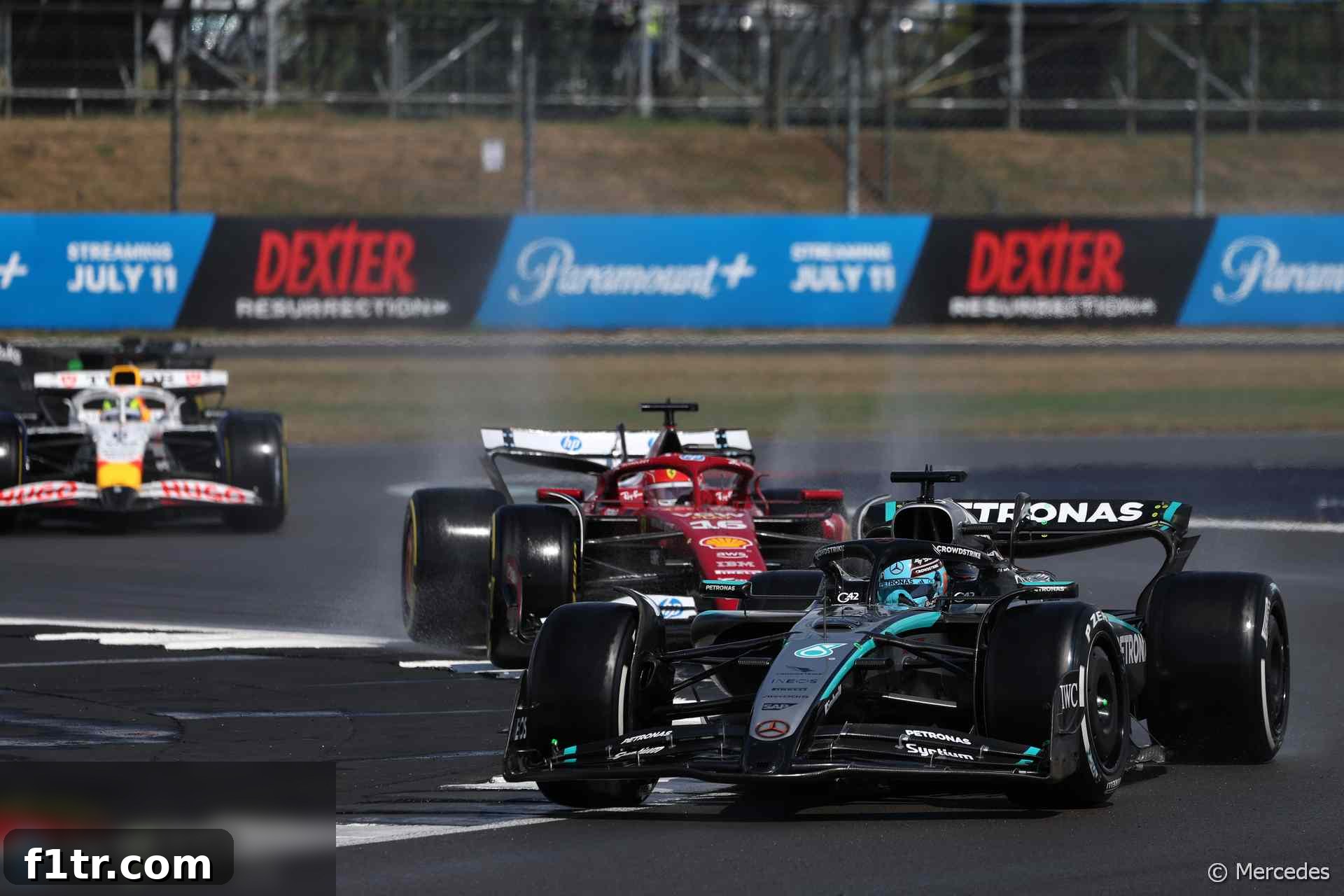
In a move that sparked intense debate and strategic scrutiny, George Russell made a bold decision to switch to slick tyres before the start of the British Grand Prix. This high-stakes gamble, taken amidst challenging wet conditions at Silverstone, ultimately proved costly, leading to a candid assessment from Mercedes team principal Toto Wolff, who deemed the race a “poor performance” overall. Despite the outcome, Russell maintained the justification for his initial call, citing unforeseen circumstances that nullified his strategic advantage.
The Controversial Call: Russell’s Formation Lap Gamble
The iconic Silverstone circuit, renowned for its unpredictable weather, presented Formula 1 teams with a formidable challenge as rain began to fall just before the grid formed for the British Grand Prix. As the cars embarked on their formation lap, the track was damp and treacherous, with most drivers opting for intermediate tyres, the standard choice for such conditions. However, displaying his characteristic readiness to take risks, George Russell became the first driver to signal his intent to pit for dry-weather slick tyres at the end of the formation lap. This early switch was a daring strategic play, predicated on the belief that the track would dry rapidly, thus giving him a significant performance advantage over those on intermediates.
Russell’s rationale was rooted in observations from the cockpit: certain sections of the track appeared to be drying, suggesting a window of opportunity. The potential reward for this aggressive strategy was immense: slick tyres, when on a dry track, can be several seconds faster per lap than intermediates. Mercedes, eager to capitalize on any advantage to compete at the front, gave Russell the autonomy to make the call from within the car, trusting his real-time feedback. However, F1’s notorious unpredictability soon reasserted itself. Shortly after the race commenced, a fresh bout of rain began to fall, drenching the circuit once more. This sudden change in weather conditions immediately undermined Russell’s gamble, leaving him struggling for grip and tumbling down the order, turning a promising strategic play into an immediate setback.
Toto Wolff’s Unflinching Assessment: A Day of Missteps for Mercedes
Mercedes Team Principal Toto Wolff did not shy away from a critical evaluation of the team’s performance at the British Grand Prix. His post-race comments highlighted a pervasive sense of disappointment, stemming from a series of strategic errors that plagued their race. “That was a poor performance all around from us,” Wolff declared, emphasizing the collective responsibility for the team’s struggles. He pointed directly to Russell’s initial tyre choice as the first in a chain of misjudgments. “The first call to take the slick tyre on the formation lap was wrong. From there, we spiralled from bad to worse.”
Wolff’s critique wasn’t limited to the opening lap. He also expressed dissatisfaction with Russell’s second dry tyre change on lap 38. As the track finally began to dry for a more sustained period, Russell pitted to switch from intermediate tyres, but the team opted for the hard compound. “We didn’t fit the right dry tyre at either stop, opting for the hard compound which suffered a challenging warm-up,” Wolff explained. The hard compound, while durable, requires a longer period to reach its optimal operating temperature and provide peak grip compared to softer compounds. This characteristic made it a less-than-ideal choice for a crucial mid-race pit stop aimed at maximizing performance on a drying track. The slower warm-up effectively hampered Russell’s ability to quickly regain lost positions and mount a significant challenge in the latter stages of the race, adding another layer of frustration to Mercedes’ strategic woes.
George Russell’s Resolute Defense: The Virtual Safety Car Conundrum
Despite the adverse outcome and his team principal’s blunt assessment, George Russell remained unwavering in his conviction regarding the initial slick tyre decision. “I think the decision in the beginning was not a bad decision,” he asserted, presenting a compelling argument centered on the unpredictable nature of Formula 1 racing. Russell highlighted the crucial role played by Virtual Safety Car (VSC) periods during the opening phase of the race, which he believed robbed him of the opportunity to demonstrate the true potential of his early slick tyre switch.
He meticulously explained, “It was dry for 25 minutes, but what we didn’t know is we would have 15 minutes of Virtual Safety Car.” The key challenge for slick tyres on a cold or damp track is generating and maintaining sufficient heat to achieve optimal grip. During a VSC, cars are mandated to significantly reduce their speed, making it nearly impossible for the tyres to build or retain the necessary temperature. This prolonged period under VSC conditions meant that Russell’s slick tyres never entered their optimal operating window, nullifying the inherent speed advantage they would have offered under normal racing conditions.
Russell provided a stark comparison to illustrate his point: “As soon as it was dry, as we got going at the end [of the first stint], we were five seconds faster than the intermediate tyre.” This significant pace differential underscored the potential he believed was within reach. Therefore, he concluded, “So I believe with no Virtual Safety Car, I think with dry tyres we would have been ahead of the people on the wet tyre. But that went against us.” He further emphasized the profound impact of these interventions: “I do believe with no [Virtual] Safety Car we would have got back into at least the top five as a minimum.” Russell’s defense effectively shifts the blame from the decision itself to the unforeseen external factors that dictated its ultimate failure, illustrating the razor-thin margins and unpredictable variables that define strategic success or failure in Formula 1.
Aggressive Strategy: A Calculated Risk for Underdog Teams
Russell further elaborated on the philosophical underpinning of his aggressive tyre strategy, particularly for a team like Mercedes that, in certain races, might not possess the outright fastest car. “At the end of the day [if] you take a conservative decision, we will come home with a conservative result,” he reasoned. This statement encapsulates a critical aspect of modern Formula 1: when a team doesn’t have the dominant pace, taking calculated risks becomes a necessity to challenge for podiums or victories. A conservative approach, while safer, often yields predictable, mid-pack results.
Conversely, Russell noted, “When you have a fast car you can afford to be conservative because you will always get a good result.” This highlights the luxury enjoyed by truly dominant teams, who can often play it safe and still secure top positions. For Mercedes, constantly battling at the sharp end of a fiercely competitive grid, embracing an aggressive strategy is sometimes the only viable path to outperform rivals who might have a slight edge in raw pace. This mentality suggests a willingness to gamble on high-reward scenarios, accepting that sometimes these gambles will not pay off, but are essential to push the boundaries of performance and strategy.
The Second Pit Stop: Desperation and Misaligned Expectations
While steadfast in defending his initial slick tyre call, George Russell was notably more introspective and critical of his subsequent dry tyre switch late in the race. This second pivotal pit stop, occurring on lap 38 as the track was drying definitively, saw Russell trade his intermediate tyres for hard compound slicks. “At the end I was a bit desperate taking the dry tyres,” he conceded, hinting at the high pressure and urgency he felt to improve his position.
A key point of contention for Russell was the choice of tyre compound. He openly admitted to an expectation misalignment with the team: “I was not expecting the hard [tyre]. At the end, I thought we would go soft or medium.” The hard compound, known for its durability but slower warm-up, proved to be a challenging choice given the immediate need for grip and pace. Russell candidly attributed the misstep to a shared responsibility: “The decision was my side to pit, the decision of the tyre [compound] was the team and I think both were wrong.” He pinpointed the timing as critical, suggesting he was “probably one lap too early for the soft tyre, but for the hard tyre was probably three laps too early.” This frank analysis underscores the intricate and sometimes fractured decision-making process between driver and pit wall in the heat of battle.
Russell further emphasized the strategic anomaly of the hard compound choice in such a scenario: “I was in [seventh] at this time, and if you don’t have the pace in the car, sometimes you need to make a brave decision. Sometimes it goes for you, sometimes it goes against you.” He reiterated his surprise, stating, “I was not expecting the hard tyre at this point. If you’re the first driver to pit for slicks, you normally take the soft tyre, not the hard tyre.” The soft tyre typically offers immediate grip and a quicker warm-up, making it the preferred choice for an aggressive early switch to exploit track conditions. The hard compound, conversely, is a long-run tyre, ill-suited for making quick inroads or capitalizing on a drying track in a sudden tactical move, thereby exacerbating the difficulties faced by Russell in the closing stages of the British Grand Prix.
Radio Communications: A Glimpse into the Strategic Crossroads
The unfiltered radio exchanges between George Russell and his race engineer, Dudley, during the crucial formation lap, offer a rare and fascinating window into the real-time, high-pressure strategic deliberations within the Mercedes cockpit. These communications illuminate Russell’s proactive role in assessing the rapidly changing track conditions and his strong inclination towards an aggressive tyre strategy. They also highlight the team’s reliance on his immediate feedback from the circuit, showcasing a collaborative yet ultimately driver-driven decision-making process.
| Russell | I don’t think this will be long. Be ready to box now. |
| Dudley | So it’ll be a standing start. |
| Dudley | So if you feel it is dry enough, George, it’s your call. |
| Russell | Just be ready. |
| Dudley | Affirm. |
| Russell | I don’t think it is. |
| Dudley | We’re ready |
| Russell | What tyre would you go? |
| Dudley | We would go hard tyre. |
| Russell | Confirm when the rain is coming. |
| Dudley | 20 to 25 minutes. |
| Russell | Be ready |
| Dudley | Copy that |
| Russell | Very wet here |
| Russell | Let’s go for it. Box, box. |
| Dudley | Copy, box, box. |
The dialogue illustrates Russell’s initial optimism and prompt for readiness, followed by his engineer’s empowering deferral to his judgment. Russell’s momentary hesitation (“I don’t think it is” — likely referring to the track being fully dry enough), quickly followed by his query about the team’s preferred tyre (“What tyre would you go?”), reveals an ongoing internal debate. The team’s suggestion of a “hard tyre” is particularly noteworthy, given Russell’s later comments about expecting a softer compound. Finally, despite acknowledging the track as “Very wet here,” Russell’s decisive call to “Box, box” underscores his commitment to the aggressive strategy. This transcript encapsulates the dynamic, high-pressure environment of Formula 1, where split-second calls, influenced by both driver instinct and team data, can pivot the entire race narrative.
Lessons Learned: Mercedes’ Enduring British Grand Prix Conundrum
The 2025 British Grand Prix served as a potent reminder of Formula 1’s inherent unpredictability and the delicate balance between strategic genius and critical misjudgment. George Russell’s fervent defense of his initial slick tyre gamble highlights the proactive and sometimes audacious approach drivers must adopt when their car lacks the outright pace to dominate. It reflects a philosophy where calculated risks are deemed necessary to achieve extraordinary results, even if they occasionally lead to setbacks. This aggressive mindset, however, must be meticulously balanced with robust team communication and flawless execution.
Toto Wolff’s broader critique of the team’s overall strategic performance at Silverstone underscores the multifaceted challenges faced by a top-tier F1 outfit. The incident prompts a deeper examination of Mercedes’ internal communication protocols, particularly the synergy between driver instincts and the pit wall’s data-driven decisions. Furthermore, it shines a light on the crucial importance of accurate weather forecasting and agile, reactive strategy adjustments in races characterized by variable conditions. While the outcome for Russell and Mercedes at their home race was far from ideal, such high-pressure scenarios often provide invaluable learning opportunities. These experiences, albeit tough, are instrumental in refining future race strategies, fostering greater trust and understanding between driver and team, and ultimately contributing to the relentless pursuit of Formula 1 success amidst its ever-changing dynamics.
Advert | Become a RaceFans supporter andgo ad-free
Related Articles: 2025 British Grand Prix
- Tsunoda says the stewards have “not been nice to me” as penalty points mount up
- ‘I’ve considered Hulkenberg an exceptional talent for a very long time’ – Wheatley
- Alpine is now F1’s highest scoring last-placed team of all time: British GP stats
- Ferrari had no GPS data from Hamilton’s car throughout British Grand Prix
- “The risk for us is a Safety Car”: Why Norris’s win was in danger for six laps
Browse all 2025 British Grand Prix articles