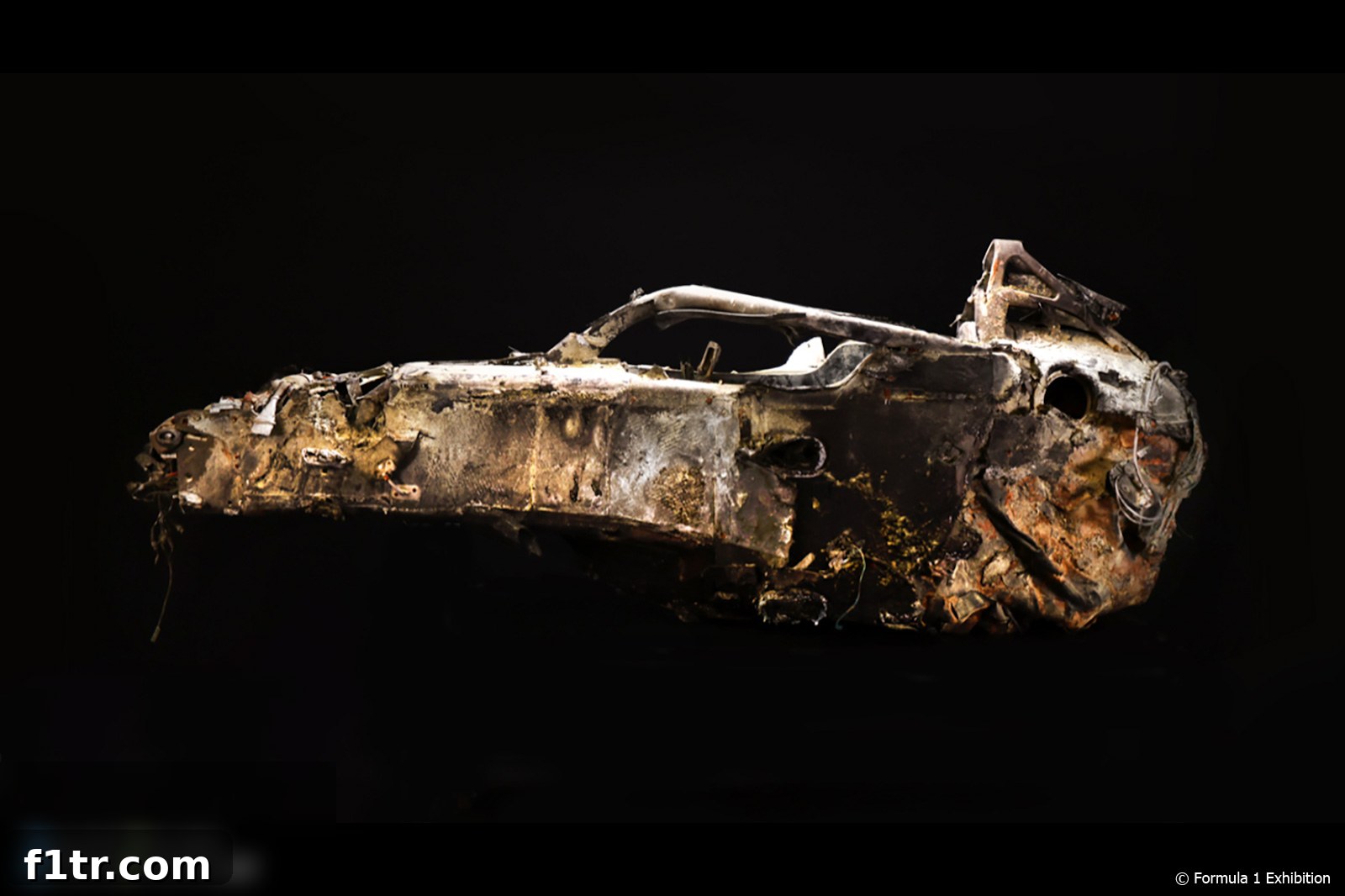
The scarred and twisted remains of the Haas VF-20 chassis, forever etched in the annals of Formula 1 history following Romain Grosjean’s harrowing and fiery crash at the 2020 Bahrain Grand Prix, is set to be unveiled to the public next month. This extraordinary relic of survival, a visceral testament to modern motorsport safety, will take centre stage at a highly anticipated exhibition, offering a rare glimpse into the sheer forces at play in a top-tier racing incident.
On that fateful day, Grosjean’s car, travelling at an astonishing 192 kilometres per hour (approximately 120 mph), veered sharply into the guardrail on the inside of Turn 3. The impact was cataclysmic, registering a staggering 67G – a force equivalent to crashing into a wall at nearly 200 km/h without crumple zones. The violence of the collision was so extreme that the car’s engine and rear assembly were instantly ripped from the monocoque, transforming the front section into a blazing inferno. This wasn’t merely a crash; it was an explosion, a brutal demonstration of mechanical failure under extreme stress, culminating in a raging fire that engulfed the driver’s survival cell.
What followed was an agonizing 28 seconds during which Romain Grosjean, trapped amidst the flames, fought desperately for his life. Miraculously, he emerged from the inferno, albeit with significant burns to his hands, a stark reminder of the immense heat and danger he faced. The primary heroes of this incredible escape were not individuals, but the advanced safety features meticulously engineered into the VF-20 chassis. Foremost among these was the controversial yet ultimately life-saving ‘Halo’ cockpit protection device, a robust titanium structure that deflected the guardrail away from Grosjean’s head. Its presence, along with the remarkable structural integrity of the carbon fibre survival cell, was universally credited with preventing a far more tragic outcome.
Since the incident in December 2020, the extensively damaged chassis has been carefully preserved and has not been publicly seen. Its impending display at the prestigious Formula 1 Exhibition in Madrid, commencing next month, marks a significant moment. It will not just be an exhibit; it will be a powerful narrative, a silent sermon on the relentless pursuit of driver safety that defines Formula 1. The exhibition promises to contextualize the severity of the crash, allowing attendees to fully grasp the miracle that unfolded on the Bahrain International Circuit.
Reflecting on the terrifying experience from his current vantage point as an IndyCar racer, Grosjean shared his profound realization. “From my point of view, it was a big accident but I didn’t realise the impact or how violent it was from the outside,” he recounted. “It was only the next day when I asked someone to show me what it looked like that I realised.” The full gravity of the situation, he explained, truly hit him when he saw the horrifying footage. He further elaborated on the emotional toll it took on his loved ones: “My wife was actually watching that race with my dad and my kids. They will remember that moment their entire life. They were just spectators waiting to hear something, waiting to see something from Bahrain.” This poignant insight underscores the far-reaching impact of such an incident, extending beyond the driver to their entire support system.
The centerpiece of the exhibition will be a dedicated chamber, aptly titled ‘Survival’. Here, the mangled chassis will be presented alongside never-before-seen footage of the crash, offering visitors an unparalleled and sobering perspective. This carefully curated display aims to immerse attendees in the raw reality of the event, highlighting not just the destructive power of a Formula 1 crash, but also the incredible resilience of both human spirit and technological innovation. It serves as a powerful educational tool, showcasing the evolution of safety protocols and engineering in the sport.
Grosjean’s own account of his escape from the burning wreck is a testament to his quick thinking and sheer determination. “I had to break the headrest, punching it with my helmet and then I eventually managed to get my helmet through and stand up in the seat,” he explained, detailing the arduous steps he took. “I realised my left foot was stuck into the chassis and I pulled as hard as I could on my left leg. My shoe stayed in the chassis but my foot came loose so I was free to exit the car.” This incredible feat of self-extrication under immense pressure and pain speaks volumes about a racing driver’s instinct and physical conditioning. The immediate response from the medical team and marshals was also critical, creating a narrow window of opportunity for escape.
Adding to the peril was the presence of highly flammable materials. “It was 120 kilos of fuel plus the battery – both were on fire,” Grosjean stated, emphasizing the sheer volume of fuel that was ablaze. He gratefully acknowledged the heroic efforts of the medical personnel: “Dr Ian Roberts, Alan [van der Merwe] from the medical car and one fireman were trying to open a gap in the fire to help me get out. I believe that helped me at least to get a vision of where I had to go and where the exit was.” Their swift action and courage in confronting the raging inferno were instrumental in providing Grosjean with the crucial pathway to safety, a powerful illustration of the coordinated response system in place during Formula 1 races.
The underlying strength of the Formula 1 car’s design, particularly the survival cell, proved its worth. “The survival cell is there for you in case of a huge impact. I was intact inside the shell,” Grosjean affirmed, underscoring the success of this critical component. He further noted the chassis’ structural integrity: “The chassis is still in one piece, the halo is there and apart from the damage and burn it is still as it should be. I guess that saved my life.” This concise yet profound statement encapsulates the triumph of engineering, highlighting how decades of continuous safety improvements culminated in protecting a driver from what could have been a fatal accident. The Halo, once a point of contention among some fans and drivers, definitively proved its indispensable value, forever altering perceptions of Formula 1 safety.
Pictures: Grosjean’s Bahrain Crash Chassis – A Symbol of Survival
The F1 Exhibition, featuring this powerful display, is scheduled to open its doors in Madrid on March 24th, promising an immersive and educational experience for motorsport enthusiasts and the general public alike. This exhibit will undoubtedly draw significant attention, serving as a poignant reminder of the inherent dangers of racing and the extraordinary lengths Formula 1 goes to protect its competitors. Visitors will have the unique opportunity to stand before the very structure that bore witness to one of the sport’s most dramatic escapes, offering a deeper understanding of the forces and safety innovations that define modern Grand Prix racing.
Video: The Unforgettable Bahrain 2020 Crash of Romain Grosjean
The full extent of the incident, captured from multiple angles, served as a stark reminder of the inherent risks of Formula 1. Footage of the crash, including previously unreleased perspectives, will be part of the exhibition. For those who wish to revisit the harrowing moments, a promotional film released by the exhibitors, often shared on social media, offers a glimpse into the dramatic event. One such example can be found in a past tweet from RaceFans: https://twitter.com/racefansdotnet/status/1627977600382509057
Further Reading: The 2023 F1 Season and Beyond
- FIA president cleared of alleged interference in two 2023 races
- First week viewing figures for new Drive to Survive season fall again
- Max who? Drive to Survive season six prefers its favourite faces
- RaceFans’ complete 2023 season review
- The F1 drivers who pulled off the 10 biggest charges through the field in 2023
Browse all 2023 F1 season articles