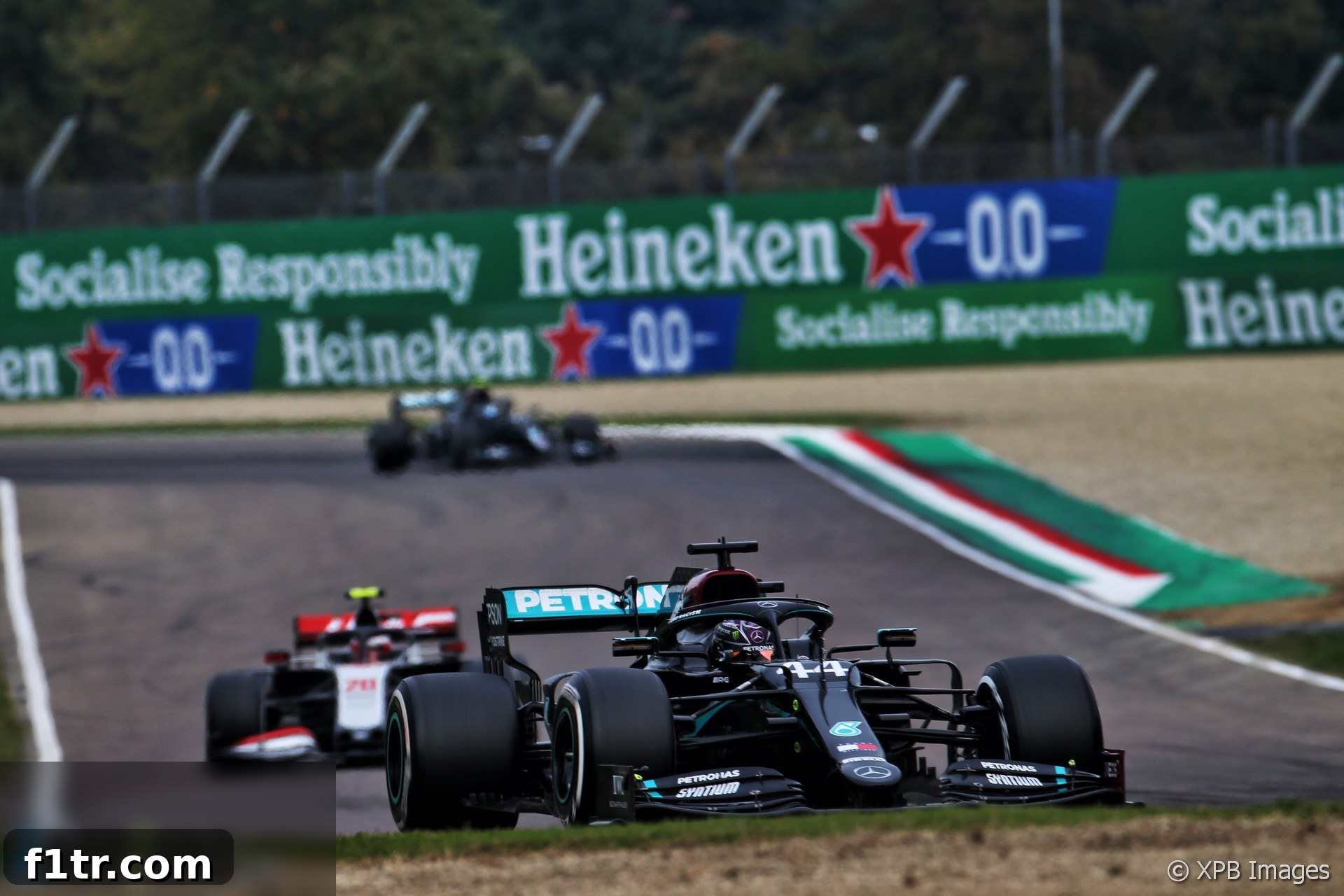
Lewis Hamilton’s resounding victory at the 2020 Emilia-Romagna Grand Prix was a meticulously crafted strategic triumph, showcasing not only his immense driving talent but also the tactical brilliance of the Mercedes-AMG Petronas F1 Team. This pivotal win, his 93rd career Grand Prix victory, was achieved through a perfectly executed long first stint and a decisive pit stop perfectly synchronized with a Virtual Safety Car period, allowing him to leapfrog his rivals into the lead.
Advert | Become a Supporter & go ad-free
The Imola Masterclass: How Hamilton Seized Victory Through Strategy and Pace
The 2020 Emilia-Romagna Grand Prix, held at the historic Autodromo Internazionale Enzo e Dino Ferrari in Imola, was a highly anticipated return to a classic Formula 1 circuit. Known for its challenging and narrow layout, Imola places a significant emphasis on qualifying performance and strategic prowess, as overtaking opportunities are notoriously scarce. It was against this backdrop that Lewis Hamilton orchestrated a victory that underscored his championship-winning credentials and the strategic depth of his team.
A Tense Start and Early Race Dynamics
The race began with a flurry of action that initially saw Hamilton lose ground. Valtteri Bottas, starting from pole position, made an excellent getaway, maintaining his lead into the first corner. However, Hamilton, starting alongside him, found himself under immediate pressure from Max Verstappen. The Red Bull driver launched a superb start, aggressively moving past Hamilton to claim second place. This early shuffle meant Hamilton was relegated to third, facing the challenging prospect of battling two formidable opponents on a circuit where track position is king.
For the initial laps, the front three settled into a rhythm, with Bottas leading, Verstappen closely behind, and Hamilton biding his time. The primary challenge for all drivers was managing their tires on a circuit that punishes errors and rewards precision. The early stages were crucial for setting up strategic options, and Hamilton, ever the master of tyre preservation, carefully monitored his mediums while keeping pressure on Verstappen.
Building the Overcut: Hamilton’s Relentless Pace
In a race anticipated by most teams to be a one-stop affair, the timing of pit stops was paramount. The standard strategy often involves an “undercut,” where a car behind pits earlier onto fresh tyres to gain pace and leapfrog the car ahead. However, Mercedes and Hamilton opted for a more aggressive and less conventional approach: the “overcut.”
Max Verstappen initiated the first wave of pit stops among the leaders, coming in on Lap 17 for fresh rubber. Valtteri Bottas reacted immediately, pitting on the very next lap to defend against the Red Bull’s fresh tire advantage. This left Lewis Hamilton out on track in the provisional lead, with a clear road ahead and an opportunity to unleash his full potential.
What followed was a sensational display of speed and tire management. Hamilton began reeling off a succession of fastest laps, pushing his Mercedes W11 to its limits. This relentless pace was critical for building a sufficient gap, but it was compounded by an unforeseen issue for his teammate. Bottas had picked up a significant piece of debris – later identified as part of Sebastian Vettel’s front wing from an earlier incident with Kevin Magnussen – during Lap 2 at Tosa. This debris, lodged in the floor of Bottas’s car, severely compromised its aerodynamic efficiency, costing him crucial lap time and hindering his ability to defend against Hamilton’s charge.
Hamilton capitalized mercilessly on both his blistering speed and Bottas’s misfortune. Each lap saw his lead extend, transforming what was initially a speculative overcut attempt into a clearly viable strategic advantage. The goal was to build a gap large enough to pit and still emerge ahead of his rivals, a challenge requiring immense precision and unwavering focus.
Reaching the Tipping Point: A Lead Secured Under Green Flags
Hamilton’s consistent, aggressive pace brought him to a critical strategic threshold. By the time his pit window opened, he had successfully stretched his lead over both Valtteri Bottas and Max Verstappen to more than 28 seconds. This specific margin is fundamental in Formula 1 strategy; it represents the approximate time lost during a standard green-flag pit stop, encompassing the entry, the stationary time, and the exit from the pit lane.
In essence, Hamilton had achieved a significant strategic advantage: he was now “a pit stop over” his main competitors. This meant that, even under normal racing conditions, if he were to pit, he would re-emerge from the pit lane comfortably ahead of both Bottas and Verstappen. The team radio conversations confirmed this turning point. Bottas was informed by his engineer, “We are one second unsafe,” clearly indicating that Hamilton had built enough of a buffer to maintain the lead after his stop.
Max Verstappen’s race engineer conveyed a similar message: “With Valtteri’s pace ahead Lewis has now jumped us.” A bewildered Verstappen questioned, “Did he pit already or not?” His engineer’s reply clarified the situation: “Not yet, he just has a pit stop over us. And Valtteri.” This exchange definitively confirmed that Hamilton’s strategic masterclass had already secured him the race lead, purely through pace and tire management, before any external factors came into play.
The Virtual Safety Car: A Perfectly Timed Intervention
Just as Hamilton’s strategic victory seemed assured, an unexpected incident added another layer of drama to the race. Esteban Ocon’s Renault suffered a suspected gearbox problem, forcing him to stop his car at the exit of Acqua Minerali. Following established safety protocols, the incident initially prompted a local yellow flag, which was quickly upgraded to a Virtual Safety Car (VSC) period to allow for the safe recovery of Ocon’s stranded vehicle.
For Lewis Hamilton, the timing of this VSC was nothing short of serendipitous. As the VSC period was declared, Hamilton was in the precise optimal position on the track – approaching the pit entry. His race engineer, Pete Bonnington, known affectionately as Bono, immediately gave the instruction to pit. Pitting under VSC conditions offers a substantial advantage: while drivers must adhere to a specific delta time around the circuit, significantly reducing their speed, the pit lane speed limit remains constant. This dramatically minimizes the time lost during a pit stop compared to pitting under full green flag conditions.
Hamilton capitalized flawlessly on this opportunity. He expertly guided his Mercedes into the pits, swiftly completed his tire change, and emerged back onto the track just as the VSC period was concluding. The perfect alignment of his track position, the VSC deployment, and the efficiency of his pit crew meant he lost an absolute minimum of time, solidifying his already established lead beyond any doubt. His rivals, having already made their stops, could only watch as Hamilton’s advantage became insurmountable.
Beyond Luck: A Victory Earned and Reinforced
While the timely intervention of the Virtual Safety Car certainly provided an additional layer of security and efficiency for Hamilton’s pit stop, it is crucial to recognize that his victory was not solely dependent on luck. The strategic groundwork laid by Hamilton and the Mercedes team – the extended first stint, the relentless pace, and the successful execution of the overcut strategy – had already put him in a commanding position to take the lead even under green flag conditions.
The VSC merely served to mitigate any remaining risks associated with a normal pit stop, making his transition into the lead smoother and more pronounced. From the moment he emerged from the pits with a clear lead, Hamilton’s dominance at the front was absolute. Any “further drama” that unfolded later in the race, such as a Safety Car period triggered by George Russell’s unfortunate crash or Max Verstappen’s subsequent retirement due to a tire failure, only further cemented Hamilton’s unassailable position, allowing him to cruise to his 93rd career victory.
His performance at the 2020 Emilia-Romagna Grand Prix stands as a powerful testament to his unparalleled ability to blend raw speed with astute race craft and strategic awareness. It highlighted the Mercedes team’s profound understanding of race strategy, enabling them to identify and exploit every available opportunity. This win was more than just another notch on his belt; it was a comprehensive demonstration of why Lewis Hamilton is regarded as one of Formula 1’s greatest champions, capable of seizing victory through sheer strategic brilliance and unwavering determination.
Conclusion: A Testament to Strategic Acumen and Driving Prowess
The 2020 Emilia-Romagna Grand Prix will forever be etched in Formula 1 history as a prime example of how races are won not only by raw speed but also by sophisticated strategy and impeccable execution. Lewis Hamilton’s 93rd career victory at Imola was a finely tuned symphony of precise driving, masterful tire management, and a perfectly executed overcut strategy that effectively neutralized his rivals long before the dramatic Virtual Safety Car intervention.
His exceptional ability to maintain blistering pace on aging tires, coupled with the Mercedes team’s quick and decisive tactical calls under pressure, perfectly illustrated the symbiotic relationship between a world-class driver and an elite strategic team. While the VSC undoubtedly added a layer of dramatic convenience and eased his final pit stop, it was Hamilton’s consistent performance and the foundational strategic advantage he had meticulously built that truly secured his triumph at Imola. This race served as another compelling chapter in his illustrious career, firmly affirming his status not merely as a fast driver, but as one of Formula 1’s most strategically intelligent, adaptable, and ultimately, successful champions.
Advert | Become a RaceFans supporter andgo ad-free
2020 Emilia-Romagna Grand Prix Related Articles
- Gasly says potential lost podium at Imola was his most painful retirement yet
- An F1 marshal explains why Stroll’s Imola near-miss raises safety concerns
- McLaren must seek “smallest gains” in qualifying to fight for third
- Pirelli begins probe into Verstappen tyre failure
- 2020 Emilia-Romagna Grand Prix Star Performers
Browse all 2020 Emilia-Romagna Grand Prix articles