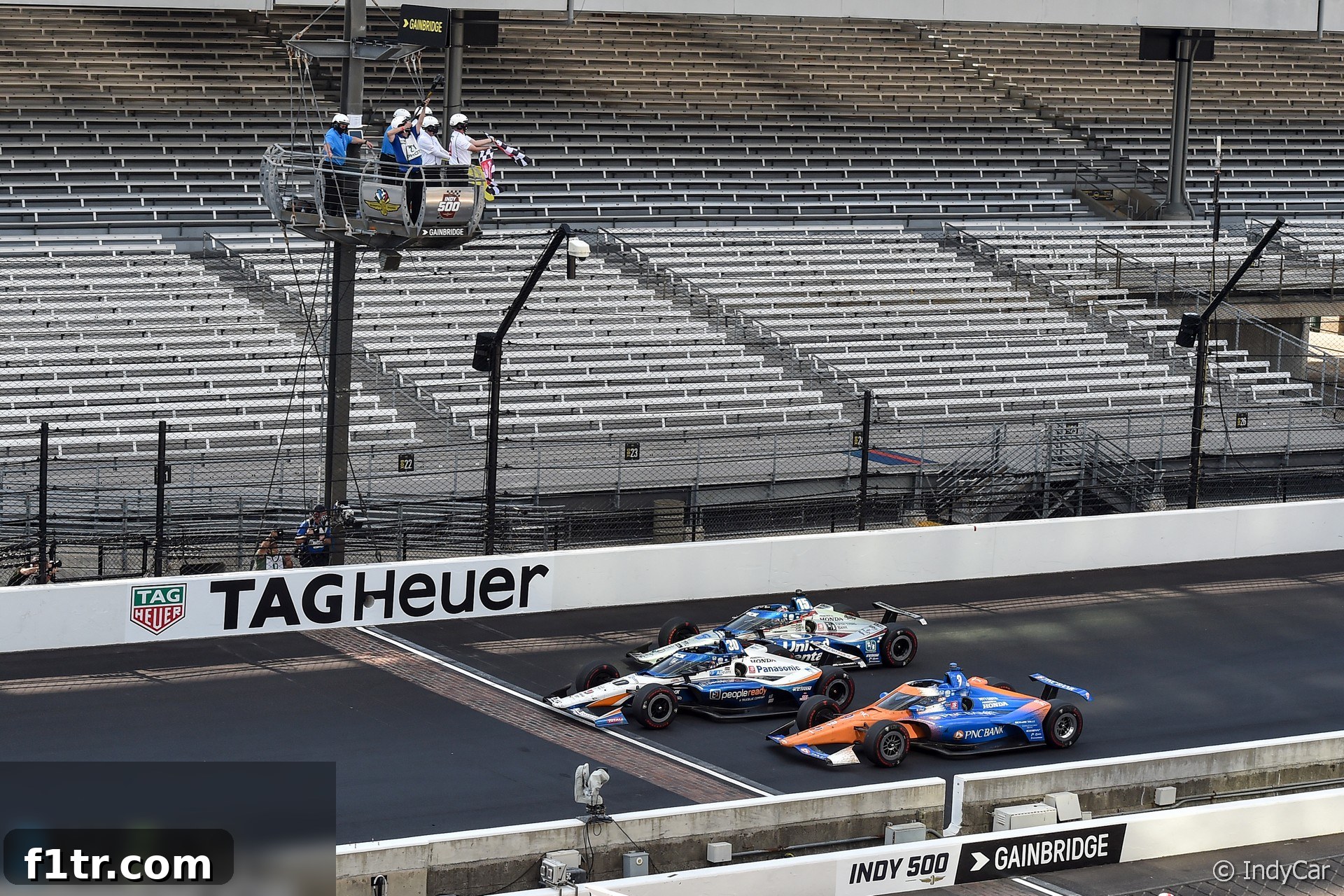
Scott Dixon Questions Indianapolis 500 Caution Finish, Cites Precedent and Fair Play
In the aftermath of the legendary Indianapolis 500, Chip Ganassi Racing’s Scott Dixon, a multiple-time IndyCar champion and a former winner of the prestigious event, voiced his considerable surprise and disagreement with race control’s decision to end the 200-lap race under caution. The contentious conclusion followed a significant crash late in the race, leaving many drivers, particularly Dixon who had led a substantial portion of the event, feeling that an opportunity for a dramatic green-flag finish was missed.
Advert | Become a Supporter & go ad-free
The Race-Altering Incident: Spencer Pigot’s Crash
The seventh and final caution period of the race was triggered by a severe incident involving Rahal Letterman Lanigan Racing driver Spencer Pigot. With a mere five laps remaining in the grueling 200-lap spectacle, Pigot’s car made heavy contact with the barrier at the crucial pit lane entrance. The force of the impact caused substantial damage not only to his vehicle but also to the safety infrastructure, necessitating a lengthy clean-up operation.
Dixon, who had skillfully navigated his way to the front for much of the race, found himself in a fierce battle for supremacy. He had ceded the lead to eventual winner Takuma Sato of Rahal Letterman Lanigan Racing early in their final stint, specifically on lap 172. As the race neared its climax, the strategic calculations and on-track duels were reaching a fever pitch, setting the stage for what many hoped would be an unforgettable sprint to the finish line.
Dixon’s Expectation: A Red Flag for a Green Finish
When Pigot’s high-speed crash occurred on lap 194, Scott Dixon firmly believed that race control would issue a red flag. This procedural halt would have allowed for the necessary clean-up and barrier repairs to be completed under safer conditions, subsequently paving the way for a restart and a climactic green-flag dash to the checkered flag. Such a scenario is often preferred by fans and competitors alike, preserving the integrity of racing and providing maximum excitement for the sport’s biggest event.
“I definitely thought [they would red-flag it] with five to go,” Dixon stated emphatically following the race. “I thought they were going to immediately because [of] the size of the crash and where it was, it wasn’t going to be a quick clean-up.” His assessment highlighted the severity of the incident and the significant time required to address it safely, factors that typically weigh heavily on race control’s decisions regarding race stoppages.
Dixon’s surprise was palpable when the red flag was not deployed. “I was surprised they didn’t,” he continued. “I heard they said normally we don’t do that. History would tell you that’s not true either.” This direct challenge to race control’s stated policy ignited a broader discussion within the IndyCar community about consistency in officiating, especially at an event as critical and historic as the Indianapolis 500.
Historical Precedent and the Debate Over Race Finishes
The contention surrounding the decision to finish under caution is amplified by recent history at the Indianapolis Motor Speedway. Just the previous year, the Indianapolis 500 was indeed red-flagged with 20 laps remaining after a multi-car collision. That specific stoppage allowed for a clean-up and a subsequent restart, ensuring a competitive green-flag finish for one of motorsport’s most coveted prizes. This recent precedent directly contradicted race control’s post-race claim that red flags are not “normally” deployed late in the event.
Furthermore, an examination of past Indianapolis 500 races reveals a mixed bag of finishes. While the four runnings preceding the controversial 2020 event all concluded under green-flag conditions, showcasing thrilling finales, the 2014 race also saw a red flag deployed with nine laps to go after a single-car crash involving Townsend Bell. This strategic pause permitted the race to restart, again allowing drivers to battle for position in the final laps. Conversely, the 2013 race did, in fact, conclude under caution, offering a point of comparison that supports race control’s final decision, albeit one that many feel detracts from the spectacle.
Fairness in Competition: Dixon’s Vision for a Restart
From Scott Dixon’s perspective, a red flag and subsequent restart would have not only honored the tradition of the Indy 500 but also ensured a fairer contest. He elaborated on the potential dynamics of such a scenario: “If they had thrown a red, at the restart the car in second in a scenario like that where you’re not trying to save fuel, going flat out… the leader would have been a bit of a sitting duck unless he did something very weird or strange that caused a bit of a chain reaction or an accordion effect.”
Dixon’s analysis highlights a key aspect of late-race restarts: they often favor the car in second or third place, as they can capitalize on the slipstream and surprise the leader, who is often forced to choose their line first. “If there was a three-lap shoot-out, that would have been pretty fair,” he concluded, underscoring his belief that a short, intense sprint would have provided a just and exciting conclusion to what had been a meticulously strategized race.
The veteran driver also pondered the reasoning behind the differing decisions: “I don’t know how or why or how they do it in the past. The last few times it was maybe more laps to go in the race. I think if they called it pretty quickly like they typically do, you still could have had at least three laps to fight it out.” This reflects a desire for greater transparency and consistency in race management, particularly when the stakes are so incredibly high.
The Role of Fuel Strategy and Sato’s Vulnerability
Had the Indianapolis 500 indeed seen a red-flag period followed by a restart, Dixon suspected that eventual winner Takuma Sato would have faced significant challenges, particularly concerning his fuel management. Dixon believed that Sato, running at the pace required to maintain his lead, would have struggled to make it to the end of the race without running critically low on fuel. This adds another layer of “what if” to the race’s conclusion, suggesting that the caution period inadvertently benefited Sato.
Dixon reflected on his team’s own strategic positioning: “It was definitely a good day. Everything we did, strategy, was on point. We definitely had a pretty fast car. We knew it was always going to get tricky at this point of the day. We thought we made the right call.” The Chip Ganassi Racing team had meticulously planned their fuel windows and pit stops, aiming to be in the optimal position for a green-flag finish.
However, their calculations were based on different race conditions. “When we ran the first couple of laps after the last restart, we couldn’t get the fuel mileage we needed to finish the race. We went to a leaner mixture, just kind of sat there. We didn’t think they were going to make it on fuel,” Dixon explained. This demonstrates the intricate dance of fuel saving and pace, a critical component of oval racing strategy. The caution period neutralized these fuel concerns for Sato, removing a potential hurdle that could have seen Dixon challenge for the win.
A Day of Near Misses and Lingering Questions
Despite the contentious finish, Scott Dixon’s performance throughout the Indianapolis 500 was undeniably stellar. Leading a significant number of laps and executing a near-flawless strategy, he solidified his reputation as one of IndyCar’s all-time greats. However, the second-place finish, while a remarkable achievement, was tinged with the bitterness of what might have been. The inability to challenge for the win in a true racing sprint left a sense of unfinished business for the New Zealander.
The debate surrounding the 2020 Indianapolis 500’s finish underscores the inherent tension between safety protocols and the desire for dramatic, competitive conclusions in motorsport. While safety must always be paramount, the application of rules and precedents often sparks passionate discussions among drivers, teams, and fans, all striving for what they perceive as the fairest and most exciting outcome for “The Greatest Spectacle in Racing.” Scott Dixon’s candid remarks ensure that this particular finish will remain a talking point for years to come, influencing future discussions on how iconic races should conclude.
Advert | Become a RaceFans supporter andgo ad-free
IndyCar News and Features
- IndyCar driver McLaughlin cleared of injury after crashing through barrier at Barber
- Schumacher says his IndyCar feels like ‘an F2 car, just with better tyres’
- IndyCar “way faster than Formula 1” in some corners, says Grosjean
- FIA to award more F1 superlicence points to IndyCar drivers from 2026
- Schumacher to race full-time in IndyCar with RLL in 2026
Browse all IndyCar articles