The 2026 Formula 1 season is poised to be a landmark year, heralding one of the most profound overhauls in the sport’s illustrious history. Beyond the significant changes to technical regulations that promise to redefine the competitive landscape, the on-track spectacle itself is expected to evolve dramatically, with energy management playing an even more critical role in the art of racing. However, amidst these sweeping technical advancements, another monumental shift awaits: the highly anticipated entry of a brand new team into the elite world of Formula 1.
With Cadillac joining the fray, Formula 1 will welcome an 11th team to the paddock for the first time in over a decade. This expansion is not merely an addition but a catalyst for widespread transformations, impacting how the sport operates both on and off the track. From financial structures to race weekend logistics and competitive dynamics, the arrival of an additional team will introduce a series of notable changes. Here, we delve into the most significant ways Formula 1 is set to evolve with an expanded grid.
Existing Teams Poised for Financial Boost
While the ten established Formula 1 teams have largely expressed reluctance to embrace a new competitor into their exclusive ranks, they are collectively set to receive a substantial financial incentive as a sweetener for Cadillac’s entry. This payment addresses one of their primary concerns regarding revenue dilution.
Ever since FIA President Mohammed Ben Sulayem initially signalled his intent to open applications for new Formula 1 teams, the existing ten constructors vociferously argued that their collective prize money and commercial rights revenue would be significantly diluted by being split 11 ways instead of the customary 10. To mitigate this potential financial setback and secure the cooperation of current stakeholders, Formula 1 Management (FOM) introduced a hefty ‘anti-dilution’ fee for any prospective new entrant.
For the privilege of securing a coveted spot on the grid for the 2026 season, Cadillac reportedly agreed to pay an increased entry fee of $450 million (£334 million). This substantial sum is designed to compensate the incumbent teams. Consequently, each of the current ten teams is projected to receive approximately £33 million, making the prospect of increased competition on the grid from the next season considerably more palatable. This fee serves as a vital safeguard, aiming to ensure the financial stability of the existing teams while allowing for the measured expansion of the sport.
Expanded Grid: 22 Cars Ignite Competition
Assuming Cadillac’s ambitious Formula 1 project remains on schedule and proves successful, the 2026 Australian Grand Prix will mark a significant milestone: the first world championship round to feature 22 entries since the 2016 Abu Dhabi Grand Prix. This expansion carries numerous implications for the on-track action and strategic dynamics.
Although a 22-car grid hasn’t been seen for nearly a decade, it was a common sight throughout the late nineties and into the early noughties. In fact, for three seasons between 2010 and 2012, the grid regularly comprised 24 cars. A memorable instance occurred at Valencia in 2011, where all 24 entries were classified finishers, with Narain Karthikeyan holding the unique distinction of being the only driver in F1 history to finish a Grand Prix in 24th place.
The most immediate and apparent consequence of adding two more cars to the grid is the natural intensification of competition for championship points. With more contenders vying for the top ten positions, securing even a single point will become an even greater achievement, particularly for teams further down the order. This could lead to more thrilling and unpredictable races, as teams push harder for every advantage. Furthermore, the increased car count raises the potential for traffic management challenges during practice and qualifying sessions, especially at shorter, more confined circuits such as the Red Bull Ring or the iconic Monaco Grand Prix circuit, where track position is paramount.
Speaking of qualifying, the format will necessarily undergo adjustments to accommodate the larger field. The addition of two cars means that one extra competitor will need to be eliminated from both the first and second phases of qualifying (Q1 and Q2). This shift will redefine the ‘safe’ zone, making 16th place the final secure position in Q1, with drivers in positions 17th through 22nd being knocked out. This subtle but significant change will intensify the pressure on all teams and drivers to perform flawlessly, with even smaller mistakes potentially proving more costly in securing a place in the subsequent qualifying segments.
Logistical Evolution: 11 Garages and Paddock Space
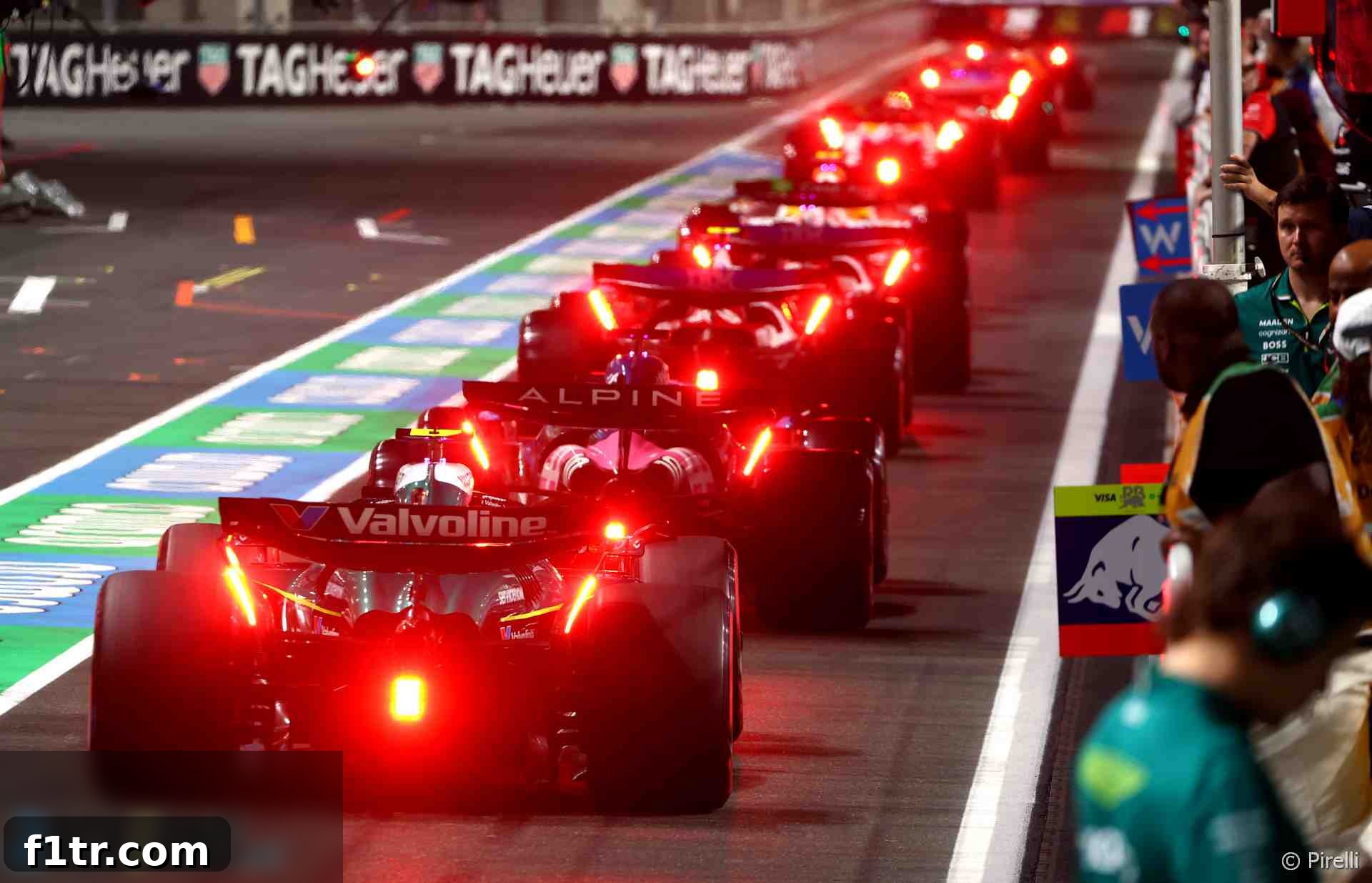
The integration of an additional team into Formula 1’s operational framework means the pit lane will experience increased activity, with an 11th garage becoming active at every circuit. This not only makes the pit lane a busier environment during races – particularly at the start of sessions, during pit stops, or after red flag periods – but it also necessitates the accommodation of more hospitality units within the already constrained paddock areas, posing a significant logistical puzzle for race organizers.
Anyone who has had the privilege of experiencing an F1 paddock during a Grand Prix weekend might instinctively wince at the thought of even more hospitality units vying for the minimal space available, especially at circuits like Zandvoort, Monaco, or the Hungaroring, where space is a particularly precious commodity. However, the current teams are not entirely unfamiliar with the demands of fitting 11 teams into the paddock. Each of the current 10 teams raced alongside Manor in 2016, demonstrating the sport’s capacity for such an arrangement.
Moreover, there’s even more recent experience to draw upon regarding adaptability. At several rounds during the 2023 and 2024 seasons, the established teams co-existed in the paddock alongside the fictional APX GP ‘team,’ which was set up for filming purposes for the official F1 movie. At circuits like Silverstone, APX GP even had its dedicated hospitality suite within the paddock to serve as a base for the film crews. This successful integration strongly suggests that Formula 1’s infrastructure and operational teams are well-equipped to manage the practicalities of an 11th party joining the paddock, albeit with careful planning and coordination.
Redistribution of Prize Money
One of the most sensitive and contentious issues surrounding the expansion of Formula 1 to include an additional team is the mechanism for distributing the coveted prize money among 11 entities instead of 10. This financial aspect is crucial for the sustainability and competitiveness of all teams.
Currently, Formula 1 teams receive a share of approximately half of FOM’s commercial revenue generated throughout a season. This significant fund is distributed through various channels, but primarily in the form of prize money, which is directly linked to a team’s finishing position in the Constructors’ Championship. Naturally, the champion team garners the largest share, while the team ranked tenth receives the smallest proportion. This tiered system rewards performance and incentivizes competition.
During the last period when F1 operated with 11 teams, the scale of distribution was significantly more skewed towards the most successful teams than it is now under the stewardship of Liberty Media. While top-performing teams still earn impressive sums commensurate with their success, Liberty Media has implemented a more equitable distribution model, ensuring that teams finishing towards the bottom of the standings receive a greater proportion of the prize pot than they did a decade ago. This strategic shift has demonstrably contributed to the increased competitiveness and overall health of modern Formula 1, aiming to prevent smaller teams from being perpetually starved of resources.
The inevitable consequence of having more teams to share the prize fund among is that, without intervention, each team would inherently receive a lower individual share than they would have previously. However, this is precisely where the aforementioned anti-dilution fee plays a critical role. The fee is specifically designed to offset, in some measure, this anticipated loss of individual revenue for the existing teams, thereby maintaining a delicate financial balance within the sport’s ecosystem.
Aerodynamic Testing Restrictions (ATR): Leveling the Playing Field
Beyond the cost cap – which Cadillac’s new team must adhere to in the year preceding their official entry – arguably one of the most impactful and consequential innovations introduced to Formula 1 under Liberty Media’s governance has been the Aerodynamic Testing Restrictions (ATR). This system is a cornerstone of the sport’s commitment to competitive balance.
Operating on a concept similar to the draft systems prevalent in most major North American sports leagues, where less successful teams are granted preferential opportunities to improve their squads compared to their more dominant rivals, the ATR sliding scale precisely limits the volume of wind tunnel and computational fluid dynamics (CFD) testing that each team can undertake. The fundamental idea behind ATR is to disrupt the ‘positive feedback loop’ of success – preventing successful teams from merely accumulating more resources and R&D capabilities, which would then make future success even easier. By restricting the amount of research and development work a leading team can perform, ATR aims to provide greater opportunities for their rivals to catch up and challenge at the front of the grid.
While it might seem logical to assume that the current scaling of ATR would be altered with Cadillac’s arrival, this is explicitly not the case. Since the ATR framework was first implemented for the 2022 season, the team at the very top of the Constructors’ standings receives a significantly reduced allocation – just 70% of the testing time enjoyed by the team in seventh place, with seventh place acting as the base level (100% allocation). When Cadillac makes it 11 teams, their allocation will be precisely defined. Both the tenth and eleventh-placed teams will receive the maximum allowance, which is 115% of the base ATR limit. This means Cadillac, as a new entrant and likely to finish at the bottom in its inaugural year, will be granted a substantial advantage in testing time compared to established front-running teams. This generous allocation is crucial for enabling the new team to accelerate its development, close the performance gap, and become a competitive force within a shorter timeframe, aligning with F1’s broader objective of fostering closer and more exciting racing throughout the field.
The 2026 Formula 1 season promises to be a period of unprecedented change and excitement. From the financial reshaping of the paddock to the intensified competition on track, and from logistical ingenuity to the strategic use of testing allocations, Cadillac’s arrival is set to be a significant chapter in F1’s ongoing evolution. These multifaceted changes underscore Formula 1’s dynamic nature, constantly seeking to balance sporting integrity with commercial viability, and ensuring a thrilling future for fans and participants alike.