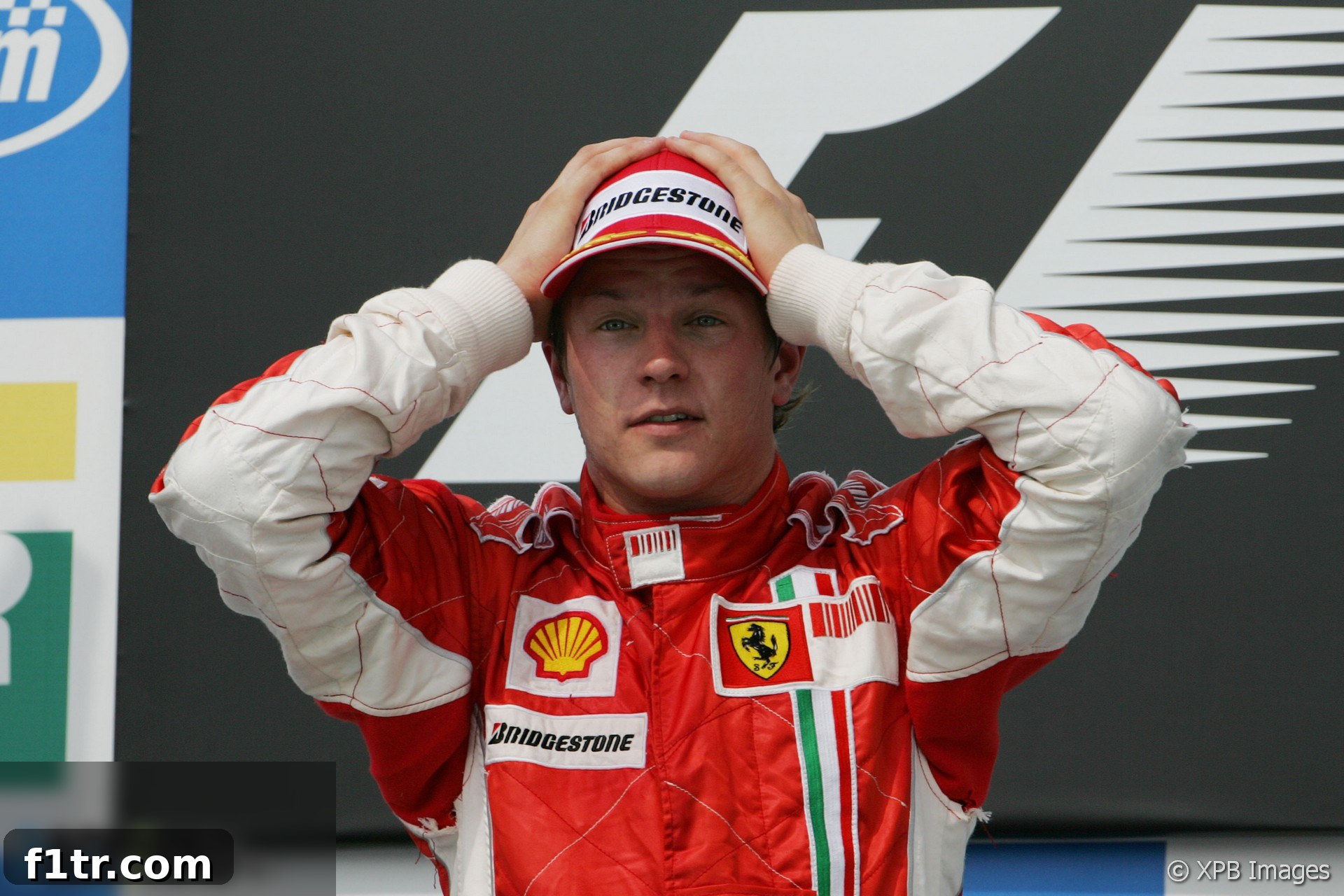
In a breathtaking climax to the 2007 Formula 1 season, Kimi Räikkönen seized the Drivers’ Championship title, capitalizing on a dramatic turn of events that saw front-runner Lewis Hamilton encounter significant technical difficulties. The Brazilian Grand Prix at Interlagos delivered an unforgettable spectacle of high-stakes racing, ultimately crowning the “Iceman” as champion by the slimmest of margins – a single point.
The stage was set for an epic showdown. Going into the final race, three drivers stood a chance at the coveted title: McLaren’s Lewis Hamilton led the standings, followed by his teammate Fernando Alonso, with Ferrari’s Kimi Räikkönen trailing in third. The tension was palpable, and the pressure immense, particularly on rookie sensation Hamilton, who had led the championship for much of the season. Interlagos, a circuit known for its challenging layout and unpredictable weather, was primed to deliver a decider for the ages.
Pre-Race Pressure and Tyre Talk
Before the engines roared to life, two topics dominated discussions in the paddock: the intense championship battle and the critical role of tyres. With track temperatures soaring to an scorching 63°C as the race commenced, coupled with a newly resurfaced track that promised faster lap times but also potentially higher degradation, tyre management was predicted to be paramount. The softer compound, in particular, was expected to suffer significantly under these extreme conditions, adding another layer of strategic complexity for all teams.
Lewis Hamilton, despite his points advantage, faced the daunting task of securing a podium finish, while Räikkönen and Alonso knew they needed to win and hope for their rivals to falter. The psychological burden on Hamilton, a rookie on the brink of F1 history, was immense, contrasting with the seasoned experience of Räikkönen and the two-time world champion Alonso.
A Catastrophic Start for Hamilton
The lights went out, and the race began with immediate drama that sent shockwaves through the McLaren garage. Kimi Räikkönen, starting from third, made an explosive start, rocketing past Hamilton on the run down to the first corner. The Finnish driver momentarily twitched wide, a subtle move that disrupted Hamilton’s rhythm and allowed Fernando Alonso to seize the initiative. Alonso, capitalising on his teammate’s compromised position, bravely dived into third place at Turn 3, demoting Hamilton further.
Hamilton’s woes were far from over. Attempting to regain ground, he misjudged Alonso’s braking point at Turn 4, running disastrously wide. This critical error sent him tumbling down the order, falling to eighth place behind the likes of Robert Kubica, Nick Heidfeld, and Jarno Trulli. What had started as a dream season for Hamilton suddenly felt like it was unravelling in the most painful way possible.
Technical Trouble Strikes and a Spirited Fightback
Just as Hamilton began his initial attempts to recover, quickly dispatching Trulli on lap two and then executing a superb overtake on Heidfeld around the outside of Turn 1 on lap seven, disaster struck once more. His McLaren suddenly slowed, appearing to lose drive, sending a wave of panic through his team and elation through the Ferrari and Alonso camps. For a heart-stopping moment, it seemed his championship challenge was over. Miraculously, the car briefly burst back into life, albeit leaving him languishing in 18th position, a staggering distance from the points-paying positions and his championship dream.
This turn of events placed Räikkönen firmly in the championship lead, with his teammate Felipe Massa leading the race. Räikkönen now needed only to maintain his position to clinch the title, a scenario that seemed improbable just moments earlier. Hamilton, meanwhile, needed a miracle – ideally, a Safety Car deployment to bunch up the field and give him a fighting chance. However, fate seemed to conspire against him. Despite a collision between Giancarlo Fisichella and Sakon Yamamoto, marshals efficiently cleared the debris under waved yellow flags, negating the need for a Safety Car and leaving Hamilton to fight his way back on pure pace.
Undeterred, Hamilton embarked on a remarkable recovery drive. He quickly caught and dispatched a four-car gaggle comprising Takuma Sato, Kazuki Nakajima, Anthony Davidson, and Ralf Schumacher. By lap 17, his relentless charge saw him climb to an impressive 11th position, proving his speed and determination despite the earlier setbacks.
Strategic Pit Stops and Mid-Race Dynamics
As the race progressed, the leaders maintained their positions, with Massa, Räikkönen, and Alonso holding the top three spots. Robert Kubica, however, was putting in a strong performance, overtaking Mark Webber for fourth. The first round of pit stops commenced with Massa pitting on lap 20, followed by Alonso a lap later. Räikkönen made his stop shortly thereafter, just before Hamilton came in on lap 21 for his first scheduled stop.
McLaren, desperate to salvage Hamilton’s race, opted for a bold gamble during his pit stop, switching him to the super-soft compound tyres. This aggressive strategy aimed to provide him with maximum grip and momentum to continue his charge through the field. The gamble paid off initially, as Hamilton demonstrated electrifying pace, notably diving past Rubens Barrichello from an enormous distance into Turn 1 with a move that showcased his raw talent and unwavering resolve.
Further up the field, Fernando Alonso began to struggle for pace, slowly dropping away from the Ferraris. This allowed Robert Kubica, who was on a different three-stop strategy, to close in rapidly. The Pole skillfully lined up Alonso at Turn 1 and executed a clean overtake on lap 32, snatching third place. However, Kubica’s three-stop strategy meant he was soon back in the pits six laps later, temporarily relinquishing the position.
The Final Stints and Hamilton’s Fading Hopes
Hamilton’s second pit stop came early, on lap 37, from ninth place. He reverted to the harder compound tyres but crucially, did not take on enough fuel to complete the race, signifying McLaren’s continued aggressive strategy to chase points. Simultaneously, Heikki Kovalainen crashed heavily after an earlier contact with Ralf Schumacher on the first lap. Yet again, the marshals swiftly cleared the incident without a Safety Car, further dimming Hamilton’s chances.
As the leaders approached their final pit stops, the toll on their tyres became visibly evident. Ferrari executed a masterstroke, bringing Räikkönen in later than Massa, a strategic move designed to elevate Räikkönen into the lead and secure his championship. Massa, demonstrating impeccable team play, did not resist, ensuring his teammate was in prime position.
Alonso, in particular, suffered significantly before his final stop, with his lap times plummeting by up to two seconds compared to the front-runners. His title challenge was now effectively over, his focus shifting to securing a podium finish.
Hamilton’s third and final pit stop left him in ninth position, staring at a daunting gap of almost 30 seconds to the crucial fifth place he desperately needed to salvage his championship. He launched a valiant final attack, passing David Coulthard on his out-lap and setting the fastest lap of the race so far with a scorching 1:12.506. However, this blistering pace was unsustainable over multiple laps. As his tyres inevitably degraded, the prospect of reaching fifth place slowly but surely slipped out of his grasp.
Räikkönen’s Triumph and Other Notable Performances
While Hamilton fought valiantly but ultimately fruitlessly, Räikkönen remained utterly serene out front. He managed his pace perfectly, even grabbing the fastest lap on the 66th tour, a testament to his controlled aggression. Unconcerned by Hamilton’s distant struggles, the “Iceman” coolly reeled off the final laps, driving unchallenged to a momentous victory.
When Kimi Räikkönen crossed the finish line, Lewis Hamilton was still two cars behind him on track, having been lapped and officially finishing in seventh place. At that precise moment, Kimi Räikkönen became the 2007 Formula 1 World Champion, completing a stunning turnaround from being 26 points behind at one stage in the season to clinching the title by a single point.
Felipe Massa, in a display of ultimate team loyalty, finished a commendable second, ensuring Ferrari’s maximum points haul. Fernando Alonso completed the podium in third. The Spaniard finished level on points with his teammate Hamilton but ended the year third overall on count-back.
Beyond the championship drama, other drivers delivered impressive performances. Nico Rosberg, driving for Williams, put in an exceptional drive to take fourth, brilliantly battling past both BMWs of Robert Kubica and Nick Heidfeld. Rosberg dived past Heidfeld at Turn 1 on lap 60, though both ran wide, briefly allowing Kubica past. Rosberg then fought back, eventually passing Kubica for fourth with just two laps remaining. This strong result helped Williams cement their fourth place in the Constructors’ Championship.
Kubica finished fifth, with Heidfeld sixth. A disconsolate Hamilton crossed the line in seventh, less than ten seconds behind Kubica, a bitter end to what had promised to be a triumphant season. Jarno Trulli, who had pitted late in the race, surrendered seventh to Hamilton and fell to eighth.
David Coulthard finished out of the points in ninth, as did his Red Bull teammate Mark Webber, who retired on lap 14. Kazuki Nakajima, finishing tenth, was fortunate to complete the race after a harrowing incident during a pit stop where he hit two of his mechanics. Both were injured but thankfully not seriously and were taken to the medical center for checks.
Rubens Barrichello’s Honda suffered a spectacular engine failure on the main straight, adding to a dismal year for the team, as neither Honda car finished. Other finishers included Ralf Schumacher, Takuma Sato, Vitantonio Liuzzi, and Anthony Davidson, who survived an aggressive move by Adrian Sutil that resulted in a drive-through penalty for Sutil before his eventual retirement.
A Season to Remember
Hamilton’s recovery drive, while ultimately insufficient, was spellbinding and drew comparisons to Michael Schumacher’s legendary comeback performances. However, the man of the moment was undeniably Kimi Räikkönen. With 110 points, he secured the title by a solitary point, overcoming a significant deficit earlier in the season to become a Formula 1 World Champion. The 2007 Brazilian Grand Prix will forever be remembered as one of the most thrilling and unpredictable season finales in Formula 1 history, showcasing raw talent, strategic brilliance, and heartbreaking misfortune. It was a race that left an indelible mark on the sport, proving that in Formula 1, the championship is never truly decided until the very last lap.