In a season often defined by the dominant silver arrows, the Hungarian Grand Prix emerged as a vibrant, welcome deviation from the predictable script. For avid Formula 1 enthusiasts and casual viewers alike, the race served up a potent tonic, a refreshing blend of unexpected twists, high-octane drama, and controversial moments that captivated from start to finish. This wasn’t merely another contest between the formidable Lewis Hamilton and Nico Rosberg; it was a pulsating spectacle that ultimately saw their efforts overshadowed by a star performance.
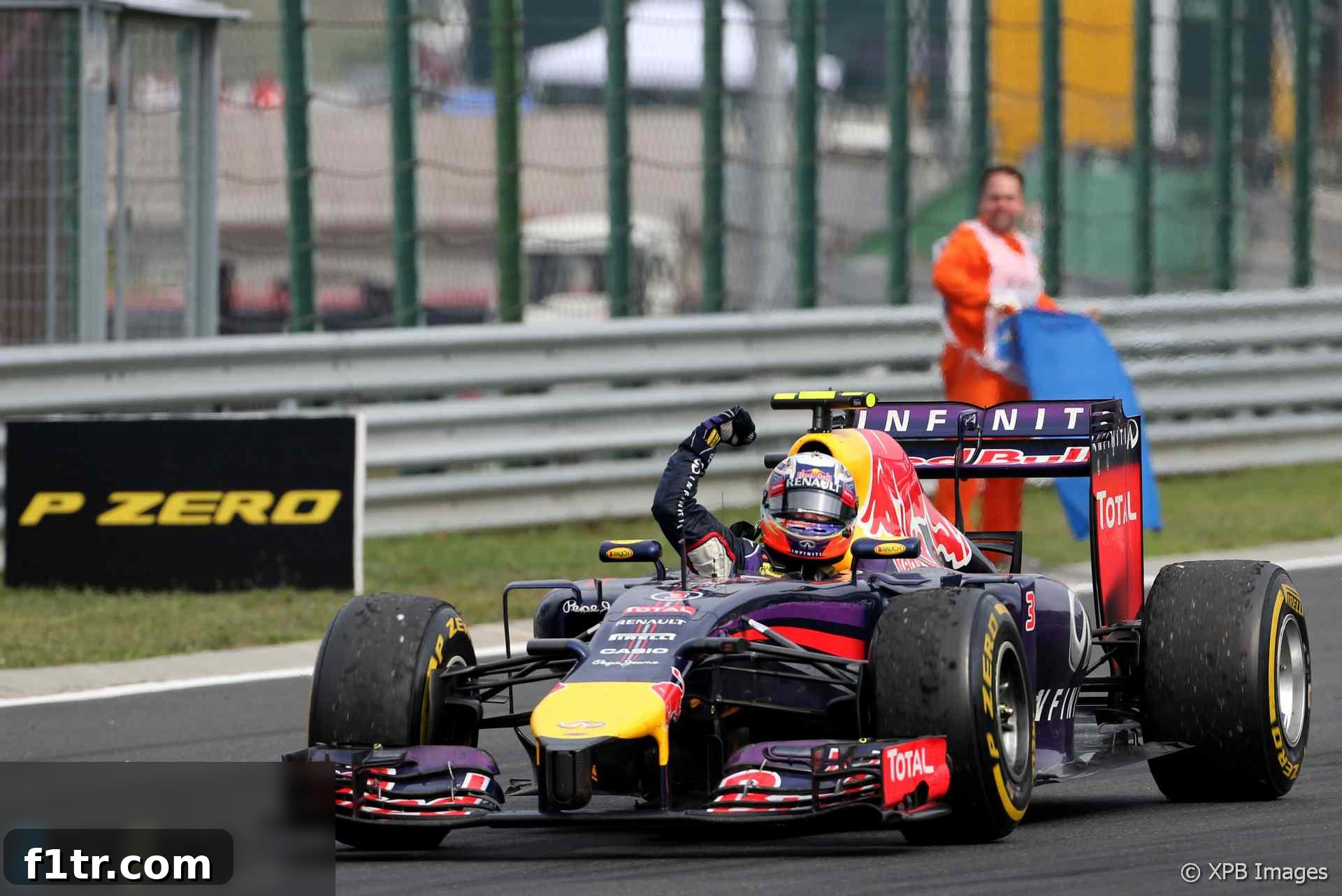
When the chequered flag finally waved over the Hungaroring, it was Daniel Ricciardo who stood atop the podium, claiming his second victory of the season in truly spectacular fashion. The Red Bull driver masterfully exploited the chaotic circumstances of a rain-affected race, showcasing his innate ability to seize opportunities and deliver under immense pressure. His triumph was a testament to bold strategy, exceptional race craft, and a touch of fortune, painting a vibrant portrait of what makes Formula 1 so thrillingly unpredictable.
Ricciardo’s Challenging Start Sets the Stage for Drama
Daniel Ricciardo’s journey to victory began with anything but a flourish. Following a pre-race downpour, the entire field opted for intermediate tyres, setting the stage for a tricky start. Ricciardo found himself in the unenviable position of starting off-line, a disadvantage that proved costly. Just like Sebastian Vettel ahead of him and Felipe Massa behind, Ricciardo immediately lost ground to rivals who had the benefit of a cleaner, grippier track surface from their starting positions. As Nico Rosberg navigated the field around at the end of the opening lap, he was closely pursued by Valtteri Bottas and Sebastian Vettel, with Fernando Alonso and Jenson Button, both of whom had passed Ricciardo, hot on their heels.
However, what initially appeared to be a setback soon transformed into a stroke of luck for Ricciardo. Within a mere handful of laps, as the track began to dry and neared the critical crossover point for slick tyres, the race was dramatically interrupted. The pivotal moment arrived when Marcus Ericsson lost control of his Sauber, twitching left on the exit kerb at Turn Four and slamming head-on into the barrier with a bone-jarring force estimated at 20G. The immediate deployment of the Safety Car reshuffled the pack and threw the leading quartet’s strategies into disarray. All four leaders had just passed the pit lane entry when the call came, forcing them to complete another full lap at reduced speed before they could dive in for fresh tyres. This delay would prove incredibly detrimental, wiping out any hard-earned advantage.
Among the first to react was Jenson Button, followed closely by Ricciardo. However, the McLaren garage made a critical miscalculation. While all teams meticulously scrutinised their weather radars for any sign of further showers, McLaren alone concluded that fresh rain was imminent. This led to a disastrous decision: they sent Button out on a fresh set of intermediate tyres. The pit stop itself was marred by a slight hesitation at the left-rear, a delay further amplified by the need to hold Button as other cars trundled past. He was eventually released precariously close to Jean-Eric Vergne, fortunate to escape a penalty for an unsafe release, but his race had already taken a significant turn for the worse. The front-runners, having lost valuable time behind the Safety Car, suffered immensely. Rosberg’s impressive ten-second lead vanished, relegating him to fifth, while Bottas plummeted from second to eleventh after a notably slow stop, highlighting the razor-thin margins and high stakes of pit stop strategy.
Ricciardo’s Audacious Gamble Pays Off Amidst Chaos
“I knew that the first Safety Car played into our hands,” Ricciardo later reflected, acknowledging the timely intervention. “We inherited the lead there.” Indeed, he did. But the race was far from settled. The restart, momentarily delayed after Romain Grosjean crashed at Turn Four, saw Ricciardo briefly concede the lead to Button. This, however, was short-lived, as McLaren’s flawed weather forecast quickly became apparent. The track remained stubbornly dry, forcing Button back into the pits for yet another set of slick tyres, a costly blunder that effectively ended his contention.
Ricciardo consequently regained the lead on lap 15, holding firm for the next eight laps. The calm was shattered once more when Sergio Perez, pushing the limits on the damp exit kerb of the final corner, clipped the wall and severely damaged his Force India. Though Perez emerged unharmed, the incident triggered the deployment of a second Safety Car. The nearby Red Bull crew, momentarily startled, swiftly recognised the implications. This was a golden opportunity. Ricciardo was immediately called into the pits, a perfectly timed stop under the Safety Car conditions that would mitigate any time loss.
The decision to fit a set of soft tyres at this juncture was a bold gamble, a high-stakes play in a race already full of strategic intrigue. Theoretically, soft tyres offered the fastest route to the chequered flag, but this strategy hinged entirely on Ricciardo’s ability to execute a series of crucial overtakes – a task not naturally suited to the Red Bull RB10, which often lacked top-end speed. “I wasn’t really sure what was going to happen,” Ricciardo admitted post-race, reflecting on the uncertainty. Yet, his resolve was unwavering. Over the radio, he exuded confidence, telling his team, “we can win this.” After his stop, Ricciardo re-joined the race in sixth, staring down several drivers who had made impressive gains during the initial, tentative laps on slick tyres while the track still carried a lingering dampness.
Hamilton’s Remarkable Ascent from the Pit Lane
While Ricciardo navigated his own strategic tightrope, Lewis Hamilton was orchestrating one of the most remarkable recovery drives in recent memory. Having started from the pit lane due to a Saturday qualifying fire and further hampered by a spin at Turn Two on the opening lap, Hamilton’s prospects seemed bleak. Yet, he ascended through the field with astonishing pace and precision, a testament to his sheer talent and the car’s underlying speed. He made progress with seemingly effortless ease, passing rivals at will. By the time the first Safety Car appeared, he had just overtaken Kimi Raikkonen for 13th place. Crucially, the Safety Car erased his considerable time deficit to the leaders – a significant stroke of fortune given the notorious difficulty of overtaking at the Hungaroring in dry conditions.
Upon the restart, Hamilton’s charge continued unabated, as he impressively dispatched four cars in a single lap. Ahead of him, Fernando Alonso, one of the ‘unlucky quartet’ who had lost out during the first Safety Car period, now led the race. Alonso had capitalised on the restart, bravely pulling alongside Vettel and then taking both Jean-Eric Vergne and Rosberg. Vergne, in second, had himself capitalised on Rosberg’s brief delay behind Kevin Magnussen, further demoting the Mercedes driver. Next came Vettel, then Hamilton, whose meteoric rise placed him firmly in contention.
On lap 27, the race restarted for the second and final time, unleashing another flurry of strategic decisions. Alonso skillfully pulled away from Vergne. Rosberg, frustrated in his attempts to pass the Toro Rosso on track, opted for an early pit stop on lap 32. Mercedes believed this was too soon to cover the remaining 38 laps on a single set of tyres, committing him to a two-stop strategy with softs. Hamilton, meanwhile, produced an inspired overtaking move on Vergne at Turn Four on lap 34, a display of audacious skill. Crucially, he then extended his stint for a considerable period, gambling on a single set of medium tyres to see him through to the end of the race. When he eventually headed to the pits on lap 38, it was astonishingly from the lead position – a truly remarkable turnaround from his enforced pit lane start.
Hamilton’s pit stop momentarily promoted Ricciardo back into the lead, but the Australian knew he still had one more stop to make. “We stayed out pretty long that stint and we were leading a fair chunk of the mid-race,” Ricciardo explained, “but then I knew we weren’t going to get to the end on that set of tyres.” His final pit stop on lap 54 dropped him back to fourth, behind race leader Alonso and the two Mercedes cars. Hamilton, having gained crucial time by expertly overtaking Vergne, had positioned himself ahead of Rosberg in the pecking order.
This hard-won track position was something Hamilton was not about to surrender easily. Despite team radio messages asking him to move aside for Rosberg, who was on a different, more aggressive strategy, Hamilton firmly held his ground. He reasoned that yielding would give Rosberg a clear run and potentially allow him to pull away permanently later in the race, a prediction that, as events unfolded, proved entirely correct. While a masterful racing decision, its implications for intra-team harmony within Mercedes would undoubtedly be a matter for discussion. Rosberg, consequently, made his final pit stop two laps after Ricciardo. The Red Bull driver, meanwhile, was valiantly closing in on Hamilton, even as he grappled with intermittent power unit problems. “Basically, we were down on power and had to get a bit crazy on the switches,” Ricciardo revealed, “so I thought the race could have potentially ended early but we got through that.” His resilience in the face of technical adversity only added to the drama of his charge.
A Thrilling Three-Way Fight to the Flag
With just ten laps remaining, the Hungarian Grand Prix culminated in a breathtaking crescendo: a mere second separated the top three drivers. Race leader Fernando Alonso clung desperately to first place on very worn soft tyres, while Lewis Hamilton held second on medium tyres that were almost equally fatigued. Breathing down their necks was Daniel Ricciardo, whose much fresher soft tyres gave him a distinct advantage. Meanwhile, Nico Rosberg, on even newer rubber, was slicing through the field with remarkable pace, having already shot past Kimi Raikkonen and Felipe Massa, and was now hurtling towards the leading trio at an incredible two seconds per lap.
The tension was palpable. As Hamilton tried to utilise DRS to attack the struggling Alonso, Ricciardo found himself lacking the outright speed advantage to pass the Mercedes on the straights. His best opportunity seemed to lie in the complex Turns Two and Three. On lap 65, he made his first serious attempt, trying to hang around the outside of Hamilton at Turn Two, but ran a touch too wide to make the move stick. Two laps later, however, he executed it to perfection. The front-left tyre smoked under heavy braking as he pulled alongside Hamilton, and as they reached the exit of the corner, Ricciardo had gained sufficient ground to claim the inside line for Turn Three, completing a decisive overtake.
His next target was Alonso, whose Ferrari was visibly struggling on its thirty-lap-old soft tyres. With no DRS assistance, Alonso was effectively defenceless on the main straight. Ricciardo needed only one opportunity, and he seized it decisively, diving down the inside at Turn One to claim the lead and set himself on course for his second Grand Prix victory. As Alonso continued to struggle, now more desperately than ever, Hamilton tried in vain to find a way past the Ferrari. But as the final lap commenced, his attention was entirely diverted to his rear-view mirrors, where the relentless Nico Rosberg had now appeared, a menacing presence.
Rosberg, following Ricciardo’s earlier successful manoeuvre, attempted the same route around Hamilton at Turn Two on the very last lap. However, his determined teammate aggressively barred the way, leaving Rosberg with no room. The Hungaroring’s inherent dearth of passing places did the rest, sealing Hamilton’s podium position. Behind the leading quartet, Felipe Massa collected a solid fifth place, while Kimi Raikkonen secured his highest points finish of the year in sixth. Sebastian Vettel, after a spectacular spin at the final turn, managed to keep his car out of the barrier, unlike Perez earlier, and slipped to seventh. Valtteri Bottas, Jean-Eric Vergne, and Jenson Button completed the points scorers, rounding out a truly unforgettable race. Notably, for the first time that year, Nico Hulkenberg was not among the points, having collided with Sergio Perez at the final corner earlier in the race.
“Everything Felt a Bit More Real”: Ricciardo’s Triumph
Each of the three drivers who graced the podium had compelling reasons to feel immense pride in their day’s work. Lewis Hamilton had staged an incredible recovery from a disastrous Saturday, transforming a pit lane start into an unlikely podium finish. Fernando Alonso had pushed his Ferrari beyond its perceived limits, coming tantalisingly close to victory in a car that wasn’t considered a genuine contender. But, as seems to be his signature trait, it was Daniel Ricciardo who sported the broadest, most infectious smile.
Much like his maiden victory in Canada, Ricciardo’s Hungarian triumph required a certain degree of luck to get his hands on the winner’s trophy. Yet, in a season overwhelmingly dominated by Mercedes, such fortune is often a prerequisite for any other driver aspiring to victory. Once again, Ricciardo proved to be the best-placed driver to capitalise on the troubles of the front-running teams. This achievement is all the more remarkable considering he was sharing a garage with a four-time world champion in Sebastian Vettel, consistently outperforming his highly decorated teammate.
“It honestly does compare to Canada,” he affirmed when questioned about his second career win. “Obviously, the first victory is special, but it definitely leaves you wanting more.” Ricciardo elaborated on the distinct sensation of this second triumph. “I was just as hungry for this second one, and it feels just as good – I won’t say better, but you realise it a bit more, so it feels like you can enjoy it a bit more. And when I crossed the line, everything felt a bit more real, so I guess I took in a bit more of this one today.” As the summer break loomed, the spotlight would inevitably return to the intense championship struggle. But for that day, the sport had reveled in yet another smashing race, and Daniel Ricciardo had served up a powerful reminder of his exceptional driving class, solidifying his reputation as one of Formula 1’s most exciting talents.
2014 Hungarian Grand Prix
- Alonso wins close Hungary Driver of the Weekend vote
- Hungarian Grand Prix gets its highest-ever rating
- 2014 Hungarian Grand Prix team radio transcript
- 2014 Hungarian Grand Prix fans’ video gallery
- 2014 Hungarian GP Predictions Championship results
Browse all 2014 Hungarian Grand Prix articles
2014 F1 race reviews
- 2014 Abu Dhabi Grand Prix review
- 2014 Brazilian Grand Prix review
- 2014 United States Grand Prix review
- 2014 Mexican Grand Prix review
- 2014 Russian Grand Prix review
Read all F1 race reviews