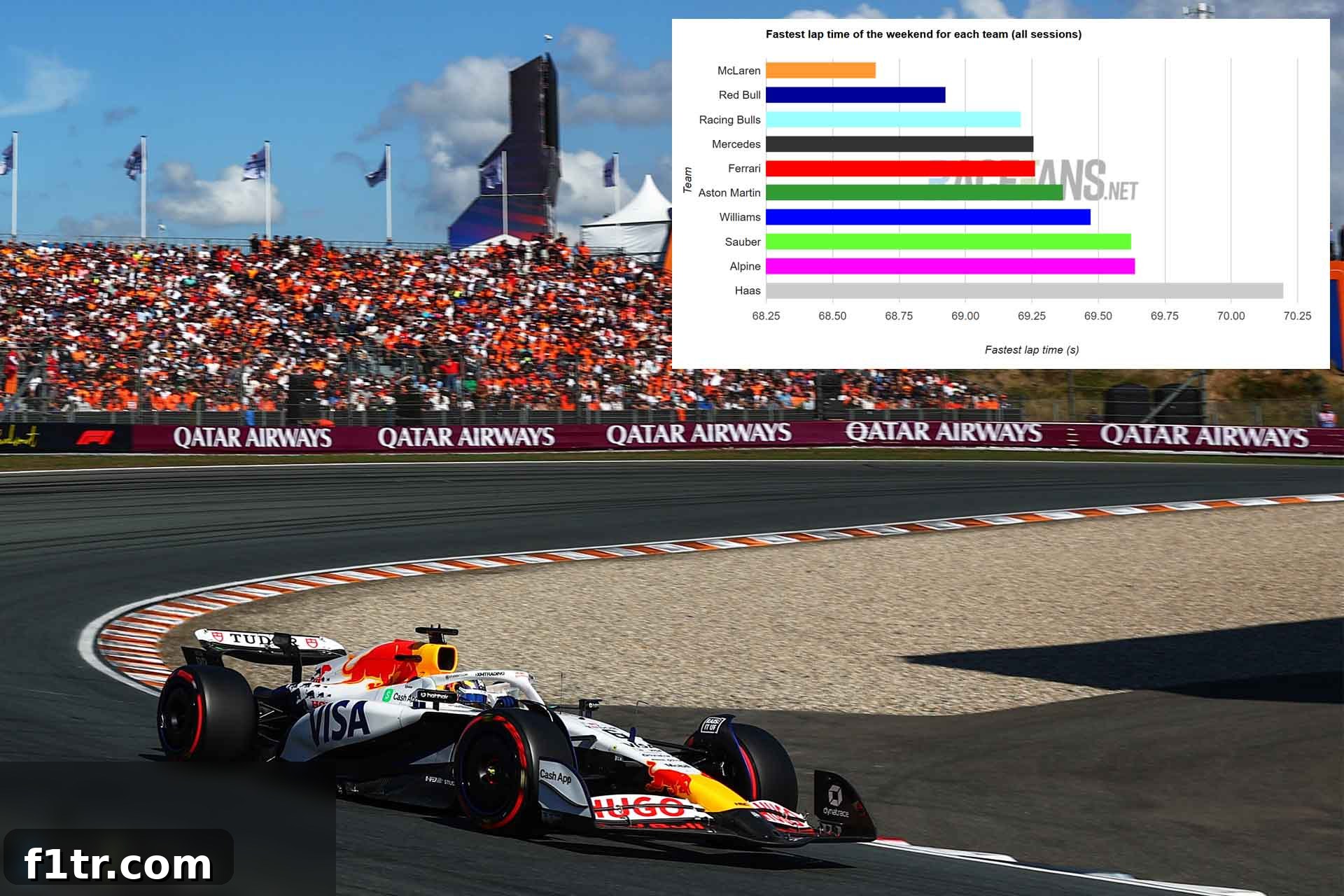
In a stunning display of talent at the Zandvoort circuit, Isack Hadjar’s sensational qualifying lap for the Dutch Grand Prix propelled the Racing Bulls team to an unexpected third-fastest position on the grid. This remarkable performance marks a significant milestone for the team, as it represents their strongest dry-weather showing in nearly two years, igniting excitement among fans and observers alike.
Racing Bulls’ Resurgence: A Zandvoort Masterclass
The qualifying session at Zandvoort was a testament to the ever-unpredictable nature of Formula 1. While McLaren comfortably established themselves as the quickest team, with Oscar Piastri ultimately clinching pole position, and Red Bull demonstrated a strong rebound from their previous struggles at the Hungaroring to secure the second-fastest time, it was Racing Bulls that truly stole the headlines. In an unexpected turn of events, they masterfully propelled themselves ahead of established powerhouses like Mercedes and Ferrari, showcasing a potent mix of car performance and driver skill.
Isack Hadjar, a rising star in the motorsport world, delivered a flawless performance that saw him claim an impressive fourth spot on the grid, placing him directly alongside reigning champion Max Verstappen. This outstanding achievement has drawn clear parallels to Daniel Ricciardo’s memorable qualifying for the same team (then AlphaTauri) at the Mexican Grand Prix in 2023. On that occasion, Ricciardo also secured fourth on the grid next to Verstappen, with a rival team (Ferrari) locking out the front row. Such comparisons underscore the rarity and significance of Hadjar’s accomplishment, as it highlights a genuine display of raw pace and potential from both driver and machinery.
The Mexican Grand Prix in 2023 was, in fact, the last instance where Racing Bulls genuinely cracked the top three in terms of pure performance in dry conditions. While they have achieved higher grid positions since then, such as Yuki Tsunoda’s third-place start in a rain-affected qualifying session at Interlagos last year, Hadjar’s Zandvoort feat stands out for its execution on a bone-dry track, emphasizing the team’s underlying pace.
One of the most compelling narratives surrounding Racing Bulls’ Zandvoort performance is their remarkable year-on-year improvement in lap times. The team recorded the second-largest lap time gain of any team compared to the previous season, a clear indicator of their relentless development efforts. While Sauber, another team at the lower end of the grid, managed a slightly larger improvement, their 2024 qualifying efforts still saw them start at the back of the grid. In stark contrast, both Racing Bulls drivers managed to reach Q3, a testament to their competitive package and the tangible progress made since the last season. This substantial leap in performance suggests that the team’s strategic development and targeted upgrades are genuinely paying off, positioning them as a dark horse capable of upsetting the established order on race weekends.
The Art of the Lap: Sector by Sector Analysis
Qualifying in Formula 1 is often decided by mere fractions of a second, making a detailed analysis of sector times crucial for understanding where advantages are gained and lost. The Zandvoort circuit, with its unique blend of banked corners, high-speed sections, and technical turns, demands precision and absolute commitment from drivers. Every thousandth of a second counts, and the sector data provides a granular view into each driver’s performance throughout their flying laps.
McLaren’s Intra-Team Battle at the Edge
The battle for pole position at Zandvoort was an intense intra-team affair at McLaren, providing a thrilling spectacle for fans. Oscar Piastri ultimately edged out his teammate Lando Norris by a minuscule 12 thousandths of a second. This incredibly tight margin underscores the fierce competition within the Woking-based squad, where both drivers are consistently pushing the limits. The sector times reveal just how close they were; had each driver produced a hypothetical “perfect lap” by combining their best individual sectors, the gap between them would have been even smaller, approximately half of the eventual qualifying difference. This internal rivalry, while challenging, is undoubtedly pushing McLaren to new heights, extracting every ounce of performance from their machinery and drivers alike.
Hadjar’s Strategic Brilliance in Q3
Isack Hadjar’s impressive fourth-place grid start was not merely a stroke of luck but a meticulously executed performance. A key factor in his success was his strategic brilliance during the crucial Q3 session. He was the only driver among the top contenders who managed to improve his time in all three sectors on his final, decisive run. This exceptional ability to find time across the entire lap in the high-pressure environment of Q3 speaks volumes about his composure, car control, and understanding of the Zandvoort circuit. It indicates that Hadjar either found an optimal rhythm, made critical adjustments, or simply unlocked additional performance from his tyres when it mattered most. This consistent improvement across all sectors allowed him to leapfrog several highly experienced drivers and secure a truly commendable starting position for Racing Bulls.
| P. | # | Driver | S1 | S2 | S3 | Ultimate lap (deficit) |
|---|---|---|---|---|---|---|
| 1 | 81 | Oscar Piastri | 23.358 (1) | 24.431 (3) | 20.819 (1) | 1’08.608 (+0.054) |
| 2 | 4 | Lando Norris | 23.386 (2) | 24.383 (2) | 20.845 (2) | 1’08.614 (+0.060) |
| 3 | 1 | Max Verstappen | 23.599 (3) | 24.365 (1) | 20.912 (3) | 1’08.876 (+0.049) |
| 4 | 63 | George Russell | 23.642 (4) | 24.542 (8) | 21.002 (8) | 1’09.186 (+0.069) |
| 5 | 6 | Isack Hadjar | 23.691 (7) | 24.565 (9) | 20.952 (6) | 1’09.208 |
| 6 | 16 | Charles Leclerc | 23.664 (5) | 24.611 (11) | 20.941 (5) | 1’09.216 (+0.088) |
| 7 | 44 | Lewis Hamilton | 23.735 (10) | 24.493 (4) | 21.017 (9) | 1’09.245 (+0.016) |
| 8 | 14 | Fernando Alonso | 23.787 (12) | 24.514 (6) | 21.029 (10) | 1’09.330 (+0.036) |
| 9 | 30 | Liam Lawson | 23.740 (11) | 24.508 (5) | 21.089 (14) | 1’09.337 (+0.046) |
| 10 | 55 | Carlos Sainz Jnr | 23.693 (8) | 24.733 (12) | 21.040 (13) | 1’09.466 (+0.006) |
| 11 | 12 | Andrea Kimi Antonelli | 23.860 (14) | 24.599 (10) | 21.034 (11) | 1’09.493 |
| 12 | 5 | Gabriel Bortoleto | 23.811 (13) | 24.804 (15) | 20.918 (4) | 1’09.533 (+0.089) |
| 13 | 10 | Pierre Gasly | 24.045 (17) | 24.540 (7) | 20.959 (7) | 1’09.544 (+0.093) |
| 14 | 22 | Yuki Tsunoda | 23.732 (9) | 24.737 (13) | 21.115 (15) | 1’09.584 (+0.038) |
| 15 | 23 | Alexander Albon | 23.680 (6) | 24.916 (18) | 21.037 (12) | 1’09.633 (+0.019) |
| 16 | 43 | Franco Colapinto | 24.036 (16) | 24.749 (14) | 21.319 (19) | 1’10.104 |
| 17 | 27 | Nico Hulkenberg | 24.077 (18) | 24.851 (17) | 21.235 (17) | 1’10.163 (+0.032) |
| 18 | 31 | Esteban Ocon | 24.031 (15) | 24.848 (16) | 21.296 (18) | 1’10.175 (+0.022) |
| 19 | 87 | Oliver Bearman | 24.156 (19) | 24.925 (19) | 21.171 (16) | 1’10.252 (+0.010) |
| 20 | 18 | Lance Stroll | 24.407 (20) | 25.053 (20) | 23.407 (20) | 1’12.867 |
Analyzing the sector times further reveals key insights into driver and car performance. Max Verstappen, for example, consistently demonstrated superior pace in Sector 2, highlighting Red Bull’s strength in the circuit’s more flowing, medium-speed corners. Conversely, drivers like Alexander Albon and Gabriel Bortoleto showed flashes of brilliance in specific sectors, suggesting either a particular strength of their car’s setup for certain parts of the track or moments of exceptional individual driving. Hadjar’s consistent improvement across all three sectors is even more impressive when viewed against the varied strengths and weaknesses displayed by other competitors, demonstrating a finely tuned balance in his Racing Bulls car and a masterful command of Zandvoort’s complex layout.
Zandvoort’s Evolving Track Record and F1’s Pace Progression
The 2024 Dutch Grand Prix qualifying session saw a significant milestone reached, as the long-standing track record at Zandvoort, originally established when Formula 1 made its eagerly anticipated return four years ago, finally fell. This feat is a powerful indicator of the relentless evolution of Formula 1 cars and the continuous push for greater speed and efficiency. Lando Norris was the first to break this benchmark during Q2, setting a blistering pace that hinted at what was to come. However, it was his teammate, Oscar Piastri, who ultimately cemented the new standard, clinching pole position with a time that was a remarkable two-tenths of a second faster than the best recorded lap with the previous generation of F1 cars. This achievement not only underscores McLaren’s current competitive edge but also serves as a testament to the engineering prowess across the grid, constantly redefining the limits of motorsport.
The Dynamics of Zandvoort Circuit
The Circuit Park Zandvoort is renowned for its unique characteristics, making it one of the most challenging and rewarding tracks on the Formula 1 calendar. Its narrow layout, high-speed banked corners like the famous Tarzanbocht, and lack of long straights place immense emphasis on aerodynamic efficiency, chassis balance, and driver precision. The circuit demands a specific car setup that can handle both the rapid changes in direction and the sustained lateral G-forces. The breaking of the track record highlights how modern F1 cars, with their sophisticated aerodynamics, advanced hybrid power units, and high-performance tyres, are capable of extracting unprecedented levels of grip and speed even on such a demanding and technical circuit. This continual advancement in technology, combined with the exceptional skill of the drivers, ensures that records are always under threat, keeping the sport on the cutting edge of performance.
The Road Ahead for Racing Bulls and Hadjar
Isack Hadjar’s stellar qualifying performance at the Dutch Grand Prix is more than just a single impressive lap; it could very well be a pivotal moment for both the young driver and the Racing Bulls team. For Hadjar, securing fourth on the grid in a dry, highly competitive session significantly elevates his profile within Formula 1. It demonstrates his ability to perform under pressure, extract maximum performance from the car, and compete at the sharp end of the grid. This result will undoubtedly bolster his confidence and strengthen his position as a promising talent for the future, potentially opening doors to further opportunities within the sport.
For Racing Bulls, this achievement at Zandvoort represents a tangible validation of their efforts in car development and strategy. To be the third-fastest team, surpassing Mercedes and Ferrari, is a huge morale booster and a clear indicator of their potential to challenge higher up the pecking order more consistently. This performance will fuel their motivation, attract more positive attention from sponsors and potentially future talent, and could mark a turning point in their season. As Formula 1 continues to evolve and competition tightens, such standout performances become crucial not only for championship aspirations but also for a team’s long-term trajectory and legacy in the sport. The Zandvoort weekend promises to be an exciting chapter in the 2024 season, largely thanks to Hadjar’s extraordinary qualifying display.