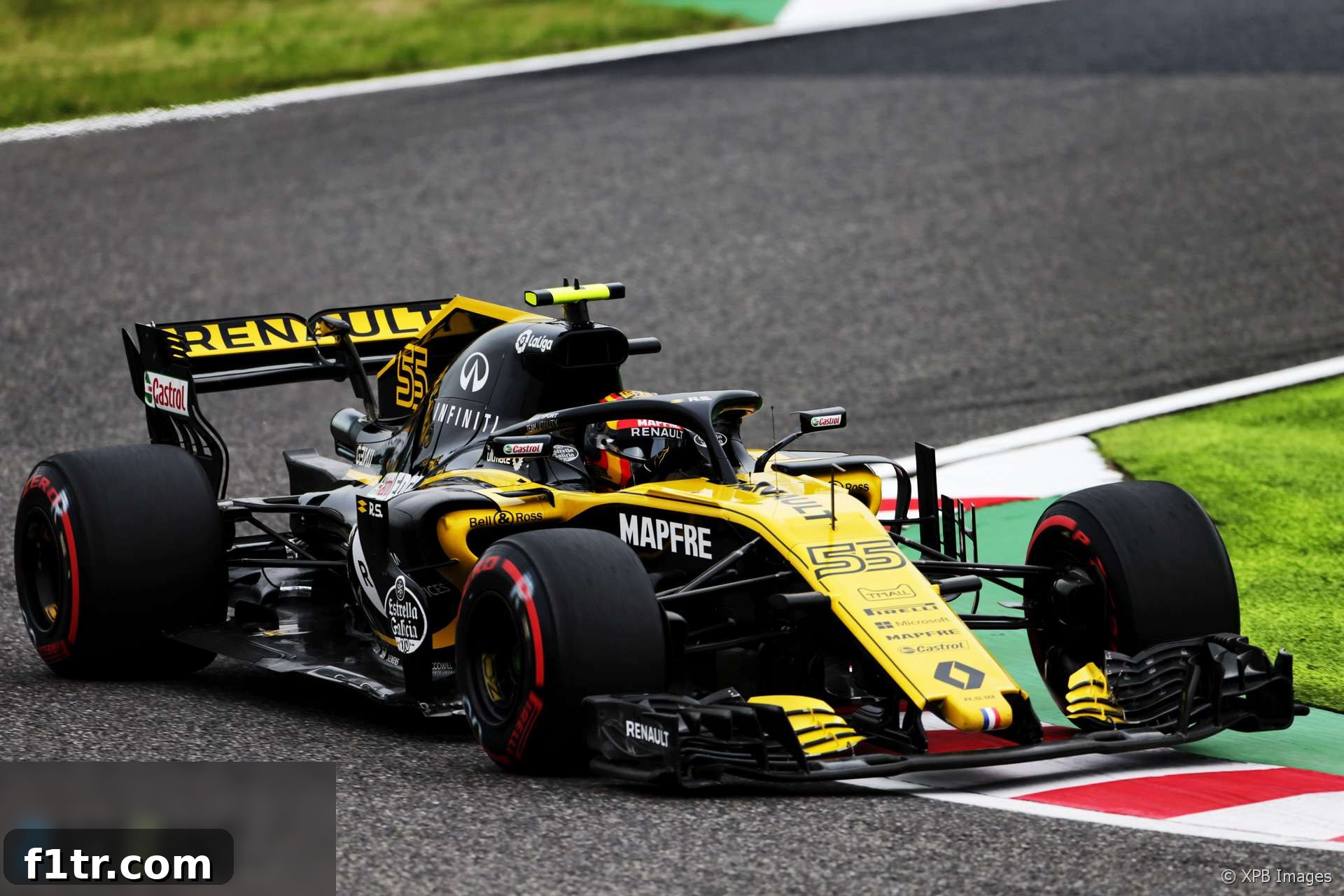
In the high-stakes world of Formula 1, the competitive landscape is ever-shifting, and recent comments from Carlos Sainz Jnr shed light on the intensifying pressure faced by the Renault F1 team. Sainz, a key driver for the French constructor, has openly stated that Renault’s rivals in the championship have achieved more significant performance gains, placing Renault increasingly on the back foot. This assertion points to a crucial mid-season development battle where some teams have evidently outpaced others in terms of car upgrades and overall package efficiency. For a manufacturer team like Renault, which harbors ambitions of climbing the constructor standings and challenging the sport’s top three outfits, such a situation demands immediate and decisive action. The pressure isn’t merely about individual race results but about the broader trajectory of their long-term development plans and their standing in a fiercely contested midfield.
Navigating Technical Setbacks: Sainz on Renault’s Challenges
Carlos Sainz further elaborated on the hurdles Renault encountered, specifically highlighting a significant setback experienced during practice sessions. This kind of transparency from a driver offers valuable insight into the often-hidden struggles teams face behind the glamour of race weekends. Sainz’s remarks underscore the delicate balance of performance development in F1 and the constant battle to extract every ounce of speed from the machinery. The competitive nature of Formula 1 means that even minor issues can have amplified effects on a team’s championship aspirations, pushing them to work harder and smarter to bridge performance gaps.
“It will depend on the next couple of races. I think at the moment we are definitely on the back foot compared to them. Our competitors have definitely done bigger steps than we have done. So, we are having to work a bit harder on Fridays, come up with alternative strategies for Sunday, much like we did in Sochi, trying to maximize every opportunity presented to us.”
“We’re working incredibly hard around the clock to understand and mitigate these issues, but at the moment, our immediate priority is to first analyze precisely what happened in FP2 to cause such a significant loss of performance. We made substantial changes to the car, including swapping the floor and adjusting quite a lot of other components. We need to pinpoint exactly where all that expected performance went, as it clearly didn’t translate into faster lap times. This investigative process is critical for us to regain our competitive edge and ensure we are moving in the right direction with our development.”
Sainz’s candid assessment reveals the profound impact of even seemingly minor component changes on a complex F1 car. The team’s decision to change the floor, a critical aerodynamic element, suggests they were pursuing a significant performance upgrade. However, the subsequent loss of performance in Free Practice 2 (FP2) indicates a miscorrelation between simulation data, wind tunnel results, and real-world track conditions. This scenario is a common, yet frustrating, occurrence in Formula 1, where the smallest deviation can unravel an entire development package. Renault’s engineers now face the arduous task of scrutinizing telemetry data, comparing different car configurations, and identifying the root cause of the performance deficit. This process is not just about raw speed but also about ensuring the car’s balance, stability, and tyre management characteristics are optimal. The need for “alternative strategies for Sunday” further emphasizes the competitive disadvantage, forcing the team to compensate for a lack of raw pace with clever tactical maneuvers, rather than relying purely on car performance.
Quotes: Dieter Rencken
Advert | Become a RaceFans supporter andgo ad-free
Social Media Spotlight: The Lighter Side of F1 and Fan Engagement
Beyond the technical analyses and strategic discussions, Formula 1 often provides moments of unexpected humor and personal insight, frequently amplified through social media. Platforms like Twitter and Instagram have become integral for fans to connect with the sport, offering immediate reactions, behind-the-scenes glimpses, and the occasional viral moment. These platforms allow drivers, teams, and journalists to share their perspectives and engage with a global audience, contributing to the sport’s ever-growing digital footprint. Notable posts from Twitter, Instagram, and other channels help capture the essence of a Grand Prix weekend, from intense on-track action to the quirks of paddock life.
Kimi is just so good to watch.
Strides quickly across the paddock, signs one autograph, desperate to avoid another he ignores everyone around him and marches straight into… the women’s toilets #F1 #JapaneseGP
— Chris Medland (@ChrisMedlandF1) October 5, 2018
One such moment, brilliantly captured by a journalist, highlighted the unique personality of Kimi Räikkönen, often dubbed “The Iceman.” His direct, no-nonsense approach and occasional social faux pas endear him to fans worldwide. The anecdote of him mistakenly entering the women’s toilets while trying to evade autograph hunters during the Japanese Grand Prix paddock walk perfectly encapsulates his legendary persona. Such incidents, while minor, contribute significantly to the narrative and entertainment value of F1, showcasing that even the most serious athletes have their human moments. These candid glimpses into driver personalities, facilitated by social media, enhance fan engagement and provide a refreshing counterpoint to the intense competition on track. It reminds us that behind the helmets and complex machinery, there are individuals with distinct characters, making the sport relatable and continuously entertaining.
- Find more official F1 accounts to follow in the F1 Twitter Directory
Motor Racing Insights: Team Developments and Technical Controversies
Beyond the headlines, a myriad of detailed reports and analyses provide deeper insights into the technical and strategic undercurrents of Formula 1. These links offer a snapshot of significant developments from various teams and ongoing discussions within the paddock, crucial for understanding the ever-evolving competitive landscape.
Advert | Become a Supporter & go ad-free
Japanese GP – free practice (Toro Rosso)
“The latest version of our Power Unit (PU), which we first utilized on Friday in Sochi, has produced encouraging data today. It represents a significant improvement and robustly validates the extensive tuning work we carried out on this new power unit since its initial deployment in Russia.”
This report from Toro Rosso underscores the continuous development cycle for power unit manufacturers, specifically Honda, which supplies the Red Bull junior team. The successful deployment and validation of an updated PU, first introduced in Sochi, highlights the crucial role of Friday practice sessions in collecting real-world data to confirm simulator and dyno findings. For Toro Rosso, a team heavily reliant on its engine supplier’s progress, these improvements are vital for boosting their competitive standing in the midfield and potentially challenging rivals for points positions. The meticulous tuning work mentioned reflects the highly detailed engineering efforts required to optimize every aspect of the complex hybrid power units, ensuring maximum performance and reliability under race conditions. Such advancements not only benefit Toro Rosso but also offer valuable feedback and development pathways for the senior Red Bull Racing team.
Ferrari tests new floor as upgrade push continues (Autosport)
“Ferrari rigorously tested a new floor design during the opening free practice session, but subsequently reverted to the older version for the second session.”
Ferrari’s ongoing pursuit of aerodynamic excellence is evident in their continuous testing of new components. The floor is one of the most aerodynamically sensitive parts of an F1 car, generating a significant portion of the downforce. Testing a new design in FP1 and then reverting to the older specification for FP2 is a standard procedure in F1. It allows teams to gather comparative data, assess the new component’s behavior, and identify if it provides the expected performance benefits without introducing unforeseen handling issues or instability. Reverting to an older specification typically indicates that the new part either didn’t deliver the anticipated gains, or it introduced undesirable characteristics that require further optimization back at the factory. For a team like Ferrari, locked in a fierce championship battle, every upgrade must deliver immediate and tangible performance, making such testing crucial for their title aspirations.
Ferrari’s engine mystery (Motorsport magazine)
“A story published post-Sochi suggested that a second sensor had been fitted to the Ferrari since Singapore, at the FIA’s insistence, and that this had clipped Ferrari’s wings. However, the FIA’s Charlie Whiting has absolutely refuted that claim here in Suzuka. There have been no additional sensors fitted to the Ferrari.”
The F1 paddock is often a hotbed of speculation, and Ferrari’s engine performance frequently comes under scrutiny, particularly when they demonstrate significant gains. Rumors regarding the legality of their power unit and the FIA’s oversight are not uncommon. The suggestion that a second sensor was fitted to Ferrari’s engine at the FIA’s insistence, supposedly to curb their performance advantage, sparked considerable discussion. Such claims often imply that a team might be operating in a grey area of the regulations. However, Charlie Whiting, the late FIA Race Director, was swift and unequivocal in his rebuttal during the Suzuka event. His clear statement that “no additional sensors have been fitted to the Ferrari” served to dispel the speculation, reaffirming the FIA’s strict monitoring protocols and the presumed legality of Ferrari’s power unit. This incident highlights the constant interplay between technical innovation, regulatory compliance, and the intense competitive environment in Formula 1, where every performance advantage is meticulously scrutinized by rivals and the governing body alike. Transparency from the FIA is crucial in maintaining trust and fairness in the sport.
We always endeavour to credit original sources. If you have a tip for a link to feature in the next RaceFans round-up please send it in here:
- Contact RaceFans
Advert | Become a RaceFans supporter andgo ad-free
Fan Debate: Tyres, Overtaking, and the Future of F1 Racing
One of the most enduring debates in Formula 1 centers around tyre compounds and their impact on racing spectacle. Lewis Hamilton, a prominent voice in the sport, has often advocated for softer tyres as a solution to enhance racing, believing it could lead to more varied strategies and increased overtaking opportunities. However, as with many seemingly straightforward solutions in F1, the reality is far more complex, prompting vigorous discussion among fans and experts alike. The question remains: Will softer tyres truly fix F1’s racing challenges, or are deeper structural changes required?
“We’ve had these Pirelli tyres for seven years now, and during that time, we’ve witnessed several cycles of debate: first, ‘this is boring, let’s make the tyres softer,’ followed by ‘OK, this is kinda ridiculous, we need to make the tyres harder again.’ Pirelli then introduces softer compounds for 2019, we inevitably see a chaotic four-stop race at Barcelona, one team inevitably comes out worst and complains that this is ridiculous, and just like that, we’re back where we started. It seems F1 never truly learns from its past experiences with tyre degradation and performance.”
“In my opinion, the most straightforward and effective way to genuinely increase the number of overtakes and improve the racing spectacle is to first increase the number of cars on the grid, perhaps from 20 to 26. Simultaneously, it’s imperative to ensure that there isn’t a two-second gap between the top teams and the rest of the field, creating a more tightly packed competition throughout. All of these goals can be realistically achieved with the implementation of a strict budget cap, fostering a more level playing field for all participants. But, of course, that would be far too logical and sensible for F1. Instead, let’s just continue endlessly discussing tyre degradation and the hypothetical scenario of three-car teams, for crying out loud, while ignoring the root causes of the problem.”
@Andae23
This insightful comment from @Andae23 succinctly captures the cyclical frustration surrounding F1 tyre regulations. The commenter highlights the recurring pattern: a shift to softer compounds in pursuit of more aggressive strategies, often leading to unpredictability and complaints about excessive degradation, followed by calls for harder, more durable tyres. This perpetual pendulum swing suggests that merely adjusting tyre compounds might be a superficial fix for a deeper problem. The core argument here is that the fundamental issue lies not just with the tyres themselves, but with the vast performance disparity between teams and the aerodynamic dependency of modern F1 cars, which makes close racing and overtaking inherently difficult.
The proposed alternative solutions – increasing the grid to 26 cars and implementing a strict budget cap – offer a compelling vision for a more competitive future. A larger grid would naturally increase the number of cars battling for position, while a budget cap would be instrumental in levelling the playing field, reducing the performance gap between the top teams and the midfield. This would foster a scenario where driver skill and race strategy become even more critical than sheer financial might, potentially leading to a more unpredictable and exciting championship. The comment challenges the sport to look beyond temporary fixes and address systemic issues that truly impact the quality of racing, advocating for solutions that promote genuine competition and accessibility across the entire grid.
Happy Birthday to a RaceFans Member!
We love to celebrate our community members! A very Happy Birthday to Gaston_Pdu!
If you want a birthday shout-out in our future round-ups, please let us know when yours is via the contact form or by adding to the list here. Your participation makes our community vibrant!
On This Day in F1 History
- Five years ago today, October 6th, 2013, Sebastian Vettel secured a commanding victory in the South Korean Grand Prix. This triumph placed him tantalizingly close to clinching his remarkable fourth consecutive Formula 1 World Championship title, showcasing the dominant era of Red Bull Racing and Vettel’s unparalleled form during that period.