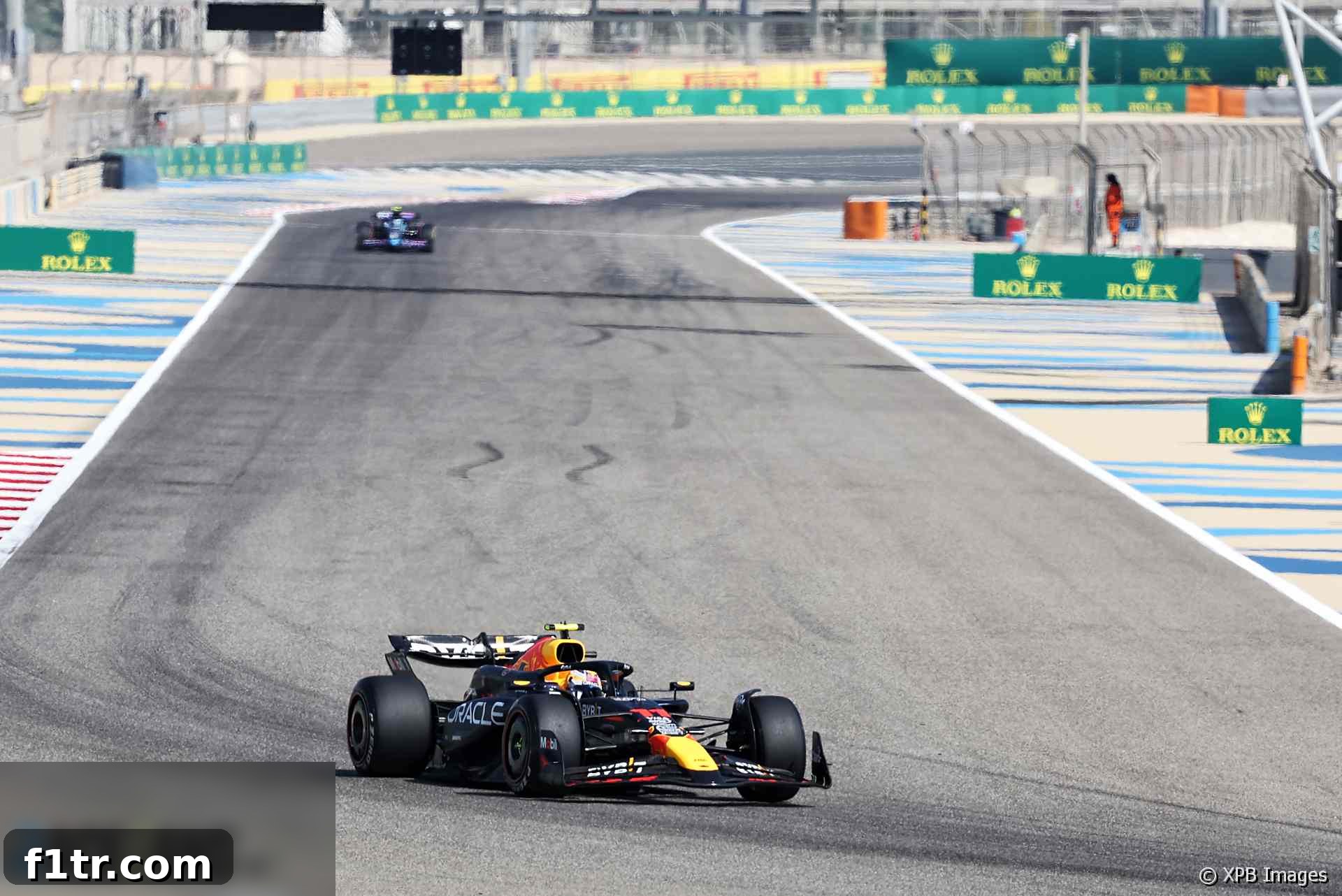
Lewis Hamilton has delivered his initial assessment of the new Mercedes W15 challenger, indicating a clear improvement over its unpredictable predecessor following his first comprehensive test sessions. However, the seven-time world champion also tempered expectations for the start of the upcoming Formula 1 season, acknowledging the formidable gap that still separates Mercedes-AMG Petronas F1 Team from the dominant Red Bull Racing squad.
Advert | Become a Supporter & go ad-free
Hamilton’s First Impressions: A Step Forward for the W15
Hamilton described Mercedes’ W15, a car that represents a significant philosophical and design departure from the team’s challenging W13 and W14 models, as a definitive “work in progress.” Despite this ongoing development, the British driver expressed tangible optimism regarding the car’s initial feel and performance on track.
“It’s definitely improved,” Hamilton stated unequivocally after extensive running at the Bahrain International Circuit. “I think everyone has made strides forward. We’re just going through the same sequence everyone is in terms of understanding and optimizing our new package.”
He further elaborated on the inherent characteristics of the current generation of Formula 1 cars, which were introduced under new technical regulations. “The cars are still stiff and bumpy as we know, this generation of car is designed for ground effect aerodynamics, which often comes with a firm ride. But credit to the team, they have done a great job over the winter, pushing the boundaries of what’s possible within the regulations to enhance the W15’s driveability.”
On Thursday, Hamilton completed an impressive 123 laps of the Bahrain International Circuit, accumulating crucial data and gaining valuable insight into the W15’s behavior. His sentiment was overwhelmingly positive compared to the previous year. “It was a good day,” he affirmed. “It felt much more enjoyable to drive, which is a significant step in the right direction. The W14 was notoriously difficult to handle, particularly in certain conditions, so this improved feeling is a promising foundation.”
The Red Bull Challenge: A Distant Horizon
Despite the improved feeling and enhanced driveability of the W15, Hamilton remains pragmatic about the immediate competitive landscape. He cautioned against overly optimistic predictions for the season opener, highlighting the formidable benchmark set by their rivals.
“We still have time to find,” he conceded, acknowledging the ongoing process of extracting maximum performance from the new car. “I think Red Bull clearly are out in the distance at this stage. Their performance in pre-season testing, even when disguised, showcased their continued strength and the benchmark they represent.”
Red Bull Racing, having dominated the previous season with their RB19, remains the team to beat. Hamilton’s comments underscore the monumental task facing Mercedes to close that performance gap. However, he concluded with a note of cautious optimism regarding Mercedes’ long-term prospects. “But I think it’s a good platform to work from this year. We have a solid base, and the potential for development appears to be much greater than what we had with the W14.” This perspective suggests that while immediate victory may be challenging, the W15 offers a more fertile ground for in-season development and performance gains.
Engineering Optimism: Andrew Shovlin’s Perspective
Mercedes’ trackside engineer director Andrew Shovlin echoed Hamilton’s sentiments, drawing considerable encouragement from the initial impressions of both Hamilton and his team mate George Russell regarding the new car. Their feedback is invaluable for the engineering team to validate their design choices and pinpoint areas for further development.
“We’ve had three useful days here in Bahrain and managed to make good progress understanding the W15,” said Shovlin, reflecting on the comprehensive testing schedule. “Compared to last year’s car, the feedback from the drivers is very different and significantly more positive, which is incredibly encouraging for everyone involved in the project.”
Shovlin highlighted the team’s concerted efforts to address the fundamental issues that plagued their previous challenger. “The team has worked tirelessly to iron out the handling flaws that were integral to the W14. It’s great that we seem to have put a number of those problems behind us with the W15. The stability, balance, and responsiveness have all seen notable improvements, making the car much more predictable for the drivers.”
The testing period is not just about raw lap times, but about data collection and deep understanding. “Over the course of the test we’ve made good steps on our understanding of the car,” Shovlin explained. This process involves meticulous analysis of telemetry, driver feedback, and aerodynamic data to optimize setup and unlock performance. “The task of the next few days is to meticulously pick through the results, correlate our simulation data with real-world track data, and put together the best possible package to take into the race weekend.” This iterative process of refinement is crucial for translating testing promise into competitive race performance.
Although he acknowledged that rival teams, particularly Red Bull, would have strategically disguised their true pace during testing, Shovlin maintained a positive outlook for Mercedes. “It’s clear that we are in a much better position than 12 months ago though,” he stated confidently. This comparison to the struggles faced at the start of the previous season provides a strong indicator of the significant strides Mercedes believes it has made with the W15.
The W15: A Radical Departure for Mercedes-AMG F1
The Mercedes W15 is not merely an evolution; it represents a bold departure from the design philosophy that guided its predecessors. Following two challenging seasons under the new ground effect regulations, Mercedes engineers, led by James Allison, have taken a more aggressive and innovative approach. This includes a revamped chassis, significantly altered aerodynamics, and a concerted effort to mitigate the notorious “porpoising” and instability issues that hampered the W13 and W14.
The car features a new rear axle concept and a revised suspension geometry, aimed at improving mechanical grip and tire management, both critical factors in modern Formula 1. The aerodynamic package, particularly the sidepods and engine cover, has also undergone extensive revisions, moving closer to concepts that have proven successful for other teams, while still retaining a unique Mercedes identity. The focus has been on creating a more stable and predictable platform, allowing drivers like Hamilton and Russell to push the car to its limits with greater confidence.
The initial feedback from testing suggests that these fundamental changes are yielding positive results, providing the team with a more robust foundation upon which to build throughout the season. The concept of the W15 as a “good platform” implies that it has strong underlying potential for development, allowing engineers to incrementally add performance upgrades without encountering the inherent limitations that characterized their previous designs.
The Grueling Bahrain Test: Laps, Data, and Durability
The three-day pre-season test at the Bahrain International Circuit is a crucial benchmark for all Formula 1 teams. For Mercedes, accumulating 123 laps with Hamilton and extensive mileage with George Russell was vital. This high lap count demonstrates the W15’s initial reliability, a cornerstone for any successful F1 campaign. Each lap represents an opportunity to gather vast amounts of data – from tire degradation and fuel consumption to aerodynamic performance and engine mapping.
The Bahrain circuit itself, with its mix of fast straights, challenging corners, and abrasive track surface, provides an excellent environment to stress-test the new machinery. The extreme temperatures and sandy conditions add another layer of complexity, mimicking the demands of the upcoming race season. The team’s ability to run consistently and gather diverse data sets under these conditions is paramount for fine-tuning the car before the first Grand Prix.
The sheer volume of data collected will now be meticulously analyzed back at the factory in Brackley and Brixworth. Engineers will pore over every sensor reading, cross-reference it with driver feedback, and compare it against their extensive simulation models. This deep dive aims to identify performance bottlenecks, optimize existing setups, and plan for future upgrades. The success of the W15’s season will heavily depend on how effectively Mercedes can interpret and act upon this wealth of information.
Advert | Become a RaceFans supporter andgo ad-free
The Road Ahead: From Testing to Race Weekend
With pre-season testing now concluded, the focus for Mercedes shifts immediately to the opening Grand Prix, also held at the Bahrain International Circuit. The challenge now is to translate the promising testing data into a competitive race package. This involves selecting the optimal aerodynamic configuration, perfecting the car’s setup for qualifying and race conditions, and developing robust race strategies.
While Hamilton’s initial feedback is positive, the true test of the W15’s capabilities will come when it goes head-to-head with its rivals under race pressure. The cautious optimism from both Hamilton and Shovlin suggests that Mercedes has made genuine progress, but the road to challenging for wins and championships remains long. The W15 is indeed a “work in progress,” but one that appears to have moved Mercedes onto a much more promising trajectory compared to the previous two seasons.
Further Formula 1 Insights
- One of F1’s greatest races happened 15 years ago today. Or did it?
- “Overtaking is overtaking”: Domenicali denies F1’s yo-yo racing is “artificial”
- The crashes F1 is trying to prevent may be rare – but the danger is obvious
- F1 returning to India soon after 2027 sounds like wishful thinking
- Verstappen loathes F1’s new generation of cars – but what do his rivals reckon?
- New F1 Car Regulations: What to Expect in 2026
- Aerodynamic Developments in F1: 2024 Season Analysis
Browse all Formula 1 articles