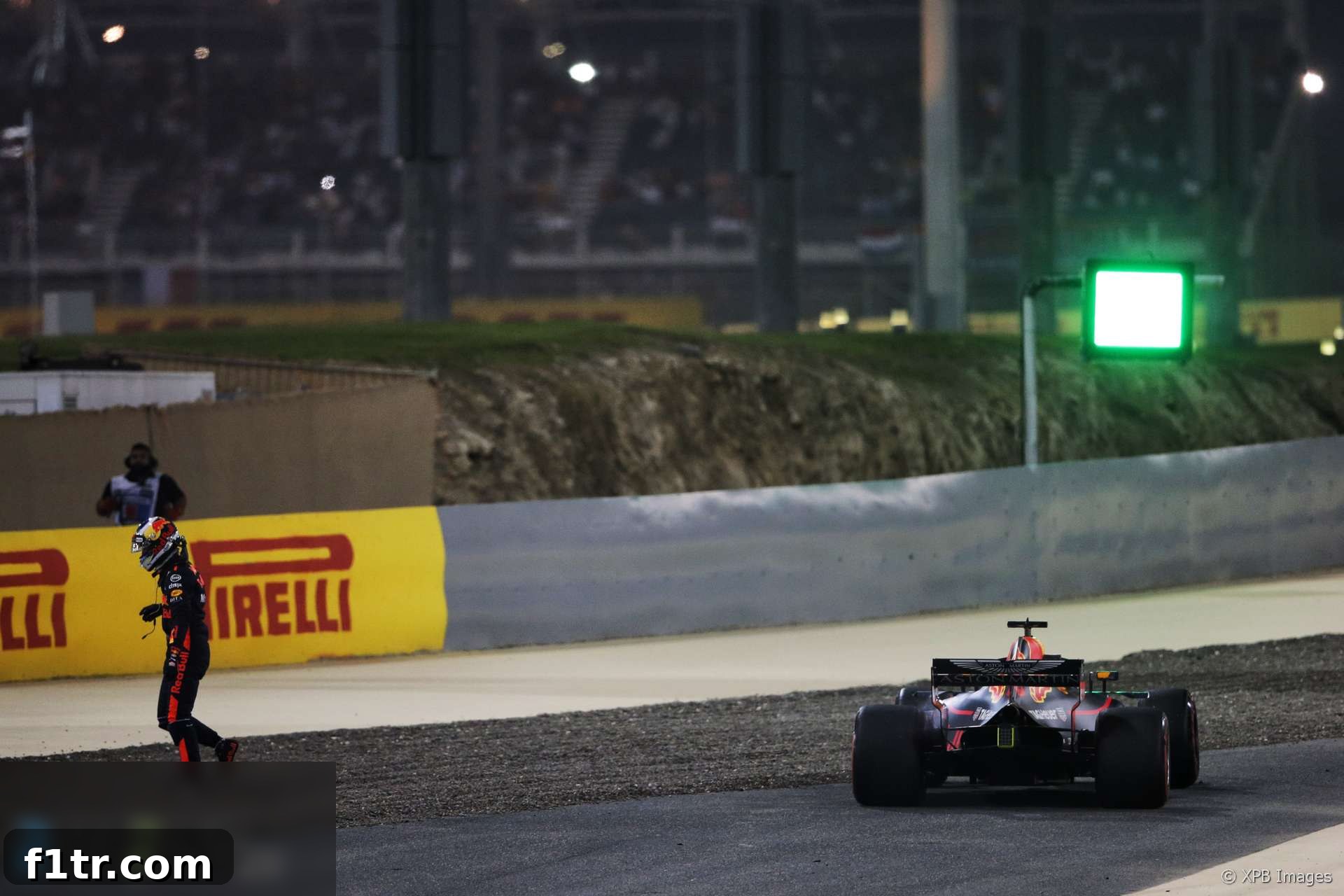
Formula 1 teams and drivers constantly navigate a tightrope of performance and reliability, especially under the sport’s stringent power unit component regulations. Red Bull Racing driver Daniel Ricciardo is facing the prospect of an inevitable grid penalty later in the 2018 season, following a critical failure of one of his allotted energy stores (ES) during the Bahrain Grand Prix. This incident has put immediate pressure on the Australian driver and his team, highlighting the unforgiving nature of modern F1 technical rules.
Ricciardo’s retirement from the Bahrain race was directly attributed to a faulty energy store within his Renault power unit. The team promptly replaced the component, but the initial assessment indicates that the failed unit cannot be salvaged or reused for future sessions. This development is a significant blow, as drivers are limited to only two energy stores for the entire championship season without incurring penalties.
Advert | Become a Supporter & go ad-free
Speaking on the matter, Ricciardo confirmed the grim reality: “We’ve got a second one here now, which we’re using. I think if they do it again, we will definitely face a penalty. We are only allowed two components for the entire year, and one is already, I believe, in the bin, completely unusable.”
The implications are stark. While Ricciardo is currently utilizing his second energy store, the long and demanding F1 calendar, featuring 21 races, makes it highly improbable that this single remaining unit will last until the season’s conclusion. Should he require a third energy store at any point, a mandatory grid penalty will be applied. Such penalties can range from five to ten places, severely hindering a driver’s chances on race day and potentially impacting championship aspirations. The sheer challenge of making one energy store endure for the remaining races after just two rounds is immense, as Ricciardo himself acknowledges, “We only survived doing one battery for one race. It’s more likely than not that we will have a penalty, but hopefully, it’s happening later in the season. So it’s the second one we’re on now, and I’m 90% sure we’ll need a third.”
This situation underscores the delicate balance F1 teams must strike between pushing the performance envelope and ensuring component longevity. Renault, as a power unit supplier, has historically faced reliability challenges, and this incident further accentuates the pressure on them to improve the robustness of their components for Red Bull Racing.
In stark contrast to Ricciardo’s predicament, Mercedes driver Valtteri Bottas received more optimistic news regarding his power unit components. Following his significant crash during the season-opening Australian Grand Prix, both his energy store and control electronics (CE) were replaced. Initial concerns suggested these components might also be irrevocably damaged, potentially leading to similar penalty worries for Bottas. However, upon thorough inspection and rigorous testing, Mercedes has confirmed the parts are salvageable.
During the practice sessions in Bahrain, Mercedes successfully ran these previously damaged components, demonstrating their recovered functionality. The team’s cautious approach dictates that they will continue to deploy these units in further practice sessions to confirm their sustained reliability under race conditions before fully reintroducing them into Bottas’s race component pool. This methodical validation process highlights Mercedes’ meticulous engineering and resource management, a stark difference from the unrecoverable failure experienced by Ricciardo’s Renault unit.
Understanding F1 Power Unit Components and Penalties
Modern Formula 1 power units are marvels of engineering, comprising six key components. For the 2018 season, drivers were limited to only three of each component type throughout the entire year, with the exception of the Energy Store (ES) and Control Electronics (CE), for which only two were permitted. Exceeding these limits for any component results in grid penalties:
- ICE (Internal Combustion Engine): The traditional gasoline engine.
- TC (Turbocharger): Boosts engine power by compressing air.
- MGU-H (Motor Generator Unit – Heat): Recovers energy from exhaust gases, crucial for hybrid efficiency.
- MGU-K (Motor Generator Unit – Kinetic): Recovers kinetic energy during braking, converting it into electrical power.
- ES (Energy Store): The battery pack that stores and deploys electrical energy generated by the MGU-H and MGU-K. This is the component causing Ricciardo’s woes.
- CE (Control Electronics): The central electronic brain managing the complex power unit systems. This was also an area of concern for Bottas.
Each time a driver uses an additional component beyond the stipulated limit, they incur a grid penalty. The first time a driver uses a fourth (or third for ES/CE) component, they receive a 10-place grid penalty. Subsequent new components beyond that result in a 5-place penalty each. Accumulating multiple new components in a single event can lead to significant drops down the grid, sometimes forcing a start from the back of the field. This system is designed to control costs and promote reliability, but it often adds a dramatic strategic layer to the season.
Power Unit Component Usage After Bahrain Grand Prix
The table below provides a snapshot of power unit component usage by each driver after the Bahrain Grand Prix in 2018. The numbers indicate the count of each component type used so far in the season. Higher numbers signify drivers who are closer to incurring grid penalties.
| No. | Car | Engine | Driver | ICE | TC | MGU-H | MGU-K | ES | CE |
|---|---|---|---|---|---|---|---|---|---|
| 26 | Toro Rosso | Honda | Pierre Gasly | 2 | 2 | 2 | 1 | 1 | 1 |
| 55 | Toro Rosso | Honda | Brendon Hartley | 1 | 2 | 2 | 1 | 1 | 1 |
| 20 | Haas | Ferrari | Kevin Magnussen | 1 | 1 | 1 | 1 | 2 | 2 |
| 77 | Mercedes | Mercedes | Valtteri Bottas | 1 | 1 | 1 | 1 | 2 | 2 |
| 3 | Red Bull | TAG Heuer | Daniel Ricciardo | 1 | 1 | 1 | 1 | 1 | 2 |
| 2 | McLaren | Renault | Stoffel Vandoorne | 1 | 1 | 1 | 1 | 1 | 1 |
| 14 | McLaren | Renault | Fernando Alonso | 1 | 1 | 1 | 1 | 1 | 1 |
| 30 | Renault | Renault | Carlos Sainz Jnr | 1 | 1 | 1 | 1 | 1 | 1 |
| 33 | Red Bull | TAG Heuer | Max Verstappen | 1 | 1 | 1 | 1 | 1 | 1 |
| 27 | Renault | Renault | Nico Hulkenberg | 1 | 1 | 1 | 1 | 1 | 1 |
| 5 | Ferrari | Ferrari | Sebastian Vettel | 1 | 1 | 1 | 1 | 1 | 1 |
| 44 | Mercedes | Mercedes | Lewis Hamilton | 1 | 1 | 1 | 1 | 1 | 1 |
| 31 | Sauber | Ferrari | Charles Leclerc | 1 | 1 | 1 | 1 | 1 | 1 |
| 9 | Sauber | Ferrari | Marcus Ericsson | 1 | 1 | 1 | 1 | 1 | 1 |
| 7 | Ferrari | Ferrari | Kimi Raikkonen | 1 | 1 | 1 | 1 | 1 | 1 |
| 8 | Haas | Ferrari | Romain Grosjean | 1 | 1 | 1 | 1 | 1 | 1 |
| 31 | Force India | Mercedes | Esteban Ocon | 1 | 1 | 1 | 1 | 1 | 1 |
| 19 | Williams | Mercedes | Lance Stroll | 1 | 1 | 1 | 1 | 1 | 1 |
| 11 | Force India | Mercedes | Sergio Perez | 1 | 1 | 1 | 1 | 1 | 1 |
| 18 | Williams | Mercedes | Sergey Sitorkin | 1 | 1 | 1 | 1 | 1 | 1 |
From the table, it’s evident that several drivers are already on their second iteration of some components. Kevin Magnussen and Valtteri Bottas, for instance, are already on their second ES and CE units, indicating they have used up their initial allocation and any further change will trigger a penalty. Daniel Ricciardo, though officially listed with 1 ES, effectively used his second in Bahrain, and as per his comments, his original is likely decommissioned. This effectively places him in the same precarious position as Bottas and Magnussen regarding the energy store. The “NB” note clarifies that Ricciardo’s new energy store had not been officially confirmed in the stewards’ reports at the time of this data, which is why he is still listed with ‘1’ instead of ‘2’ in the official tally, but practically, he is on his second.
Honda-powered Toro Rosso drivers, Pierre Gasly and Brendon Hartley, have also seen high usage for their ICE, TC, and MGU-H components. This early consumption often points to ongoing reliability struggles or aggressive development cycles requiring more frequent component changes. These teams, in particular, will need to carefully manage their remaining components to avoid race-ruining grid penalties in the latter half of the season.
The strategic decisions around power unit components are complex. Teams often choose to take penalties at circuits where overtaking is easier or where they believe their car has a stronger overall package to recover positions. However, unexpected failures like Ricciardo’s severely limit these strategic options, forcing teams into reactive rather than proactive decisions. The quest for performance often clashes directly with the need for reliability, and as the 2018 season unfolds, engine manufacturers and teams will be under constant scrutiny to deliver both.
The early stages of the season are crucial for establishing component reliability. Drivers like Lewis Hamilton, Sebastian Vettel, and Kimi Raikkonen, who have only used one of each component, are in a stronger position. Their teams, Mercedes and Ferrari, appear to have robust power units, giving them a significant advantage in terms of strategic flexibility for the rest of the year. For others, particularly those with higher component counts like Ricciardo and the Toro Rosso drivers, every race becomes a careful calculation of risk versus reward, with the looming threat of grid penalties hanging over their heads.
Go ad-free for just £1 per month>> Find out more and sign up
2018 F1 season
- F1 feared “death knell” for Drive to Survive after Ferrari and Mercedes snub
- McLaren staff told us we were “totally crazy” to take Honda engines in 2018 – Tost
- ‘It doesn’t matter if we start last’: How Red Bull’s junior team aided Honda’s leap forward
- Honda’s jet division helped F1 engineers solve power unit problem
- McLaren Racing losses rise after Honda split
Browse all 2018 F1 season articles