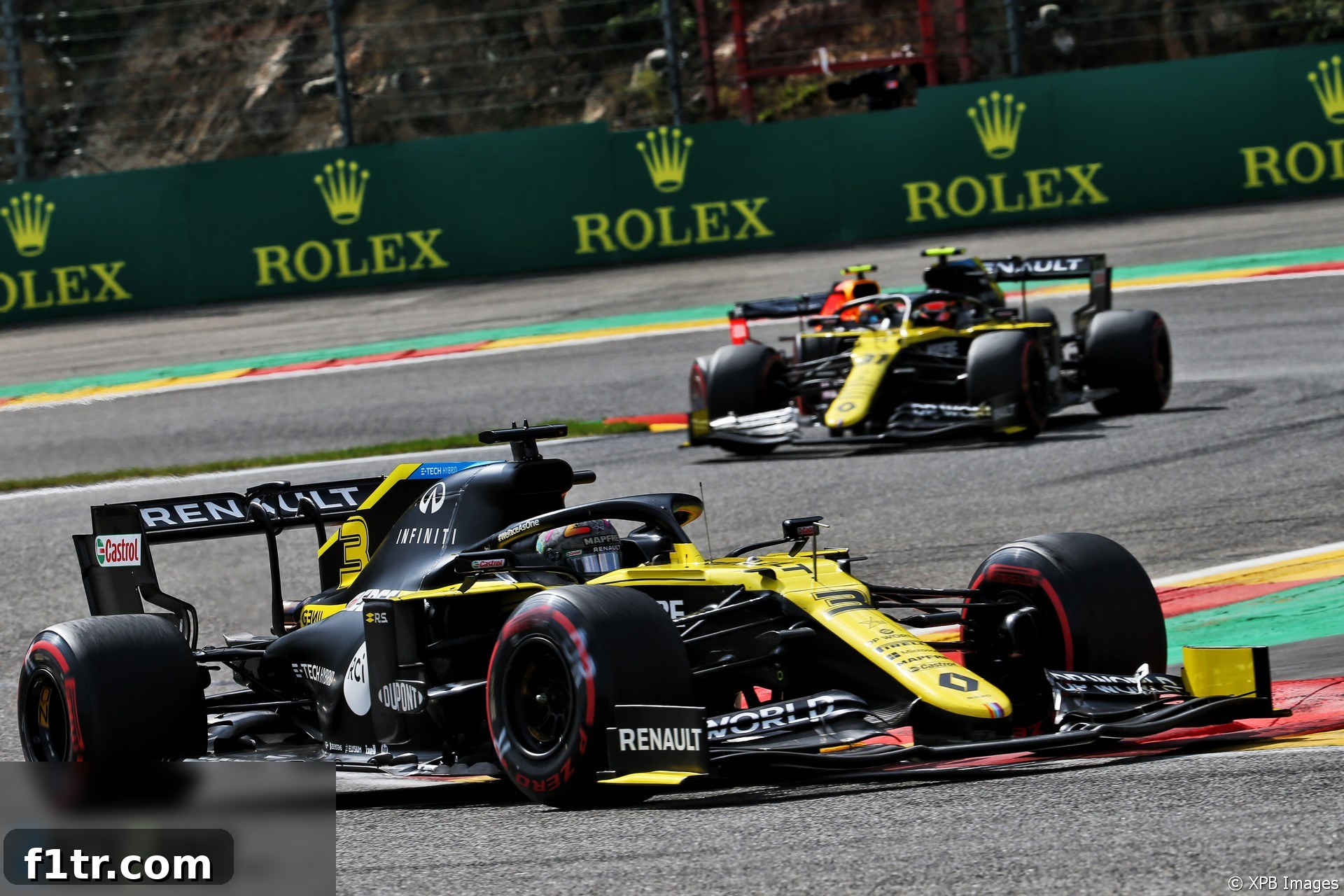
Daniel Ricciardo Confident Renault’s Setup Breakthrough Will Transform Performance Across F1 Tracks
Daniel Ricciardo, the charismatic Australian driver for the Renault F1 team, has voiced strong confidence that the significant breakthrough his team has achieved with its low-downforce performance will not only deliver exceptional results at circuits requiring minimal downforce but will also translate into substantial gains at tracks demanding higher downforce levels. This optimistic outlook follows a standout performance at the Belgian Grand Prix, hinting at a pivotal shift in the team’s understanding of their RS20 challenger and potentially redefining their trajectory for the remainder of the Formula 1 season.
Renault’s Resurgent Performance at Spa: A Glimpse of Potential
The recent Belgian Grand Prix at the iconic Spa-Francorchamps circuit served as a crucial proving ground for Renault, where both Ricciardo and his teammate, Esteban Ocon, finished an impressive fourth and fifth respectively. This double points finish marked one of the team’s strongest showings of the season, immediately drawing attention to the underlying improvements made to the RS20. Ricciardo attributed this significant upturn in form to a fundamental adjustment in the car’s setup, which has profoundly altered its on-track behavior and unlocked a new level of performance.
“A specific set-up on the car is now working significantly better, and it’s essentially providing the car with a lot more grip,” Ricciardo explained, highlighting the tangible benefits of their meticulous development work. The increased grip allows the drivers to push harder, extract more performance through corners, and maintain better stability at high speeds, all critical factors in competitive Formula 1 racing. This improvement wasn’t merely a stroke of luck but the culmination of iterative testing, sophisticated data analysis, and close collaboration between engineers and drivers, leading to a deeper understanding of the car’s dynamic characteristics.
Unlocking the RS20’s Potential: The Silverstone “Sweet Spot” Discovery
Ricciardo further revealed that the genesis of this performance enhancement dates back to the British Grand Prix, held at the challenging Silverstone circuit. It was there, amidst the demanding high-speed corners and technical sections of the iconic track, that the team began to truly unlock the latent performance capabilities of the RS20. This discovery wasn’t an overnight revelation but a gradual process of fine-tuning and meticulous driver feedback, culminating in a critical breakthrough.
“There’s definitely something we picked up during the first weekend at Silverstone regarding the set-up,” he elaborated, emphasizing the precise nature of the breakthrough. “It felt like we found a sweet spot.” The term “sweet spot” in Formula 1 parlance refers to an optimal configuration of the car – balancing aerodynamics, suspension, tire pressures, and other parameters – where the vehicle performs at its peak efficiency and the driver feels most comfortable and confident to extract maximum pace. For a driver of Ricciardo’s caliber, renowned for his aggressive yet precise driving style, identifying this “sweet spot” is paramount as it directly translates into confidence and lap time.
“In particular, I found it, in terms of feeling in the car, as ‘right, this is where we need to run the car’,” Ricciardo recounted, underscoring the intuitive and visceral connection a driver has with their machine. This initial understanding from Silverstone was then rigorously tested and refined across subsequent sessions. During the second practice session at Spa, the team continued to experiment with this newfound configuration, validating its efficacy. “There was one session, I think it was in second practice, where I was like, ‘okay, we found the sweet spot’,” he confirmed, indicating a moment of definitive realization and confirmation. This provided crucial validation, suggesting that the team now possessed a robust and repeatable understanding of how to optimize the RS20. “So there is something fundamental which I think we’ve got a good choke-hold on,” he concluded, expressing a firm grasp on the technical principles behind their improved performance and hinting at a sustainable path forward.
Beyond Low Downforce: Versatility for All Circuits
The Formula 1 calendar presents a diverse range of circuits, each demanding unique aerodynamic and mechanical setups. This weekend’s race takes place at the historic Autodromo Nazionale Monza, often dubbed the “Temple of Speed.” Monza, much like Spa, is characterized by long straights and fast corners, necessitating a low-downforce setup to minimize drag and maximize top speed. While Renault’s recent success has been on these low-downforce tracks, Ricciardo’s optimism extends significantly beyond this specific characteristic, promising broader implications for the championship.
“I think we can get it working on high downforce,” he declared, challenging the notion that their breakthrough is limited to only certain track types. This statement is particularly significant because high-downforce tracks, which make up a substantial portion of the F1 season, require cars to generate maximum aerodynamic grip, particularly through slower and medium-speed corners. Achieving strong performance across both ends of the downforce spectrum is a hallmark of a truly competitive F1 car and separates championship contenders from midfield runners.
Ricciardo clarified the versatile nature of their discovery: “This set-up is not typical to low downforce. We can run it on all levels.” This suggests that the core principles of the “sweet spot” involve a more adaptable aspect of the RS20’s chassis or suspension geometry, rather than a purely aerodynamic trick specific to low-drag configurations. The challenge now lies in “just finding what works best with high downforce,” implying a period of further optimization and adaptation through simulation and track testing. He noted that they have already seen positive effects: “We found that with these medium [tyres] and it certainly brings the car alive.” The ability to extract better performance and longevity from the tires, particularly over a race stint, is a significant advantage, often dictating strategic options and overall race pace, providing a crucial edge in a tightly contested field. “So that’s something which I’m pretty confident is where the RS20 likes to be run,” Ricciardo affirmed, highlighting a newfound harmony between car and driver that inspires confidence. Reflecting on past seasons, he added, “And I’m not sure we had something like this, a real discovery like this, last year. So that’s been encouraging.” This comparison to the previous year underscores the depth and significance of the current technical progress, offering a tangible reason for the team’s renewed hope and ambition.
The Unforeseen Fastest Lap: A Moment of Brilliance at Spa
Beyond the team’s impressive overall performance at Spa, Daniel Ricciardo delivered a personal highlight by setting the fastest lap of the race. What made this feat even more remarkable was that he achieved it at the very end of the Grand Prix, without pitting for a fresh set of tires – a common strategic move for teams chasing the single point awarded for the fastest lap. His crew did, however, ‘turn up’ his engine in the closing stages, a decision that reportedly faced objections from Renault’s managing director, Cyril Abiteboul, adding a layer of tactical intrigue and daring to the achievement.
Ricciardo admitted that it was “certainly surprising” to find himself in contention for the fastest lap, indicating that it wasn’t a pre-planned objective for his race strategy, but rather an opportunity that arose organically. “I knew we would have a decent car, but when I heard the lap times that the Mercedes was dropping off to, I thought, ‘OK, maybe everyone’s just saving their engines and whatever’,” he recalled, painting a vivid picture of his real-time assessment and strategic calculations during the race. As he observed his leading competitors’ pace diminishing, while his own RS20 continued to gain momentum, his confidence surged. “But it sounded like they were genuinely struggling a bit and we were just getting faster and faster. And we had to deal with some traffic.” Navigating through backmarkers and managing traffic while pushing for ultimate pace further amplified the challenge, making his eventual fastest lap all the more impressive and a testament to his skill and the car’s underlying speed.
“I think they all kind of had their gaps and didn’t really have a hard time on their tyres. So it was really encouraging,” Ricciardo observed, noting that his rivals weren’t under the same pressure regarding tire degradation, yet his car was still quicker. “The pace at the end took me by surprise, although I was getting quicker and quicker.” This self-awareness of his increasing speed and the car’s improving performance set the stage for the dramatic final lap.
The decisive moment came when his race engineer relayed the target lap time. “My engineer told me what the fastest lap was, and I think it was about half a second quicker than what I’d done. And I was like, maybe if I could use a bit of the battery, maybe we can get it.” This internal dialogue showcases the delicate balance between pushing limits, managing hybrid energy systems, and making split-second decisions in modern F1. The decision was made, and Ricciardo committed fully. “On the last lap, about halfway around the lap, I used every bit of track I could, and I was like ‘I’m going for it, I’ve gone this far now, I’m just going to put it all on the line’.” This vivid description captures the raw intensity, calculated risk, and sheer determination of a driver pushing to the absolute edge of performance and personal bravery. “So that lap probably scared me more than Q3,” he quipped, humorously comparing the visceral thrill and inherent danger of an unbridled race lap to the high-pressure, single-lap qualifying session, Q3, where margins are often razor-thin.
Looking Ahead: Renault’s Momentum and Ricciardo’s Impact
The combined performance at Spa – the strong team result, the discovery of a versatile and effective setup, and Daniel Ricciardo’s scintillating fastest lap – injects a significant dose of optimism and renewed vigor into the Renault F1 camp. It suggests that the team is not only understanding its current machinery better but is also developing a robust foundation for sustained improvement across various circuit types. Daniel Ricciardo’s role in this, both as a highly skilled driver capable of extracting maximum performance and as an astute feedback provider aiding technical development, is undeniably crucial.
With Monza on the horizon, another low-downforce challenge, Renault will be keen to further validate their recent findings and potentially build on their momentum. However, the true test of their breakthrough will come at the subsequent high-downforce races, where they aim to prove the versatility and adaptability of their RS20 and confirm Ricciardo’s confidence. This newfound confidence and deeper technical understanding could be the turning point Renault needs to climb further up the constructors’ standings and consistently challenge for podium finishes in the fiercely competitive world of Formula 1. The journey of the RS20, guided by Ricciardo’s insights and the team’s persistent efforts, promises an exciting remainder of the F1 season, showcasing the potential for a strong finish.
2020 F1 Season: Related Articles
- Grosjean to make F1 test return tomorrow for first time since Bahrain horror crash
- Pictures: Wrecked chassis from Grosjean’s Bahrain fireball crash to go on display
- Bottas vs Rosberg: Hamilton’s Mercedes team mates compared after 78 races each
- F1 revenues fell by $877 million in Covid-struck 2020 season
- Hamilton and Mercedes finally announce new deal for 2021 season
Browse all 2020 F1 season articles