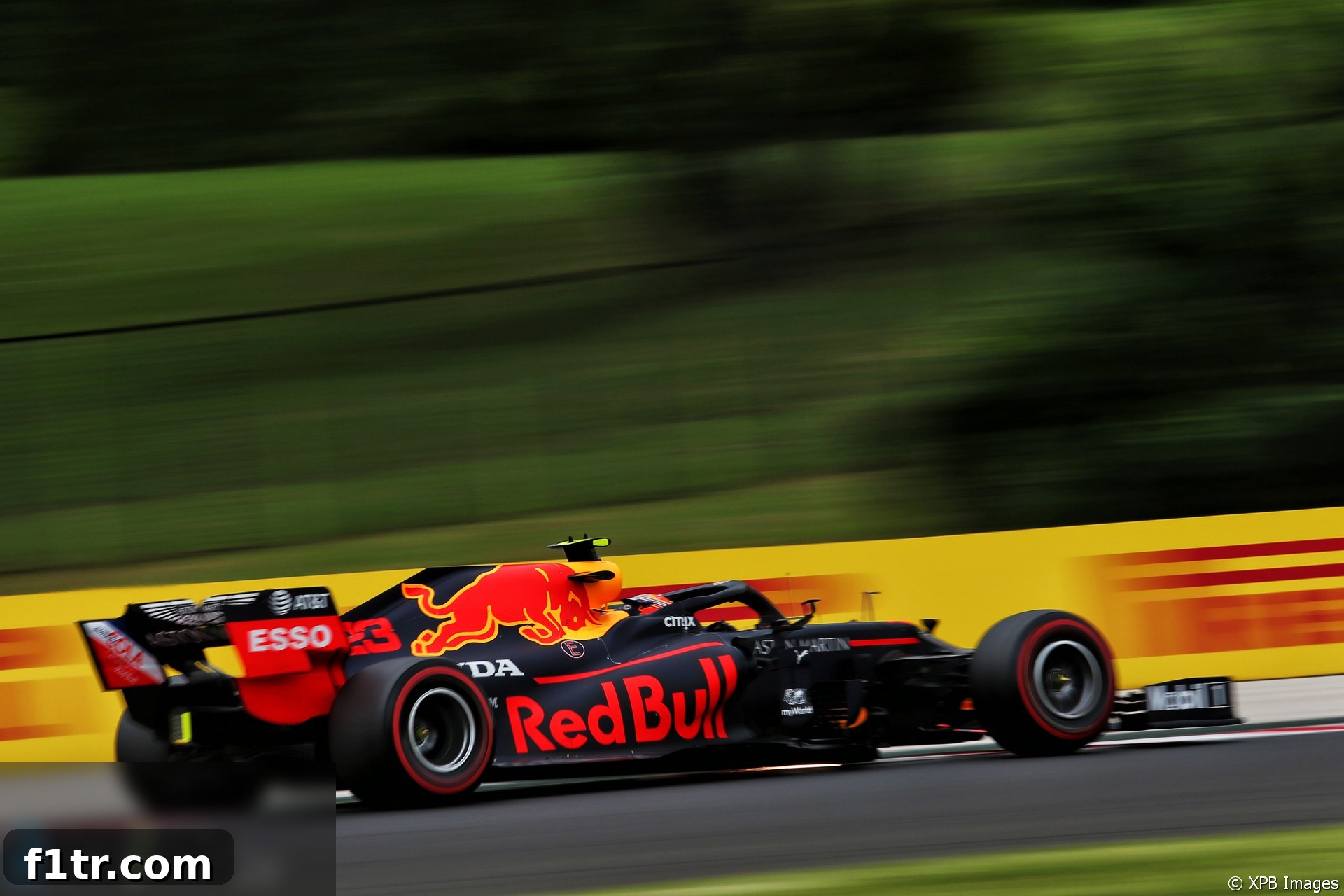
Red Bull Under FIA Scrutiny for Allegedly Drying Alexander Albon’s Grid Box at Hungaroring
Red Bull Racing found themselves under intense scrutiny from the FIA during the 2020 Hungarian Grand Prix weekend, following allegations of artificially drying the grid box designated for their driver, Alexander Albon’s car. This incident, which unfolded just moments before the race start at the challenging Hungaroring circuit, quickly became a focal point of discussion regarding fair play and strict adherence to Formula 1’s stringent sporting regulations.
Advert | Become a Supporter & go ad-free
The Wet Start and the Alleged Advantage
The 2020 Hungarian Grand Prix began under treacherous conditions, with rain heavily impacting the track surface. As is common in such scenarios, most drivers, including Alexander Albon, opted for intermediate tyres to navigate the initial laps of the race. The choice of intermediate tyres is a critical strategic decision, as these tyres perform optimally on a damp track but quickly degrade if the surface dries out, or conversely, struggle if the rain intensifies. In this context, even a small patch of artificially dried asphalt in a grid box could potentially offer a tangible, albeit controversial, advantage by providing immediate grip where others might find less.
The essence of the allegation against Red Bull centred on their use of engine cooling blowers. While these devices are standard equipment in the pitlane and on the grid for managing engine temperatures, their deployment was reportedly extended to deliberately dry the area around Albon’s starting position. FIA technical delegate Jo Bauer meticulously documented the situation in a formal note, stating: “The Aston Martin Red Bull Racing team artificially dried the grid box of car number 23 [Albon] by using the engine cooling air of their leaf blowers when using these to cool the car engine.”
This observation by Bauer immediately raised red flags, prompting him to refer the matter to the race stewards for further investigation. The core issue wasn’t simply the act of drying, but that it directly contravened specific instructions issued by the race director. The implications of such an action could be profound, influencing a driver’s launch off the line and potentially affecting the entire race outcome in a sport where milliseconds count.
FIA Regulations and Race Director’s Explicit Notes
Formula 1 operates under a comprehensive set of sporting and technical regulations designed to ensure fair competition and driver safety. Beyond these overarching rules, the Race Director issues specific ‘Race Director’s Notes’ for each event. These notes serve to clarify existing rules, address specific track conditions, or provide reminders of procedures and prohibitions, often reacting to previous incidents or anticipated scenarios. For the 2020 Hungarian Grand Prix, such a note had been explicitly published prior to the race, on July 19th, 2020, at 13:56hrs, by Race Director Michael Masi.
Masi’s directive was unequivocal, specifically reminding teams that “they are not permitted to use any means to artificially dry the track, including but not limited to grid boxes e.g: blowers, tyre blankets, etc…” This clear and concise instruction left little room for ambiguity, making Red Bull’s alleged actions a direct challenge to the authority and intent of the race control. The explicit mention of “blowers” and “tyre blankets” in the prohibition was particularly pertinent, as it seemed to directly address the very tools allegedly used by Red Bull in this incident.
The rationale behind such a rule is deeply rooted in the principles of sporting fairness. All teams and drivers should face the same track conditions, ensuring that skill, strategy, and car performance are the primary determinants of success, rather than artificial alterations to the racing surface. Artificially altering a specific section of the track, especially a starting grid box, could potentially offer a grip advantage that is not naturally available to competitors. This could lead to a better getaway from the grid, which in a sport as marginal as Formula 1, can be the difference between gaining or losing several crucial positions in the critical opening moments of a race. Such a rule helps maintain the integrity of the competition and prevents teams from gaining an unfair competitive edge through track manipulation.
The Stewards’ Hearing and Red Bull’s Initial Response
Following Jo Bauer’s referral, Red Bull Racing was officially summoned to a hearing before the stewards at 5:15pm local time. Such hearings are a standard procedure in Formula 1 when a potential rule infringement is identified. The stewards, typically comprising experienced racing officials and often a former driver, meticulously review all available evidence, hear testimonies from involved parties, and then deliberate before issuing a ruling and, if necessary, an appropriate penalty.
Team principal Christian Horner was quick to offer an initial reaction to the allegations, though he acknowledged he hadn’t yet received a full debrief from his team manager regarding the exact circumstances. Horner stated: “I don’t think there’s been anything intentionally done. I haven’t spoken with the team manager yet I hope that its a non issue but obviously somebody has reported it so I’ll wait to hear from the team manager.” His emphasis on the word “intentionally” suggests a potential defense strategy centered on asserting that any drying was an inadvertent consequence of standard engine cooling procedures, rather than a deliberate attempt to gain an unfair advantage. This distinction is often crucial in motorsport penalties, where the perceived intent behind an action can significantly influence the severity of the sanction imposed by the governing body.
Alexander Albon, who started the race from a relatively challenging 13th position, would have been acutely aware of the potential implications for his own race result, depending on the stewards’ verdict. While drivers are rarely held directly responsible for team procedural infringements, penalties imposed on the team, such as grid drops for the car, can directly impact a driver’s performance and championship aspirations for that particular event and potentially beyond.
Historical Context and Fair Play in Formula 1
The incident involving Red Bull at the Hungaroring is not an isolated occurrence in the annals of Formula 1 where teams have explored, and sometimes overstepped, the boundaries of regulations, sometimes deliberately, sometimes inadvertently. The sport has a rich history of teams pushing the envelope of technical and sporting rules, leading to new interpretations of existing rules or the introduction of new directives, much like Michael Masi’s notes in this instance.
Incidents related to track conditions, particularly at the start of a race, have always been under strict supervision due to their immediate and significant impact on competition. Teams are constantly looking for any marginal gain, and the starting grid is one of the most competitive and scrutinized areas. The FIA’s vigilance in this area is paramount to maintaining sporting integrity and ensuring a level playing field. Whether it involves complex aerodynamic devices, advanced energy recovery systems, or seemingly simple track alterations, the core principle remains: the playing field must be as equal as possible for all competitors, and any advantage must be gained within the specified regulatory framework.
The “artificial drying” rule, in particular, highlights the FIA’s commitment to ensuring that the natural challenges of racing, such as variable weather conditions, are embraced rather than circumvented through artificial means. If teams were permitted to selectively dry parts of the track, it would fundamentally alter the strategic landscape of wet races and could lead to an unfair arms race in drying technology, ultimately detracting from the spectacle and fundamental fairness of the sport.
The severity of any potential penalty would typically depend on several factors: the perceived intent of the team, the actual advantage gained (if any, which can be hard to quantify), and whether it was a repeat offense. Penalties could range from a simple reprimand or a financial fine to a grid penalty for Albon’s car in the race or for a subsequent event, or even more severe sanctions if the intent to cheat was unequivocally proven. However, given Horner’s immediate denial of intentional wrongdoing, a thorough and impartial investigation would be critical to establish the precise facts and context surrounding the alleged infringement.
Potential Impact and Broader Implications for F1 Governance
While the immediate focus of the investigation was on the 2020 Hungarian Grand Prix and Alexander Albon’s start, the implications of such an inquiry extend far beyond a single race. It reinforces the FIA’s unwavering dedication to upholding the rules and serves as a strong reminder to all competing teams about the paramount importance of adhering to every directive, no matter how seemingly minor or insignificant it might appear. In a sport where millions of dollars are invested, and milliseconds separate victory from defeat, every rule is critical and must be respected to maintain the credibility of the competition.
Furthermore, incidents of this nature often spark broader debates among fans, pundits, and within the paddock about the ‘spirit of the regulations’ versus the ‘letter of the law.’ While a team might argue they were merely performing a standard procedure like cooling an engine, if that action simultaneously provided an illegal advantage, the consequences could still be significant. This dynamic tension is a constant feature of Formula 1, where engineering brilliance and strategic cunning often rub up against the strictures of governance and the fundamental principles of fair play.
The stewards’ decision following the hearing would not only determine Red Bull’s immediate fate but also set a crucial precedent for future interpretations of similar directives. It would underscore the fact that even seemingly small actions on the grid can have far-reaching consequences when they involve a potential breach of fair play principles in the fiercely competitive and highly regulated world of Formula 1. The outcome would serve as a powerful statement regarding the FIA’s commitment to maintaining an equitable and transparent racing environment for all participants.
Stay Connected with Formula 1 Insights
To ensure you don’t miss out on the latest developments, in-depth analyses, and exclusive content from the captivating world of Formula 1, we encourage you to follow us on our social media channels and subscribe for direct updates delivered straight to your inbox.
- Join RaceFans on Facebook
- Follow RaceFans on Twitter
- Get daily email updates from RaceFans
Advert | Become a RaceFans supporter andgo ad-free
Exploring the 2020 F1 Season Archives
Delve deeper into the events, stories, and controversies that shaped the 2020 Formula 1 season. From thrilling races and championship battles to pivotal moments and rule changes, our extensive archives provide comprehensive coverage and detailed insights into a truly memorable year of racing history.
- Grosjean to make F1 test return tomorrow for first time since Bahrain horror crash
- Pictures: Wrecked chassis from Grosjean’s Bahrain fireball crash to go on display
- Bottas vs Rosberg: Hamilton’s Mercedes team mates compared after 78 races each
- F1 revenues fell by $877 million in Covid-struck 2020 season
- Hamilton and Mercedes finally announce new deal for 2021 season
Browse all 2020 F1 season articles