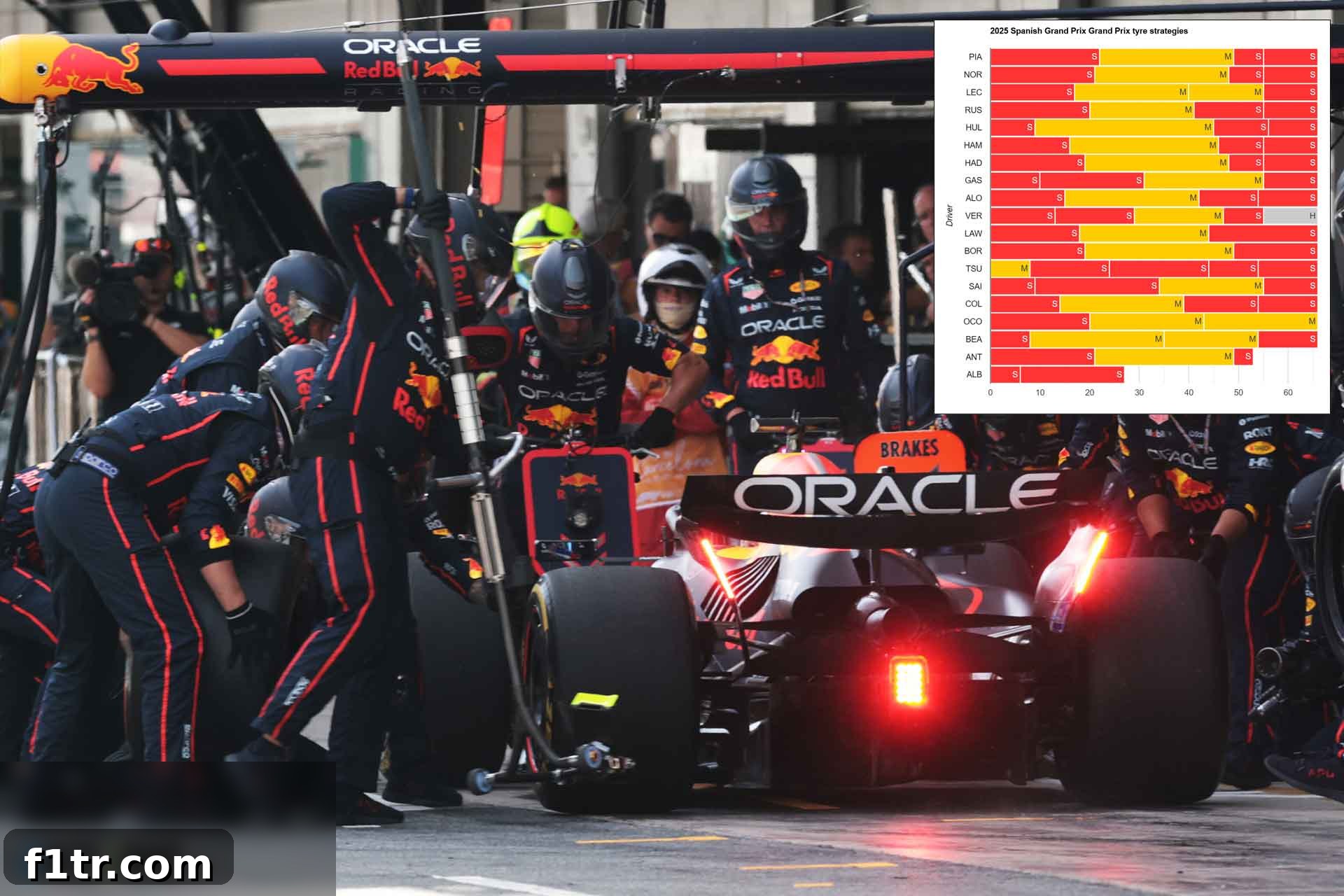
The 2025 Spanish Grand Prix proved to be a thrilling tactical battle, particularly for Red Bull and their star driver, Max Verstappen. Approaching the race with their characteristic boldness, Red Bull opted for an aggressive three-stop strategy for Verstappen, aiming to directly challenge the formidable pace of the McLarens.
Race Data Highlights:
- Lap Chart Overview
- Gaps Chart Analysis
- Detailed Lap Times
- Comprehensive Tyre Strategies
- Pit Stop Durations
This audacious strategy was designed to leverage Verstappen’s raw speed and the car’s performance by minimizing tyre degradation over shorter, faster stints on softer compounds. Starting the race, Verstappen and both McLaren drivers had four sets of soft tyres at their disposal – one new and three used. Red Bull’s plan hinged on maximizing performance with these softs, even if it meant more pit stops.
Echoing Verstappen’s strategic path, teammate Yuki Tsunoda, who started from the pit lane, mirrored the three-stop approach. In fact, Tsunoda’s early pit stops, including a notably short eight-lap first stint on medium tyres after passing Franco Colapinto alongside Carlos Sainz Jnr, almost foreshadowed Red Bull’s aggressive intentions and tyre management philosophy for the race. This demonstrated the team’s commitment to pushing the envelope from the outset, gauging tyre wear and performance limits.
Race winner Oscar Piastri of McLaren admitted to being impressed by how effectively Verstappen’s three-stop strategy initially unfolded. By lap 40, Verstappen had successfully closed the gap to the McLarens, pushing Lando Norris closer to his teammate Piastri. Red Bull’s gamble appeared to be paying dividends, with Verstappen firmly in contention for a podium finish, applying significant pressure on the leading duo.
However, as McLaren anticipated the optimal window for Verstappen’s final pit stop, Piastri responded by extracting maximum performance from his car, effectively putting the hammer down. By the time Red Bull decided it was opportune to pit Verstappen on lap 47, Norris had managed to establish a comfortable 4.4-second lead over the Red Bull, effectively negating any potential one-lap undercut threat. Piastri, already leading, extended his advantage even further over his teammate, showcasing McLaren’s astute race management and superior pace when it mattered most.
By lap 50, all three front-runners had completed their planned stops and resumed their positions, albeit with slightly reduced gaps due to the combined effect of strategic pit stops and the undercut. It was at this crucial juncture that an unforeseen event exposed the inherent vulnerability in Red Bull’s ambitious strategy: the retirement of Andrea Kimi Antonelli, which triggered a Safety Car period.
The timing of the Safety Car was nothing short of catastrophic for Red Bull. Suddenly, staying out on worn tyres presented an immense risk of being overtaken by competitors who would undoubtedly pit for fresh rubber. This exact scenario had played out dramatically in the Formula 2 sprint race just the day before, highlighting the critical importance of tyre advantage during restarts. The strategic landscape had shifted entirely, transforming a carefully planned three-stop into a high-stakes lottery.
Verstappen and the McLaren pair had all commenced the race with four sets of soft tyres. However, by this critical point, Verstappen had already completed three stints on softs – one more than both Norris and Piastri. Red Bull’s pit wall faced a grim realization: Verstappen’s final set of soft tyres, already designated for the run to the flag, were deemed too old and potentially compromised for a competitive sprint to the finish after a Safety Car restart. This put the team in an excruciating dilemma.

Red Bull was presented with two unenviable options: either remain on the severely worn soft tyres, inheriting the lead but facing an immediate and overwhelming threat from the McLarens on fresher rubber, or make a switch to his new set of hard tyres. The undesirability of the latter option was starkly evident; not a single other driver had touched the hard compound tyres throughout the entire race, underscoring their perceived lack of pace and grip on the Circuit de Barcelona-Catalunya.
Red Bull’s ultimate decision, to fit the hard tyres, will inevitably be scrutinized, particularly given Verstappen’s dramatic plunge from third place to a disappointing tenth at the checkered flag. However, the subsequent on-track performance of Verstappen post-restart also played a significant role. Arguments could be made that he possessed the raw pace to hold onto at least third, if not fourth, had he avoided a snap of oversteer at the exit of the final corner during the crucial restart. Once the initial chaos of the first corner subsided, Verstappen demonstrated sufficient speed to keep George Russell behind him.
The question of whether this hard tyre gamble was truly preferable to the alternative boils down to the perceived vulnerability of Verstappen on his aged soft tyres. If Red Bull’s strategists believed they could at least secure a safe third place on the hard compound, they must have harbored deep fears that remaining on the worn softs would have exposed Verstappen to an even greater risk of falling further down the order, potentially outside the points altogether. It was a calculated risk, but one that ultimately did not pay off.
Team Principal Christian Horner articulated the challenging situation, stating, “The Safety Car came out at the worst possible time for our strategy. We had to decide between staying out on older tyres and being exposed at the restart, or taking a gamble with the new set of hard tyres. Hindsight is always 20/20, but we made the best decision at the time with the information we had.” This emphasizes the split-second nature of F1 strategy and the cruel hand of fate that can derail even the most meticulously planned races.
The Red Bull team will undoubtedly conduct a thorough review to ascertain whether they made the optimal call under intense pressure. The incident serves as a stark reminder of the unpredictable nature of Formula 1 and how external factors can utterly redefine a race’s outcome, leaving teams to ponder the ‘what ifs’ long after the chequered flag.
2025 Spanish Grand Prix Lap Chart: A Visual Journey Through Positions
The lap chart provides a fascinating visual representation of each driver’s position throughout every lap of the race. For the 2025 Spanish Grand Prix, this chart would vividly illustrate the initial progression of Verstappen’s three-stop strategy, showing his climbs and descents around pit stops. More critically, it would highlight the sudden and dramatic drop in positions for Verstappen following the Safety Car restart and his switch to hard tyres, offering clear evidence of the strategic impact. Analyzing this chart allows fans to track overtakes, strategic plays, and the overall flow of the race from start to finish, identifying key moments of gain or loss for each competitor.
2025 Spanish Grand Prix Gaps Chart: Understanding the Race Dynamics
The gaps chart is an invaluable tool for understanding the relative performance and strategic gaps between drivers compared to the leader’s average lap time. For the 2025 Spanish Grand Prix, this chart would demonstrate how Verstappen’s initial strategy helped him close the gap to the McLarens, showcasing periods of intense pressure. The impact of the Safety Car would be immediately apparent, as it would compress the field, bringing all drivers closer together before the restart. Post-Safety Car, the chart would visually confirm the struggles faced by Verstappen on the hard tyres, as his gap to the leaders and immediate rivals would rapidly expand. This chart helps to pinpoint exactly when and where strategic decisions or incidents altered the race dynamic.
2025 Spanish Grand Prix Lap Times: Performance Under Scrutiny
A detailed breakdown of all driver lap times (excluding unusually slow laps) offers deep insights into individual performance and tyre effectiveness throughout the race. For this Grand Prix, the lap times chart would reveal the raw speed Verstappen could extract from the soft tyres during his aggressive stints, often outpacing his rivals before a pit stop. It would also clearly illustrate the comparatively slower pace he endured on the hard compound after the Safety Car, explaining his inability to defend positions effectively. Conversely, the McLarens’ consistent lap times, especially towards the end, would highlight their strong race pace and superior tyre management. Analyzing these times helps differentiate between car performance, driver skill, and the impact of various tyre compounds.
2025 Spanish Grand Prix Fastest Laps: Who Set the Pace?
Examining each driver’s fastest lap provides a snapshot of their car’s ultimate potential and their ability to extract peak performance on a given lap. Interestingly, George Russell set the two fastest pit stop times, indicating Mercedes’ efficiency in the pits, but Oscar Piastri ultimately claimed the fastest race lap, demonstrating McLaren’s dominant pace in race conditions. Max Verstappen’s fastest lap, though quick, occurred during a pit phase, highlighting the nature of his aggressive strategy. These fastest laps are crucial for understanding which teams and drivers had the absolute pace, even if race circumstances prevented them from translating it into a victory or higher finish.
| Rank | # | Driver | Team | Complete stop time (s) | Gap to best (s) | Stop no. | Lap no. |
|---|---|---|---|---|---|---|---|
| 1 | 63 | George Russell | Mercedes | 21.739 | 1 | 20 | |
| 2 | 63 | George Russell | Mercedes | 21.752 | 0.013 | 2 | 41 |
| 3 | 6 | Isack Hadjar | Racing Bulls | 21.769 | 0.03 | 1 | 19 |
| 4 | 1 | Max Verstappen | Red Bull | 21.802 | 0.063 | 3 | 47 |
| 5 | 22 | Yuki Tsunoda | Red Bull | 21.822 | 0.083 | 3 | 44 |
| 6 | 81 | Oscar Piastri | McLaren | 21.838 | 0.099 | 2 | 49 |
| 7 | 6 | Isack Hadjar | Racing Bulls | 21.841 | 0.102 | 3 | 55 |
| 8 | 27 | Nico Hulkenberg | Sauber | 21.849 | 0.11 | 2 | 45 |
| 9 | 81 | Oscar Piastri | McLaren | 21.858 | 0.119 | 1 | 22 |
| 10 | 16 | Charles Leclerc | Ferrari | 21.863 | 0.124 | 1 | 17 |
| 11 | 4 | Lando Norris | McLaren | 21.863 | 0.124 | 2 | 48 |
| 12 | 22 | Yuki Tsunoda | Red Bull | 21.868 | 0.129 | 1 | 8 |
| 13 | 1 | Max Verstappen | Red Bull | 21.869 | 0.13 | 1 | 13 |
| 14 | 43 | Franco Colapinto | Alpine | 21.874 | 0.135 | 3 | 54 |
| 15 | 16 | Charles Leclerc | Ferrari | 21.893 | 0.154 | 2 | 40 |
| 16 | 27 | Nico Hulkenberg | Sauber | 21.904 | 0.165 | 3 | 56 |
| 17 | 1 | Max Verstappen | Red Bull | 21.933 | 0.194 | 2 | 29 |
| 18 | 44 | Lewis Hamilton | Ferrari | 21.957 | 0.218 | 1 | 16 |
| 19 | 55 | Carlos Sainz Jnr | Williams | 21.984 | 0.245 | 3 | 55 |
| 20 | 10 | Pierre Gasly | Alpine | 22.006 | 0.267 | 2 | 31 |
| 21 | 87 | Oliver Bearman | Haas | 22.009 | 0.27 | 1 | 8 |
| 22 | 6 | Isack Hadjar | Racing Bulls | 22.019 | 0.28 | 2 | 48 |
| 23 | 30 | Liam Lawson | Racing Bulls | 22.039 | 0.3 | 1 | 18 |
| 24 | 5 | Gabriel Bortoleto | Sauber | 22.041 | 0.302 | 1 | 19 |
| 25 | 22 | Yuki Tsunoda | Red Bull | 22.056 | 0.317 | 2 | 24 |
| 26 | 43 | Franco Colapinto | Alpine | 22.119 | 0.38 | 2 | 39 |
| 27 | 30 | Liam Lawson | Racing Bulls | 22.127 | 0.388 | 2 | 44 |
| 28 | 1 | Max Verstappen | Red Bull | 22.197 | 0.458 | 4 | 55 |
| 29 | 14 | Fernando Alonso | Aston Martin | 22.216 | 0.477 | 3 | 54 |
| 30 | 10 | Pierre Gasly | Alpine | 22.224 | 0.485 | 1 | 10 |
| 31 | 27 | Nico Hulkenberg | Sauber | 22.233 | 0.494 | 1 | 9 |
| 32 | 12 | Andrea Kimi Antonelli | Mercedes | 22.234 | 0.495 | 1 | 21 |
| 33 | 14 | Fernando Alonso | Aston Martin | 22.242 | 0.503 | 2 | 42 |
| 34 | 87 | Oliver Bearman | Haas | 22.27 | 0.531 | 2 | 35 |
| 35 | 22 | Yuki Tsunoda | Red Bull | 22.283 | 0.544 | 4 | 54 |
| 36 | 55 | Carlos Sainz Jnr | Williams | 22.346 | 0.607 | 2 | 34 |
| 37 | 16 | Charles Leclerc | Ferrari | 22.383 | 0.644 | 3 | 55 |
| 38 | 4 | Lando Norris | McLaren | 22.454 | 0.715 | 1 | 21 |
| 39 | 31 | Esteban Ocon | Haas | 22.468 | 0.729 | 2 | 43 |
| 40 | 43 | Franco Colapinto | Alpine | 22.491 | 0.752 | 1 | 14 |
| 41 | 31 | Esteban Ocon | Haas | 22.554 | 0.815 | 1 | 20 |
| 42 | 81 | Oscar Piastri | McLaren | 22.748 | 1.009 | 3 | 55 |
| 43 | 87 | Oliver Bearman | Haas | 22.765 | 1.026 | 3 | 54 |
| 44 | 14 | Fernando Alonso | Aston Martin | 22.782 | 1.043 | 1 | 15 |
| 45 | 10 | Pierre Gasly | Alpine | 22.818 | 1.079 | 3 | 55 |
| 46 | 44 | Lewis Hamilton | Ferrari | 22.83 | 1.091 | 3 | 55 |
| 47 | 5 | Gabriel Bortoleto | Sauber | 22.953 | 1.214 | 2 | 49 |
| 48 | 63 | George Russell | Mercedes | 23.167 | 1.428 | 3 | 55 |
| 49 | 12 | Andrea Kimi Antonelli | Mercedes | 23.457 | 1.718 | 2 | 49 |
| 50 | 4 | Lando Norris | McLaren | 23.562 | 1.823 | 3 | 55 |
| 51 | 44 | Lewis Hamilton | Ferrari | 24.416 | 2.677 | 2 | 46 |
| 52 | 55 | Carlos Sainz Jnr | Williams | 30.547 | 8.808 | 1 | 9 |
| 53 | 23 | Alexander Albon | Williams | 30.823 | 9.084 | 1 | 6 |
2025 Spanish Grand Prix Tyre Strategies: A Deep Dive
Understanding each driver’s tyre strategy is fundamental to deciphering the tactical narratives of any Formula 1 race. The tyre strategies chart for the 2025 Spanish Grand Prix would explicitly show Red Bull’s commitment to multiple stints on soft tyres for Max Verstappen, highlighting their aggressive intent. In contrast, McLaren’s strategy would likely reveal a more balanced approach, potentially leveraging fewer stops or different compound combinations to manage tyre wear and track position. The impact of the Safety Car would be clearly visible, as some drivers might have made an unplanned stop for fresh tyres, shifting their intended strategy. This section helps to illustrate the delicate balance between tyre performance, degradation, and strategic timing, which ultimately determines a driver’s competitiveness.
2025 Spanish Grand Prix Pit Stop Times: The Race Against the Clock
Pit stop efficiency is a critical factor in modern Formula 1, capable of gaining or losing valuable seconds. The pit stop times table details how long each driver’s stops took, revealing which teams executed their stops flawlessly and which struggled. In the 2025 Spanish Grand Prix, analysing these times can reveal if Red Bull’s multiple pit stops for Verstappen were executed quickly enough to justify the aggressive strategy, or if any delays contributed to his final position. Quick pit stops can negate an undercut, while slow ones can undo a brilliant stint. This data provides another layer of performance analysis, evaluating the “human element” of the pit crew alongside driver and car performance.
| Rank | # | Driver | Car | Lap time | Gap | Avg. speed (kph) | Lap no. |
|---|---|---|---|---|---|---|---|
| 1 | 81 | Oscar Piastri | McLaren-Mercedes | 1’15.743 | 221.34 | 61 | |
| 2 | 4 | Lando Norris | McLaren-Mercedes | 1’16.187 | 0.444 | 220.05 | 61 |
| 3 | 1 | Max Verstappen | Red Bull-Honda RBPT | 1’17.019 | 1.276 | 217.68 | 62 |
| 4 | 63 | George Russell | Mercedes | 1’17.244 | 1.501 | 217.04 | 62 |
| 5 | 16 | Charles Leclerc | Ferrari | 1’17.259 | 1.516 | 217 | 62 |
| 6 | 27 | Nico Hulkenberg | Sauber-Ferrari | 1’17.575 | 1.832 | 216.12 | 63 |
| 7 | 44 | Lewis Hamilton | Ferrari | 1’17.706 | 1.963 | 215.75 | 62 |
| 8 | 6 | Isack Hadjar | Racing Bulls-Honda RBPT | 1’17.770 | 2.027 | 215.57 | 63 |
| 9 | 10 | Pierre Gasly | Alpine-Renault | 1’17.896 | 2.153 | 215.23 | 63 |
| 10 | 22 | Yuki Tsunoda | Red Bull-Honda RBPT | 1’17.998 | 2.255 | 214.94 | 46 |
| 11 | 14 | Fernando Alonso | Aston Martin-Mercedes | 1’18.128 | 2.385 | 214.59 | 66 |
| 12 | 12 | Andrea Kimi Antonelli | Mercedes | 1’18.255 | 2.512 | 214.24 | 52 |
| 13 | 5 | Gabriel Bortoleto | Sauber-Ferrari | 1’18.297 | 2.554 | 214.12 | 51 |
| 14 | 43 | Franco Colapinto | Alpine-Renault | 1’18.353 | 2.610 | 213.97 | 41 |
| 15 | 31 | Esteban Ocon | Haas-Ferrari | 1’18.624 | 2.881 | 213.23 | 46 |
| 16 | 87 | Oliver Bearman | Haas-Ferrari | 1’18.907 | 3.164 | 212.47 | 63 |
| 17 | 55 | Carlos Sainz Jnr | Williams-Mercedes | 1’19.317 | 3.574 | 211.37 | 65 |
| 18 | 30 | Liam Lawson | Racing Bulls-Honda RBPT | 1’19.424 | 3.681 | 211.08 | 62 |
| 19 | 23 | Alexander Albon | Williams-Mercedes | 1’20.508 | 4.765 | 208.24 | 9 |
More on the 2025 Spanish Grand Prix:
- Verstappen: Don’t blame Spanish GP penalty for hitting Russell if I narrowly lose title
- Russell’s radio comments influenced Red Bull’s decision to let him past Verstappen
- Verstappen says he won’t make any changes to his driving to avoid a ban
- ‘No issues’ with Verstappen but ‘it’d be different if he’d taken me out’ – Russell
- Ferrari “don’t want us to talk much” about “massive” Spanish GP problems – Hamilton
Browse all 2025 Spanish Grand Prix articles