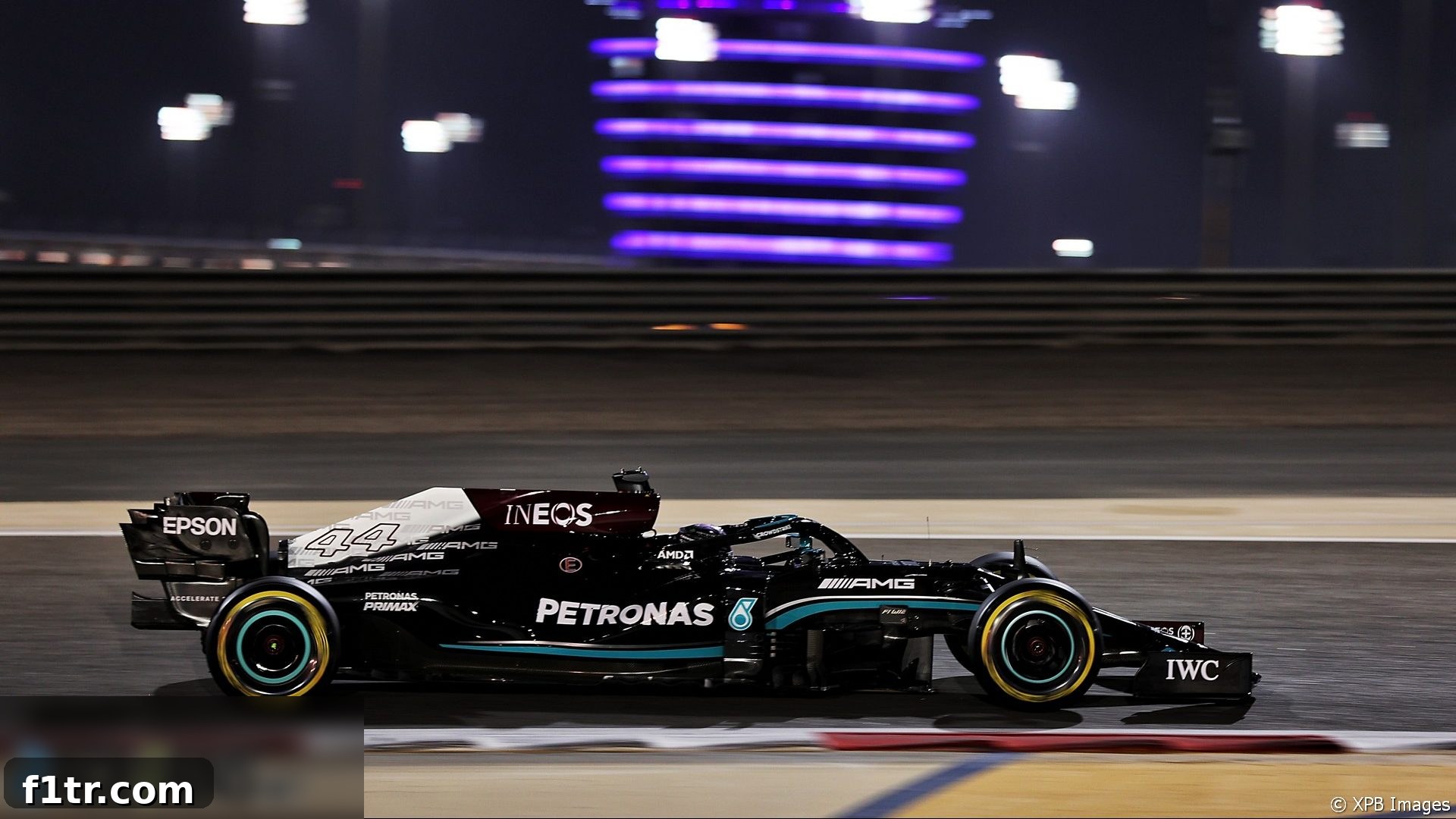
Lewis Hamilton, the reigning Formula 1 World Champion, delivered a candid assessment of Mercedes’ early performance in the 2021 season, stressing the critical need to enhance the W12 car’s rear-end stability. His comments followed the Friday practice sessions for the Bahrain Grand Prix, where despite securing the third-fastest time, underlying issues persisted. The veteran driver’s observations highlight a challenging start for Mercedes, a team that has dominated the sport for the better part of a decade, as they navigate significant regulatory changes and fierce competition.
Advert | Become a Supporter & go ad-free
The journey to the Bahrain Grand Prix has been anything but smooth for Hamilton and his Mercedes team. During the three-day pre-season test held at the Bahrain International Circuit, the seven-time world champion appeared noticeably uncomfortable with his new machine. This unease stemmed largely from a set of off-season rule adjustments specifically targeting the reduction of rear downforce. These changes, primarily involving cuts to the floor of the car, were intended to slow down the cars and, inadvertently, seem to have impacted Mercedes more profoundly than many of their rivals. Hamilton himself had previously voiced concerns, suggesting that the “rear grip doesn’t feel too great with these new regulations,” an observation that set the stage for a potentially arduous start to their championship defense.
Friday’s practice offered a glimpse of progress, albeit under more stable track conditions which undoubtedly aided the car’s behaviour. Hamilton acknowledged the efforts made by the team since the pre-season test. “Obviously coming into this weekend we’ve done a lot of work in the past week and I think we have taken a step forward, but we still have more to do,” he stated after the sessions. This cautious optimism underscores the arduous task facing the Brackley-based squad as they strive to unlock the full potential of their W12 challenger. The inherent balance of the car has been fundamentally altered by the reduced downforce and changes to tyre compounds, moving it away from the optimal window the team is accustomed to. While improvements were evident, the pursuit of perfection remains ongoing.
When pressed on the key areas for Mercedes to concentrate on for qualifying and the race, Hamilton’s answer was succinct and telling: “Stability.” He elaborated on the profound importance of this characteristic in modern Formula 1. “It’s all about having a stable car, and knowing how to make the tyres last. That’s going to be key in this climate and the wind that we have here.” A stable car not only grants the driver greater confidence to push closer to the limit but also allows for more consistent tyre management, a crucial factor in the energy-sensitive world of F1. The ability to extract maximum performance from the tyres over a race distance, without overheating or excessive wear, often dictates the outcome of a Grand Prix. The unique environmental challenges of Bahrain, particularly the blustery winds and the ever-present threat of sandstorms, further complicate this delicate balancing act, making car stability an even more prized asset.
Indeed, the weather forecast for the remainder of the Bahrain Grand Prix weekend paints a challenging picture for Mercedes. Blustery winds and possible sandstorms are anticipated, conditions that Hamilton described as “not great” for his team. These adverse conditions exacerbate the inherent stability issues Mercedes is battling, as they work relentlessly to claw back the vital downforce lost due to the 2021 regulation changes. The interplay between aerodynamics and unpredictable wind gusts can turn a marginally unstable car into a handful, pushing drivers beyond their comfort zones and making precision driving incredibly difficult. For a team like Mercedes, whose previous successes were often built on a finely tuned, predictable aerodynamic platform, this represents a significant hurdle.
Hamilton further articulated the sensation of driving a car with a compromised rear end. “The rear is unstable as it is, but everyone I’m sure will be in the same boat, some more and some less [with the wind],” he explained, acknowledging that all teams are grappling with the new regulations to some degree. However, the degree of impact varies, and Mercedes appears to be on the more challenging end of that spectrum. He highlighted the crucial concept of the “tipping point” when approaching a corner. This is the moment where the car’s grip limit is reached, and the rear begins to slide. “But the tipping point used to be further away with more downforce on the car, now it falls away much quicker than usual.” This reduced margin for error means drivers have less time to react and correct, demanding an even higher level of precision and control. The performance loss from the 2021 Pirelli tyres, designed to be more robust but potentially less grippy, only compounds this challenge, making the task of achieving optimal car balance even more complex.
The competitive landscape revealed during Friday practice was also a point of discussion for Hamilton. Red Bull Racing, long considered Mercedes’ closest competitor, once again demonstrated formidable pace. “We thought Red Bull would be as fast as they are, if not faster. So we know they’re leading at the moment,” Hamilton conceded, acknowledging the impressive form of their rivals. Max Verstappen and his team have consistently shown strength during pre-season testing and the initial practice sessions, suggesting a genuine title challenge is on the cards. Equally notable was the strong showing from McLaren, who appeared to have made significant strides forward. “McLaren are looking great, and it’s great to see them taking a step,” Hamilton observed. The Woking-based outfit, now powered by Mercedes engines, displayed excellent speed, signaling their ambition to firmly establish themselves at the sharp end of the midfield, and potentially challenge the top two teams on occasion. The longer runs in practice, which offer a truer indication of race pace and tyre degradation, would be crucial for a more comprehensive understanding of the competitive hierarchy.
However, the relevance of Saturday’s third practice session for race pace analysis at Bahrain is nuanced. This session takes place during daylight hours, meaning track temperatures will be considerably higher than during Saturday’s evening qualifying or Sunday’s twilight race. Consequently, the long-run data gathered in FP3 won’t entirely mirror the cooler conditions expected for the Grand Prix. Mercedes team principal Toto Wolff underscored this challenge, revealing that the W12 hadn’t performed as optimally in the lower evening temperatures witnessed during Friday’s second practice session, which is more representative of race conditions. “The night has fallen and the conditions haven’t come towards us,” Wolff told Sky Sports. This suggests that as temperatures drop, the car’s handling characteristics might shift, potentially affecting tyre warm-up, grip levels, and overall balance. This sensitivity to temperature variations adds another layer of complexity to Mercedes’ engineering challenge.
Wolff’s candid assessment painted a picture of an incredibly tight field, describing the competition as a “real dogfight.” He emphasized the marginal differences between teams. “When you overlay the fastest laps, and even the long runs, it’s just so very close that every kilogram in fuel load can make quite a big swing. So we don’t really know [where we are].” This statement highlights the intensity of the F1 grid in 2021, where minute details and precise execution will be paramount. The slightest error in strategy, setup, or driver performance could easily tip the balance between victory and defeat. For Mercedes, accustomed to having a comfortable performance buffer, this newfound equilibrium demands flawless operation across all fronts. The early races of the season will be crucial in understanding the true pecking order and identifying which teams have best adapted to the new regulations and the specific challenges of each circuit.
The battle for the 2021 Formula 1 World Championship promises to be one of the most enthralling in recent memory, and Lewis Hamilton’s comments from Bahrain practice sessions lay bare the intricacies of this high-stakes contest. The pursuit of optimal rear-end stability for the Mercedes W12 is not merely a technical adjustment; it’s a fundamental challenge that impacts every aspect of the car’s performance, from outright pace to critical tyre management and driver confidence. The team’s ability to meticulously analyze data, refine their setup, and adapt to varying track and environmental conditions will be the ultimate determinant of their success. With Red Bull and McLaren showing strong early form, the pressure is squarely on Mercedes to quickly unlock the W12’s full potential and address its handling vulnerabilities. As the lights prepare to go out for the Bahrain Grand Prix, the opening chapter of this thrilling season will reveal just how effectively the reigning champions can overcome these initial hurdles and reassert their dominance.
Advert | Become a RaceFans supporter andgo ad-free
Related 2021 Bahrain Grand Prix Articles
- Why one driver says there’s no easy solution to F1’s ‘messy’ track limits problem
- Verstappen: Lost win in Bahrain “is not going to matter” if we have fastest car
- The classic rivalry for ‘best of the rest’ and six more Imola talking points
- Ocon: We need to extract the maximum from the car to score points
- Vettel feeling “not at home in the car yet” after tough weekend
Browse all 2021 Bahrain Grand Prix articles