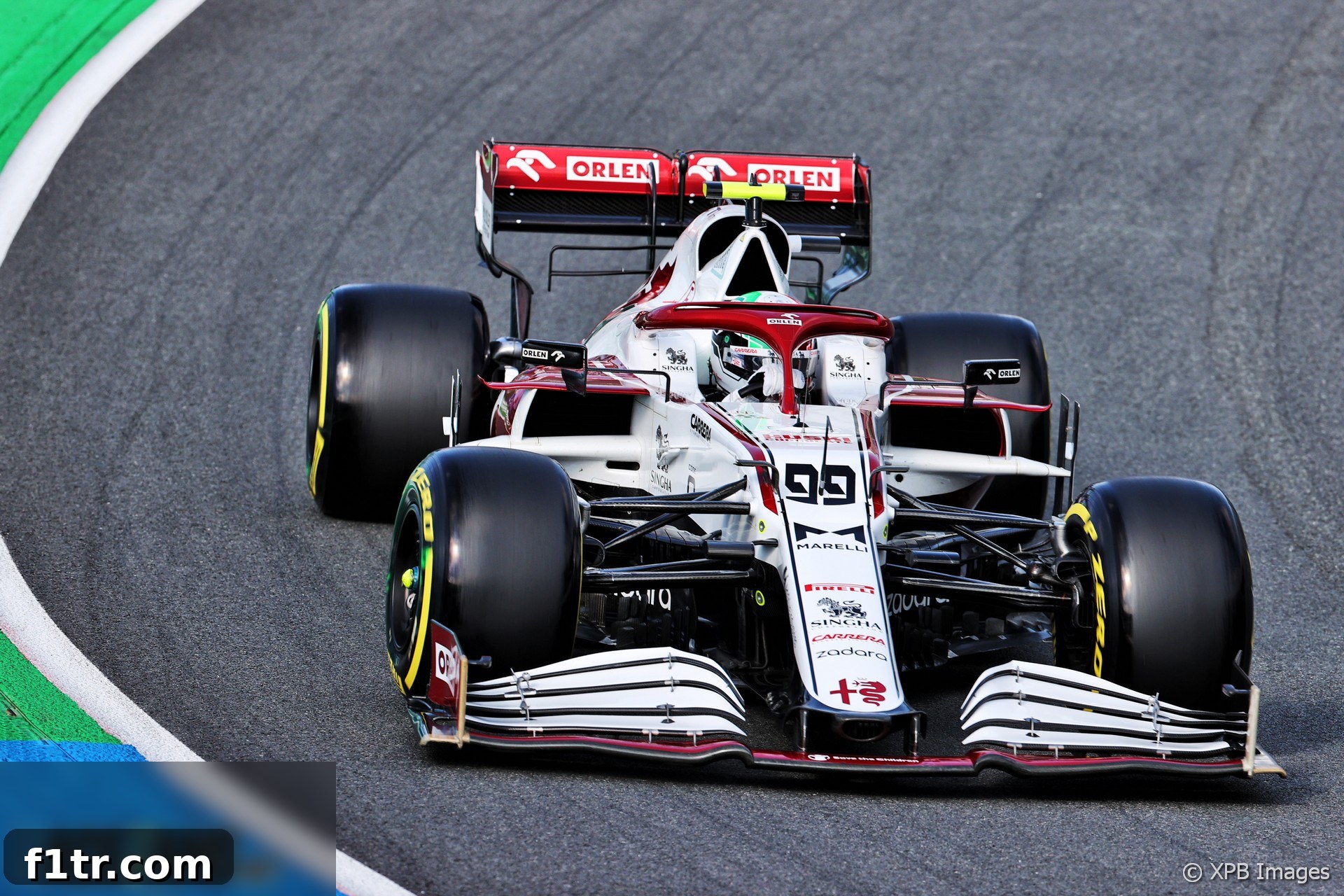
Antonio Giovinazzi’s Dutch Grand Prix: A Tale of Unfulfilled Potential and Cruel Fortune
The 2021 Dutch Grand Prix at Zandvoort presented a unique challenge and a rare opportunity for many drivers, including Alfa Romeo’s Antonio Giovinazzi. After securing a season-best seventh position on the grid, hopes were high for the Italian driver to finally break into the points. However, his aspirations were cruelly dashed by a mysterious right-rear tyre puncture just before the halfway mark of the race, effectively ending what had been a remarkably strong showing up to that point.
A Promising Start Derailed: Giovinazzi’s Strong Qualifying and Initial Race Pace
The weekend at Zandvoort had started exceptionally well for Giovinazzi. Known for his raw speed and qualifying prowess, he put in a stellar performance during Saturday’s qualifying session to line up seventh, ahead of established talents and much-fancied competitors. This was not only his best qualifying result of the 2021 season but also a significant boost for an Alfa Romeo team that had largely struggled for consistent performance throughout the year. Starting from such a strong position offered a legitimate chance to score valuable championship points, a commodity that had been scarce for both Giovinazzi and his team.
As the lights went out for the Dutch Grand Prix, Giovinazzi held his nerve amidst the chaotic opening laps. He successfully navigated the tight and challenging corners of the Zandvoort circuit, maintaining a position within the top ten. Before his scheduled first pit stop, he was running comfortably in 10th place, right in the mix for what would have been a well-deserved point-scoring finish. The team’s strategy appeared sound, and Giovinazzi’s pace was competitive, hinting at a potential breakthrough performance that could reshape perceptions of his season.
The Unseen Threat: A Crucial Puncture Ends Point Hopes
The race trajectory, which had looked so promising, took a dramatic and unforeseen turn just six laps into his stint on the medium compound tyres. A right-rear tyre puncture forced Giovinazzi to make an unscheduled pit stop, ripping away any chance of securing points. “We had a puncture on the rear-right, but we don’t know why,” Giovinazzi explained, his voice laced with clear disappointment. “I think after that, the race was over because we’d done one stop more than the others and then it was just difficult.”
This unexpected tyre failure was a devastating blow. In Formula 1, an extra pit stop almost invariably ruins a driver’s strategy, especially on a circuit like Zandvoort where track position is paramount and overtaking is notoriously difficult. The time lost in the pit lane, combined with the need to claw back positions from the rear of the field, created an insurmountable challenge. Giovinazzi firmly believed that without this setback, points were well within his grasp. “We were in the points at that moment,” he reiterated, highlighting the bitter taste of what could have been. “So tricky to say, but up until that moment, we were in the points.” The incident served as a stark reminder of the fine margins in Formula 1, where a single, unpredictable event can completely alter the outcome of a race, irrespective of a driver’s prior performance or potential.
Opening Lap Scramble: Contact with Fernando Alonso
The Dutch Grand Prix was not without its moments of intense on-track action, particularly during the opening lap. Antonio Giovinazzi found himself embroiled in a frantic battle for position, making minor contact with Alpine’s Fernando Alonso. The incident occurred as the pair charged down towards the high-speed Scheivlak corner, a challenging section of the Zandvoort circuit known for its sweeping, uphill nature and limited run-off.
“We were in turn three and then on the straight and then I had touch with Fernando,” Giovinazzi recounted, downplaying the significance of the minor contact. While such incidents are often par for the course in the opening laps of a Grand Prix, especially on a tight circuit like Zandvoort, they underscore the competitive intensity and the high stakes involved in gaining track position early on. Fortunately, the contact did not result in significant damage to either car, allowing both drivers to continue their race. However, it added another layer of complexity to Giovinazzi’s already challenging afternoon, highlighting the constant pressure drivers face to navigate both their rivals and the circuit itself.
Navigating the Zandvoort Labyrinth: A Circuit of Unique Challenges
The return of the Dutch Grand Prix to the Formula 1 calendar at the extensively remodelled Zandvoort circuit was met with immense excitement, particularly given the passionate home crowd for Max Verstappen. However, the circuit itself presented a unique set of challenges that significantly impacted race dynamics and drivers’ ability to make progress through the field. Giovinazzi was quick to echo the sentiments of many drivers regarding the difficulty of overtaking on the tight and twisty course.
“It’s difficult, especially to follow,” he stated, explaining the aerodynamic complexities that make it hard for cars to maintain close proximity to one another. The modern Formula 1 cars generate significant downforce, but this also means they create turbulent air, known as ‘dirty air’, which severely compromises the aerodynamic efficiency of a following car. This effect was particularly pronounced at Zandvoort, a circuit characterised by its high-speed corners and narrow sections.
Giovinazzi specifically highlighted Turns Seven, Eight, and Nine – the Scheivlak, Mastersbocht, and Bocht 11 sequence – as being “just terrible” for following. This segment of the track is a series of fast, flowing corners that demand absolute precision and grip. In dirty air, cars lose vital downforce, leading to understeer and a struggle for traction, making any attempt to stay close to the car ahead, let alone overtake, incredibly risky and often futile. The lack of straights long enough to truly utilise DRS (Drag Reduction System) or to build up significant speed differentials further compounded the problem, reducing the number of genuine overtaking opportunities throughout the race. The unique banking of corners like the Tarzanbocht and Arie Luyendykbocht, while visually spectacular, didn’t inherently create more overtaking zones in the way some might have hoped, rather adding to the technical demands on the drivers.
Alfa Romeo’s Season and Giovinazzi’s Enduring Fight
The 2021 season was a challenging one for Alfa Romeo. Despite flashes of potential, the team often found itself battling in the lower midfield, making every point a hard-fought achievement. For Antonio Giovinazzi, who was fighting to secure his future in Formula 1, strong performances and point-scoring finishes were paramount. His seventh-place qualifying in Zandvoort and his initial race pace showcased his capabilities, proving that he could extract performance when the car allowed and when conditions were right. The cruel puncture was not just a loss of points for him personally, but also a missed opportunity for Alfa Romeo to gain crucial ground in the Constructors’ Championship.
Despite the unfortunate outcome, Giovinazzi’s performance at the Dutch Grand Prix underscored his talent and determination. In a sport where luck plays as significant a role as skill, Giovinazzi experienced the harsh realities of misfortune. While the points evaded him, the demonstration of speed and race craft undoubtedly served as a reminder of his potential within the sport. His ability to qualify so strongly and maintain a points-scoring position against formidable opposition speaks volumes about his capabilities, even if the ultimate reward was snatched away by an unforeseen technical issue.
Looking Ahead: Lessons from Zandvoort
The 2021 Dutch Grand Prix will be remembered by Antonio Giovinazzi as a race of what-ifs. It was a race that promised so much, only to deliver profound disappointment due to circumstances beyond his control. Yet, from every challenge comes a lesson. For Giovinazzi, it reinforced his belief in his own abilities and the team’s potential, despite the setbacks. For Alfa Romeo, it highlighted the need for reliability and perhaps a touch more luck to convert strong performances into tangible championship points.
While the immediate frustration of lost points was palpable, Giovinazzi’s strong showing at Zandvoort, particularly his impressive qualifying, served as a testament to his raw talent and commitment. It painted a picture of a driver capable of delivering when given the opportunity, even if cruel fortune sometimes intervened. The narrative of his 2021 Dutch Grand Prix is a classic F1 tale: a blend of high hopes, fierce competition, and the unpredictable nature of motorsport that can elevate or crush aspirations in an instant.