Mick Schumacher’s Baku Nightmare: Porpoising Blamed for Catastrophic Water Leak and Driver Discomfort
The exhilarating yet unforgiving Baku City Circuit once again proved to be a challenging battleground for Formula 1 teams, particularly during the initial practice sessions of the 2022 Azerbaijan Grand Prix. For Mick Schumacher, the opening session took an early and dramatic turn when a significant water leak forced his Haas VF-22 to a halt. The culprit, according to Schumacher himself, was the violent ‘porpoising’ – the aerodynamic bouncing phenomenon – exacerbated by the high speeds and notoriously bumpy surface of the street circuit.
The return of ground effect aerodynamics in the 2022 regulations brought with it the re-emergence of porpoising, a historical issue that has plagued teams throughout the season. While various teams have grappled with its effects, the problem appeared especially pronounced for the Haas drivers in Baku, a track characterized by its long, high-speed straights and a less-than-smooth asphalt. This unique combination of factors pushed the limits of the new generation of F1 cars, leading to dramatic and visually striking bouncing.
The Incident: A Sudden Stop for Schumacher
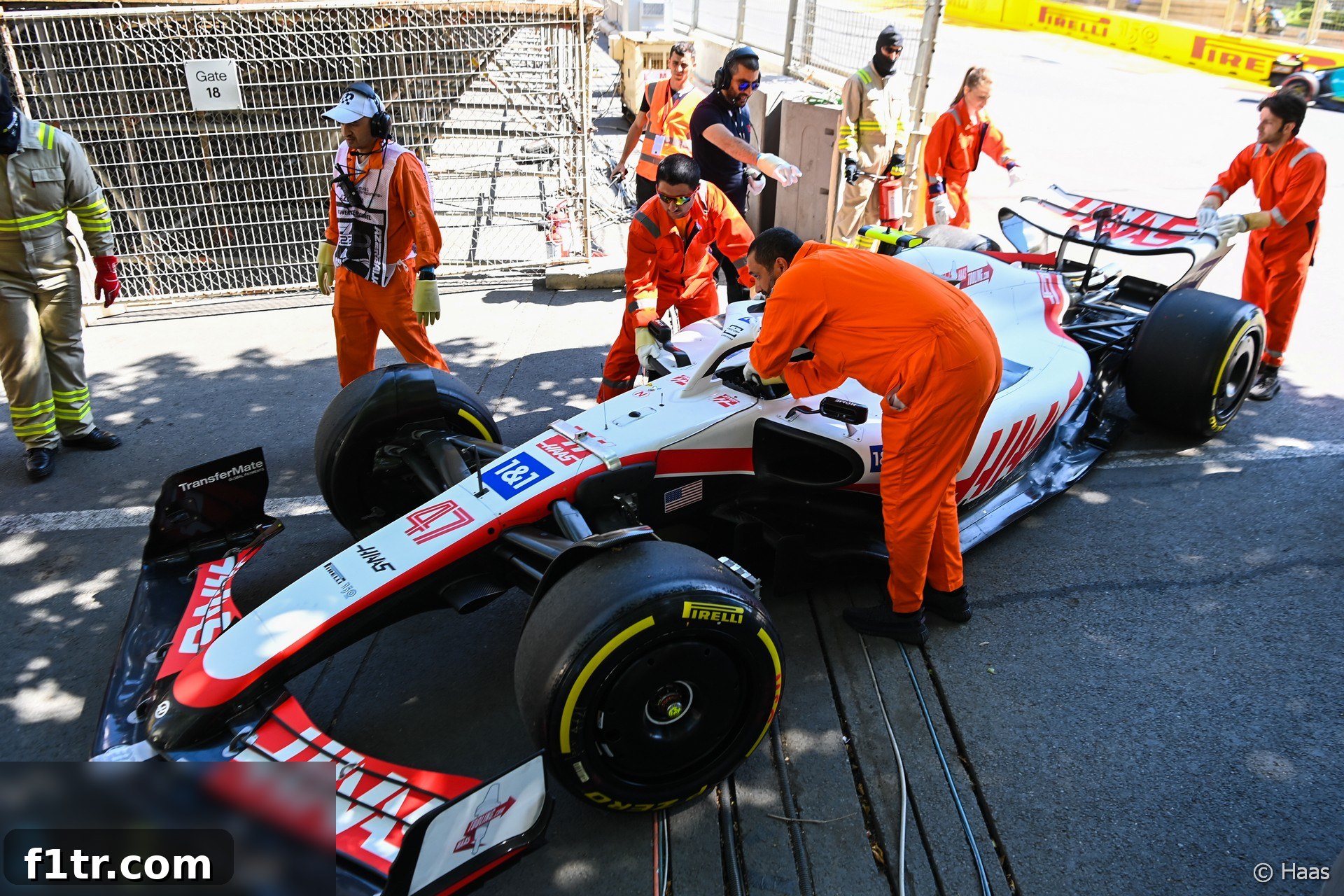
Schumacher’s unfortunate incident unfolded early in the first practice session (FP1). After enduring a particularly heavy jolt upon hitting a bump – an impact that occurred as Yuki Tsunoda passed him – he immediately reported a problem with his car. The team swiftly instructed him to stop, and as he pulled over, fluid was visibly gushing from the side of his VF-22. It was a disheartening end to his session, costing him crucial track time and data on a circuit where every lap is invaluable for setup optimization.
“There were no warning signs,” Schumacher later explained, detailing the sudden nature of the failure. “It seems like, from what we know, it comes from the heavy bouncing that we suffered in the first lap. It just broke the clamp, and then the water came out, which obviously isn’t great.” This diagnosis highlighted the severe mechanical stress inflicted upon the car by the persistent porpoising, turning a complex aerodynamic issue into a tangible and costly mechanical failure.
The Toll of Porpoising: Physical and Mechanical Strain
Porpoising, far from being a mere aesthetic quirk, presents significant challenges for both car and driver. Aerodynamically, it disrupts the flow under the car, causing inconsistent downforce and making the car unstable, particularly at high speeds. This directly impacts performance, as drivers struggle to find a consistent rhythm and push the car to its limits. However, the consequences extend far beyond lap times.
For the drivers, the constant jarring and vertical acceleration take a significant physical toll. Schumacher explicitly stated, “It’s the first time physically that I do feel an effect of [porpoising]. It’s quite harsh on the body and also on the car.” Drivers have reported experiencing headaches, back pain, and even impaired vision due to the violent oscillations. This physical discomfort not only affects their immediate performance but also raises long-term health concerns, prompting calls for action from the sport’s governing body.
Mechanically, the repeated, violent impacts place immense strain on every component of the car. From suspension linkages and floor structures to engine mounts and cooling systems, the constant pounding can lead to fatigue and failure, as evidenced by Schumacher’s water leak. The fragile balance of a Formula 1 car, designed to operate within incredibly tight tolerances, is fundamentally challenged by forces it was not engineered to withstand on a sustained basis.
Call for Resurfacing: A Safer Future for Baku?
The severity of the porpoising in Baku led Schumacher to suggest a proactive measure for future events. He proposed that the street circuit, notorious for its uneven surfaces, should be relaid before Formula 1 returns in subsequent seasons. “So it’s definitely something to think about for future events if we come back here to maybe have a think about resurfacing,” he asserted, underlining the importance of driver safety and car reliability.
The call for resurfacing is not unprecedented in F1. Circuits have often undergone upgrades to improve safety and racing quality. However, resurfacing a complex street circuit like Baku presents unique logistical and financial challenges. Despite this, the comments from drivers like Schumacher underscore a growing concern within the paddock about the combined effects of the new regulations and certain track characteristics. The candid remark, “We’ll see how many cars will survive the race,” further highlighted the apprehension among competitors regarding the durability of their machinery and their own physical well-being over a full race distance.
The debate around track conditions and car design highlights the dynamic interplay between circuit demands, aerodynamic regulations, and driver welfare. As F1 continues to evolve, finding the right balance between challenging circuits and safe, reliable racing remains a paramount consideration.
Haas’s Perspective: A Close Call for Magnussen and Performance Woes
Team Principal Guenther Steiner echoed Schumacher’s concerns and provided further insight into the team’s challenging start to the weekend. He revealed that the team was fortunate to avoid a similar catastrophic failure on their other car, driven by Kevin Magnussen.
“FP1 started badly with the water leak on Mick’s car – he couldn’t go out – which is not good at a track like this,” Steiner commented, acknowledging the immediate setback. “Something strange happened and actually we’re lucky the same thing didn’t happen to Kevin as he was very close to having it happen as well, so we fixed it for FP2.” This revelation indicated that the issue wasn’t an isolated incident for Schumacher’s car but rather a potential design vulnerability exacerbated by Baku’s unique demands. The swift action to address the problem on Magnussen’s car before FP2 was a testament to the team’s quick analysis and damage control.
Despite the repairs, the day proved to be a struggle for the American outfit. Both Haas drivers finished the day towards the back of the pack, with Schumacher in 19th and Magnussen in 17th, only ahead of the two Williams cars. This disappointing performance came as a surprise, especially after Steiner initially expressed optimism about their FP1 performance.
“FP1 was actually pretty good,” Steiner noted, highlighting the deceptive nature of the early session. “We then made some changes for FP2 and we didn’t perform as we planned to perform. So we need to go back to the drawing board a little bit overnight and see what we can do for tomorrow to be able to get some performance into the car.” The team’s inability to translate their FP1 findings into improved performance for FP2 signaled a fundamental struggle with understanding and optimizing their car’s setup, likely complicated by the persistent porpoising and the need to manage potential reliability issues.
Looking Ahead: The Challenges of an F1 Race Weekend
The Azerbaijan Grand Prix weekend posed a significant challenge for Haas. Lost track time for Schumacher in FP1 meant less data acquisition for setup adjustments, putting the team at a disadvantage for qualifying and the race. The need to address reliability concerns while simultaneously trying to extract performance from a porpoising car is a delicate balancing act that smaller teams, in particular, find arduous.
As the F1 season progresses, the issue of porpoising and its impact on driver safety and car integrity continues to be a central topic of discussion. The FIA, the sport’s governing body, has indicated that it is monitoring the situation closely and is prepared to intervene with regulatory changes if the safety risks are deemed too high. Incidents like Schumacher’s water leak in Baku serve as stark reminders that while Formula 1 constantly pushes the boundaries of engineering and speed, driver well-being and car reliability must remain at the forefront of development and circuit design.
2022 Azerbaijan Grand Prix: Further Reading
- FIA should black-flag cars if their porpoising endangers drivers’ safety – Horner
- Transcript: Why Norris reluctantly complied with McLaren’s Baku team orders
- Montreal is “going to hurt” in stiff 2022 cars say drivers hoping for bouncing fix
- Leclerc was heading to a ‘comfortable win’ before retirement – Ferrari
- F1 should penalise those who ‘obviously’ slow on purpose in qualifying – Norris
Browse all 2022 Azerbaijan Grand Prix articles