Penalties and Controversies: A Deep Dive into the 2021 Austrian Grand Prix Incidents
The 2021 Formula 1 season delivered relentless excitement and drama, and the Austrian Grand Prix at the iconic Red Bull Ring was no exception. Amidst a thrilling battle for crucial championship points, the race was overshadowed by a series of contentious incidents that led to significant penalties for two of the grid’s most prominent drivers: Lando Norris of McLaren and Sergio Perez of Red Bull Racing. Together, they accumulated a total of three time penalties and several critical penalty points, sparking widespread debate among fans and pundits about track limits, racing etiquette, and the consistency of stewarding decisions in Formula 1.
Advert | Become a Supporter & go ad-free
These penalties, all stemming from drivers being judged to have forced a competitor off-track, began early in the race. The first major flashpoint occurred on lap three, involving an intense skirmish between Norris and Perez. This initial clash set the tone for a Grand Prix that would see the stewards’ office become as busy as the pitlane.
The Opening Salvo: Norris vs. Perez at Turn 4
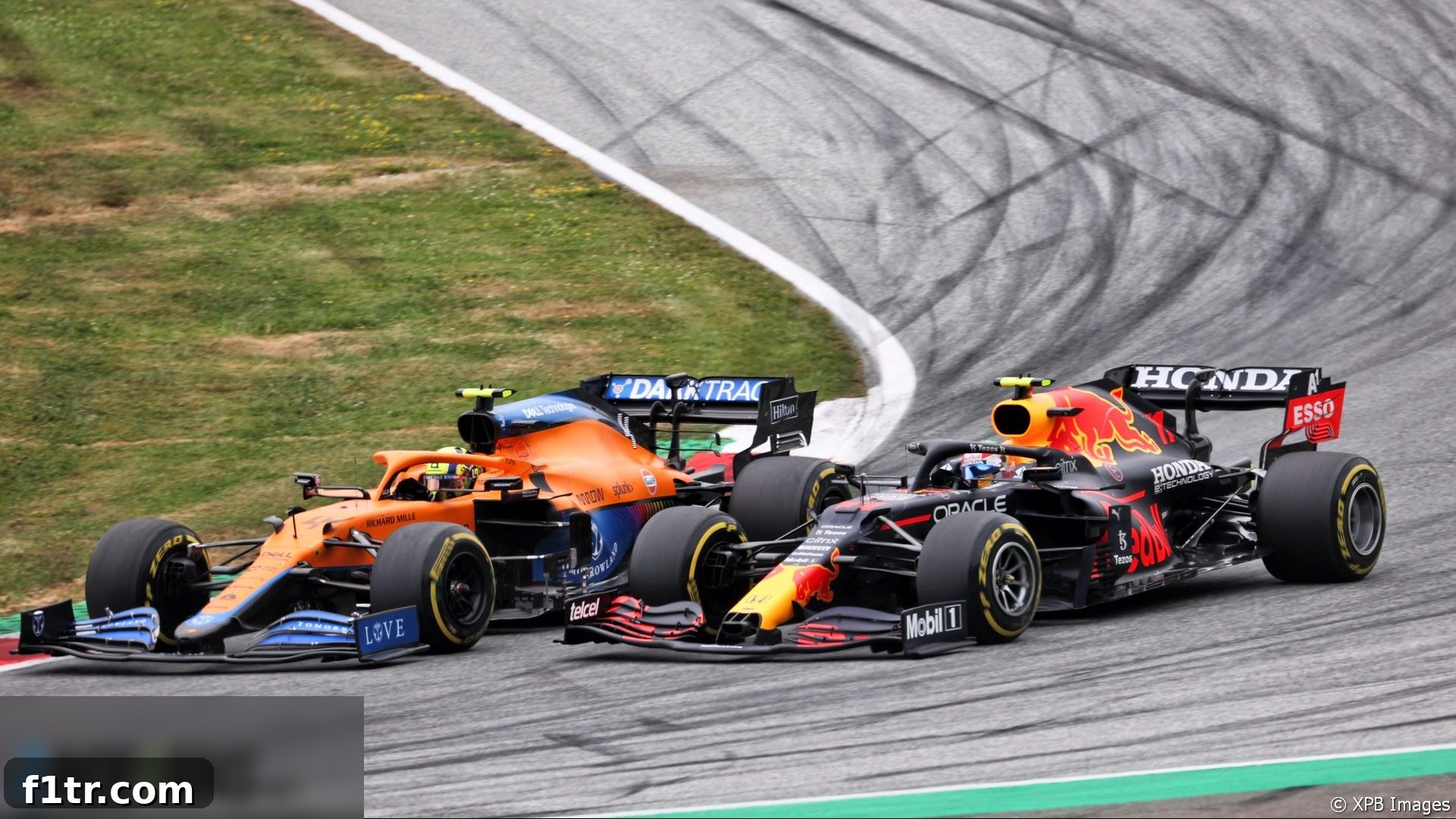
Following a Safety Car restart, the battle for second position ignited with fierce intensity. As the cars streamed into the challenging Turn 4, Lando Norris, positioned on the inside line, and Sergio Perez found themselves side-by-side, each fighting for every inch of tarmac. Norris, known for his aggressive yet usually fair racing style, pushed to the limits of the corner. However, as the McLaren driver ran wide towards the exit, Perez, on the outside, found himself with nowhere to go. The Red Bull driver was unceremoniously forced onto the gravel trap, a moment that sent gasps through the paddock and grandstands alike.
The immediate consequence for Perez was severe; he lost seven crucial places, plummeting from a potential podium position to tenth. This incident not only disrupted his race significantly but also brought the focus squarely onto the delicate balance between hard racing and exceeding the unwritten rules of engagement. The stewards swiftly announced an investigation, a process that felt particularly lengthy, keeping teams and fans on tenterhooks about the impending verdict.
Approximately 20 laps into the race, the official verdict arrived: Lando Norris was deemed culpable. The stewards ruled that Norris “was judged not to give [Perez] enough room and [Perez] was forced off the track.” This decision resulted in a five-second time penalty for Norris, which he duly served during his subsequent pit stop. While serving the penalty on track, Norris’s team worked efficiently, minimising the time loss, yet the penalty itself remained a significant dent in his race strategy and overall performance.
Beyond the time penalty, Norris also received two penalty points on his Super Licence. This pushed his cumulative total to ten points, leaving him precariously close to an automatic race ban, which is triggered upon reaching twelve points within a twelve-month period. The looming threat of a ban added a layer of tension to Norris’s already high-pressure season. Thankfully for the British driver, two points were scheduled to be deducted from his licence on July 10th, prior to the British Grand Prix, bringing his total down to eight and offering a slight reprieve from the immediate danger of suspension.
Perez’s Double Dilemma: Clashes with Charles Leclerc
The drama, however, was far from over, and ironically, Sergio Perez would soon find himself on the other side of similar infractions. Later in the race, the Red Bull driver became embroiled in two separate incidents with Charles Leclerc of Ferrari, both mirroring the circumstances of his earlier clash with Norris and each resulting in further penalties.
The first incident occurred at the notorious Turn 4, the very corner that had claimed Perez’s earlier misfortune. In a parallel scenario, Perez was judged to have forced Leclerc wide, pushing the Ferrari driver off the racing line and onto the run-off area. Leclerc’s frustration was palpable, echoing loudly over team radio as he expressed his fury at the aggressive manoeuvre. The stewards once again intervened, and following their review, Perez was handed a five-second time penalty, identical to the one Norris had received earlier for a similar infringement.
Just a few laps later, history tragically repeated itself, this time at Turn 6. Another intense wheel-to-wheel battle saw Perez and Leclerc again making contact, with Perez once more being deemed responsible for not leaving sufficient room for his competitor. This second infraction resulted in yet another five-second time penalty for the Red Bull driver. Leclerc, understandably, was incensed by the repeated infringements against him, highlighting the fine line between robust racing and actions deemed unsporting by the officials.
Mirroring Norris’s earlier consequence, Perez was also issued two penalty points for each of these incidents with Leclerc, accumulating a total of four points from these two events alone. This brought his personal tally of penalty points to eight. The stewards’ consistent rulings in all three cases – Norris vs. Perez, and both of Perez vs. Leclerc incidents – underlined a strict interpretation of the rules regarding drivers needing to afford enough racing room to their rivals at corner exits, particularly when alongside. This consistency, however, did not diminish the debate surrounding the severity and impact of such penalties on the race outcomes and the championship narrative.
Advert | Become a RaceFans supporter andgo ad-free
The Broader Implications: Track Limits, Stewarding, and Driver Conduct
The 2021 Austrian Grand Prix served as a microcosm of the ongoing challenges facing Formula 1 regarding track limits and the adjudication of racing incidents. The Red Bull Ring, with its fast, sweeping corners and gravel traps, often tests the boundaries of what constitutes fair play. These incidents involving Norris, Perez, and Leclerc brought into sharp focus the nuances of wheel-to-wheel combat: when does aggressive racing cross the line into an unfair advantage or dangerous driving?
The FIA’s stance on track limits and driver conduct aims to ensure both safety and sporting integrity. While drivers are expected to race hard, the rules are in place to prevent actions that could compromise a rival’s race unfairly or lead to an accident. The stewards’ decisions in Austria underscored a clear directive: drivers must leave “a car’s width” of room to a competitor when alongside, especially at corner exits. Failing to do so, as seen in these three cases, will result in penalties.
The penalty points system itself, a topic of frequent debate, also gained renewed attention. Designed to deter repeat offenders from dangerous or unsporting behaviour, it accumulates points over a twelve-month period. Lando Norris’s brush with a potential race ban highlighted the system’s severity. While some argue it can be too harsh for minor infractions, proponents believe it’s a necessary tool to maintain high standards of professionalism and safety. The debate often centres on whether racing incidents, which are inherent to the sport, should carry the same weight as deliberately dangerous actions.
From a strategic perspective, these penalties significantly impacted the race. Norris’s five-second penalty, though efficiently served, still cost him track position and valuable time. Perez’s two penalties were arguably even more detrimental, accumulating ten seconds that had to be added to his race time, effectively costing him several positions and any chance of a strong points haul. Leclerc, despite being the aggrieved party, also lost valuable time and momentum in his battles, although he avoided personal penalties.
The incidents also spark discussions about driver psychology. In the heat of battle, under immense pressure, the instinct to gain every possible advantage is natural. However, these penalties serve as a stark reminder that the line drawn by the rulebook must be respected. Such decisions influence how drivers approach future wheel-to-wheel situations, potentially leading to slightly more cautious overtakes or defensive driving, impacting the spectacle of racing.
The 2021 Austrian Grand Prix Legacy
Beyond the immediate race results, the 2021 Austrian Grand Prix left an indelible mark on the season’s narrative. It underscored the intensity of the competition, the unforgiving nature of the Red Bull Ring, and the constant scrutiny under which Formula 1 drivers operate. The penalties issued to Norris and Perez were not isolated incidents but part of a broader conversation about fair play, the application of rules, and the fine margins that separate victory from defeat, or indeed, a clean race from a penalty-laden one.
The events at Spielberg highlighted the challenges faced by race stewards, who must make rapid, high-stakes decisions that can significantly alter the outcome of a Grand Prix and even influence the championship battle. Their role in maintaining the integrity of the sport is paramount, and their consistent application of rules, even when unpopular, aims to ensure a level playing field for all competitors.
As the season progressed, drivers and teams continued to adapt their strategies and driving styles in response to such rulings, making every overtake and defensive move a calculated risk. The Austrian Grand Prix incidents served as a crucial lesson and a talking point that resonated throughout the rest of the 2021 Formula 1 championship, reminding everyone of the intricate balance between aggression and adherence to the sporting regulations.