Carlos Sainz’s Austrian Grand Prix Frustration: Unpacking Ferrari’s Strategy and Track Limits Controversy
Carlos Sainz Jnr delivered one of his most compelling performances of the 2023 Formula 1 season at the Austrian Grand Prix, yet it culminated in a result that left him deeply frustrated. Despite showcasing exceptional pace and skill throughout the challenging Red Bull Ring weekend, the Spanish driver firmly believes Ferrari’s strategic decisions, compounded by stringent track limits penalties, significantly compromised his potential for a well-deserved podium finish. His race, a masterclass in overtaking and tenacious defense, ultimately yielded a sixth-place classification, a stark contrast to the second or third position he felt was genuinely within reach.
Advert | Become a Supporter & go ad-free
A Weekend of Highs and Unfulfilled Potential for Carlos Sainz
The Spielberg weekend at the Red Bull Ring began with immense promise for Carlos Sainz and the Scuderia Ferrari team. From the outset, Sainz demonstrated competitive form, securing a commendable third place in Friday’s qualifying session for the main Grand Prix. This strong grid position immediately set high expectations for Sunday’s feature race. The sprint race weekend format further highlighted his capability; he qualified fifth for the shorter sprint event and then converted that into a robust third-place finish, signaling Ferrari’s improved one-lap pace and strong performance over shorter stints. Such consistency across diverse sessions underscored Sainz’s growing comfort and confidence with the SF-23 chassis, particularly evident in Austria’s high-speed corners and demanding braking zones.
However, the Grand Prix itself unfolded into a narrative of what-ifs and strategic dilemmas that would ultimately overshadow Sainz’s impressive driving. Although he crossed the finish line effectively in fourth place, just 4.189 seconds behind the eventual third-place finisher, two separate penalties for exceeding track limits demoted him to sixth in the official standings. For Sainz, this demotion was particularly galling, as he firmly believed his underlying pace was not only strong enough to outpace rivals who started far behind him, such as Sergio Perez, but also to genuinely challenge his teammate, Charles Leclerc, for a higher position on the podium. The frustration stemmed from the feeling that his raw speed and race craft were not adequately rewarded due to circumstances beyond his immediate control.
“The car was very quick today, especially with the medium tyres. I felt like we had a lot of pace. It’s just a shame we couldn’t use it fully, but it is what it is,” Sainz lamented after the race, reflecting on the untapped potential of his machine and the opportunities that slipped away.
The Pivotal Strategy Call: VSC and Ferrari’s Double Stack Dilemma
Carlos Sainz’s race trajectory was significantly altered during the critical first stint of the Grand Prix. He had maintained a strong third position, diligently trailing his teammate Charles Leclerc, who was running in second. The turning point arrived on lap 15 when a Virtual Safety Car (VSC) was deployed to recover a stranded car. This presented a prime opportunity for teams to execute a ‘cheap’ pit stop, significantly minimizing time loss compared to a regular stop under green flag conditions. Ferrari opted for a highly debated double-stack pit stop, bringing both Leclerc and Sainz into the pits consecutively to switch to hard tires.
While a double-stack can be efficient in principle, its execution and timing proved disastrous for Sainz. As Leclerc serviced his stop and rejoined the track, Sainz had to wait an additional few seconds behind him, losing crucial time. More critically, the VSC period concluded just as Sainz was exiting his pit box, or shortly after he had already lost precious time waiting. This unfortunate timing disadvantage proved immensely costly; he plummeted from his comfortable third position to sixth, surrendering valuable track position to several competitors who had either pitted earlier or stayed out. Leclerc, having pitted first, managed to retain his second position without incident, highlighting the stark disparity in outcome for the two Ferrari drivers from the same team strategy.
The immediate setback forced Sainz into an arduous recovery drive, a particularly demanding task on a circuit like the Red Bull Ring where clean overtaking, despite its relatively short lap, requires significant commitment and risk. It took him a demanding five laps to battle his way back to third place, a period during which he had to push the car aggressively through corners like Turns 9 and 10, where track limits were meticulously monitored. This intense effort, while demonstrating his exceptional race craft, inadvertently set the stage for his subsequent issues with track limits, as he was forced to drive on the very edge of the circuit to regain the lost ground, thereby putting himself at risk of penalties.
Fighting Back, Defending Hard, and the Cost of Track Limits Penalties
The imperative to recover positions after the VSC pit stop meant Sainz had to push his Ferrari SF-23 harder than anticipated, especially on the medium compound tyres during his recovery phase. This aggressive driving, while effective in regaining ground and showcasing his determined spirit, came at a steep price: track limits violations. The Red Bull Ring is notoriously challenging for its track boundaries, with the white lines rigorously enforced. The 2023 Austrian Grand Prix saw an unprecedented number of penalties issued throughout the weekend, affecting numerous drivers across various sessions. For Sainz, the pressure to make up for lost time directly contributed to him exceeding these limits multiple times, resulting in the cumulative time penalties that would later seal his fate and demote him in the final classification.
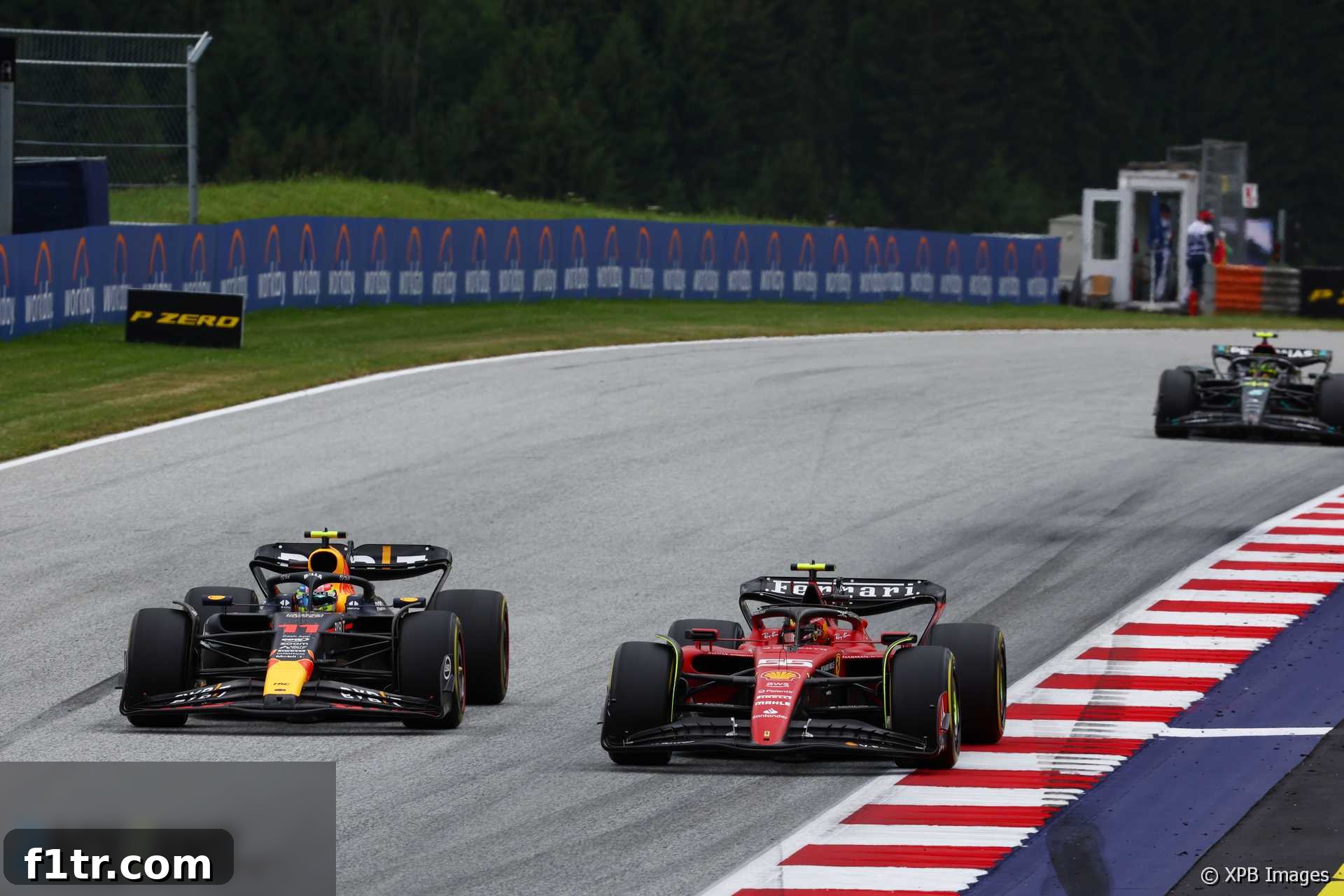
Even after his valiant recovery to third place, his race was far from straightforward. The second half of the Grand Prix saw him engaged in intense wheel-to-wheel combat, highlighting both his defensive prowess and the competitive nature of the field. For thirteen crucial laps, Sainz found himself defending stoutly against first Lando Norris, who was running strongly in the upgraded McLaren, and then the charging Sergio Perez, who had started from a lowly 15th position due to his own qualifying struggles but was now demonstrating Red Bull’s superior race pace. Sainz defended with all his might, showcasing exceptional defensive driving skills and tactical positioning, particularly into Turn 3 and Turn 4, but eventually, with just ten laps remaining, he had to concede position to the faster Red Bull of Perez. This prolonged defensive battle had a further detrimental effect on his race, widening the gap between him and Leclerc from a manageable 8.5 seconds to a substantial 13.7 seconds by the end, underscoring the compounding losses from the earlier strategic misstep and the subsequent need to defend aggressively.
“I was very quick on the first and second stint, obviously the second stint was already compromised by the first stop pitting behind Charles, and catching the Virtual Safety Car ending, which made me lose six, seven seconds of race time, made me lose positions to cars that I shouldn’t have lost, which meant then I had to push on the medium to overtake them [and] get the track limits [penalty],” Sainz elaborated, pinpointing the cascade of events that unraveled his race. “My race was compromised from that point onwards, but if I look at the pace I was very quick.”
Advert | Become a RaceFans supporter andgo ad-free
Sainz’s Frustration: Questioning Ferrari’s Strategic Decisions
The post-race debrief brought Carlos Sainz’s frustration vividly to the fore. He openly questioned Ferrari’s strategic rationale, particularly the decision to double-stack during the VSC period. While acknowledging that the team must have had a reason for their approach, he visibly struggled to reconcile it with the profound negative impact on his own race. He articulated his feelings of being strategically undermined, especially given a pre-race agreement to work collaboratively as a team to create a gap to the cars behind and maximize Ferrari’s overall points haul.
Sainz stated that Ferrari “need to analyse what we could have done” regarding the VSC pit stop, emphasizing the need for an internal review. “Clearly my race was compromised by that pit stop there. I guess the team had a reason to stop both cars. And if not, I don’t know,” he admitted, expressing a clear sense of bewilderment and disappointment.
He further elaborated on the team agreement, revealing a potential disconnect between planning and execution: “We had agreed before the race to work as a team in the first stint to open the gap to the cars behind, so they didn’t want to fight. I followed the plan, even though I had quite a bit of pace and I was quite comfortable there and probably could have gone faster. It’s a shame that after all doing the teamwork and then the pit stop arrives, and you’re compromised the way I [was].” This sentiment highlights a crucial point of contention: the perceived fairness of strategic outcomes for individual drivers within a team structure, particularly when one driver seems to bear the brunt of a collective decision.
For Sainz, the missed opportunity for Ferrari was glaringly obvious. He firmly believed that a double Ferrari podium was not just a remote possibility but a tangible outcome, especially given the strength of his car and the quality of his driving. “I’m just frustrated. It’s been a few races that I have a lot of pace in the car, a lot of race pace, and I wish I could maximise it a bit more,” he expressed, acknowledging that without the penalties, he would have matched his best 2023 result of fourth place, which still fell short of his perceived potential.
Exceptional Performance Overshadowed by Circumstance for Carlos Sainz
Despite the bitter taste of the final result, Carlos Sainz took immense pride in his individual performance at the Austrian Grand Prix. He felt his driving was among his best of the season, showcasing a compelling blend of aggression, precision, and tactical acumen. His ability to execute clean overtakes on competitors, manage tire degradation effectively while simultaneously attacking, and defend resolutely against faster cars like Perez’s Red Bull, underscored a significant step forward in his overall race craft and consistency this season.
“I’m very quick this year, especially in the races. I feel like I’ve done a big step forward, if you look at my pace yesterday and today. But P4 I guess [was] not bad. But I think today P2 or P3 was in our hands,” Sainz asserted, underlining his belief in his own merit and the car’s true potential.
He continued, reflecting on his efforts and the lingering disappointment: “I’m very happy with my performance today. I think I did some very clean moves. I defended well with Checo. As soon as I was arriving to one car, I was passing them. I was managing my tyres well at the same time that I was attacking. That’s why I’m, I guess, frustrated right now because I struggle to see the positive on this P4 with all the pace and the overtaking and defending that I did.”
His sentiments perfectly encapsulated the paradox of the Austrian Grand Prix for Carlos Sainz: a performance worthy of celebration, yet one ultimately marred by strategic decisions and external factors that denied him the reward he felt he truly deserved. The incident at Spielberg serves as a potent reminder of the intricate balance between driver skill, team strategy, and the unpredictable nature of Formula 1 racing, where even a seemingly flawless drive can be undone by circumstances beyond a driver’s immediate control, leading to deep frustration for even the most accomplished competitors.
Bringing the F1 news from the source
RaceFans strives to bring its readers news directly from the key players in Formula 1. We are able to do this thanks in part to the generous backing of our RaceFans Supporters.
By contributing £1 per month or £12 per year (or the equivalent in other currencies) you can help cover the costs involved in producing original journalism: Travelling, writing, creating, hosting, contacting and developing.
We have been proudly supported by our readers for over 10 years. If you enjoy our independent coverage, please consider becoming a RaceFans Supporter today. As a bonus, all our Supporters can also browse the site ad-free. Sign up or find out more via the links below:
- Become a RaceFans Supporter
- RaceFans Supporter FAQ
Advert | Become a RaceFans supporter andgo ad-free
2023 Austrian Grand Prix Related Articles
- Mercedes left scratching heads by lack of performance at Austrian GP
- Verstappen’s determination to grab every point makes him a record-breaker
- Austrian GP track limits farce was avoidable like ‘IndyGate’ and Spa 2021 – Brown
- Alpine now “definitely beatable” for McLaren after upgrade – Brown
- Paddock Diary: 2023 Austrian Grand Prix
Browse all 2023 Austrian Grand Prix articles