Emanuele Pirro: The Unsung Architect of McLaren’s Dominance and a True Motorsport Icon
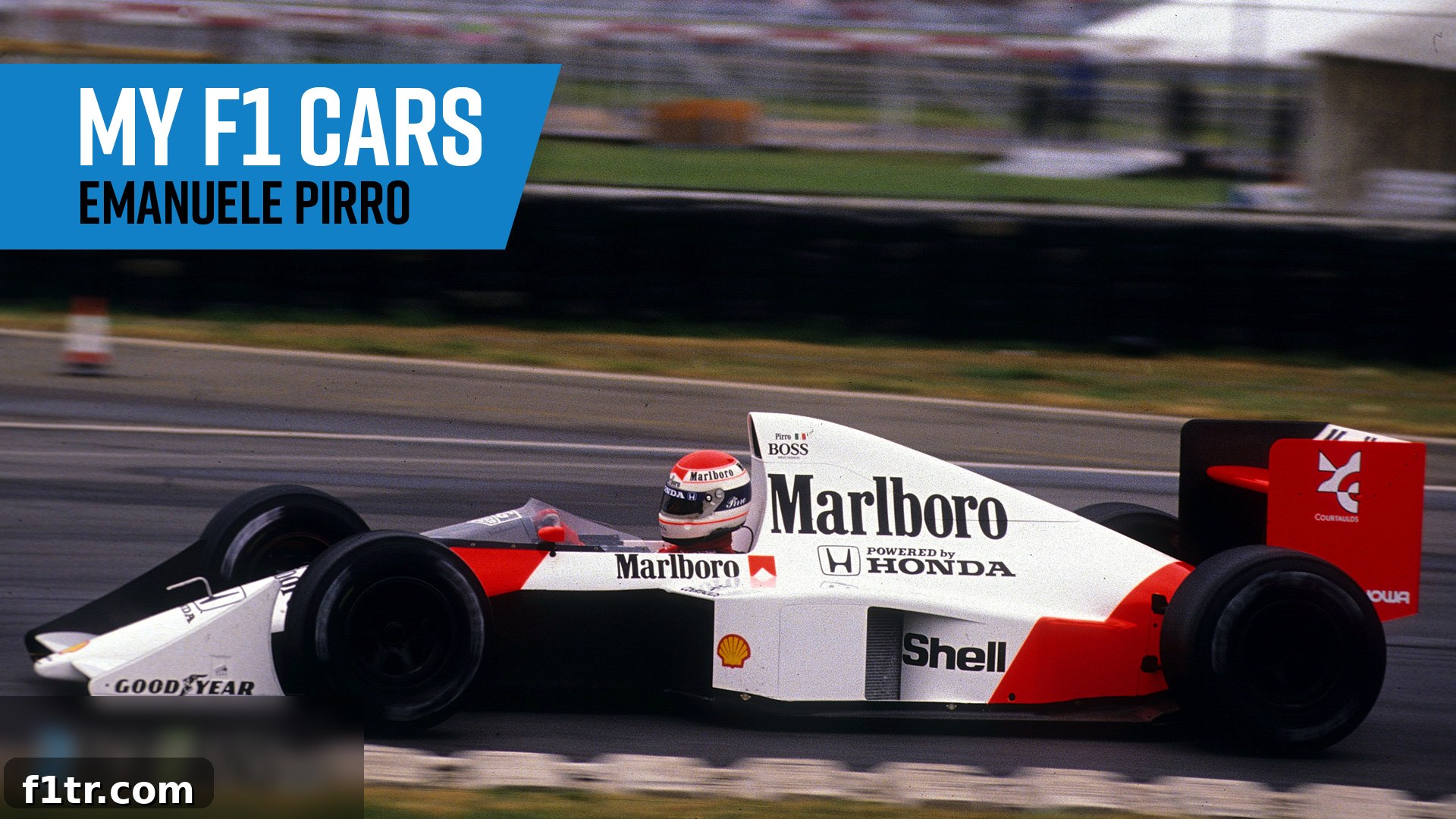
Emanuele Pirro stands as a titan in the world of sports and touring car racing, a name synonymous with endurance and success. Now 59, his impressive racing résumé boasts an astounding five victories at the legendary Le Mans 24 Hours, along with multiple touring car championships secured in Germany and Italy. Beyond these well-documented triumphs, his career is dotted with numerous other international successes that underscore his versatility and enduring talent. Yet, a crucial chapter of his story often remains untold: his instrumental role in the development of the championship-winning McLaren-Hondas, machines that Ayrton Senna and Alain Prost propelled to unparalleled glory. This is a remarkable achievement, especially considering Pirro himself never competed in anything quite so dominant during his own three-year stint in Grand Prix racing.
An individual of profound introspection, unfailingly polite, and always meticulously “correct” in his approach, Emanuele Pirro today serves as a distinguished ambassador for Audi. Alongside his Belgian wife Marlene – whom he met serendipitously during the Monaco F3 race – he manages a luxurious lodge nestled in the picturesque Dolomites. When not engaged in these pursuits, he actively participates in classic motorsport events, conditions permitting. However, for many contemporary fans, Pirro is perhaps most recognizable in his significant capacity as an FIA driver-steward, a role he undertakes for approximately four Grand Prix weekends each year, bringing his immense experience to the governance of the sport.
Early Career and the Raw Power of F1 Turbos
Despite his inherent and undeniable talent, evidenced by a string of junior championship victories, Pirro’s early career was perpetually hampered by a lack of budget. This financial constraint meant that he considers himself fortunate to have even competed in 40 Grands Prix between 1989 and 1991, a testament to his sheer ability and determination.
In 1984, Pirro allied himself with Onyx Racing, making an immediate impact by securing a podium finish in his inaugural F2 season. He remained with the team for two more seasons as F2 transitioned into the new F3000 series, a period where teams often relied on cast-off Cosworth DFV engines as Formula 1 embraced the revolutionary turbo era. Pirro’s natural speed and adaptability quickly shone through.
His performance in F3000 saw him topping the standings at the midway point of the 1985 season. This impressive form caught the eye of none other than Brabham boss Bernie Ecclestone, who was then searching for a replacement for the struggling François Hesnault. Ecclestone extended an invitation for Pirro to test the Brabham BT54 at Silverstone, offering Pirro his first taste of Formula 1’s formidable turbo power. His memories of that era’s F1 power unit are vivid and striking.
“It was quite brutal,” Pirro recalls, “because at the time there was free boost, and in terms of feeling, I have very clear memories. F3000 was already a rather heavy car with good power, not really brutal, but quite a ‘muscle’ car. The F1 turbo car, however, demanded an entirely different level of mastery. You had to be absolutely on top of it; otherwise, it was very easy to be left behind, both literally and metaphorically.”
He further elaborates on the technical characteristics of the time: “At that time, all teams primarily wanted to generate downforce, as turbo power was relatively easy to achieve. Consequently, the cars carried a lot of aerodynamic drag; the rear wings were practically straight up, vertical. The difference between on- and off-throttle was immense, not just due to turbo lag, but also a significant surge of power upon application and a strong deceleration when lifting off. This demanded a delicate yet forceful driving style.”
Pirro remembers the BT54 suffering from “significant” turbo lag, though he quickly adds that it was still a vast improvement over the Group 5 Lancia Monte Carlo he had raced at Le Mans in 1981, which notoriously had a three-second void between pressing the accelerator and achieving full power. “The aero brake [due to drag] was actually bigger than full braking in my F3000 car,” he explains, highlighting the extreme demands placed on drivers. “So, you had to be really careful using the throttle in both directions. I remember the car had to be driven with muscles, but also with fingertips – a true balance of strength and finesse.”
A particularly fond memory from this period is working with Charlie Whiting, who served as his race engineer during the Brabham test. Whiting would, of course, later become the revered F1 Race Director, a role he held with distinction until his untimely passing on the eve of the 2019 world championship. Pirro’s early interactions with such a significant figure underscore the quality of connections he made throughout his career.
Despite making a strong impression and receiving a provisional promise of the drive, Pirro ultimately lost out to Marc Surer, who he believes possessed superior connections with engine supplier BMW. This setback meant a return to Onyx and F3000, where he consistently finished third in the championship for the next two years. With no immediate F1 opportunities on the horizon, Pirro pivoted to touring car racing for the 1987 season, showcasing his adaptability once more.
Towards the end of that year, another F1 call-up arrived, this time from Benetton. They were conducting rookie tests at Donington in their BMW-powered B187, with each driver granted 16 laps to impress. Pirro emerged as the fastest, even beating the benchmark set by regular driver Teo Fabi. Modestly, he adds, “I don’t want to sound arrogant, because I’ve had similar situations where you set a benchmark just to ensure the car is okay. I have incredible respect for his career.”
He vividly recalls “the brutality of the grip” of the B187. “At Donington, you usually approach limits in small, incremental steps,” he explains. “But there was no time for that; I had to guess the speed I could carry, as it was a familiarisation run followed by a new set of tyres. I thought, ‘If the car stays [on the track], it stays; otherwise, I’m going to have a major shunt.’ I couldn’t afford to approach it with any other mindset. I kept my foot down, feeling it couldn’t possibly be that the car was still sticking to the ground. I believe this audacity and confidence in the car is why, two years later, Benetton called, offering a full-time drive.”
The Secret Weapon: Developing Senna’s McLaren-Hondas
Then came a truly career-changing opportunity, one that would cement his legacy in an unexpected way: promotional work for Marlboro and McLaren in the USA. This seemingly minor engagement unexpectedly led to far greater things.
“I was living in London, and my best friend at the time was Stefan Johansson, who was a McLaren driver,” Pirro recounts. “Onyx boss Mike Earle also happened to be good friends with McLaren team principal Ron Dennis. Through these connections, I received an invitation from Ron himself.” During their time in the USA, Dennis presented Pirro with an intriguing proposal: “He said, ‘We’ve signed a contract with Honda. We plan to set up a test team in Japan, based at Suzuka, to develop the engine; it’s a very big programme. Would you like to do it?’”
Without hesitation, Pirro seized the opportunity. “I packed my suitcase,” he recalls, “and they even organized my Japanese F3000 season, which I won with a local team, Le Mans. Basically, my single-seater career was reopened, but with a completely new focus.” For four grueling years, Pirro dedicated himself to relentlessly thrashing a McLaren-Honda around the demanding figure-of-eight Suzuka circuit. This monumental testing program ran fortnightly, from nine to five, come sun, cloud, or torrential rain.
“Remove some weeks for January and Christmas, and basically, that was the schedule,” Pirro describes the relentless commitment. “I have no precise records about kilometres or days, but it was every fortnight – Tuesday, Wednesday, Thursday, full time, driving, driving, driving. In today’s terms, it’s absolutely crazy. Absolutely.” This dedication was pivotal to McLaren’s unprecedented success.
The McLaren-Honda MP4/4, which famously won 15 of 1988’s 16 races, was, as Emanuele vividly recalls, “a very good car because it had a fine balance between power, aerodynamics, and mechanical balance, offering incredible drivability and versatility. It was by far not as brutal as some other cars of the era; it was quite gentle, especially at low speed, primarily because McLaren was strategically trying to generate mechanical grip using Showa dampers.”
He elaborates on the car’s dynamic character: “As you went through the gears and picked up speed, the car would progressively settle down on its bumper rubbers, with the aerodynamic load becoming stiffer and more pronounced. At high speed, the car was truly exceptional and rather stiff, but at low speed, it felt light and almost old-school to drive, providing a nuanced experience.”
Pirro’s primary focus in Japan was engine development, specifically enhancing drivability. “Most of the work we did in Japan was engine development, especially drivability,” he confirms, “because Senna was really demanding in terms of drivability. We constantly worked on engine mapping and throttle mapping to find the best compromise between good pickup and a response that wasn’t overly brutal.” The only personal drawback, Pirro adds with a chuckle, was that “it was a small car for my size.”
The transition to the naturally aspirated V10-powered MP4/5, developed for the 1989 season, brought a strikingly different machine. “That car required a lot more fine-tuning,” Pirro explains, “because it was inherently more brutal, though not as extreme as the later V12 engines. It wasn’t as pleasant [as the MP4/4] in terms of driving dynamics, largely because the V10 engine was physically larger – not as large as the V12, but certainly bigger than the V6 turbo unit.”
“The car consequently lost a little bit of its driving pleasure due to the increased mass of the engine,” he continues, “but it was undeniably faster. The initial pick-up and initial acceleration of the naturally aspirated engine were superior, contributing to its enhanced performance despite the handling trade-offs.” Pirro also undertook testing duties in Europe, at tracks like Silverstone, Estoril, and Jerez, and grins fondly when recalling setting the fastest lap at the latter. “I was fastest of all cars,” he remembers with satisfaction. “They were FOCA tests, so everybody was present. It was a small piece of satisfaction; it was nice.”
A Dual Role: F1 Racer and Master Test Driver
Mid-season in 1989, Gérard Larrousse extended an offer for Pirro to test for his eponymous team at Silverstone. During this test, Pirro quickly identified a critical aerodynamic flaw that starved the Lamborghini V12 engine of air at lower speeds, a significant performance inhibitor. Larrousse, impressed by Pirro’s astute diagnosis, was ready to offer him a contract on the spot. However, Ron Dennis, always keeping a keen ear to the ground, advised his somewhat baffled test driver to hold off. Within days, Pirro received compelling offers from both Tyrrell and Benetton, showcasing his growing reputation and the shrewdness of Dennis’s advice.
Pirro ultimately signed with Benetton, stepping in as a replacement for Johnny Herbert – who was still grappling with the severe after-effects of his horrific 1988 F3000 crash – to partner Alessandro Nannini. He made his official Formula 1 debut at the French Grand Prix in the B188, transitioning to the newer B189 car just two races later. While conceptually similar to its predecessor, the B189 was powered by Cosworth’s advanced HB engine, a significant upgrade from the venerable DFR unit.
“Everything was better with the B189,” he states unequivocally. “Aerodynamics, engine power, engine weight – and they ingeniously used the front wing as a ground effect device. It featured a long chord (the distance between leading and trailing edges) which effectively worked as an undertray, like a ground effect wing utilizing the venturi effect. The challenge, however, was that this system demanded extremely accurate control of the front ride height to function optimally.”
“In theory, it was a brilliant system,” Pirro acknowledges, remembering the car’s designer, Rory Byrne. “Rory was very kind in an interview, saying, ‘I wish I could have given [Pirro] a better car for the short time he was with us.’ That was really nice to hear.” He continues, “Later, when they introduced a new front wing, the car became an absolute dream to drive. It was incredibly fast on the straight, even though the engine wasn’t quite in the same league as the Honda, a comparison I could make firsthand since I continued testing the McLaren that year and for the next two seasons.”
The sheer logistical complexity of Pirro’s life at this juncture is astonishing. He was simultaneously testing for the Honda ‘works’ team in Japan, racing in F1 for Ford’s ‘works’ team (Benetton), and incredibly, also winning the Nürburgring 24 Hour for BMW! “I did the statistics for that period,” Pirro reveals, “and I took 103 flights that year alone, which means one flight every 3.3 days. It was an absolutely insane schedule, a true testament to my dedication and love for the sport.”
The B189 proved fast enough for Pirro to score his first Formula 1 points with a commendable fifth-place finish at a drenched, season-closing Australian Grand Prix. The chaotic race was stopped after 70 of the scheduled 81 laps due to the treacherous conditions. In the ensuing confusion, his pit crew made a critical error with the pit board, displaying a plus sign rather than a minus. Despite rapidly pulling away from Pierluigi Martini’s Minardi, Pirro initially believed he was being caught until he spotted a white car ahead. “I thought he had passed me, and I didn’t even realize,” he recounts, a hint of amusement in his voice. “Don’t laugh, but when you are in such a difficult situation, with your visor all misted up and utterly fatigued… I still don’t know why I didn’t crash just because of that plus and minus mistake!”
Challenges and Resilience: The BMS Scuderia Italia Chapter
The F1 landscape changed rapidly. With triple world champion Nelson Piquet becoming available, team boss Flavio Briatore swiftly snapped him up, consequently ousting Pirro from Benetton. Undeterred, Pirro found a new seat alongside Andrea de Cesaris at the BMS Scuderia Italia team, owned by steel magnate Beppe Luchini, running Dallara chassis powered by Cosworth DFR V8s.
The 1990 season with BMS Scuderia Italia proved to be immensely disappointing, largely blighted by crippling unreliability. Across 16 Grands Prix (32 attempts for both cars), the team recorded a staggering 23 retirements and two ‘Did Not Qualify’ results. “1990 was nothing but frustration,” Pirro plainly states, “with persistent engine problems and a car that was simply slow. We even ended up having to pre-qualify the following year. But from a personal pleasure standpoint, it was still a nice season because I gained significant self-confidence. At Benetton, largely due to my height, it wasn’t easy for me, and Sandro (Nannini), apart from one occasion, always qualified ahead of me.”
“But Andrea [de Cesaris] was an excellent benchmark,” Pirro reflects, “and in qualifying, I was a bit more often quicker than him, which was great for my self-confidence and instrumental in developing the car’s setup with the engineers.” This period, despite its challenges, allowed Pirro to hone his skills and solidify his self-belief.
For the 1991 season, Dallara made a shrewd move by hiring the relatively unknown aerodynamicist Nigel Cowperthwaite. The result was the Judd V10-powered BMS 191 car, which proved to be an unexpected revelation. The team dramatically moved out of the pre-qualifying sessions at mid-season and remarkably finished eighth (out of 17 entrants) in the constructors’ championship, a testament to the car’s surprising performance.
“Nigel was a nice but strange guy,” Emanuele recalls with a smile. “But the car was properly beautiful, not necessarily in terms of aesthetics, but certainly in performance terms. We had virtually no testing; we all went straight to the first (street) Grand Prix of the season in Phoenix, USA. All the teams, except McLaren, had a shakedown at a small circuit, Firebird, just outside Phoenix. We were incredibly fast there; I think only Williams was quicker.”
“JJ [Lehto] was a good teammate,” Pirro continues, “but we unfortunately suffered from a lot of engine problems. The core issue was that the team was basically not paying the engine builder. Consequently, essential rebuilds weren’t happening due to a lack of budget, which was a real pity because our chassis was arguably better than even a McLaren. It was truly a very good car with immense potential.”
Dallara engineer Jos Claes concurs with Pirro’s assessment of the BMS 191, fondly saying, “I have very fond memories of that year.” Pirro’s performance saw him secure seven top-10 finishes, and although points were only awarded to the top six at the time, he was classified an impressive 18th out of 41 hopefuls that season. Pirro, with his intimate knowledge of the car’s capabilities, firmly believes, “If we had Honda engines, it could have been a world championship car.”
A Legacy Beyond F1: Le Mans Glory and Enduring Influence
That pivotal year of 1991, despite the flashes of brilliance, marked the conclusion of Emanuele Pirro’s Formula 1 racing career. However, it was far from the end of his illustrious journey in motorsport. He seamlessly transitioned to a full-time career in touring cars with BMW, before making a significant move to Audi in 1994. This decision proved to be a masterstroke, as it ushered in the most dominant phase of his career. With Audi, Pirro went on to achieve an incredible five victories at the Le Mans 24 Hours, solidifying his reputation not only as a fast driver but also as one of the safest and most dependable pairs of hands in endurance racing.
Emanuele Pirro’s story is a compelling narrative of talent, resilience, and adaptability. From the brutal power of early F1 turbos to the meticulous development of championship-winning McLarens, and finally to the unparalleled success at Le Mans, his contributions to motorsport are both profound and multifaceted. His often-overlooked role as a development driver for legends like Senna highlights the critical, behind-the-scenes work that underpins racing glory. Today, as an esteemed FIA steward, Pirro continues to shape the sport, drawing upon a career rich with experience, insight, and an unwavering passion for racing.