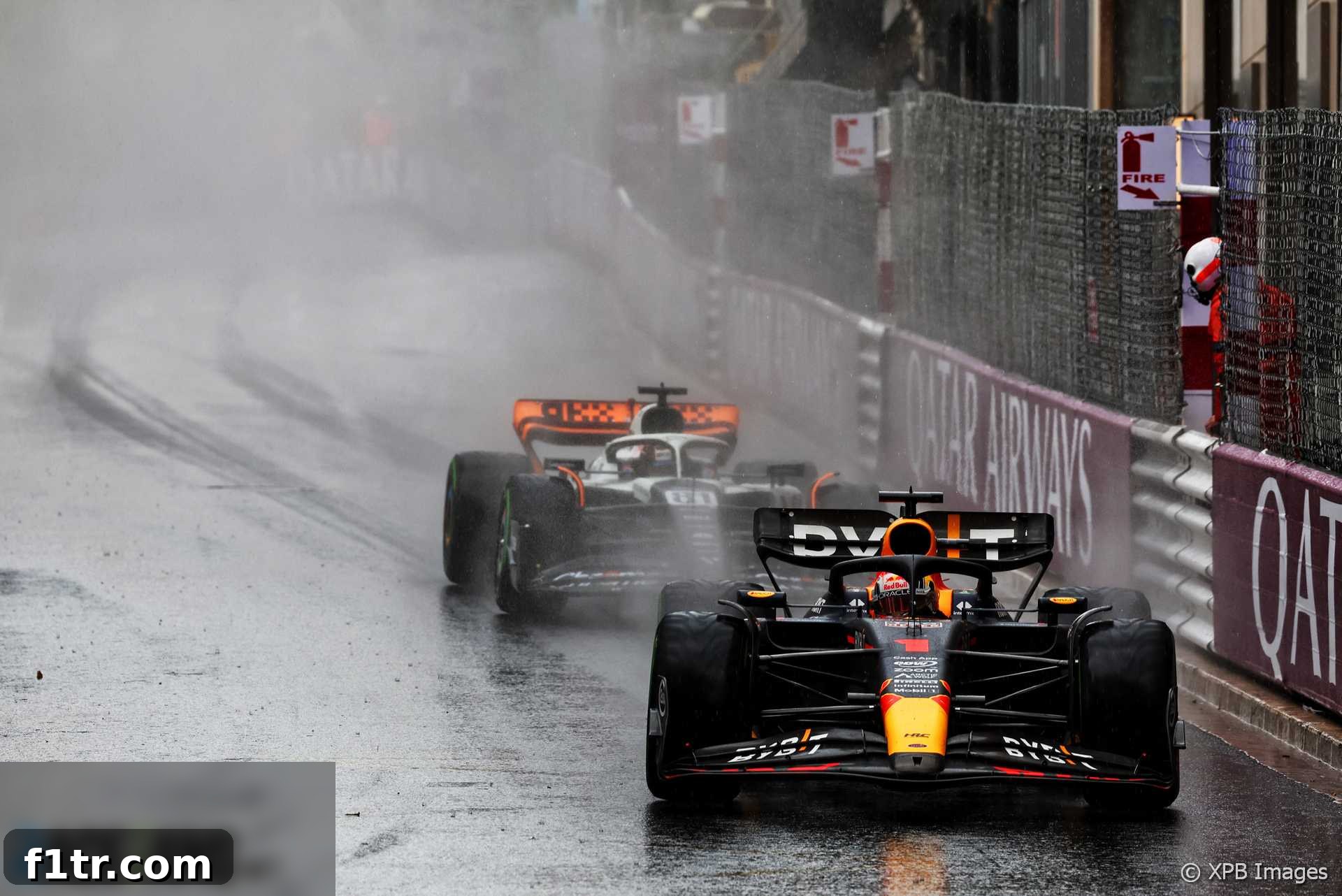
Oscar Piastri’s Wet Weather Revelation: Learning from Max Verstappen at the Monaco Grand Prix
The Monaco Grand Prix is renowned for its glamour, history, and unforgiving street circuit. When rain transforms this iconic track into a treacherous arena, it becomes the ultimate test of driver skill and nerve. For Formula 1 rookie Oscar Piastri, the 2023 Monaco Grand Prix offered an unexpected, yet invaluable, learning experience, as he found himself navigating the slick asphalt not just for a points finish, but also by observing the masterclass delivered by race leader Max Verstappen.
Piastri, in his debut F1 season with McLaren, arrived in Monaco with limited experience of driving a Formula 1 car in wet conditions. The pre-season testing regimen, condensed to just three days in Bahrain, provided no opportunity to simulate such challenging scenarios. Thus, when the heavens opened over the principality in the final 25 laps of the race, Piastri was thrust into a high-stakes, real-time education.
Piastri’s Rookie Revelation: Adapting to Monaco’s Wet Challenge
The initial phase of the rain was particularly perilous, with drivers grappling to control their high-powered machines on slick tyres designed for dry conditions. This delicate dance on the razor’s edge tested every ounce of a driver’s instinct and car control. Piastri recounted the intensity of these moments, confessing to several “very, very close” encounters with Monaco’s infamous barriers. “I don’t think there was any touches [with the walls] but some very, very close moments, especially when we were on the slicks,” Piastri shared with media after the race, highlighting the fine margins involved. He even recalled a near miss while attempting to communicate with his team: “One time I keyed up on the radio to talk and almost put it in the wall like mid-sentence. I won’t do that next time. A few close calls.”
As the rain intensified, the inevitable switch to intermediate tyres offered a semblance of relief, providing more grip but still demanding extreme precision. Despite the daunting conditions, Piastri demonstrated impressive composure, guiding his McLaren to a respectable tenth-place finish, securing a crucial point for his team. However, beyond the championship points, the true reward for Piastri was the unique educational opportunity that presented itself during the race.
The Unexpected Mentor: Trailing Max Verstappen
A peculiar turn of events saw Piastri being lapped by the dominant race leader, Max Verstappen. Far from being a mere formality, this moment provided Piastri with a front-row seat to a masterclass in wet-weather driving from the reigning world champion. For a rookie still finding his feet in the pinnacle of motorsport, this was an unparalleled chance to observe and learn from the best in real-time.
“Having Max right in front of me was actually quite useful in some ways because that was my first time on slicks on a rainy track in an F1 car,” Piastri explained. The opportunity to witness Verstappen’s lines, braking points, throttle application, and overall car control in such treacherous conditions was invaluable. Piastri understood the caliber of the driver ahead of him: “Having Max there, I obviously knew that if it was going to be anyone that’s probably going to be okay, it’s probably going to be him. So that was quite useful in some ways.” This observation allowed Piastri to calibrate his own approach, understanding the limits and nuances of driving an F1 car on a soaking wet Monaco circuit.
While Verstappen, despite his eventual victory, admitted to having multiple brushes with the walls himself, his overall composure and pace were a benchmark. Piastri initially managed to match Verstappen’s pace, particularly when the Red Bull driver was exercising extreme caution. “When it was raining on the slicks, understandably he was I think being very cautious, so I could keep with him quite well there. And even when we came out on inters, I could keep with him quite well,” Piastri remarked. This rare moment of parity with a champion was a significant confidence booster for the young Australian. “Once the track dried up and he got a bit more comfortable, then he was a fair bit quicker. But initially I was managing to keep behind him, which is the first time I’ve been able to say that, so it was nice.” This direct comparison offered a tangible measure of his progress and potential.
Verstappen’s Calculated Command: Navigating the Rain
From Max Verstappen’s perspective, the rain-affected final laps of the Monaco Grand Prix were a masterclass in strategic conservatism blended with an underlying display of raw talent. Having built a substantial lead, his primary objective shifted from outright speed to managing risk and bringing the car home safely for victory. “It was just that I had a big lead and I didn’t want to risk trying to be the same pace or faster and then end up in the wall,” Verstappen explained, shedding light on his mindset. “You have to be a little bit more careful. It’s just not taking too much risk but at the same time, of course not driving too slowly.”
The champion’s approach highlighted the nuanced decision-making required at the elite level of Formula 1, especially in unpredictable conditions. While caution was paramount, maintaining a certain pace was equally important to keep tyre temperatures optimal and avoid losing rhythm. This delicate balance is a hallmark of truly great drivers.
Verstappen also had to contend with the added pressure of other cars behind him, notably Lando Norris, Piastri’s McLaren teammate. “I had Lando [Norris] in my gearbox as well so at one point,” Verstappen continued. “I was like, well, I do need to speed up a bit.” This external pressure forced him to slightly increase his pace, demonstrating the constant dynamic interplay between caution, speed, and competitive instinct even when leading comfortably. To further optimize his performance and car balance in the tricky conditions, Verstappen made adjustments to his steering wheel. “But luckily after five laps I changed a few things on the steering wheel as well to just give me a bit of a better balance and that definitely helped as well,” he revealed, underscoring the granular level of control F1 drivers have over their vehicles.
The Science of Wet Weather Racing in F1
Wet weather racing in Formula 1 is a brutal examination of driver skill, car setup, and strategic acumen. The choice between slick and intermediate tyres, and then potentially full wets, is critical. Monaco, with its extremely tight confines and varied surface textures, amplifies every decision and every mistake. The ever-changing grip levels demand constant adaptation and an almost preternatural feel for the car.
Verstappen articulated the importance of maintaining a “rhythm” in these conditions. Slowing down too much out of caution can actually be counterproductive, leading to colder tyres, reduced grip, and a loss of the driver’s ‘zone’ – that state of optimal focus and performance. “When you’re on a rhythm it’s better to just stay in that,” he stated. Despite his caution, the Red Bull driver did graze the barriers once, illustrating just how fine the margins are. “I think just one time out of 16 I clipped the barrier. I thought I had a bit more margin and then I just I touched those [and thought] okay, I didn’t have the margin. But it was fine.”
This insight underscores the psychological aspect of wet-weather racing. The confidence derived from staying in a rhythm helps a driver anticipate the car’s movements and react instinctively. “It’s better to be in a rhythm and feel good than slowing down and then be a bit out of your zone, and then also your tyres get colder. It’s not what you like, they were already quite cold. So what is better I think is to stay in that because I was not over-driving it or whatever, it was just in my own zone.” This ‘zone’ is where champions operate, blending caution with precision to extract performance even when conditions are at their most challenging.
Monaco’s Enduring Allure: A Test of Champions and Rookies
The 2023 Monaco Grand Prix ultimately delivered another thrilling chapter in its storied history. Max Verstappen’s dominant performance, culminating in victory, further cemented his status as a master of all conditions. His ability to blend outright speed with calculated risk management under immense pressure was on full display. For Oscar Piastri, the race provided a crucial baptism by fire. His tenth-place finish was a commendable effort for a rookie in such demanding circumstances, but the true prize was the unique opportunity to learn from the very best.
Monaco consistently tests the mettle of every driver on the grid, pushing them to their absolute limits. When rain is added to the equation, the challenge intensifies exponentially, transforming the circuit into a gladiatorial arena where only the most skilled and resilient can truly thrive. For Piastri, this race was more than just a point on the scoreboard; it was a fundamental part of his rapid education in Formula 1, providing invaluable experience that will undoubtedly shape his future performances. The insights gained from shadowing Verstappen in the rain will serve as a foundational lesson as he continues his journey in the world of F1, proving that even in defeat or challenging conditions, there is always an opportunity for growth and learning.
Supporting Independent Motorsport Journalism
High-quality, independent journalism is crucial for bringing in-depth analysis and behind-the-scenes stories from the world of Formula 1. Dedicated journalists work tirelessly to provide original content, covering everything from race insights to technical developments and driver interviews.
By contributing a small amount monthly or annually, readers can help sustain the costs involved in producing this unique content. Your support directly contributes to travel expenses, writing, research, content creation, hosting, and ongoing development.
For over a decade, such independent coverage has been powered by the generosity of its readers. If you value insightful and unbiased reporting, please consider becoming a supporter today. As an added benefit, supporters often enjoy an ad-free browsing experience on the platform. Find out more about how you can contribute:
- Become a Motorsport Content Supporter
- Supporter FAQ
Further Reading: 2023 Monaco Grand Prix Highlights
- Mercedes’ Strategic Adjustments After W14 Update in Monaco
- Verstappen’s Record-Breaking Performance for Red Bull
- Key Tyre Strategy: How Teams Mastered Intermediate Calls in Monaco
- Verstappen’s Pole Lap: A Testament to His Monaco Prowess
- Team Haas’s Unexpected Performance Boost from Monaco Upgrades
Browse all 2023 Monaco Grand Prix articles