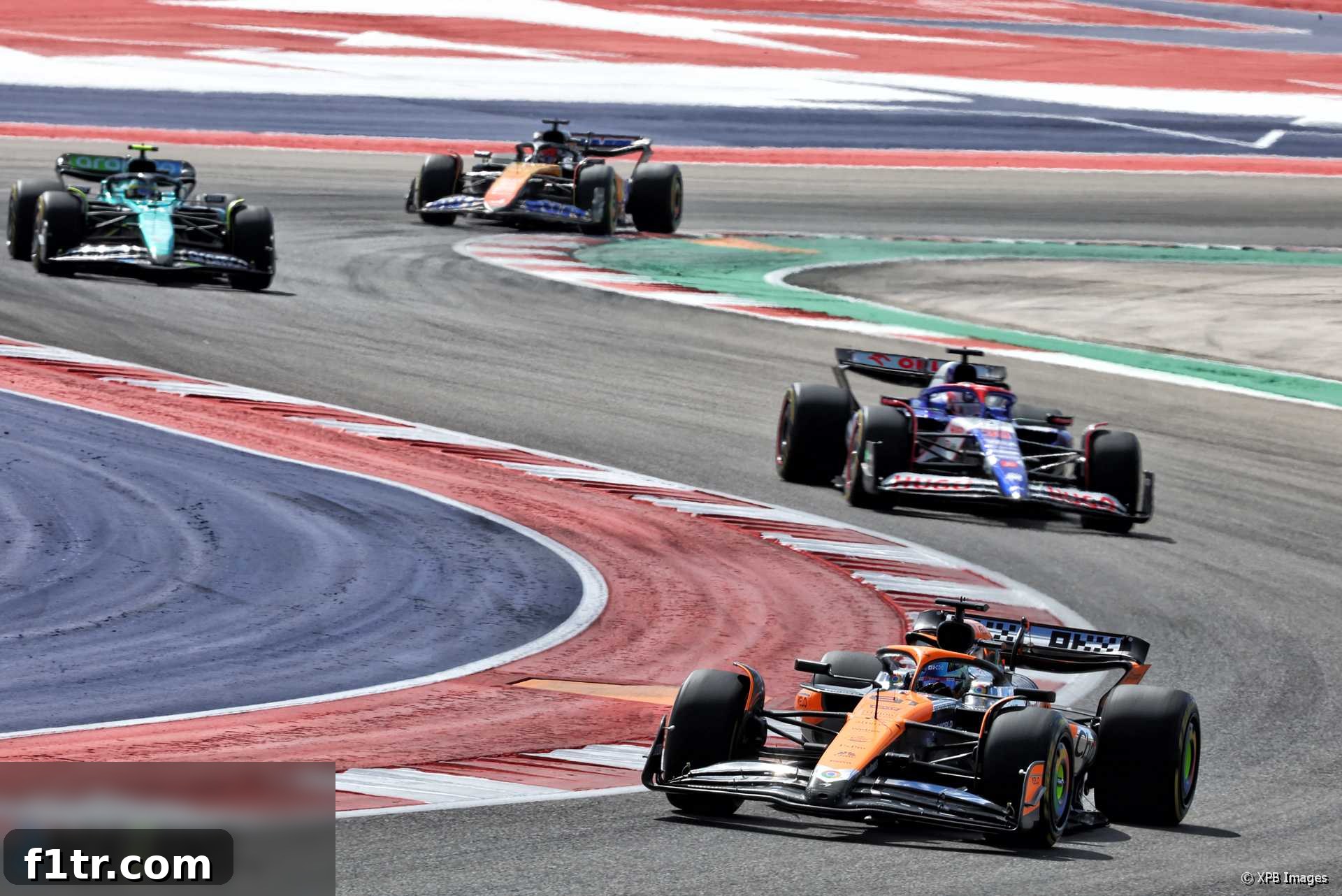
In the high-octane world of Formula 1 sprint races, every inch of track and every tenth of a second counts. Such was the case in a recent sprint event where Oscar Piastri, the promising McLaren driver, found himself at the center of a racing incident that ultimately resulted in a five-second time penalty. Piastri, known for his calm demeanor and meticulous approach, openly admitted post-race that the penalty was “probably deserved,” shedding light on the intensity and razor-thin margins that define wheel-to-wheel combat at the pinnacle of motorsport.
The incident unfolded during the early stages of Saturday’s sprint race, a condensed format that often encourages aggressive driving and bold overtaking maneuvers. Competing fiercely for 13th position, Piastri’s McLaren was locked in a spirited duel with Pierre Gasly’s Alpine. The pivotal moment arrived on the fourth lap as the cars hurtled down the long back straight, approaching Turn 12 – a critical braking zone offering a prime overtaking opportunity. It was here that Piastri attempted a late lunge, a high-risk, high-reward move designed to gain an advantage.
Advert | Become a Supporter & go ad-free
As Piastri braked hard, his front wheels barely drew level with Gasly’s rear wheels, a clear indication of how late the McLaren driver committed to the move. Despite the tight proximity and the aggressive nature of the pass attempt, Gasly, demonstrating significant spatial awareness and race craft, left a discernible amount of space for Piastri as they navigated the entry to the corner. This act of sportsmanship, often lauded in racing, allowed both cars to initially maintain their lines and progress through the turn side-by-side.
However, the delicate balance of the maneuver quickly unraveled at the apex. As Piastri clipped the inner kerb, his car was already on full steering lock, pushing the limits of grip and trajectory. The momentum carried him wide, causing his McLaren to drift progressively towards the outer edge of the track and the exit kerb. This unavoidable trajectory change, driven by speed and the chosen line, encroached directly into the space Gasly occupied, leaving the Alpine driver with no alternative but to take immediate evasive action to prevent a collision. The near-miss was palpable, underscoring the fine line between an assertive overtake and an infringment.
The immediate aftermath saw a frustrated Pierre Gasly voice his concerns over the team radio. “I’m sorry, but he pushed me off the track,” he reported to his pit wall, his tone conveying both disappointment and a clear expectation of intervention. Such radio communications are standard procedure in Formula 1 and often serve as crucial evidence for race stewards when reviewing potential infractions. Gasly’s assertion highlighted the core of the issue: while Piastri’s move might not have been intentionally malicious, its execution undeniably compromised Gasly’s ability to remain on track.
Following Gasly’s report, the race stewards promptly initiated an investigation into the incident. After careful review of multiple camera angles, telemetry data, and likely the aforementioned radio transmissions, they concluded that Oscar Piastri was indeed at fault. The stewards determined that Piastri had failed to adhere to the fundamental principle of leaving “a fair and acceptable width” for Gasly’s car during the overtaking attempt. This rule is paramount in ensuring safe and equitable racing, preventing drivers from unjustifiably forcing competitors off the circuit to gain an advantage.
While the stewards found Piastri culpable, their decision regarding the penalty itself reflected a nuanced understanding of the incident. Rather than imposing the standard 10-second time penalty often associated with such violations, they opted for a reduced five-second sanction. Their reasoning was explicit: they judged that “the forcing off track was not deliberate and [Piastri] was in control of the car at all times.” This distinction is critical, separating aggressive but controlled driving that leads to an infringement from reckless or dangerous maneuvers. It suggests that while Piastri made a misjudgment in his corner exit, it wasn’t an act of wilful obstruction or an out-of-control vehicle posing a significant danger beyond the immediate inconvenience to Gasly.
Despite the penalty being applied at the end of the race, Piastri’s ultimate finishing position remained unaffected. He crossed the line in tenth place and, thanks to a sufficient time advantage over the driver behind him, Yuki Tsunoda, he retained his position. This outcome, while fortunate for Piastri, underscores how crucial it is for drivers to not only manage their on-track battles but also their gaps to competitors, as post-race penalties can dramatically alter final standings.
Speaking to Sky Sports after the sprint race, Piastri offered his candid assessment, acknowledging the validity of the stewards’ decision. “Once I committed to the corner, I couldn’t really back out of it,” he explained, illustrating the split-second nature of decisions made at incredibly high speeds. This highlights the predicament drivers face: once a maneuver is initiated, especially under braking and into a turn, altering trajectory or backing off can often be more dangerous than committing to the intended line, even if that line ultimately leads to a squeeze. He added, “I tried to give as much space as I could, but it was very much on Pierre to, kind of, get out of my way, so that was nice of him.” This latter comment, delivered with a hint of dry wit, pointed to Gasly’s proactive role in avoiding a collision, inadvertently saving both drivers from a more significant incident.
Advert | Become a RaceFans supporter andgo ad-free
The incident involving Piastri and Gasly serves as a microcosm of the intense competition and the constant scrutiny under which Formula 1 drivers operate. Every decision, every millimeter, and every interaction on track is meticulously analyzed, not only by the drivers themselves but also by their teams, fans, and, critically, the race stewards. The fine line between aggressive, fair racing and an infringement is often blurred, and it’s in these moments that the stewards’ judgment becomes paramount.
Oscar Piastri, in his relatively nascent Formula 1 career, has quickly established himself as a formidable talent. His willingness to admit fault in this instance further solidifies his reputation as a mature and self-aware competitor. For McLaren, such incidents are part of the learning curve for a young driver pushing the limits. For Pierre Gasly and Alpine, the frustration of being forced wide without tangible consequence for the aggressor, beyond a time penalty that didn’t affect track position, is a recurring theme in F1.
This event underscores the dynamic tension between the desire for thrilling, wheel-to-wheel action and the necessity of maintaining strict safety and fair play standards. As Formula 1 continues to evolve, with sprint races adding another layer of complexity to grand prix weekends, these types of incidents are likely to remain a talking point, fueling debates among fans and professionals alike about the rules of engagement in the world’s fastest sport. Piastri’s penalty, though seemingly minor in its immediate impact on his finishing position, stands as a reminder that even the smallest miscalculation can draw the attention of the stewards, reinforcing the imperative for precision and respect on every lap.
Miss nothing from RaceFans
Stay updated with all the latest developments, exclusive insights, and breaking news from the world of Formula 1. Get a daily email with all our latest stories – meticulously curated for you, ensuring no marketing clutter, no unsolicited ads, just pure F1 content. Sign up here and join our community of dedicated motorsport enthusiasts:
Explore More from the 2024 United States Grand Prix
Dive deeper into all the action, controversies, and analyses from the 2024 United States Grand Prix. From dramatic on-track battles to crucial steward decisions, our comprehensive coverage ensures you’re up-to-date with every significant event. Read our latest articles:
- McLaren insist stewards made ‘provable error’ after losing bid for review of Norris’ penalty
- Why McLaren’s focus on Verstappen’s driving failed to overturn Norris’ penalty
- Stewards reject McLaren’s request to review Norris’ United States GP penalty
- McLaren know Norris’ penalty is likely to stand – so what do they hope to gain?
- McLaren request review of Norris’ penalty for off-track pass on Verstappen
Browse all 2024 United States Grand Prix articles