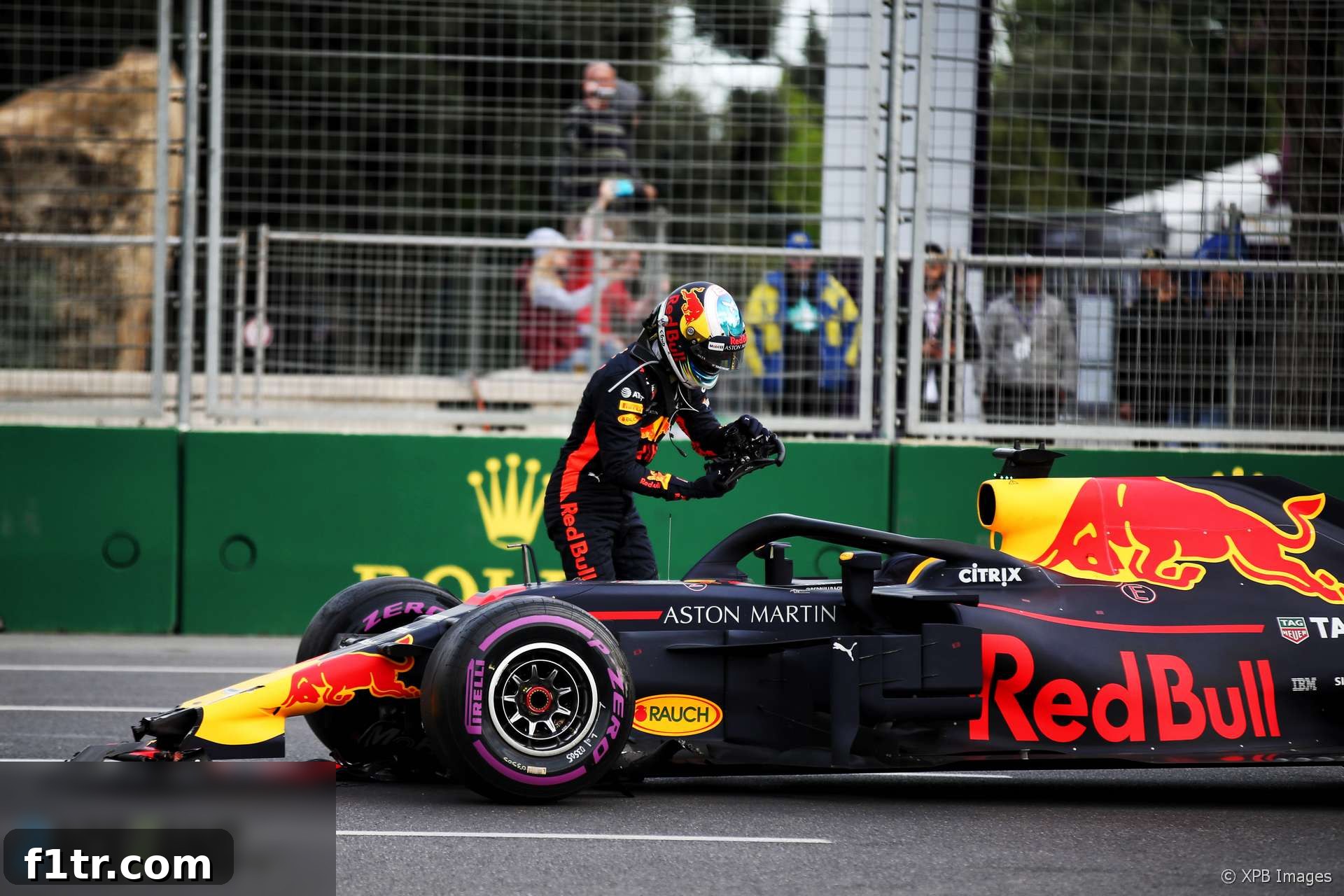
The 2018 Azerbaijan Grand Prix delivered an unforgettable spectacle of Formula 1 racing, albeit one culminating in a bitter disappointment for Red Bull Racing. In a dramatic turn of events, both of the team’s highly competitive drivers, Daniel Ricciardo and Max Verstappen, were forced to retire from the race following an intense collision at Turn 1. This incident, occurring during a pivotal phase of the Grand Prix, sent shockwaves through the paddock and ignited significant debate among fans and pundits alike regarding driver conduct and team strategy.
Immediately following the race, Red Bull Racing issued a statement via social media, seeking to temper the controversy and project a united front. The team declared, “There are no team orders here, but you’ve got to keep it clean. No blame on either driver, both race hard and want to win.” This official stance underscored the team’s long-standing philosophy of allowing its drivers to compete freely, a principle that has often yielded thrilling on-track battles but, in this instance, led to a catastrophic outcome. The statement further acknowledged the unfortunate nature of the day, adding, “An Azerbaijan Grand Prix to forget for us today, but both drivers’ have apologised and we all move on to Spain.” This swift public response aimed to de-escalate tensions and refocus the team’s efforts on future races.
The Baku Incident: A Detailed Look at the Crash
The collision itself was the culmination of a race-long duel between Ricciardo and Verstappen, two of the most aggressive and talented drivers on the grid. Ricciardo described his perspective on the critical moment, explaining his commitment to an overtaking manoeuvre. “The thing is once I’ve come out, [I] thought the gap was opening up on the inside, and then once I was there I had to commit to that,” he elaborated. This quote highlights the razor-thin margins and split-second decisions inherent in Formula 1 racing, especially on a challenging street circuit like Baku, known for its tight corners and high-speed sections. The incident occurred as Ricciardo attempted to pass Verstappen, diving to the inside, which resulted in wheel-to-wheel contact that ultimately ended both their races prematurely.
The emotional toll of the crash was palpable, particularly for Ricciardo. He expressed profound regret, stating he was “heartbroken for how everyone’s feeling in the team right now.” Such an admission underscores the deep sense of responsibility drivers feel towards their team, especially after an incident that deprives them of significant championship points and places immense pressure on the entire Red Bull operation. For a team that invests heavily in its personnel and machinery, a double retirement due to an internal clash is not just a loss of points, but a blow to morale and a significant financial cost.
Race Dynamics: A Precursor to Collision
The seeds of the crash were sown much earlier in the race, with Ricciardo and Verstappen engaged in a fierce fight for track position for a substantial portion of the Grand Prix. Following a Safety Car restart, Verstappen had managed to overtake Ricciardo, setting the stage for the subsequent battle. Ricciardo candidly admitted his frustration with his own performance during the restart phase. “I wasn’t too happy with myself on the restart,” he confessed. “I think leaving the door open in two, I could’ve done better. I was pretty filthy with myself with that.” This self-critique reveals the high standards drivers hold themselves to and the intense scrutiny applied to every decision made on track.
Despite this initial setback, Ricciardo demonstrated his characteristic resilience. He recounted his efforts to regain position: “Eventually, [I] finally got Max and in clean air we were actually quite quick. The super-soft was terrible on the restart but it was OK after. But we just never had enough clear track.” This segment illustrates the complex interplay of tyre strategy, track position, and traffic management in modern F1. The battle was further complicated by strategic plays, including an overcut by Verstappen during an in-lap with traffic, which saw the teammates return to close proximity, reigniting their on-track rivalry. “On the in-lap we had some traffic and Max was able to over-cut us so we were back in the same position that we’d been in. We’ll look over it and see if we could’ve done something different from that point onwards,” Ricciardo reflected, indicating the team’s commitment to post-race analysis.
The Enduring Debate: Team Orders in Formula 1
The Baku incident inevitably reignited the perennial debate surrounding team orders in Formula 1. Following the crash, Verstappen publicly urged Red Bull against imposing team orders, a sentiment shared by Ricciardo. “I’m thankful we’re allowed to race, especially myself and Max we love to race as we show, so that’s cool,” Ricciardo stated, emphasizing his preference for unrestricted competition. He acknowledged the risks involved, noting, “We did get close a few times in the race, already touching. Sometimes we were on the limit and unfortunately it’s ended how it did. It’s not a nice situation. I think we both look pretty bad that it ended like that and for the team it’s pretty crappy.”
Red Bull’s historical stance has been to let its drivers fight, a philosophy that has both brought them success and occasionally created internal friction, most notably during the Sebastian Vettel and Mark Webber era. While this approach is lauded by fans for delivering pure racing spectacle, it carries the inherent risk of incidents like the one in Baku. The team’s decision not to issue immediate blame is crucial, as it avoids alienating either driver and aims to preserve team harmony. However, it also places immense responsibility on the drivers to manage their on-track aggression and respect the team’s interests, especially when battling each other for crucial championship points.
Consequences and Moving Forward
The Azerbaijan Grand Prix crash was a significant blow to Red Bull’s championship aspirations in the 2018 season. The loss of potential points for both the Drivers’ and Constructors’ Championships was substantial, especially in a fiercely competitive season. Beyond the immediate point tally, such incidents can have a lasting impact on team morale and driver relationships. While both drivers offered apologies and the team publicly moved on, the memory of such a high-profile collision inevitably lingers.
The focus immediately shifted to the next race in Spain, where Red Bull would be under pressure to demonstrate a cohesive and disciplined performance. The incident served as a stark reminder of the fine line between aggressive, exciting racing and detrimental internal competition. For Red Bull, the challenge lay in maintaining their commitment to allowing drivers to race freely, while simultaneously ensuring that such rivalry does not repeatedly compromise the team’s overall objectives. The incident in Baku became a defining moment of the 2018 season, highlighting the inherent drama and high stakes of Formula 1, and the delicate balance every team must strike in managing the ambitions of its star drivers.
2018 F1 season
- F1 feared “death knell” for Drive to Survive after Ferrari and Mercedes snub
- McLaren staff told us we were “totally crazy” to take Honda engines in 2018 – Tost
- ‘It doesn’t matter if we start last’: How Red Bull’s junior team aided Honda’s leap forward
- Honda’s jet division helped F1 engineers solve power unit problem
- McLaren Racing losses rise after Honda split
Browse all 2018 F1 season articles