The 2018 Bahrain Grand Prix delivered a captivating spectacle of Formula 1 racing, a testament to strategic brilliance, relentless driving, and the razor-thin margins that define the pinnacle of motorsport. While Mercedes drivers showcased impressive pace, setting the fastest lap times despite running extended stints on the hardest available tyre compounds in the second half of the race, ultimate victory eluded them. The desert night race saw Ferrari’s Sebastian Vettel clinch a hard-fought win, demonstrating exceptional tyre management and defensive driving under immense pressure.
The closing stages of the Grand Prix were a nail-biting affair, with Valtteri Bottas in his Mercedes mounting a fierce challenge on Vettel. Bottas meticulously chipped away at the Ferrari driver’s lead, bringing the gap down to a mere 1.7 seconds with just five laps remaining. The tension was palpable as he pushed his car to its absolute limits, battling not only Vettel but also the clock and the limitations of his medium-compound tyres. Despite his heroic efforts and the raw speed of his Mercedes, it took Bottas until the final lap of the race to get within the crucial one-second window required to activate DRS (Drag Reduction System). This narrow window, combined with Vettel’s masterful defense, proved just enough for the Ferrari man to hold on for a memorable victory, leaving Bottas to settle for a frustrating second place.
Lewis Hamilton, Bottas’s teammate, also delivered a commendable performance, executing a superb recovery drive from ninth on the grid to secure a podium finish. His ability to navigate through the field and maintain competitive lap times underscored the underlying strength of the Mercedes package. However, the driver who arguably made the most significant progress during the race was Marcus Ericsson. Starting from a challenging 17th position, Ericsson put on a stellar display of consistent driving and strategic execution, gaining a remarkable eight places to bring his Sauber home in ninth, securing valuable points for his team in a highly competitive midfield.
To truly appreciate the intricate dynamics of the 2018 Bahrain Grand Prix, a deeper dive into the statistical data is essential. The race was a masterclass in strategy, tyre management, and individual driver performance, all of which are reflected in the detailed breakdowns below. From the subtle shifts in position over the laps to the critical decisions made regarding tyre compounds and pit stops, every element played a pivotal role in shaping the final outcome.
2018 Bahrain Grand Prix Lap-by-Lap Analysis
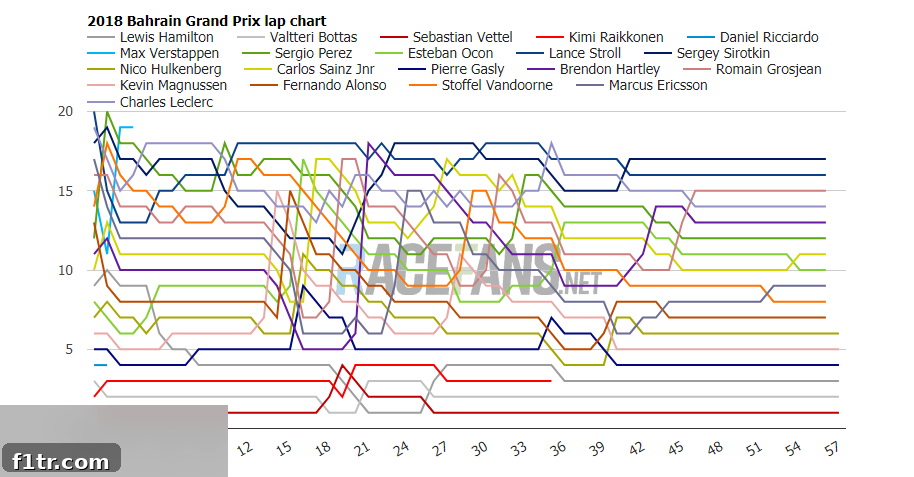
Understanding a Formula 1 race often means tracking the ebb and flow of positions on every lap. While interactive charts would visually represent the position of each driver throughout the Grand Prix, a textual analysis allows us to appreciate the sustained efforts and strategic plays made by teams and drivers. The initial laps of any race are often chaotic, with drivers vying for track position, but the Bahrain Grand Prix showed sustained battles and strategic gains that unfolded over the entire race distance. Analyzing the lap charts would reveal how drivers like Hamilton meticulously worked their way up the order, or how Bottas maintained a relentless pursuit of Vettel, often closing the gap only to find a new challenge.
2018 Bahrain Grand Prix Race Pace Comparison
The race chart, if visualized, would illustrate the gaps between each driver relative to the leader’s average lap time, offering critical insights into comparative race pace and potential strategic advantages. Large gaps are often indicative of retirements, significant incidents, or severely compromised performances, while consistent, smaller gaps highlight intense battles and effective tyre management. This metric is crucial for understanding how different tyre strategies played out and which cars maintained optimal performance throughout their stints. In Bahrain, this would clearly show Vettel’s ability to maintain pace on soft tyres, resisting Bottas’s surge on mediums, and Hamilton’s consistent performance from the midfield.
Position Change: The Movers and Shakers of the Race
The Bahrain Grand Prix was not just about the front-runners; it was also a story of resilience and strategic brilliance throughout the grid. The “Position Change” table offers a clear snapshot of how each driver performed relative to their starting position, highlighting those who gained significant ground and those who struggled to maintain their initial grid slots. This data is invaluable for assessing individual driver performance and the effectiveness of their team’s strategies in navigating the demanding Sakhir circuit.
| Driver | Start position | Lap one position change | Race position change |
|---|---|---|---|
| Lewis Hamilton | 9 | -1 | 6 |
| Valtteri Bottas | 3 | 1 | 1 |
| Sebastian Vettel | 1 | 0 | 0 |
| Kimi Raikkonen | 2 | -1 | |
| Daniel Ricciardo | 4 | 0 | |
| Max Verstappen | 15 | 4 | |
| Sergio Perez | 12 | -8 | -4 |
| Esteban Ocon | 8 | 1 | -2 |
| Lance Stroll | 20 | 5 | 6 |
| Sergey Sirotkin | 18 | -1 | 3 |
| Nico Hulkenberg | 7 | -1 | 1 |
| Carlos Sainz Jnr | 10 | -3 | -1 |
| Pierre Gasly | 5 | 0 | 1 |
| Brendon Hartley”>Brendon Hartley | 11 | -1 | -6 |
| Romain Grosjean | 16 | 0 | 3 |
| Kevin Magnussen | 6 | 0 | 1 |
| Fernando Alonso”>Fernando Alonso | 13 | 4 | 6 |
| Stoffel Vandoorne | 14 | -4 | 6 |
| Marcus Ericsson | 17 | 3 | 8 |
| Charles Leclerc | 19 | 2 | 7 |
As highlighted, Marcus Ericsson was undoubtedly the “mover” of the race, climbing eight positions from 17th to 9th. This exceptional climb showcased Sauber’s potential and Ericsson’s skill. Similarly, Lewis Hamilton’s six-place gain from 9th to 3rd was a masterclass in overtaking and strategic execution. Other impressive gains came from Charles Leclerc (7 places), Lance Stroll, Fernando Alonso, and Stoffel Vandoorne (all gaining 6 places), underlining the highly competitive nature of the mid-field. Conversely, some drivers faced challenges, with Sergio Perez losing four places and Brendon Hartley dropping six places, illustrating the unforgiving demands of the Bahrain circuit and the impact of race incidents or suboptimal strategies.
2018 Bahrain Grand Prix Lap Times: The Pacing Game
The lap times achieved by drivers throughout the race are a direct indicator of their car’s performance, their personal driving skill, and their ability to manage tyres. An interactive chart showing all lap times would illustrate consistency, spikes (due to traffic or incidents), and the periods where drivers were pushing hardest. Very slow laps, often resulting from pit stops or significant on-track events, would typically be excluded for a clearer view of pure racing pace. Analyzing these trends helps dissect the race, identifying key moments where pace shifted and strategic advantages were either gained or lost. For instance, Hamilton and Bottas consistently logging fast laps towards the end of their stints on harder tyres underscores Mercedes’ aerodynamic efficiency and engine power.
Advert | Become a RaceFans supporter andgo ad-free
2018 Bahrain Grand Prix Fastest Laps: The Ultimate Speed Test
The fastest lap of a Grand Prix is a coveted achievement, showcasing the ultimate single-lap pace a driver and car combination can deliver. In the 2018 Bahrain Grand Prix, this metric revealed some interesting insights, particularly concerning Mercedes’ underlying speed even as they battled strategic challenges. Despite Vettel taking the win, both Mercedes drivers set the two fastest laps of the race, a clear indicator of their car’s raw performance potential. This table provides a comprehensive overview of each driver’s quickest circulation, the car they were driving, the gap to the fastest time, and the lap on which it was achieved.
| Rank | Driver | Car | Fastest lap | Gap | On lap |
|---|---|---|---|---|---|
| 1 | Valtteri Bottas | Mercedes | 1’33.740 | 22 | |
| 2 | Lewis Hamilton | Mercedes | 1’33.953 | 0.213 | 51 |
| 3 | Romain Grosjean | Haas-Ferrari | 1’34.053 | 0.313 | 47 |
| 4 | Fernando Alonso | McLaren-Renault | 1’34.168 | 0.428 | 47 |
| 5 | Kevin Magnussen | Haas-Ferrari | 1’34.327 | 0.587 | 29 |
| 6 | Kimi Raikkonen | Ferrari | 1’34.337 | 0.597 | 22 |
| 7 | Sebastian Vettel | Ferrari | 1’34.453 | 0.713 | 21 |
| 8 | Sergey Sirotkin | Williams-Mercedes | 1’34.563 | 0.823 | 42 |
| 9 | Nico Hulkenberg | Renault | 1’34.667 | 0.927 | 50 |
| 10 | Brendon Hartley | Toro Rosso-Honda | 1’34.689 | 0.949 | 44 |
| 11 | Pierre Gasly | Toro Rosso-Honda | 1’34.863 | 1.123 | 46 |
| 12 | Esteban Ocon | Force India-Mercedes | 1’35.043 | 1.303 | 38 |
| 13 | Charles Leclerc | Sauber-Ferrari | 1’35.058 | 1.318 | 40 |
| 14 | Sergio Perez | Force India-Mercedes | 1’35.075 | 1.335 | 35 |
| 15 | Marcus Ericsson | Sauber-Ferrari | 1’35.093 | 1.353 | 26 |
| 16 | Stoffel Vandoorne | McLaren-Renault | 1’35.131 | 1.391 | 30 |
| 17 | Lance Stroll | Williams-Mercedes | 1’35.266 | 1.526 | 32 |
| 18 | Carlos Sainz Jnr | Renault | 1’35.535 | 1.795 | 35 |
| 19 | Daniel Ricciardo | Red Bull-TAG Heuer | 1’38.684 | 4.944 | 1 |
| 20 | Max Verstappen | Red Bull-TAG Heuer | 1’43.654 | 9.914 | 1 |
It is noteworthy that Valtteri Bottas claimed the fastest lap of the race on lap 22, setting a blistering 1’33.740. This was achieved early in his second stint, likely on fresh medium tyres, demonstrating his outright pace. Lewis Hamilton was not far behind, securing the second-fastest lap on lap 51, very late in the race, which speaks volumes about his tyre management and the enduring performance of his Mercedes. The presence of Haas drivers, Romain Grosjean and Kevin Magnussen, and Fernando Alonso in the top five fastest laps indicates strong one-lap pace from these midfield teams, showcasing their car’s potential on a flying lap. Sebastian Vettel’s fastest lap was 7th overall, a testament to his focus on conserving tyres for race victory rather than chasing individual lap honours.
Advert | Become a RaceFans supporter andgo ad-free
2018 Bahrain Grand Prix Tyre Strategies: The Chess Game on Asphalt
In modern Formula 1, tyre strategy is as crucial as raw pace. The 2018 Bahrain Grand Prix exemplified this, with various approaches to tyre management profoundly influencing the race outcome. Teams had to balance the grip offered by softer compounds against their higher degradation rates, making critical decisions about pit stop timing and tyre choices. This table meticulously details the tyre strategies employed by each driver, indicating the compound used and the number of laps completed on each stint.
| Stint 1 | Stint 2 | Stint 3 | Stint 4 | |
|---|---|---|---|---|
| Sebastian Vettel | Super soft (18) | Soft (39) | ||
| Valtteri Bottas | Super soft (20) | Medium (37) | ||
| Lewis Hamilton | Soft (26) | Medium (31) | ||
| Pierre Gasly | Super soft (15) | Soft (19) | Super soft (23) | |
| Kevin Magnussen | Super soft (13) | Super soft (14) | Soft (30) | |
| Nico Hulkenberg | Super soft (15) | Soft (24) | Super soft (18) | |
| Fernando Alonso | Soft (14) | Medium (25) | Super soft (17) | |
| Stoffel Vandoorne | Super soft (10) | Soft (18) | Medium (28) | |
| Marcus Ericsson | Soft (23) | Medium (33) | ||
| Esteban Ocon | Super soft (15) | Medium (20) | Soft (21) | |
| Carlos Sainz Jnr | Super soft (16) | Super soft (10) | Soft (30) | |
| Charles Leclerc | Soft (3) | Medium (31) | Super soft (22) | |
| Romain Grosjean | Super soft (18) | Soft (12) | Super soft (15) | Super soft (11) |
| Lance Stroll | Soft (10) | Super soft (20) | Medium (26) | |
| Sergey Sirotkin | Soft (22) | Medium (18) | Super soft (16) | |
| Sergio Perez | Soft (9) | Medium (23) | Super soft (24) | |
| Brendon Hartley | Super soft (20) | Soft (22) | Super soft (14) | |
| Kimi Raikkonen | Super soft (19) | Soft (16) | ||
| Max Verstappen | Soft (2) | Super soft (1) | ||
| Daniel Ricciardo | Super soft (1) |
The primary strategic battle unfolded between Sebastian Vettel and Valtteri Bottas. Vettel opted for a two-stop strategy, starting on Super Softs for 18 laps, then switching to Softs for a lengthy 39-lap final stint. This aggressive choice on the Soft tyre proved to be a masterstroke, allowing him to maintain pace and manage degradation impeccably. Bottas, on the other hand, went for Super Softs for 20 laps, followed by Mediums for 37 laps. While the Medium tyre offered greater durability, its slightly reduced pace compared to Vettel’s Softs in the final stint ultimately made the difference in their head-to-head battle, especially without the immediate advantage of DRS. Lewis Hamilton’s strategy was also a two-stopper, but he started on Softs for 26 laps, then moved to Mediums for the remaining 31 laps, a strategy that aided his recovery from a lower grid position by offering greater flexibility.
Further down the grid, diverse strategies were employed. Many drivers, particularly in the midfield, opted for three-stop races, trying to extract maximum performance from fresh rubber or recover from early tyre wear. Examples include Pierre Gasly, Nico Hulkenberg, and Fernando Alonso. Romain Grosjean even pitted four times, indicative of either aggressive performance seeking or significant tyre wear issues. These varied approaches highlight the delicate balance between tyre life, outright speed, and track position that teams constantly evaluate.
Go ad-free for just £1 per month>> Find out more and sign up
2018 Bahrain Grand Prix Pit Stop Times: Precision Under Pressure
Pit stops are often described as a ballet of precision and speed, where fractions of a second can make or break a race. The 2018 Bahrain Grand Prix saw teams pushing the boundaries of efficiency to gain a critical edge. This table records the duration of each driver’s pit stops, providing a clear indication of team performance under pressure and the impact of pit stop execution on overall race strategy.
| Driver | Team | Pit stop time | Gap | On lap | |
| 1 | Lewis Hamilton | Mercedes | 24.302 | 26 | |
| 2 | Nico Hulkenberg | Renault | 24.382 | 0.080 | 39 |
| 3 | Nico Hulkenberg | Renault | 24.454 | 0.152 | 15 |
| 4 | Sebastian Vettel | Ferrari | 24.524 | 0.222 | 18 |
| 5 | Fernando Alonso | McLaren | 24.581 | 0.279 | 39 |
| 6 | Esteban Ocon | Force India | 24.596 | 0.294 | 35 |
| 7 | Kevin Magnussen | Haas | 24.629 | 0.327 | 27 |
| 8 | Lance Stroll | Williams | 24.638 | 0.336 | 30 |
| 9 | Sergey Sirotkin | Williams | 24.672 | 0.370 | 22 |
| 10 | Sergio Perez | Force India | 24.677 | 0.375 | 32 |
| 11 | Esteban Ocon | Force India | 24.719 | 0.417 | 15 |
| 12 | Pierre Gasly | Toro Rosso | 24.835 | 0.533 | 15 |
| 13 | Brendon Hartley | Toro Rosso | 24.953 | 0.651 | 42 |
| 14 | Pierre Gasly | Toro Rosso | 24.957 | 0.655 | 34 |
| 15 | Sergio Perez | Force India | 24.992 | 0.690 | 9 |
| 16 | Fernando Alonso | McLaren | 24.993 | 0.691 | 14 |
| 17 | Romain Grosjean | Haas | 25.011 | 0.709 | 18 |
| 18 | Kimi Raikkonen | Ferrari | 25.018 | 0.716 | 19 |
| 19 | Stoffel Vandoorne | McLaren | 25.081 | 0.779 | 10 |
| 20 | Kevin Magnussen | Haas | 25.106 | 0.804 | 13 |
| 21 | Stoffel Vandoorne | McLaren | 25.131 | 0.829 | 28 |
| 22 | Charles Leclerc | Sauber | 25.139 | 0.837 | 34 |
| 23 | Marcus Ericsson | Sauber | 25.194 | 0.892 | 23 |
| 24 | Carlos Sainz Jnr | Renault | 25.307 | 1.005 | 26 |
| 25 | Romain Grosjean | Haas | 25.527 | 1.225 | 30 |
| 26 | Charles Leclerc | Sauber | 25.563 | 1.261 | 3 |
| 27 | Sergey Sirotkin | Williams | 25.693 | 1.391 | 40 |
| 28 | Carlos Sainz Jnr | Renault | 25.768 | 1.466 | 16 |
| 29 | Valtteri Bottas | Mercedes | 26.105 | 1.803 | 20 |
| 30 | Romain Grosjean | Haas | 26.263 | 1.961 | 45 |
| 31 | Max Verstappen | Red Bull | 30.381 | 6.079 | 2 |
| 32 | Lance Stroll | Williams | 33.612 | 9.310 | 10 |
| 33 | Brendon Hartley | Toro Rosso | 36.646 | 12.344 | 20 |
The pit stop times underscore the relentless pursuit of perfection by all teams. Mercedes executed a stellar stop for Lewis Hamilton at 24.302 seconds, making it the fastest of the race. This precision was crucial for Hamilton’s charge through the field. Nico Hulkenberg also benefited from two exceptionally quick pit stops from the Renault team, highlighting their operational efficiency. Sebastian Vettel’s stop, critical for his race lead, was also commendably fast at 24.524 seconds. Interestingly, Valtteri Bottas’s stop was slightly longer at 26.105 seconds, potentially a small but impactful factor in his inability to close the final gap to Vettel. Longer pit stops for Max Verstappen, Lance Stroll, and Brendon Hartley often indicate unforeseen issues or strategic adjustments, sometimes contributing to their eventual retirements or compromised race performances. These details reveal the fine margins on which Formula 1 victories are built.
Further Insights into the 2018 Bahrain Grand Prix
For those eager to delve deeper into the nuances and memorable moments of this thrilling race, explore our collection of related articles:
- Top ten pictures from the 2018 Bahrain Grand Prix
- Vettel’s narrow win bodes well for 2018 title fight
- 2018 Bahrain Grand Prix Star Performers
- McLaren go 100 races without a win as Hamilton equals Raikkonen record
- Vote for your 2018 Bahrain Grand Prix Driver of the Weekend
Browse all 2018 Bahrain Grand Prix articles