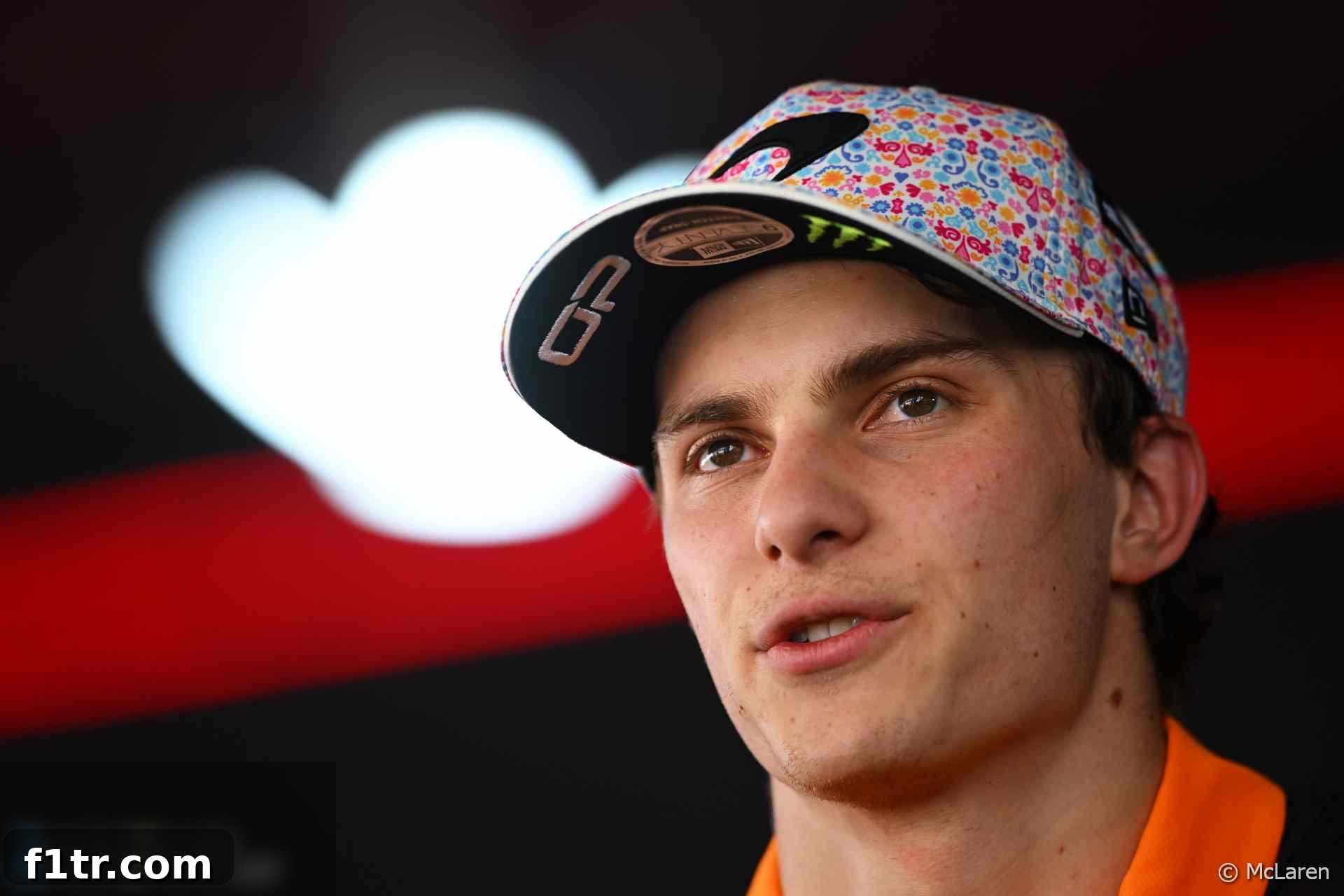
Oscar Piastri found himself searching for answers after a perplexing lack of pace saw him trailing his teammate for the second consecutive race at the Mexican Grand Prix.
Advert | Become a Supporter & go ad-free
While Piastri grappled with an elusive sweet spot, Lando Norris delivered a truly commanding performance, clinching a dominant victory at the iconic Autodromo Hermanos Rodriguez. Norris crossed the finish line an astonishing half a minute ahead of Charles Leclerc, showcasing McLaren’s impressive pace and his own exceptional skill on a challenging circuit.
Piastri, meanwhile, finished in a distant fifth position, a significant 42 seconds behind his triumphant teammate. The disparity was further highlighted by Piastri requiring an additional pit stop during the race, a clear indicator of differing tyre wear or strategic approaches between the two McLaren drivers. In Saturday’s crucial qualifying session, the gap between them was nearly six tenths of a second, marking the largest margin between the pair at this particular event since their first season together. This performance gap sparked considerable discussion among pundits and fans alike, raising questions about the specific characteristics of the MCL38 on the unique Mexican tarmac and how each driver was able to extract performance.
This result carried significant championship implications for Piastri, as he relinquished the championship lead to his teammate by a single point. It also marked the fourth consecutive race in which the young Australian has failed to secure a podium finish. While any dip in form can be concerning, Piastri openly admitted his primary concern stemmed from his performance over the preceding two rounds, where the gap to Norris had become noticeably pronounced. The consistency that defined much of his early season had seemingly evaporated, leaving both Piastri and the McLaren team with a puzzle to solve.
“Definitely, I think the last couple of races has been surprising in terms of the pace,” Piastri told the official Formula 1 channel, reflecting on his recent struggles. His candid admission underscored the unexpected nature of the performance drop-off, particularly given McLaren’s generally strong trajectory throughout the season. “I think there’s been some evidence of where the pace is and what to do,” he added, hinting that the team might have identified potential areas for improvement or understanding, even if the execution on track proved challenging. This suggests an ongoing analysis within the team to pinpoint the root causes of the performance differential.
Piastri elaborated on the profound impact the car’s behaviour had on his driving style. “I’ve [had] to drive the car very differently these last couple of weekends,” he explained. “Which, when it’s been working well for you for the previous 18, is a little bit difficult to kind of wrap your head around.” This insight is crucial; forcing a driver to fundamentally alter their natural style can be detrimental to their rhythm, confidence, and ability to extract maximum performance. For a driver whose rookie season was marked by impressive adaptability and speed, this sudden requirement to change his approach indicated a significant shift in the car’s characteristics or how it interacted with specific track conditions.
Despite the challenges, Piastri remained proactive. “But I tried a few things today and I’ll have a look at if that was what we were looking for,” he stated, indicating that he was actively experimenting with setup changes or driving techniques during the race to try and find a solution. This willingness to adapt and experiment under pressure is a hallmark of top drivers, even when facing difficult circumstances. The data gathered from these experiments would be invaluable for McLaren’s engineers in their quest to understand and mitigate the issues Piastri was experiencing.
Advert | Become a RaceFans supporter andgo ad-free
In stark contrast, Lando Norris was ecstatic about the performance of his McLaren in Mexico. His dominant victory was a testament to his ability to unlock the car’s full potential, even if he conceded that its performance could be “peaky” throughout the season. “The car is just quick,” Norris affirmed. “It has been the whole season.” This statement reflects the inherent speed of the MCL38, a car that has undergone a remarkable transformation from its early-season struggles to become a consistent front-runner.
Norris further elaborated on the fine margins involved in extracting performance from the cutting-edge machinery of Formula 1. “Clearly it’s still difficult to drive at times,” he admitted. “But I think when you just find that sweet spot, it can be down the road and make your life a bit easier.” This highlights the often-overlooked challenge of F1 driving: not just raw speed, but the nuanced skill of tuning into the car’s subtle feedback, understanding its limits, and consistently operating within its optimal window. Norris’s ability to locate and exploit this “sweet spot” in Mexico proved to be the decisive factor in his commanding victory.
McLaren team principal Andrea Stella offered a crucial insight into the performance disparity between his two drivers. Speaking on Saturday, Stella suggested that the unusual low-grip nature of the Mexico City circuit produced handling characteristics that Piastri struggled with more than Norris. The Autodromo Hermanos Rodriguez is notoriously challenging due to its high altitude, which results in thinner air and significantly less downforce. This necessitates running higher wing levels, but even then, the cars produce less grip than at sea-level tracks. Furthermore, the track surface itself can be dusty and low-abrasion, contributing to a lack of mechanical grip.
These unique conditions can profoundly affect a car’s balance and how a driver perceives its limits. Some drivers thrive in a car that slides more, feeling comfortable on the edge of adhesion, while others prefer a more planted and stable rear end. It appears that Norris’s driving style, which often involves a degree of car rotation and excellent throttle control, was better suited to these specific low-grip conditions. Piastri, perhaps, prefers a more stable platform, and when the car became more unpredictable or prone to sliding, he found it harder to commit and extract the last tenths of a second. Stella’s analysis points to a fundamental difference in how each driver interacts with the car under highly specific environmental and track conditions, offering a technical explanation for the observable performance gap. Understanding these nuances is vital for McLaren’s engineers as they continue to develop the MCL38 and tailor it for optimal performance across a diverse range of circuits and conditions. The team will undoubtedly be reviewing data from Mexico closely to ensure Piastri can quickly regain his competitive edge in future low-grip scenarios.
The implications of the Mexican Grand Prix extend beyond individual driver performances. For McLaren, it underscored both the immense potential of their revitalized car and the ongoing challenge of optimizing it for two drivers with potentially differing preferences, especially when confronted with extreme track characteristics. Norris’s victory reaffirmed McLaren’s status as a genuine contender, capable of challenging for wins against the likes of Red Bull and Ferrari. However, Piastri’s struggles highlighted that there are still areas for the team to address to ensure both drivers can consistently operate at the peak of their abilities.
Piastri’s candidness about having to “drive the car very differently” suggests a complex interplay between car setup, tyre management, and personal driving style. In an era of tightly contested F1, even minor discomforts or mismatches can lead to significant time losses. The young Australian’s ability to adapt and learn from such challenging weekends will be key to his long-term success. The team will undoubtedly dedicate considerable resources to analyzing the data from Mexico, comparing both drivers’ telemetry, and working with Piastri to refine his setup and driving approach for similar conditions in the future.
Looking ahead, the team will be aiming for a more consistent performance from both drivers, particularly as the championship battle intensifies. The insights gained from such contrasting performances, while challenging in the short term, are invaluable for refining car development and driver coaching strategies. Piastri’s resilience and determination to overcome this hurdle will be closely watched, as will McLaren’s ability to provide him with a car that allows him to return to the blistering pace he showcased earlier in the season. The journey through an F1 season is rarely smooth, and Mexico offered a potent reminder of the complexities and challenges inherent in grand prix racing, even for a team enjoying a resurgence.
Miss nothing from RaceFans
Get a daily email with all our latest stories – and nothing else. No marketing, no ads. Sign up here:
2025 Mexican Grand Prix
- F1 fans shocked as ferry company screens “adult film” by mistake
- Russell: Lack of penalties over corner-cutting was ‘especially unfair for Lewis’
- Williams aim to give Albon more “consistent” car after consecutive Q1 exits
- Lawson “not at fault” for marshal incident says FIA following criticism from Mexico’s OMDAI
- Stats: Norris takes F1’s biggest win for two years as Ferrari go win-less for 12 months
Browse all 2025 Mexican Grand Prix articles