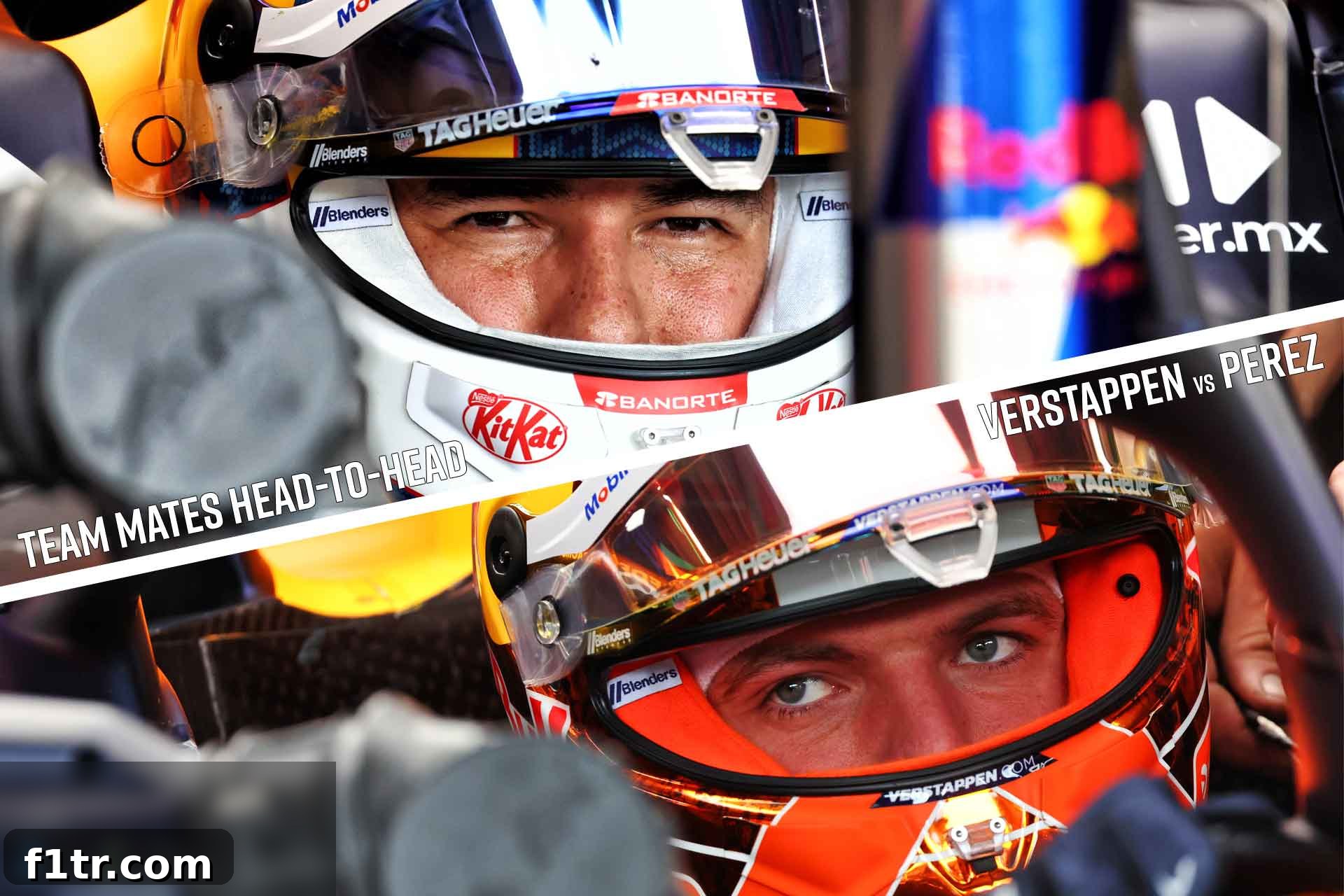
The exhilarating world of Formula 1 consistently delivers captivating narratives, yet few rivalries within a single team have been as stark or as consistently one-sided as that between Max Verstappen and Sergio Perez at Red Bull Racing. Across their four seasons as teammates, the competitive chasm between the two drivers has rarely, if ever, narrowed into a genuine contest. While Verstappen has ascended to an unprecedented level of dominance, Perez has navigated a turbulent path, often struggling to match the relentless pace and consistency of his championship-winning partner. This season, however, witnessed a particularly alarming dip in Perez’s form, a decline that commenced roughly after the first half-dozen races, curiously coinciding with Red Bull’s decision to extend his contract. This move, intended by many as a vote of confidence to galvanize the Mexican driver, paradoxically appeared to have little to no positive impact, leading to intense scrutiny and raising significant questions about his future with the team.
Advert | Become a Supporter & go ad-free
It is easy, in hindsight, to focus solely on Perez’s recent struggles, but such a perspective risks overlooking a genuinely respectable start to the championship campaign. In the initial four rounds, Sergio Perez consistently demonstrated his capability to back up his team mate, contributing significantly to Red Bull’s dominant one-two finishes in Bahrain, Saudi Arabia, and Japan. This early run of form placed him second in the drivers’ standings, a position many teams would covet for their second driver, especially one supporting a championship leader. Indeed, six races into the season, Perez had impressively finished every single Grand Prix within the top five, accumulating valuable points and showcasing a level of consistency that hinted at a more competitive year for him. This period represented a fleeting moment of renewed optimism for Perez, suggesting he might finally be finding his stride in the complex Red Bull RB20 and cementing his role as a crucial points scorer for the Constructors’ Championship.
However, even during this commendable early phase, the underlying disparity between the two Red Bull drivers was unmistakably evident. While Perez was consistently in the top five, he was almost invariably behind Max Verstappen. This persistent gap, particularly pronounced in qualifying sessions, is a metric most top-tier Formula 1 teams scrutinize with immense detail. The stark reality underscores a fundamental challenge for Perez: he has not out-qualified his formidable team mate since Verstappen’s slip in qualifying at the Miami Grand Prix of the previous year, an astonishing streak now extending to 31 consecutive rounds. This statistic alone highlights a critical area of weakness for Perez: the inability to consistently extract maximum performance from the car over a single lap. In modern Formula 1, grid position is paramount, dictating race strategy, tyre management, and the psychological edge, making this consistent qualifying deficit a significant hurdle for Perez to overcome.
Following a particularly difficult mid-season spell in the previous year, Perez had shown encouraging signs of recovery, ending the 2023 campaign with renewed vigor and improved results. This improved momentum seemingly carried over into the start of the current season, fostering hopes among the team and fans that he had finally conquered his previous struggles with adapting to the car’s nuances. Yet, this fragile stability began to unravel dramatically at the Emilia-Romagna Grand Prix. In a weekend that saw Max Verstappen once again showcasing his unparalleled skill by securing pole position, Perez shockingly failed to advance beyond Q2, starting the race significantly out of position. Despite a determined drive, he could only recover to an eighth-place finish, a result far below Red Bull’s expectations for their second driver and a stark reminder of his past difficulties. This performance marked a significant downturn, a pivotal moment when the season truly began to go off the rails for the Mexican driver.
Red Bull team principal Christian Horner initially described Perez’s Emilia-Romagna weekend as an “anomaly,” perhaps hoping it was merely an isolated blip in an otherwise improving season. However, what followed proved Horner’s initial assessment to be tragically optimistic. Perez’s form did not merely stabilize; it worsened considerably and alarmingly over subsequent races. Soon, the respectable performances of the opening rounds began to appear as the true anomalies, overshadowed by a succession of struggles that cast a long shadow over his championship aspirations and his place within the team. The performance gap between the two drivers widened significantly, particularly concerning single-lap pace, on the rare occasions when Perez even managed to set a truly representative time in qualifying, highlighting a worrying trend of diminishing confidence and pace.
Indeed, consistency in qualifying became an even greater issue for Perez, marked by a series of costly errors that severely impacted his race weekends. He suffered damaging crashes in consecutive qualifying sessions at Silverstone and the Hungaroring, incidents that not only severely compromised his starting positions but also put additional strain on the team’s resources and budget, leading to extensive repair work. These incidents were further compounded by a massive shunt at the iconic Monaco Grand Prix, a circuit where track position is everything. After a dismal performance saw him fail to get out of Q1, Perez started from a lowly 20th position. On the opening lap, he was involved in a dramatic, high-speed collision with Kevin Magnussen, an incident that utterly destroyed his Red Bull RB20, leading to a red flag and significant financial damage. Such high-profile crashes are detrimental not just to a driver’s confidence but also to the team’s development schedule and morale, highlighting a worrying trend in Perez’s performance under intense pressure.
As Red Bull Racing relentlessly pursued advancements for their dominant RB20 chassis throughout the season, introducing continuous upgrades and aerodynamic tweaks, the two drivers, Verstappen and Perez, have not consistently been afforded the exact same specification hardware. This practice, while not unique to Red Bull and often occurring within other top teams as they introduce new components or test different configurations, may have been particularly aggravating in Perez’s specific case. His string of qualifying crashes and, most notably, his colossal accident in Monaco, inevitably led to a backlog of spare parts and can delay the introduction of the latest upgrades to a damaged car. Consequently, Perez might have found himself consistently running slightly older specifications or components due to the need for repairs, potentially widening the performance gap between him and Verstappen, who consistently receives the very latest advancements for his undamaged car. This dynamic can create a vicious cycle, where a driver’s struggles lead to car damage, which in turn limits access to upgrades, further hindering performance and confidence.
Following Perez’s third point-less weekend out of five, a period of severe underperformance that was far from acceptable for a team of Red Bull’s caliber, Christian Horner publicly acknowledged the gravity of the situation, candidly describing it as “unsustainable.” Such a statement from a team principal is a rare and powerful signal of concern, indicative of the immense pressure building on Perez. Yet, despite this public admonition and the continued struggles, Red Bull, after some internal reflection and a pair of marginally better seventh-place finishes, reiterated their commitment by extending Perez’s contract. The team appears to be banking on the theory that a renewed show of faith, coupled with stability, will eventually lead to a resurgence in performance from their embattled driver. This decision is not without its significant risks, and the success of this high-stakes gamble will ultimately dictate the outcome of the Constructors’ Championship. While Max Verstappen continues to deliver peerless performances, Sergio Perez goes into the summer break with a points tally barely half that of his team mate. More critically, over the last eight races, Verstappen has out-scored Perez by a staggering margin of more than four-fold, a statistic that lays bare the urgent need for a dramatic turnaround in Perez’s fortunes if Red Bull is to maintain its commanding lead in both championships and ward off increasingly competitive rivals.
Advert | Become a RaceFans supporter andgo ad-free
Verstappen vs Perez: Season Summary
Analyzing the season’s trajectory for both Max Verstappen and Sergio Perez through a comprehensive summary table reveals a tale of contrasting fortunes and highlights Verstappen’s near-unrivalled supremacy across all key metrics. This section typically illustrates cumulative points, podium finishes, fastest laps, and DNF statistics for each driver, offering a quick yet impactful overview of their overall performance throughout the season. From consistent qualifying dominance, leading to optimal starting positions, to superior race pace and unerring consistency in converting opportunities into victories, Verstappen’s performance has been consistently flawless. Perez, conversely, has grappled with significant inconsistency, particularly in qualifying, which has severely hampered his ability to convert the potent RB20 into regular podium finishes or even consistent top-tier points. The stark points differential, as highlighted, is a direct and undeniable indicator of this performance gap, directly impacting Red Bull’s commanding position in the Constructors’ Championship.
Verstappen vs Perez: Race-by-race
Delving into the race-by-race breakdown provides a granular view of how the season has unfolded for both drivers across individual Grand Prix weekends. This detailed table typically documents qualifying positions and final race results for each event, offering specific insights into their individual performances at various circuits and under diverse conditions. It visually underscores Verstappen’s consistent front-row starts and dominant victories, contrasted sharply with Perez’s fluctuating fortunes, often involving difficult recoveries from compromised grid positions. The progression of the season, from Perez’s strong initial start to his subsequent downturn marked by errors and a lack of pace, can be clearly traced through these individual race results, highlighting the exact moments where his performance began to falter and the widening gap to his formidable teammate became undeniable.
| BAH | SAU | AUS | JAP | CHI | MIA | EMI | MON | CAN | SPA | AUT | GBR | HUN | BEL | ||
| Verstappen | Q | ||||||||||||||
| R |
Advert | Become a RaceFans supporter andgo ad-free
Further analysis would typically extend to lap time comparisons, revealing intricate details about their on-track performance across practice, qualifying, and race sessions. This data, often visualized in a dedicated table or dynamic chart, meticulously compares their fastest laps, average race pace, and sector times across various Grand Prix weekends. Such granular data frequently illustrates how Max Verstappen consistently extracts more raw speed and precision from the Red Bull RB20, maintaining blistering pace throughout a race distance and often setting significantly faster sector times even under pressure. Conversely, Perez’s data often shows greater variability and a struggle to consistently match Verstappen’s peak performance, particularly on specific tyre compounds, in challenging conditions, or during critical race stints. The provided table, structured to highlight these differences, would typically show negative values when Verstappen was demonstrably faster and positive values when Perez managed to be quicker, though such instances are rare and often qualified by specific circumstances, strategic differences, or unique track events. Unrepresentative comparisons, such as those heavily impacted by traffic, punctures, safety car periods, or early retirement, are deliberately omitted from this analysis to ensure the integrity and accuracy of the performance comparison.
Unrepresentative comparisons omitted. Negative value: Verstappen was faster; Positive value: Perez was faster
Miss nothing from RaceFans
Get a daily email with all our latest stories – and nothing else. No marketing, no ads. Sign up here:
Formula 1
- The ‘throwback weekend’ is back in fashion. But it’s a flawed concept – especially for F1
- Is Formula 1’s double race cancellation a blessing in disguise?
- Todt admits Schumacher crashed on purpose – but did it really cost him two titles?
- 25 of the most memorable radio exchanges from the ‘Max and GP show’
- FIA explains next steps after first meeting to discuss fixes for 2026 F1 rules
Browse all Formula 1 articles