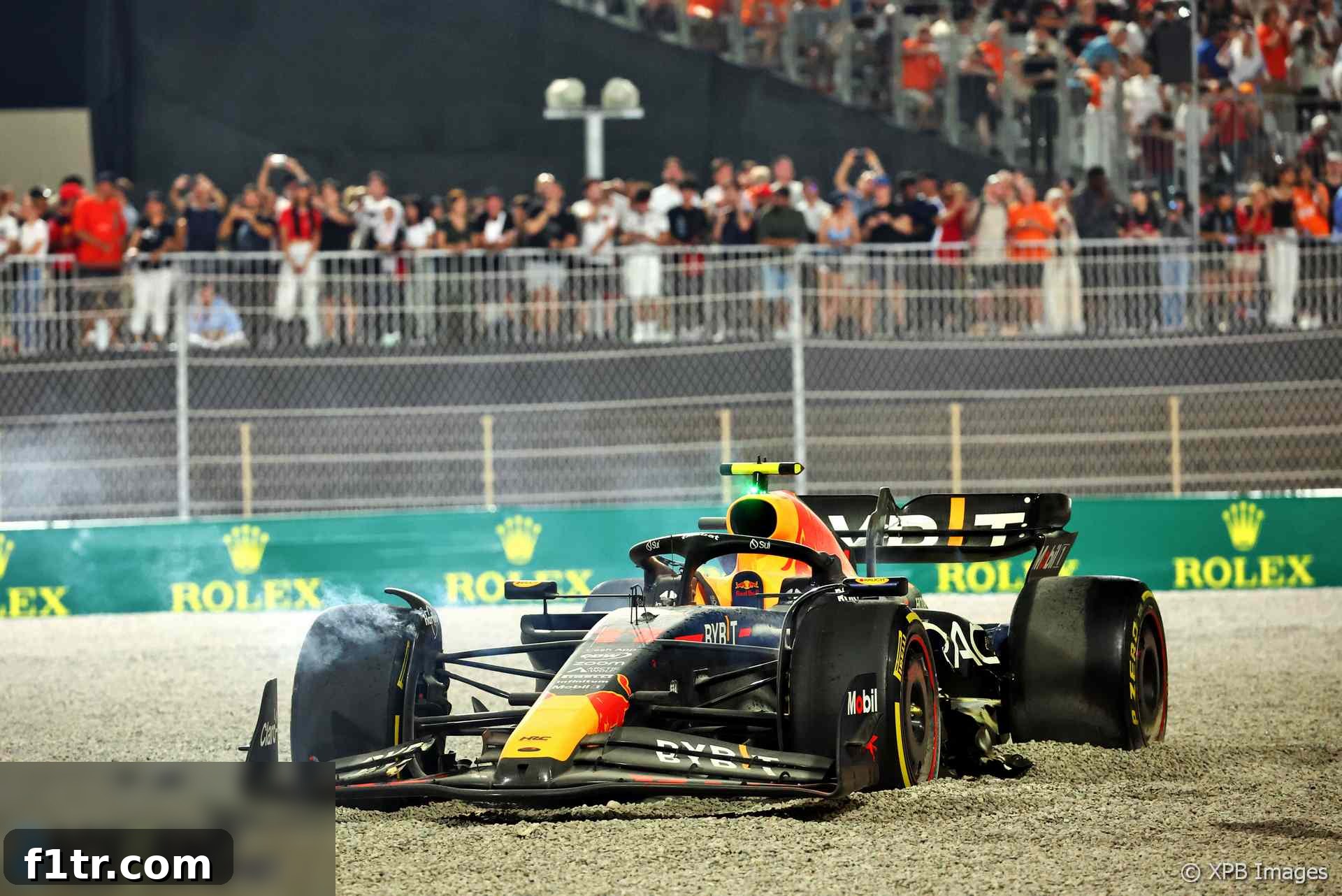
Sergio Perez was handed a significant penalty ahead of the Qatar Grand Prix, forcing him to start the race from the pit lane. This decision came after the FIA found that his Red Bull Racing team had undertaken extensive work on his car under parc ferme conditions, a clear breach of Formula 1 regulations designed to ensure fairness and prevent unauthorized modifications after qualifying.
Parc Ferme Breach Leads to Pit Lane Start for Perez
The incident stemmed from a tumultuous sprint race on Saturday at the Losail International Circuit. Perez, who had originally qualified 13th for the main Grand Prix, was involved in a multi-car collision that left his RB19 machine heavily damaged. The crash, which also involved Esteban Ocon’s Alpine and Nico Hulkenberg’s Haas, occurred during a chaotic moment, with Perez describing the damage to his car as “massive” after being hit by Ocon’s out-of-control vehicle and coming to rest in the gravel trap at Turn Two.
The Aftermath of the Sprint Race Collision
Following the sprint race incident, the Red Bull team faced a race against time and a complex regulatory challenge. The extent of the damage to Perez’s car necessitated more than just superficial repairs; it required the construction of a replacement chassis. This is where the team ran afoul of the stringent parc ferme rules. Under these regulations, once cars enter parc ferme after qualifying, they are effectively “impounded,” meaning only very limited and specified work can be performed on them without incurring a penalty.
Teams are permitted to repair damage, but only using original specification parts and under strict supervision. The assembly of an entirely new chassis, as was the case for Perez, goes beyond the scope of permissible repairs under normal parc ferme conditions. The intention behind these rules is to prevent teams from gaining an unfair advantage by making significant setup changes or introducing new components after the official qualifying sessions, thereby locking in the competitive pecking order established on Friday or Saturday morning.
FIA’s Findings: Unsupervised Chassis Assembly
The gravity of Red Bull’s actions was highlighted in the report issued by the FIA’s Formula 1 technical delegate, Jo Bauer. Bauer meticulously documented that the amount of work carried out on Perez’s car far exceeded what is permitted by the sporting regulations. Specifically, the technical delegate noted that “chassis two was assembled without supervision to more than an assembly comprising a survival cell as defined in SR Article 27.2.” This statement is critical, as it implies that the team built up a significant portion of a new car without the necessary oversight from FIA officials.
Bauer’s report further clarified the severity of the breach: “This has to be considered as a third car available to the competitor.” This classification is a key element of the penalty, as teams are generally only allowed to have two active cars per driver over a Grand Prix weekend. Having a “third car” – even if it’s a rebuilt chassis for an existing driver – constitutes a significant infringement. The report also detailed the timing of the compliance submission: “A self-declared scrutineering sheet for car 11, chassis two, was submitted at 14:05 today, 55 minutes before the covers-off time,” indicating that while Red Bull did eventually notify the FIA, the work itself had already progressed beyond the regulatory limits.
Understanding Parc Ferme and its Importance
Parc ferme, a French term meaning “closed park,” is a designated secure area at race circuits where cars are kept after qualifying and before the race. Its purpose is multi-faceted: it ensures fairness by preventing teams from making significant performance-enhancing changes, maintains technical integrity, and contributes to the competitive balance of the sport. Teams are typically allowed to make minor adjustments, such as brake changes, wheel changes, and specific engine adjustments, but major structural work or the introduction of new components is strictly prohibited unless under very specific circumstances and with FIA approval.
In cases of significant damage, like that sustained by Perez, teams are often faced with a difficult dilemma: either attempt to repair the car within the parc ferme constraints, knowing it might not be optimal, or undertake more extensive repairs/chassis changes and accept a penalty. Red Bull’s decision to replace the chassis, even knowing the potential consequences, underscores the severity of the damage Perez incurred and the team’s commitment to providing him with a competitive and safe car for the race, even if it meant starting from the very back.
A Familiar Position for Sergio Perez
For Sergio Perez, starting from the pit lane for the Qatar Grand Prix is an unfortunate and familiar turn of events. This marks the third time this season that the Mexican driver has been relegated to the back of the grid or a pit lane start. Such penalties have consistently hampered his ability to convert strong qualifying performances into race results, adding further pressure in what has been a challenging season for the Red Bull driver at times, despite his team’s dominant performance in the constructors’ championship.
The pit lane start adds a significant challenge to Perez’s race. From the pit lane, drivers effectively start behind all other competitors and must navigate their way through traffic, often losing valuable time in the initial laps. On a circuit like Losail, which is known for its high-speed corners and limited overtaking opportunities, making up ground can be particularly arduous. This scenario places a greater emphasis on strategy, tire management, and opportunistic overtaking, demanding a flawless performance from Perez if he hopes to score points.
Implications for Red Bull and the Championship
While Red Bull had already secured the Constructors’ Championship prior to the Qatar Grand Prix, every point still matters for individual driver standings and team morale. A pit lane start for Perez means a potential loss of valuable points that could otherwise contribute to his fight for a higher position in the drivers’ championship, solidifying his runner-up spot against rivals. It also highlights the extreme pressures and split-second decisions teams must make under the intense scrutiny of a Grand Prix weekend.
The Qatar Grand Prix itself was already shaping up to be a demanding event, with extreme heat and humidity adding an extra layer of challenge for drivers and cars alike. The physically demanding nature of the race, coupled with the need for aggressive overtaking from the back, further amplifies the task ahead for Perez. His ability to manage his tires, conserve energy, and execute a strategic race will be crucial in determining his final position.
Looking Ahead: Perez’s Recovery Drive
Despite the setback, Sergio Perez and Red Bull Racing are known for their resilience and strategic prowess. While a pit lane start is far from ideal, the powerful RB19 car, coupled with Perez’s proven ability to make up positions, offers a glimmer of hope for a recovery drive. The team will undoubtedly employ an aggressive strategy, potentially using alternative tire compounds or pit stop timings to gain an advantage. Fans will be watching closely to see if Perez can replicate some of his past heroic recovery performances and salvage valuable points from what has become a very challenging weekend.
The incident serves as a stark reminder of the rigorous technical regulations that govern Formula 1 and the constant balancing act teams face between performance, safety, and compliance. Even for a dominant team like Red Bull, a momentary lapse or an unavoidable consequence of racing damage can lead to significant penalties, reshaping the dynamic of a Grand Prix weekend.
2023 Qatar Grand Prix Updates and Related Articles
- Albon fears Qatar GP conditions risked creating dangerous “wet bulb effect”: Dive deeper into the extreme environmental conditions that challenged drivers and teams at Losail.
- Alonso: New-spec fireproofs and pre-race anthem timing made Qatar heat worse: Fernando Alonso’s perspective on how various factors intensified the heat struggle for drivers.
- Magnussen admits he took “too long to learn” Losail circuit: Kevin Magnussen shares his challenges in adapting to the unique demands of the Losail track layout.
- Analysis: Sargeant’s Qatar radio reveals his painful struggle to end point-less run: An in-depth look at Logan Sargeant’s difficulties and his quest for his first F1 points.
- Alfa Romeo ‘finally understand their upgrade’ Bottas believes as team target Williams: Valtteri Bottas discusses Alfa Romeo’s progress and their aims in the Constructors’ Championship battle.
Browse all 2023 Qatar Grand Prix articles