Sergio Perez’s Hungarian GP Practice Crash: Red Bull Faces Early Setback and Strategic Tyre Puzzle
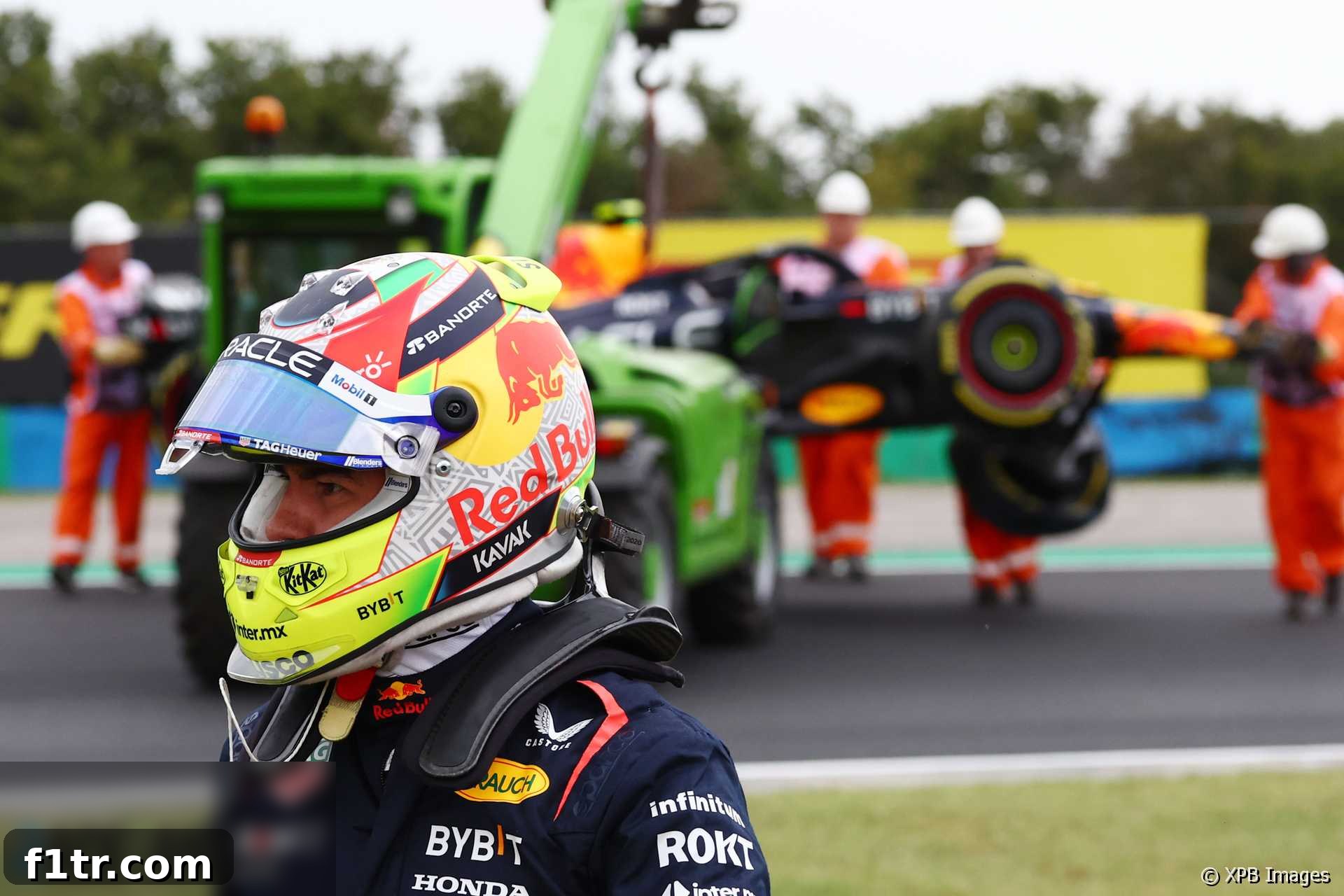
The Hungarian Grand Prix weekend kicked off with dramatic flair as Red Bull Racing’s Sergio Perez endured a challenging start, crashing his RB19 just two laps into the opening free practice session at the Hungaroring. The incident not only cut short his crucial track time but also brought into sharp focus the immediate pressure on both the driver and his team, especially with the introduction of new car upgrades and the stringent Alternative Tyre Allocation (ATA) rules.
Early Drama at the Hungaroring: Perez’s FP1 Incident
During what should have been a routine early shakedown run in Free Practice 1, Sergio Perez’s session took an abrupt turn for the worse. As the Mexican driver navigated the tricky Turn 5, a challenging right-hander at the Hungaroring, he lost control of his car. The RB19 drifted wide, its wheels catching the grass on the approach to the corner. This sudden loss of grip sent the car snapping uncontrollably, leading to an unavoidable impact with the barrier. The front-left corner of his Red Bull sustained significant damage, a sight that immediately raised concerns for the team and fans alike.
The severity of the damage was evident, jeopardizing his participation in the subsequent sessions. Such an early incident in a race weekend is particularly impactful, as it deprives the driver and engineers of valuable data and track time needed to fine-tune the car’s setup, especially crucial on a circuit as technically demanding as the Hungaroring.
Perez Takes Responsibility, Praises Team’s Swift Action
Following the unfortunate shunt, Sergio Perez offered no excuses, taking full responsibility for the error. “It was just a mistake from my side,” Perez candidly admitted to the official F1 website, reflecting his characteristic honesty and self-awareness. This straightforward acknowledgement of his misjudgment underscored his commitment to his performance and the team.
Despite the personal disappointment, Perez was quick to commend the extraordinary efforts of his Red Bull crew. The mechanics faced a monumental task: dismantling the damaged front section of the car, assessing the extent of the structural integrity, and replacing compromised components, all under intense time pressure. Their efficiency and dedication were paramount, enabling Perez to return to the track for Free Practice 2. “The guys have done a tremendous job to get the car together and get some running in FP2, and at least we have got some data to look through,” he added, highlighting the team’s resilience and their ability to salvage crucial track time from a difficult situation.
New Upgrades and the Impact of Alternative Tyre Allocation
The timing of Perez’s crash compounded the challenges for Red Bull. The team had introduced several new upgrades to the RB19 for the Hungarian Grand Prix weekend, aimed at extracting further performance from their dominant car. The damage sustained in FP1 meant that some of these brand-new components were compromised or destroyed, forcing the team to revert to older specifications or scramble for replacement parts. This not only added to the repair workload but also made it harder to accurately assess the effectiveness of the new package.
Further complicating the weekend’s preparation were Formula 1’s new Alternative Tyre Allocation (ATA) rules, which were being trialed at the Hungaroring. Under these regulations, drivers are allotted fewer sets of tyres for the entire weekend compared to a standard Grand Prix. Specifically, the total number of dry tyre sets is reduced from 13 to 11. This reduction forces teams to be far more strategic with their tyre usage, particularly in practice sessions, where extensive running on multiple compounds is usually the norm. The ATA rules meant that Perez’s limited running in FP1, exacerbated by the crash, had an even greater impact on his ability to gather essential data and adapt to the circuit and the car’s setup across various tyre compounds.
Navigating the New ATA Rules: A Strategic Gauntlet
The Alternative Tyre Allocation system is designed to introduce a new layer of strategic complexity to race weekends, pushing teams and drivers to think more critically about tyre management from the very first practice session. With fewer sets available, teams cannot afford the luxury of extensive testing on every compound. Every lap becomes more valuable, and any lost track time, like Perez’s crash, carries a heavier penalty.
Furthermore, the ATA rules mandate specific tyre compounds for each phase of qualifying: hard tyres in Q1, medium tyres in Q2, and soft tyres in Q3. This forces teams to ensure their car is well-balanced and performs optimally on all three dry weather compounds, rather than just focusing on the softest tyre for maximum qualifying pace. This strategic gauntlet means that finding a versatile setup is paramount, making comprehensive practice running even more critical for success.
Returning to Track: FP2 Insights and Tyre Management
Thanks to the heroic efforts of the Red Bull mechanics, Sergio Perez was able to participate in the second free practice session. This was a crucial opportunity to make up for lost time, albeit with compromised data from FP1. However, with the limited tyre allocation, his team had to make calculated decisions about which compounds to use.
While his teammate, Max Verstappen, opted for a more conservative approach, using only a single set of soft tyres during FP2, Perez utilized both a set of medium tyres and a set of soft tyres. This difference in strategy likely stemmed from Perez’s need to gather more data across various compounds, given his curtailed FP1 session. Despite getting back on track, Perez remained cautious about drawing early conclusions regarding the effectiveness of any new parts or the car’s overall pace. “I think it’s very early in that regard given the little running that we ended up doing with the tyre format that we have,” he explained. The tight competition on the grid further amplified this uncertainty: “I think we will have a better idea tomorrow. Certainly, the grid is really, really tight.”
Qualifying Under Scrutiny: The Three-Compound Challenge
The unique tyre rules for qualifying at the Hungarian Grand Prix present a significant challenge for all teams, but especially for those like Red Bull and Perez who had limited practice time. Drivers must demonstrate pace and consistency on hard tyres in Q1, medium tyres in Q2, and soft tyres in Q3. This progressive requirement means that finding a versatile car setup that performs well across all three compounds is absolutely essential for a strong grid position.
“Obviously with this weekend format in terms of tyre usage it will be very important to be able to get a good balance basically through all compounds because we see that in qualifying we’re going to be going through them all,” Perez elaborated. His decision to run the medium tyre in FP2, in addition to the soft, was a direct consequence of this strategic imperative. “I think we got good information, we managed to run the medium tyre as well, so some good news for there,” he concluded, expressing cautious optimism about the data gathered.
The ability to optimize the car’s handling for each specific compound under the pressure of qualifying will be a defining factor in who secures pole position and favorable starting slots for Sunday’s race. Teams that have struggled to find that balanced setup across all tyre types could find themselves at a significant disadvantage, highlighting the strategic gamble introduced by the ATA rules.
Looking Ahead: Perez’s Resilience and Red Bull’s Weekend Ambitions
Despite the initial setback and the subsequent challenges posed by limited running and the new tyre rules, Sergio Perez remained remarkably resilient and optimistic about the remainder of the Hungarian Grand Prix weekend. His ability to quickly put the FP1 incident behind him and focus on the tasks ahead speaks volumes about his mental fortitude and experience as a top-tier Formula 1 driver.
The Red Bull team, renowned for its efficiency and strategic prowess, will undoubtedly burn the midnight oil analyzing the data gathered in FP2. Their objective will be to extract every ounce of performance from the RB19, finding that crucial balance across all tyre compounds, and delivering a car that allows Perez to showcase his full potential. The tight nature of the competition, as noted by Perez, suggests that even minor gains could make a significant difference in qualifying and the race.
Perez’s confidence, despite the obstacles, is a testament to the strength of the Red Bull package and the team’s ability to recover from adversity. With the strategic intricacies of qualifying looming, and a demanding race ahead, the Hungarian Grand Prix promises to be a true test of adaptability and skill for Sergio Perez and Red Bull Racing. The early drama of FP1 has merely set the stage for what is sure to be a thrilling and unpredictable battle at the Hungaroring.