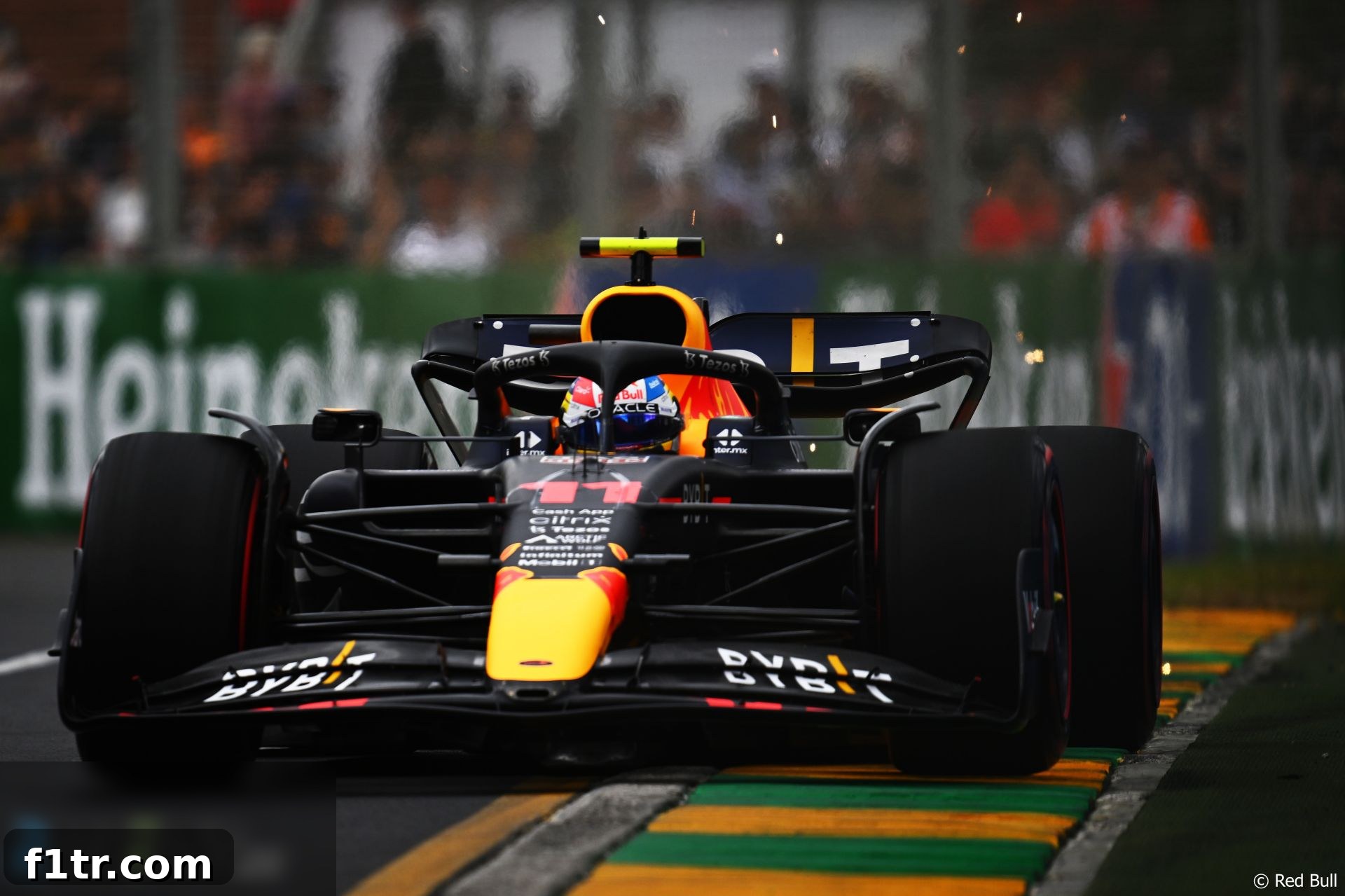
Sergio Perez Cleared in Australian GP Yellow Flag Investigation: Red Bull Maintains Strong Grid Position
In a significant development following a high-stakes qualifying session at the Australian Grand Prix, Red Bull Racing driver Sergio Perez has been officially cleared by the race stewards after an investigation into an alleged yellow flag infringement during Q2. The decision ensures that Perez will retain his crucial third-place starting position on the grid, providing a substantial boost to Red Bull’s strategic aspirations for tomorrow’s race at Albert Park.
Qualifying Drama: A Crucial Moment Under the Yellow Flags
The qualifying session for the 2022 Australian Grand Prix was, as often is the case in Formula 1, fraught with tension and split-second decisions. As drivers pushed the limits of their machinery around the demanding Albert Park circuit, every fraction of a second and every adherence to the complex rulebook became critically important. Sergio Perez, known for his consistent performances and strategic acumen, had delivered a strong Q2 lap, expertly navigating his Red Bull RB18 to secure a promising grid position among the front runners.
However, his stellar performance faced scrutiny when race control announced a post-session investigation into his actions under a single waved yellow flag. The incident occurred during Perez’s initial flying lap in the second qualifying segment (Q2), triggered by a momentary lapse from Mercedes driver George Russell. As Russell approached the challenging braking zone of Turn 11, he made an error, running wide and temporarily venturing off the circuit. This promptly led to the deployment of a single yellow flag in that specific sector, signaling a potential hazard to oncoming drivers.
As Russell diligently worked to recover his car and rejoin the circuit safely, Sergio Perez arrived at the scene, preparing to tackle the very corner where the yellow flag was displayed. The core of the investigation centered on whether Perez had sufficiently reduced his speed and demonstrated due caution in strict accordance with the stringent regulations governing yellow flag conditions. His subsequent lap time, which was approximately three-tenths slower than his teammate Max Verstappen’s best, would later become a pivotal piece of evidence in the stewards’ assessment.
Understanding Yellow Flag Regulations in Formula 1
Formula 1’s yellow flag rules are among the most critical safety protocols in motorsport, meticulously designed to protect drivers, marshals, and all trackside personnel. When a yellow flag is deployed, it signifies an incident, hazard, or obstacle on or near the track. The precise nature and severity of the incident dictate whether a single or double yellow flag is waved.
A **single waved yellow flag**, which was the signal in Perez’s specific case, transmits clear instructions to drivers: “reduce speed, do not overtake, and be prepared to change direction.” While this rule doesn’t necessarily mandate a complete lift off the throttle or heavy braking in all circumstances, it unequivocally demands a demonstrable reduction in speed and an elevated level of caution. Drivers must provide clear evidence of having lifted off the accelerator or braked earlier than usual, thereby proving they are in full control and adequately prepared for any unforeseen circumstances. Failure to adhere to this vital safety regulation can result in severe penalties, including grid place drops for the upcoming race, in-race time penalties, or even outright disqualification, reflecting the FIA’s unwavering commitment to driver and personnel safety.
In contrast, a **double waved yellow flag** indicates a significantly more severe hazard, often present when marshals are actively working on or very close to the track, or when a car is in a particularly dangerous position. Under double yellow flag conditions, drivers must “reduce speed significantly, not overtake, and be prepared to stop.” These distinctions between single and double yellow flags are absolutely crucial, and professional drivers are constantly trained to react instinctively and appropriately to these signals, which can appear both physically waved by marshals and electronically displayed on their sophisticated steering wheel dashboards and trackside LED panels.
Sergio Perez’s Defence and the Stewards’ Diligent Investigation
Immediately after the conclusion of the qualifying session, Perez confidently expressed his belief in his own actions, stating to the assembled media, “I lifted. I lifted for more than half a second, just on the straight and I lost six tenths or so. So I think it should be a straightforward thing.” His assertion suggested a clear understanding of the established rules and a firm belief that he had complied with them appropriately. The primary task of the race stewards was then to meticulously verify this claim using all available data and evidence.
The investigation process undertaken by the FIA stewards is known for its meticulousness and comprehensive nature. It involves a detailed review of a variety of crucial information sources, leaving no stone unturned:
- Telemetry Data: This is arguably the most crucial piece of evidence. Modern Formula 1 cars generate an enormous amount of data every millisecond, including precise throttle position, brake pressure, vehicle speed, gear selection, and steering angle. By comparing Perez’s lap under yellow flags to his preceding clean laps in the same session, the stewards can precisely measure any minute changes in his driving inputs and the resulting vehicle behavior.
- Team Radio Communications: The exact dialogue between the driver and their pit wall team is also thoroughly examined to ascertain if the driver was promptly informed of the yellow flag and, crucially, how they acknowledged and responded to the instruction.
- On-board Camera Footage: Video recordings from Perez’s car, in addition to various trackside cameras, provide essential visual context to the incident, clearly showing flag displays and the exact positioning of George Russell’s car.
- Marshalling System Data: Electronic data transmitted from the track’s advanced marshalling system confirms the precise timing and geographical location of the yellow flag deployment, ensuring accuracy.
After a thorough and painstaking review of all these critical data points, the stewards released their official decision, unequivocally clearing Perez of any wrongdoing. Their statement provided specific, data-backed reasoning for their definitive conclusion:
“As [Perez] approached Turn 11, a single yellow flag was displayed for a car in the escape road. [Perez] was warned by his team on the radio at the same time the signals were displayed at the corner. Compared to his previous lap, he lifted 70 meters earlier, braked 50 meters earlier, and carried 14kph less speed into the corner. As a result of these actions, the stewards conclude that [Perez] acted appropriately to the situation and take no further action.”
This detailed explanation precisely mirrored Perez’s own account and validated his actions. The telemetry data unequivocally demonstrated that he had initiated his lift from the throttle and braking significantly earlier than on a normal, uninterrupted lap. This resulted in a measurable and substantial reduction in his speed upon entering Turn 11, precisely as the regulations demand. This concrete and irrefutable evidence of appropriate action under the yellow flag conditions ultimately led the stewards to their definitive conclusion of no further action.
Implications of the Decision: A Strategic Advantage for Red Bull Racing
The stewards’ decision to clear Sergio Perez is undoubtedly a significant positive outcome for both the driver personally and the Red Bull Racing team as a whole. Retaining his vital third-place grid position means Perez will start the Australian Grand Prix directly behind his formidable teammate Max Verstappen, who secured a brilliant pole position, and Ferrari’s Charles Leclerc, who qualified second. This powerful starting grid allows Red Bull to deploy a truly formidable and multifaceted strategic approach for the race at Albert Park.
A front-row and third-place grid slot offer Red Bull numerous tactical advantages. With two cars positioned prominently at the sharp end of the grid, they possess the potential to apply immense pressure to their main rivals, Ferrari, from the very outset of the race. This strategic flexibility could involve splitting strategies between their two drivers, using one car to effectively cover off opposing strategies, while the other pushes aggressively for overall victory. Perez’s P3 is not merely about his individual performance; it is fundamentally about the collective strength and strategic depth it lends to the team’s race day plan, especially crucial on a circuit like Albert Park where track position is often vital and effective overtaking can be notoriously challenging.
For Perez himself, this decision is a personal vindication of his professional conduct and a considerable boost to his confidence. Avoiding a grid penalty ensures he can directly convert his strong qualifying pace into valuable championship points, which are essential for both the Drivers’ and Constructors’ Championships. His consistent role as a reliable points scorer and strategic asset to Verstappen’s overall championship campaign is paramount, and a strong showing in Australia will be vital for Red Bull’s early season momentum and confidence.
Anticipation Builds for the 2022 Australian Grand Prix
With the grid now officially confirmed and set, anticipation for the 2022 Australian Grand Prix is reaching an exhilarating fever pitch. The Albert Park circuit, having undergone significant revisions and upgrades for this season, promises a thrilling and unpredictable contest. Its unique mix of high-speed sections and technically demanding corners requires exceptional precision and unwavering bravery from the drivers, while the perennial potential for safety cars and strategically timed pit stops adds another captivating layer of unpredictability to the race narrative.
Red Bull, with Max Verstappen on pole position and Sergio Perez starting P3, finds itself in an enviable position to challenge forcefully for victory and maximize its overall points haul. However, they will undoubtedly face fierce and relentless competition from Ferrari, particularly from Charles Leclerc, who has consistently shown exceptional pace throughout the weekend. The midfield battle is also expected to be incredibly intense, with ambitious teams like Mercedes, McLaren, and Alpine all fiercely vying for crucial championship points. The incident involving Perez and its subsequent resolution serves as a stark reminder of the razor-thin margins and critical, split-second decisions that ultimately define success in the incredibly demanding world of Formula 1, both on and off the track.
Ultimately, the stewards’ decision to clear Sergio Perez highlights the thoroughness and impartiality of the FIA’s investigation process and powerfully reinforces the absolute importance of driver adherence to all safety regulations. Sergio Perez’s prompt and entirely appropriate reaction to the yellow flag, unequivocally backed by irrefutable telemetry data, proved his full compliance. This ruling paves the way for what promises to be an exhilarating and memorable race, with all eyes firmly fixed on the front row and how Red Bull plans to execute its strategy from a formidable and highly advantageous starting position.