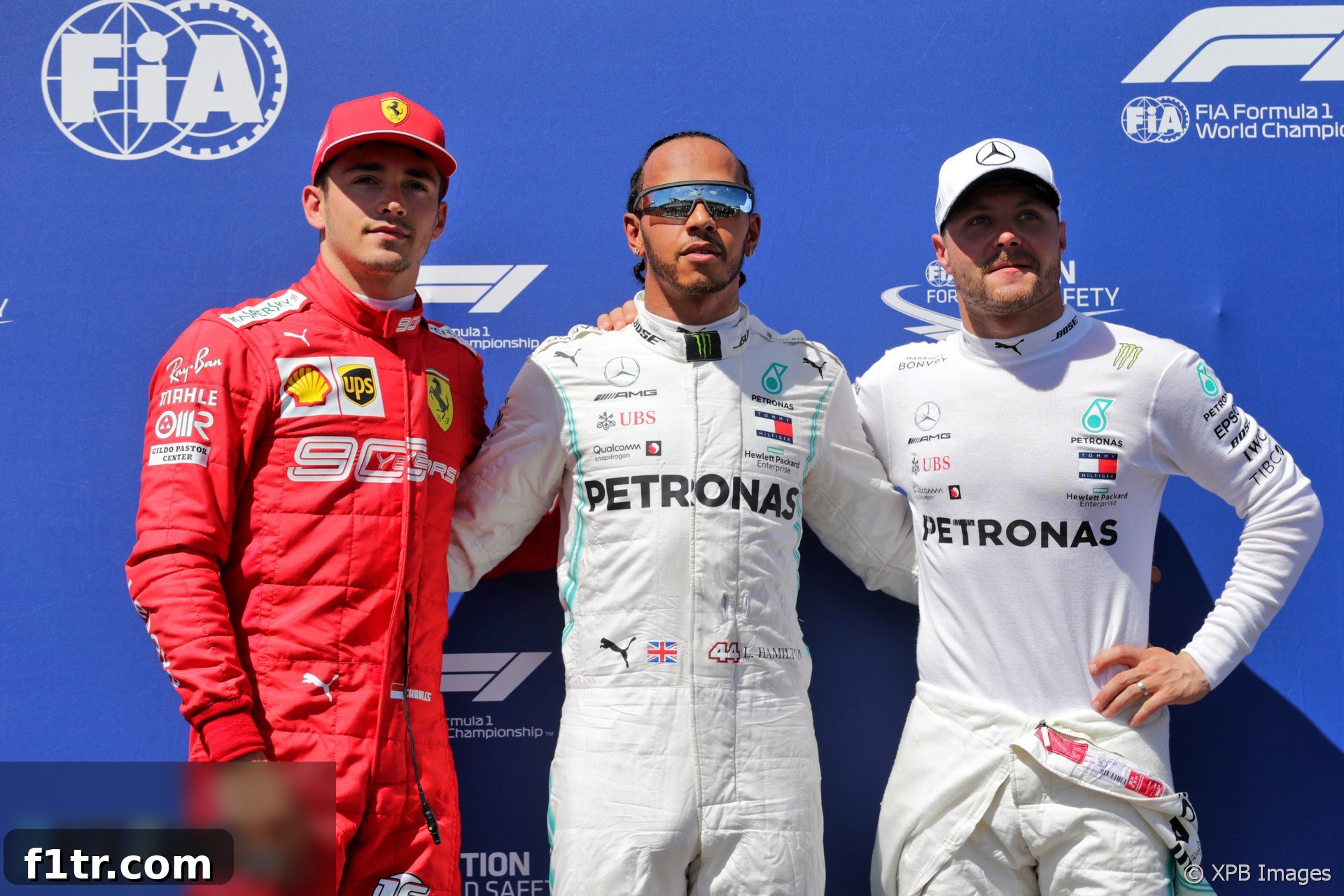
The picturesque Paul Ricard circuit in France set the stage for another thrilling Formula 1 qualifying session, albeit one that reinforced the dominant narrative of the 2019 season. While Ferrari’s Charles Leclerc showed commendable progress, bridging a significant gap to the pole position, the Mercedes-AMG Petronas Motorsport team once again asserted its formidable authority. Leclerc, who was six-tenths off pole in Canada and visibly frustrated, found himself with the same margin in France but expressed a distinctly more positive outlook. This subtle shift in sentiment speaks volumes about Ferrari’s evolving expectations and the stark reality of competing against a seemingly invincible Silver Arrows outfit.
Heading into the French Grand Prix, a track characterized by its smooth tarmac, long straights, and technical high-speed corners – attributes historically favoring Mercedes – Ferrari knew they faced an uphill battle. Despite Sebastian Vettel’s pole position in Canada, it was Leclerc who emerged as the leading red car on the grid this weekend, showcasing his burgeoning talent. However, even his impressive efforts couldn’t truly challenge the raw pace of their silver rivals. The outcome of qualifying delivered a grid remarkably similar to the previous year, with Lewis Hamilton spearheading another Mercedes front-row lockout, followed by a solitary Ferrari in third – this time with Leclerc instead of Vettel – and the second SF90 relegated off the second row.
Twelve months prior, Sebastian Vettel, starting from third, made an aggressive start but found himself boxed in by the Mercedes pair, leading to an unfortunate collision with Valtteri Bottas and a subsequent penalty. Leclerc now faces a similar predicament. The long run down to Turn 1 at Paul Ricard offers Ferrari a tantalizing opportunity to utilize their straight-line speed advantage, potentially allowing Leclerc to challenge the Mercedes cars off the line. However, this aggressive approach also carries inherent risks, echoing Vettel’s prior experience. Should Leclerc manage to leapfrog one or, in the dream scenario for Ferrari, both Mercedes at the start, the challenge to maintain that position would be immense.
Leclerc himself acknowledged the formidable task ahead after qualifying, stating, “Their race pace on Friday was very, very, very strong. I think a good start will be very important and then we’ll see what happens. Obviously if we’re in front at the start it will be easier – but it’s not going to be easy.” This insight from the young Monegasque driver highlights the fundamental difference between qualifying pace and race day performance, an area where Mercedes consistently demonstrates unparalleled strength through superior tyre management and sustained car performance over long stints.
For Valtteri Bottas, losing pole position to his teammate Lewis Hamilton in Q3 was a significant setback. Bottas had looked poised to take the top spot for much of the qualifying session, appearing to have the edge over Hamilton until the decisive final runs. In the intense championship battle against his teammate, every point counts, and starting behind Hamilton is a blow to his aspirations. He desperately needs to finish ahead of the championship leader to stem the flow of points away from him and keep his title hopes alive. The psychological impact of consistently being outpaced by Hamilton in the critical moments of Q3 also adds another layer of pressure on the Finn.
Meanwhile, Sebastian Vettel’s qualifying session was particularly disappointing, leaving him down in seventh on the grid. His chances of a podium finish, or even climbing higher than fourth, appear slim given the strength of the cars ahead. The German driver will have to contend with an impressive McLaren duo, Lando Norris and Carlos Sainz Jnr, who qualified an excellent fifth and sixth respectively. The resurgent Woking team has shown exceptional form this weekend, and their drivers will be eager to not only challenge Max Verstappen in the Red Bull ahead but also replicate Renault’s success in Canada by successfully defending against any charges from behind, including Vettel’s Ferrari. Vettel’s struggle hints at a deeper issue, possibly related to car balance or setup, which Ferrari will need to address urgently as the season progresses.
Adding another intriguing element to the race strategy is the tyre choice for several drivers. Pierre Gasly, following another underwhelming qualifying performance in the second Red Bull, will be one of two drivers starting the race on the fragile soft compound tyres. The other is Antonio Giovinazzi, his former Prema GP2 teammate. This decision immediately puts them on a different strategic footing from the majority of the field. The soft tyre has proven to be too fragile in the hot conditions experienced so far at the Paul Ricard circuit, and Sunday’s forecast predicts even higher temperatures. The smooth surface of the track also tends to be less abrasive, but the sheer heat often leads to significant degradation for softer compounds.
Consequently, there is little reason to expect the remaining drivers to deviate from the preferred single-stop strategy, utilizing either the medium or hard compound tyres for the bulk of the race. The soft tyre’s susceptibility to blistering and degradation means that those starting on it will likely be forced into an early pit stop, potentially compromising their race length and overall strategy. While the prospect of any team truly taking the fight to Mercedes seems remote, Charles Leclerc represents Ferrari’s best chance. For once, he shouldn’t have to worry about the close proximity or strategic interplay with his teammate, Sebastian Vettel, a dynamic that Ferrari has seldom shied away from exploiting in favor of one driver over the other earlier in the season. The team’s focus will squarely be on maximizing Leclerc’s potential against the dominant Mercedes machines, hoping for an opportunity to snatch a victory or at least a strong podium finish.
The strategic battle will be as critical as raw pace. Mercedes’ ability to manage their tyres, especially the harder compounds, has been a cornerstone of their success. Ferrari, on the other hand, has often struggled with consistent tyre performance throughout a race stint. The warm weather will amplify these challenges, making intelligent tyre management paramount for all competitors. The long straights followed by heavy braking zones at Paul Ricard will test both engine power and brake longevity, while the multiple sweeping corners will push aerodynamic efficiency and driver precision to their limits. Ultimately, the French Grand Prix promises to be a test of endurance, strategy, and pure speed, with Mercedes entering as clear favorites but with Leclerc eager to spring a surprise.
Advert | Become a RaceFans supporter andgo ad-free
Qualifying times in full
| Driver | Car | Q1 | Q2 (vs Q1) | Q3 (vs Q2) | |
| 1 | Lewis Hamilton | Mercedes | 1’30.609 | 1’29.520 (-1.089) | 1’28.319 (-1.201) |
| 2 | Valtteri Bottas | Mercedes | 1’30.550 | 1’29.437 (-1.113) | 1’28.605 (-0.832) |
| 3 | Charles Leclerc | Ferrari | 1’30.647 | 1’29.699 (-0.948) | 1’28.965 (-0.734) |
| 4 | Max Verstappen | Red Bull | 1’31.327 | 1’30.099 (-1.228) | 1’29.409 (-0.690) |
| 5 | Lando Norris | McLaren | 1’30.989 | 1’30.019 (-0.970) | 1’29.418 (-0.601) |
| 6 | Carlos Sainz Jnr | McLaren | 1’31.073 | 1’30.319 (-0.754) | 1’29.522 (-0.797) |
| 7 | Sebastian Vettel | Ferrari | 1’31.075 | 1’29.506 (-1.569) | 1’29.799 (+0.293) |
| 8 | Daniel Ricciardo | Renault | 1’30.954 | 1’30.369 (-0.585) | 1’29.918 (-0.451) |
| 9 | Pierre Gasly | Red Bull | 1’31.152 | 1’30.421 (-0.731) | 1’30.184 (-0.237) |
| 10 | Antonio Giovinazzi | Alfa Romeo | 1’31.180 | 1’30.408 (-0.772) | 1’33.420 (+3.012) |
| 11 | Alexander Albon | Toro Rosso | 1’31.445 | 1’30.461 (-0.984) | |
| 12 | Kimi Raikkonen | Alfa Romeo | 1’30.972 | 1’30.533 (-0.439) | |
| 13 | Nico Hulkenberg | Renault | 1’30.865 | 1’30.544 (-0.321) | |
| 14 | Sergio Perez | Racing Point | 1’30.964 | 1’30.738 (-0.226) | |
| 15 | Kevin Magnussen | Haas | 1’31.166 | 1’31.440 (+0.274) | |
| 16 | Daniil Kvyat | Toro Rosso | 1’31.564 | ||
| 17 | Romain Grosjean | Haas | 1’31.626 | ||
| 18 | Lance Stroll | Racing Point | 1’31.726 | ||
| 19 | George Russell | Williams | 1’32.789 | ||
| 20 | Robert Kubica | Williams | 1’33.205 |
Sector times
| Driver | Sector 1 | Sector 2 | Sector 3 |
|---|---|---|---|
| Lewis Hamilton | 21.951 (1) | 27.300 (1) | 39.005 (1) |
| Valtteri Bottas | 22.046 (2) | 27.493 (4) | 39.066 (2) |
| Charles Leclerc | 22.184 (3) | 27.434 (3) | 39.215 (3) |
| Max Verstappen | 22.279 (5) | 27.652 (9) | 39.455 (5) |
| Lando Norris | 22.369 (6) | 27.631 (7) | 39.407 (4) |
| Carlos Sainz Jnr | 22.254 (4) | 27.648 (8) | 39.611 (6) |
| Sebastian Vettel | 22.370 (7) | 27.388 (2) | 39.675 (7) |
| Daniel Ricciardo | 22.514 (8) | 27.630 (6) | 39.725 (9) |
| Pierre Gasly | 22.523 (9) | 27.880 (13) | 39.685 (8) |
| Antonio Giovinazzi | 22.667 (13) | 27.745 (10) | 39.996 (13) |
| Alexander Albon | 22.570 (10) | 27.863 (12) | 39.857 (11) |
| Kimi Raikkonen | 22.651 (12) | 27.754 (11) | 39.940 (12) |
| Nico Hulkenberg | 22.610 (11) | 27.583 (5) | 40.128 (15) |
| Sergio Perez | 22.815 (16) | 28.038 (15) | 39.808 (10) |
| Kevin Magnussen | 22.791 (14) | 27.921 (14) | 40.105 (14) |
| Daniil Kvyat | 22.929 (17) | 28.196 (18) | 40.439 (17) |
| Romain Grosjean | 22.804 (15) | 28.183 (17) | 40.562 (18) |
| Lance Stroll | 23.164 (18) | 28.150 (16) | 40.412 (16) |
| George Russell | 23.220 (19) | 28.491 (19) | 41.078 (20) |
| Robert Kubica | 23.566 (20) | 28.649 (20) | 40.990 (19) |
Speed trap
| Pos | Driver | Car | Engine | Speed (kph/mph) | Gap |
|---|---|---|---|---|---|
| 1 | Daniel Ricciardo | Renault | Renault | 342.5 (212.8) | |
| 2 | Kimi Raikkonen | Alfa Romeo | Ferrari | 341.8 (212.4) | -0.7 |
| 3 | Antonio Giovinazzi | Alfa Romeo | Ferrari | 341.2 (212.0) | -1.3 |
| 4 | Sebastian Vettel | Ferrari | Ferrari | 340.3 (211.5) | -2.2 |
| 5 | Alexander Albon | Toro Rosso | Honda | 340.2 (211.4) | -2.3 |
| 6 | Charles Leclerc | Ferrari | Ferrari | 339.8 (211.1) | -2.7 |
| 7 | Sergio Perez | Racing Point | Mercedes | 339.7 (211.1) | -2.8 |
| 8 | Nico Hulkenberg | Renault | Renault | 339.5 (211.0) | -3.0 |
| 9 | Lewis Hamilton | Mercedes | Mercedes | 338.6 (210.4) | -3.9 |
| 10 | Kevin Magnussen | Haas | Ferrari | 337.1 (209.5) | -5.4 |
| 11 | Valtteri Bottas | Mercedes | Mercedes | 336.9 (209.3) | -5.6 |
| 12 | Lando Norris | McLaren | Renault | 336.6 (209.2) | -5.9 |
| 13 | Lance Stroll | Racing Point | Mercedes | 335.9 (208.7) | -6.6 |
| 14 | Carlos Sainz Jnr | McLaren | Renault | 335.4 (208.4) | -7.1 |
| 15 | Max Verstappen | Red Bull | Honda | 333.9 (207.5) | -8.6 |
| 16 | Robert Kubica | Williams | Mercedes | 333.3 (207.1) | -9.2 |
| 17 | George Russell | Williams | Mercedes | 331.5 (206.0) | -11.0 |
| 18 | Pierre Gasly | Red Bull | Honda | 331.4 (205.9) | -11.1 |
| 19 | Romain Grosjean | Haas | Ferrari | 330.3 (205.2) | -12.2 |
| 20 | Daniil Kvyat | Toro Rosso | Honda | 329.4 (204.7) | -13.1 |
Advert | Become a RaceFans supporter andgo ad-free
Drivers’ remaining tyres
| Driver | Team | Hard | Medium | Soft | |||
|---|---|---|---|---|---|---|---|
| New | Used | New | Used | New | Used | ||
| Lewis Hamilton | Mercedes | 1 | 0 | 1 | 1 | 0 | 3 |
| Valtteri Bottas | Mercedes | 1 | 0 | 1 | 1 | 0 | 3 |
| Sebastian Vettel | Ferrari | 1 | 0 | 0 | 2 | 1 | 2 |
| Charles Leclerc | Ferrari | 1 | 0 | 0 | 2 | 1 | 2 |
| Max Verstappen | Red Bull | 1 | 0 | 1 | 1 | 0 | 3 |
| Pierre Gasly | Red Bull | 1 | 0 | 0 | 1 | 0 | 4 |
| Daniel Riccairdo | Renault | 1 | 0 | 0 | 1 | 0 | 4 |
| Nico Hulkenberg | Renault | 1 | 0 | 0 | 1 | 2 | 3 |
| Kevin Magnussen | Haas | 1 | 0 | 1 | 0 | 1 | 4 |
| Romain Grosjean | Haas | 1 | 0 | 1 | 0 | 3 | 2 |
| Carlos Sainz Jnr | McLaren | 1 | 0 | 0 | 2 | 0 | 3 |
| Lando Norris | McLaren | 1 | 0 | 0 | 1 | 0 | 4 |
| Sergio Perez | Racing Point | 1 | 0 | 1 | 0 | 1 | 4 |
| Lance Stroll | Racing Point | 1 | 0 | 1 | 0 | 3 | 2 |
| Kimi Raikkonen | Alfa Romeo | 1 | 0 | 0 | 1 | 1 | 4 |
| Antonio Giovinazzi | Alfa Romeo | 1 | 0 | 1 | 0 | 0 | 4 |
| Daniil Kvyat | Toro Rosso | 1 | 0 | 1 | 0 | 2 | 3 |
| Alexander Albon | Toro Rosso | 1 | 0 | 1 | 0 | 1 | 4 |
| George Russell | Williams | 1 | 0 | 2 | 0 | 1 | 3 |
| Robert Kubica | Williams | 1 | 0 | 2 | 0 | 1 | 3 |
Over to you
Share your views on the French Grand Prix qualifying results and your predictions for the race in the comments section below. We’d love to hear your thoughts on the strategies, potential overtakes, and who you think will emerge victorious at Paul Ricard.
2019 French Grand Prix
- 2019 French Grand Prix Star Performers
- Top ten pictures from the 2019 French Grand Prix
- Hamilton urges change in F1 after supreme display in France
- Mercedes poised to equal McLaren’s 31-year-old consecutive wins record
- Paddock Diary: French Grand Prix day four
Browse all 2019 French Grand Prix articles