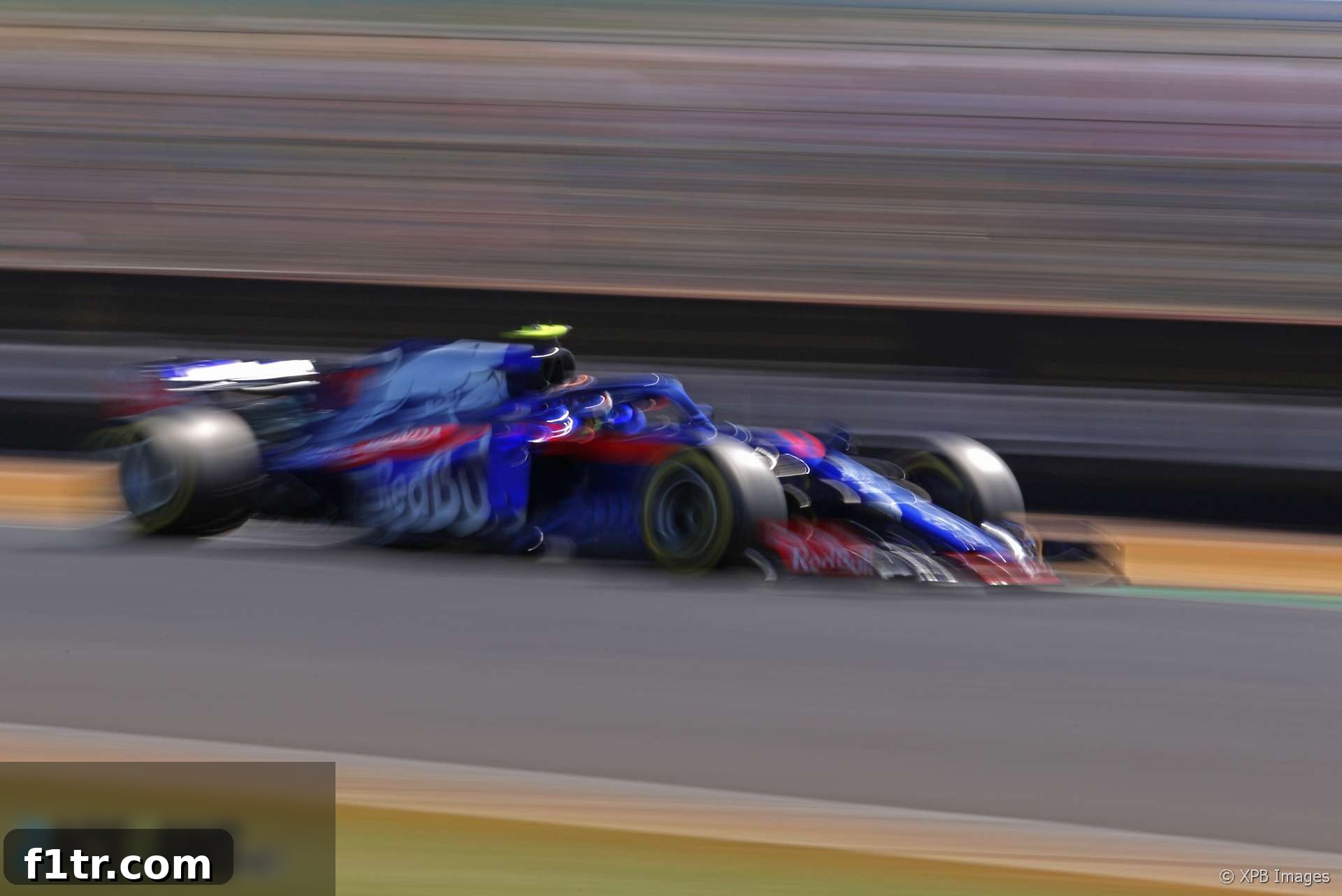
Sergio Perez Secures Crucial Point at British Grand Prix After Pierre Gasly Penalty
In a dramatic post-race twist at the 2018 British Grand Prix, Sergio Perez was retrospectively awarded the final championship point for tenth place, following a five-second time penalty issued to Pierre Gasly. This decision significantly altered the outcome of the midfield battle, highlighting the intricate and often contentious nature of Formula 1 racing.
Late Race Battle Leads to Controversy at Silverstone
The incident that led to the penalty unfolded in the closing stages of a thrilling British Grand Prix. Pierre Gasly, then driving for Toro Rosso, had executed a daring overtaking maneuver on Sergio Perez’s Force India car into the iconic Club corner complex. The move saw the two cars make contact, a moment of high tension as both drivers fought for position in the fiercely competitive midfield.
Gasly initially crossed the finish line in tenth, seemingly securing a valuable point for his team. However, the contact between the two drivers immediately caught the attention of the race stewards, who launched an investigation into the circumstances surrounding the late-race pass. Such investigations are a standard procedure in Formula 1 to ensure fair play and adherence to racing regulations, particularly when contact occurs between competitors.
The Stewards’ Scrutiny: Unpacking the Incident
Following a comprehensive review of telemetry, video evidence, and potentially driver testimonies, the stewards concluded that Gasly was primarily responsible for the collision. Their detailed explanation shed light on the nuances of racing incidents and the fine line between aggressive driving and an infringing maneuver.
The stewards’ statement elaborated, “The Stewards felt that Gasly’s maneuvers were generally reasonable, and that he was attempting to make a good racing pass.” This initial assessment indicated that Gasly’s intent was not malicious, but rather a legitimate attempt to gain position. Furthermore, they acknowledged, “Perez left him sufficient room throughout.” This suggests that Perez had done his part to avoid an incident, providing adequate space for Gasly’s car.
However, the pivotal moment that swayed the stewards’ decision was Gasly’s interaction with the circuit’s infrastructure: “Gasly touched the sausage kerb at the apex of Turn 16 which caused him to collide with Perez. This subsequently forced Perez off the track on driver’s left before Turn 17 and severely compromised his ability to race through Turns 17 and 18, and Gasly was thus able to pass Perez.” The “sausage kerb,” designed to deter drivers from exceeding track limits or cutting corners, played a direct role in the contact. Gasly’s slight misjudgment in riding this kerb destabilized his car just enough to cause the contact, which in turn forced Perez wide and hindered his ability to defend or recover his position through the subsequent fast corners of the Club complex.
The stewards concluded, “The Stewards determined that Gasly was wholly or predominantly to blame, and while the collision was light it led directly to the pass. Therefore the Stewards ordered a five second penalty.” The crucial aspect here was that even though the contact might have been minor, it was deemed to have directly facilitated the overtake. This principle is fundamental in F1 stewarding: an unfair advantage gained through contact, regardless of severity, often results in a penalty.
Impact on Championship Standings: A Crucial Point for Force India
The application of a five-second time penalty after the race proved costly for Pierre Gasly, dropping him from his hard-earned tenth place to thirteenth in the final classification. This meant the loss of a valuable championship point for himself and his Toro Rosso team.
Conversely, for Sergio Perez and Force India, the stewards’ decision was a significant boost. The promotion to tenth place meant that Perez secured a solitary but extremely important point. For a midfield team like Force India, which operated on a more limited budget compared to the front-running outfits, every single point was a treasure. Such points contribute directly to their position in the Constructors’ Championship, which in turn has substantial financial implications in terms of prize money and future development budgets. A single point can be the difference between millions of dollars and a higher standing, critical for a team’s long-term viability and competitiveness.
This penalty also underscored the relentless nature of the midfield battle in Formula 1, where teams and drivers often fight tooth and nail for the final points-paying positions. The difference between finishing tenth and eleventh can be immense for these teams, making every decision and every maneuver on track incredibly high-stakes.
Superlicense Points: A Driver’s Concern
Beyond the immediate loss of a championship point, Pierre Gasly also incurred two penalty points on his FIA superlicense for his role in the collision. This brought his total superlicense penalty points to four over a twelve-month period. Superlicense penalty points are a critical aspect of Formula 1 regulations designed to promote safer and cleaner racing. Drivers accumulate points for various infringements, and reaching a total of twelve penalty points within a twelve-month rolling period results in an automatic one-race ban.
For any Formula 1 driver, accumulating penalty points is a serious concern. While four points might seem far from the twelve-point threshold, it puts a driver on notice, requiring them to exercise greater caution in subsequent races to avoid further infractions. A race ban is a devastating blow for a driver’s career, their team, and their championship aspirations. It also carries a significant financial penalty and can severely impact morale and reputation. The penalty points system acts as a constant reminder for drivers to race within acceptable limits, balancing aggressive racing with respect for their competitors and the regulations.
The Broader Context of F1 Penalties and Racing Incidents
The incident between Gasly and Perez at the 2018 British Grand Prix serves as a pertinent example of the challenges and complexities involved in stewarding Formula 1 races. Decisions are often made under immense pressure, with millions of fans and stakeholders scrutinizing every call. The stewards’ role is to interpret the rules and apply them consistently, ensuring fair competition while allowing for the inherent competitive nature of motor racing.
Racing incidents, where contact occurs, are an inevitable part of the sport. Drivers are constantly pushing the limits of their cars and the track, often wheel-to-wheel at incredible speeds. The line between a “racing incident” (where no driver is predominantly to blame, and thus no penalty is issued) and an “avoidable collision” (where one driver is deemed at fault) is often very fine and subject to intense debate among fans, pundits, and even drivers themselves.
The Silverstone circuit, known for its high-speed corners and multiple overtaking opportunities, frequently witnesses such close-quarters battles. The Club corner, specifically Turns 16, 17, and 18, is a challenging sequence that requires precision and commitment. Late-braking maneuvers here, while exciting, carry inherent risks, as demonstrated by the Gasly-Perez encounter.
This particular decision highlighted the F1 ethos that while aggressive and bold overtaking is encouraged, it must not come at the cost of unfairly compromising a competitor. The stewards’ detailed explanation provided transparency, illustrating how a seemingly minor contact, exacerbated by touching a kerb, could have significant consequences for both drivers and their respective teams.
Ultimately, this British Grand Prix incident, like many others throughout Formula 1 history, reinforces the importance of clean racing and respect on track, even as drivers push their machines to the absolute limit in pursuit of championship glory. It also reminds us that in the high-stakes world of Formula 1, every second, every inch, and every point counts, right down to the very last lap and the final ruling of the race stewards.