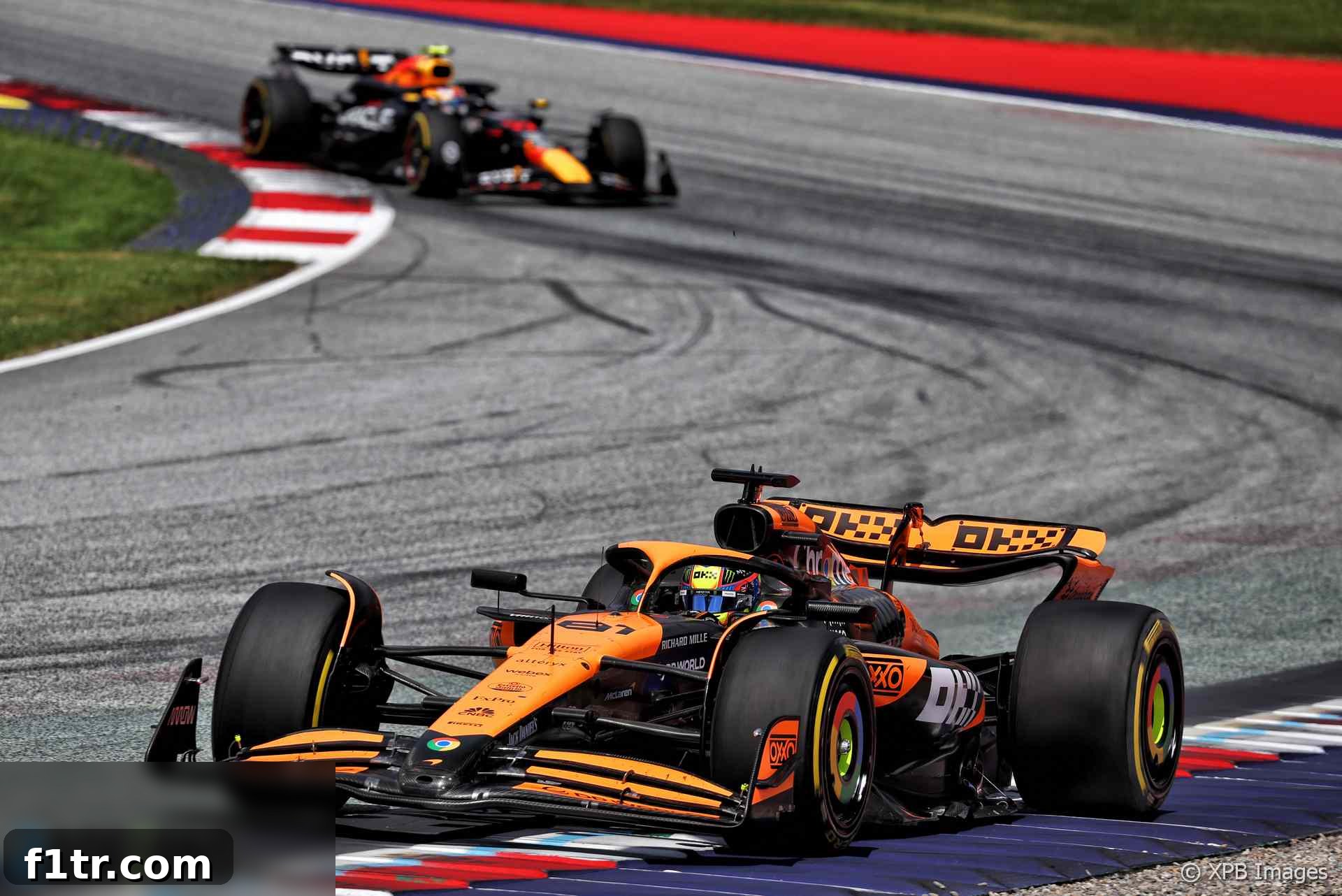
Oscar Piastri Unleashes Inner Fire to Conquer Austrian Grand Prix After Track Limits Heartbreak
The Austrian Grand Prix at the iconic Red Bull Ring delivered a thrilling spectacle, but for McLaren’s rising star Oscar Piastri, the race was fueled by a potent blend of frustration and fierce determination. After a contentious track limits penalty stripped him of a coveted third-place grid slot, Piastri admitted he approached Sunday’s main event with an “inner fire,” pushing the boundaries and taking calculated risks to reclaim what he felt he had lost.
Advert | Become a Supporter & go ad-free
Starting from a frustrating seventh position, a full four places lower than his initial qualifying pace, Piastri’s McLaren team had diligently attempted to overturn the penalty. However, their efforts were ultimately dismissed, leaving the young Australian with a point to prove. The incident reignited the perennial debate surrounding track limits enforcement in Formula 1, particularly at a circuit notorious for such infringements.
Piastri openly voiced his displeasure regarding the penalty, highlighting the paradox of circuit modifications aimed at mitigating these issues. “I was pretty upset yesterday,” he confessed, elaborating on the specific corner in question. “There are so many corners, we’ve made changes on the track here to get rid of the track limits issue, but this one corner, for some reason, we moved the white line, but not enough.” While acknowledging his own part in the transgression – “At the end of the day, I went slightly outside and that’s the mistake on me, or that’s what it was” – he underscored the contentious nature of the evidence used against him. The decision, based on helicopter camera footage of “questionable resolution” that was focused solely on his car, clearly left a bitter taste. “That stung quite a lot,” he added, emphasizing the psychological impact of the ruling.
This palpable sense of injustice transformed into a powerful motivator once the lights went out. Piastri revealed that his heightened emotional state translated directly into his driving style. “I had a bit of fire in me going into the race,” he remarked, indicating a more aggressive and daring approach than he might typically adopt. “I think some of my overtakes probably came from a bit further back than they would have otherwise.” This candid admission offers a fascinating glimpse into the mindset of a top-tier athlete channeling frustration into peak performance, using the perceived unfairness as fuel for an extraordinary comeback drive.
One particular move stood out as a testament to his renewed aggression and exceptional race craft: his audacious pass on Carlos Sainz Jnr at Turn 6 for a hard-fought second place. This maneuver was not just a single moment of brilliance but a culmination of Piastri’s strategic understanding of the circuit. “Turn six was a happy hunting ground this weekend,” Piastri noted with satisfaction. He recalled executing “three moves there around the outside,” showcasing his confidence and superior grip at that specific part of the track. The final overtake on Sainz was executed with precision, involving a close entry into Turn 4 before brilliantly sweeping around the outside of Turn 6. “Managed to get it done. So I’m pretty happy with that,” he concluded, highlighting the technical proficiency required for such a demanding pass.
Advert | Become a RaceFans supporter andgo ad-free
The start of the race, however, presented an immediate challenge, further testing Piastri’s resolve. He found himself embroiled in a multi-car tussle at the very first corner, being forced wide by the converging lines of Sergio Perez and Charles Leclerc. “I didn’t get the best of starts,” he explained, recounting the tense moments. Despite this, his quick thinking and decisive braking allowed him to find an opening on the outside. “I couldn’t really see where Checo went on the inside, but I didn’t think he was really that far up alongside Charles, but obviously all three of us kind of met at the apex.” It was a potentially race-ending moment that Piastri skillfully navigated. “It was quite fortunate for myself – I think there was a little bit of damage, but I don’t think anything major. I had a bit more contact with Checo again a bit later in the lap,” he detailed, underscoring the physicality of the opening lap and his resilience in managing the aftermath.
The early stages of the Austrian Grand Prix proved to be a test of patience and tyre management for Piastri. Stuck in a frustrating train of cars, he struggled to make significant inroads. The infamous “dirty air” effect, a bane of modern Formula 1, made closing in on rivals a formidable task, leading to tyre overheating and limiting his ability to challenge for positions. “In the first stint didn’t make quite as much progress as I would have liked. Obviously I had a bit of an incident in turn one and then just overheated the tyres a little bit. With the dirty air, it was so hard to get within a second so I didn’t make much progress there,” he explained, painting a clear picture of the initial difficulties.
Advert | Become a RaceFans supporter andgo ad-free
However, the tide began to turn dramatically after his first scheduled tyre stop. McLaren’s strategic decisions, combined with Piastri’s evolving race pace, allowed him to unlock the car’s potential. “But then the next two stints, it really started to come alive,” he recounted. The team opted for extended runs on both subsequent pit stops, a strategy that paid dividends in terms of track position and tyre performance. This aggressive yet calculated approach allowed Piastri to showcase his raw speed and ability to manage his machinery over longer periods. He began to carve through the midfield, picking off competitors one by one, demonstrating the maturity and confidence that have become hallmarks of his burgeoning F1 career.
Despite his sensational charge through the field, Piastri ultimately fell short of catching race-winner George Russell by a mere 1.9 seconds, securing a phenomenal second place finish. The tantalizingly small gap left him wondering what might have been with a few more laps, or perhaps, without the initial grid penalty. “It just kind of felt like we needed some more laps towards the end, unfortunately,” he mused, reflecting on the final moments of the race. Nevertheless, his performance was a resounding success, transforming a challenging weekend into a podium finish. “But after starting seventh, obviously a good turnaround,” he summarized, encapsulating the sheer scale of his achievement.
Piastri’s performance at the Austrian Grand Prix was more than just a strong result; it was a powerful statement. It highlighted his resilience in the face of adversity, his exceptional race craft under pressure, and his unwavering belief in his own abilities. The controversy surrounding the track limits penalty ultimately served to ignite a competitive fire that propelled him to one of his most impressive drives to date, reaffirming his status as one of Formula 1’s most exciting talents to watch. As the season progresses, such displays of character and skill will undoubtedly be pivotal in McLaren’s aspirations and Piastri’s own journey towards future F1 triumphs.
Never Miss a Moment: Subscribe to Our Daily F1 Updates!
Stay on top of all the latest Formula 1 news, analysis, and race reports. Get our fresh stories delivered directly to your inbox every day – no spam, just pure F1 content. Sign up now:
More on the 2024 Austrian Grand Prix
- Austrian GP clash will have taught Norris how to race Verstappen – Ricciardo
- Verstappen was “lucky” tyre damage didn’t force him to retire like Norris
- Pirelli introducing new C6 tyre to improve racing on street tracks next year
- Norris admits ‘overreacting’ but queries why Verstappen avoided track limits penalty
- Norris and Verstappen’s Austrian GP collision “blown out of proportion” – rivals
Browse all 2024 Austrian Grand Prix articles