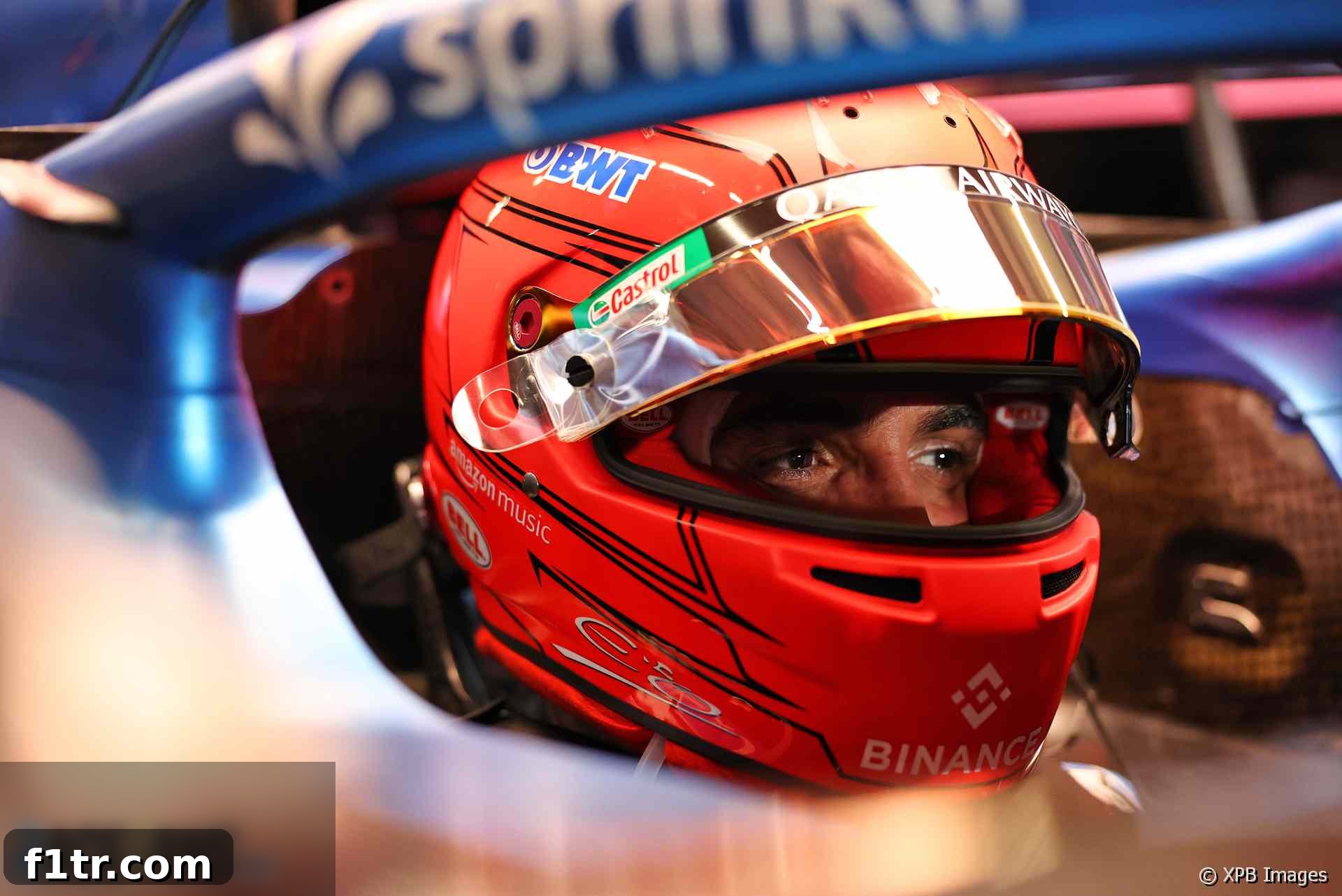
Esteban Ocon’s Incredible Battle: Vomiting in Cockpit, Refused to Retire at Qatar GP
Esteban Ocon delivered one of the most remarkable displays of resilience witnessed in recent Formula 1 history at the Qatar Grand Prix. Despite battling severe illness and vomiting inside his cockpit, the Alpine driver adamantly refused to withdraw from the grueling race, ultimately securing a hard-fought seventh place. This extraordinary feat underscored not only Ocon’s iron will but also the immense physical and mental demands placed upon drivers in extreme conditions.
The Losail International Circuit, hosting its second Formula 1 Grand Prix, presented an exceptionally challenging environment with scorching temperatures and stifling humidity. These conditions pushed many drivers to their absolute limits, but Ocon’s struggle was particularly severe, a fact he only revealed to his team after bravely taking the chequered flag.
The Toughest Points: Ocon’s Mid-Race Ordeal
“That was the hardest-fought points that I’ve ever had to fight for,” Ocon recounted after the race, visibly exhausted but triumphant. His ordeal began alarmingly early in the 57-lap event. “I was feeling ill on lap 15, 16, I was throwing up for two laps inside the cockpit. Then I was like, ‘shit, that’s going to be a long race’.”
At this critical juncture, Ocon was running in 13th position, having just completed his first pit stop. The onset of illness could easily have led to a retirement for a lesser driver, but Ocon’s determination shone through. He revealed that he had to consciously “calm down” and intensely refocus his mind to continue competing at the pinnacle of motorsport.
“I tried to remember that the mental side in sport is the strongest part of your body and I managed to get that under control and finish the race,” he explained. This quote encapsulates the profound psychological battle he waged internally, demonstrating the critical role of mental fortitude in F1 alongside physical prowess. “But, honestly I was not expecting for the race to be that hard.”
Extreme Conditions: A Universal Challenge in Qatar
While Ocon’s struggle was particularly harrowing, the Qatar Grand Prix proved to be a test of endurance for the entire grid. The combination of intense heat and humidity pushed ambient temperatures to over 30°C, with cockpit temperatures soaring to uncomfortable, even dangerous, levels. This unique blend of environmental factors meant that even the world’s most physically conditioned athletes found themselves at their breaking point.
One notable incident involved Logan Sargeant of Williams, who, already feeling unwell before the race, was forced to retire after 40 laps due to severe dehydration and heatstroke-like symptoms. His withdrawal underscored the very real health risks posed by such extreme racing conditions. Other drivers, including George Russell and Lance Stroll, also reported feeling unwell, dizzy, and on the verge of collapsing after the race.
Ocon highlighted the unprecedented nature of the conditions he faced. “I never felt something like that, it was so hot that I wanted to open the visor on the straight-line because I had no air,” he elaborated. “I was trying to also guide with my hands some air into the helmet because I couldn’t. The more I was breathing to try and get everything lower, the more heat was coming inside the helmet and honestly it was hell in there.” This vivid description paints a clear picture of the suffocating environment within the cockpit, exacerbating the physical toll on the drivers.
Despite his elite training, Ocon expressed surprise at how debilitating the race became. “I can normally do two race distances, even in Singapore,” he stated, referring to another notoriously challenging hot and humid race. “Physically like muscle-wise and cardio-wise I’m always fine but I don’t know it was just like 80 degrees inside the cockpit this race.”
The Cockpit Heat Conundrum and Driver Safety
Ocon also raised a critical point regarding the design of the F1 cars themselves, suggesting a potential contributing factor to the extreme heat. “I don’t think we probably do the best job in terms of not keeping the heat in the back, dissipating it inside the cockpit where the driver drives and I think that was the reason probably today where we felt so bad.”
Modern Formula 1 cars are marvels of engineering, designed for ultimate performance. However, the pursuit of aerodynamic efficiency and tightly packaged components can sometimes lead to compromises in driver comfort and heat management. The sheer amount of heat generated by the engine, MGU-H, MGU-K, and turbocharger, combined with brake heat and the minimal airflow into the cramped cockpit, creates an oven-like environment. This challenge becomes particularly acute in hot climates, raising important questions about driver welfare and safety that the FIA and teams regularly address.
The intense conditions at Qatar sparked wider discussions within the F1 paddock about the scheduling of races in such extreme environments and potential measures to mitigate risks. Drivers and teams are constantly evaluating strategies, from pre-race hydration protocols to the design of fireproof overalls and helmet ventilation, to better prepare for and manage these physiological stresses. The “wet bulb effect,” a measure combining temperature and humidity that indicates the body’s ability to cool itself, was even discussed by drivers like Alex Albon, underscoring the scientific approach to understanding these dangers.
Unwavering Resolve: “You Need to Kill Me to Retire”
Despite the excruciating pain and discomfort, Ocon’s resolve never wavered. His steadfast commitment to finishing the race was absolute. “It’s not an option, retiring,” he declared emphatically. “I was never going to do that. You need to kill me to retire.” This powerful statement perfectly encapsulates the mindset of a top-tier Formula 1 driver – an almost superhuman refusal to yield, driven by an unyielding competitive spirit and loyalty to his team.
This level of dedication is what separates the elite in any sport. For Ocon, finishing the race, however agonizing, was a non-negotiable objective. His ability to push through such severe physical adversity, coupled with the critical mental regrouping, not only earned him valuable points for Alpine but also cemented his reputation as one of the grid’s most determined competitors.
“But glad that we finished the race, a hard one, well deserved, the maximum that we could have done and got a happy ending,” Ocon concluded, reflecting on his incredible effort. His seventh-place finish was a testament to his grit and a vital contribution to his team’s championship standing.
Advert | Become a Supporter & go ad-free
Ocon’s heroic performance at the Qatar Grand Prix will undoubtedly be remembered as one of the defining moments of the season, a stark reminder of the immense challenges F1 drivers face and the extraordinary lengths they go to compete at the pinnacle of motorsport.
Bringing the F1 news from the source
RaceFans strives to bring its readers news directly from the key players in Formula 1. We are able to do this thanks in part to the generous backing of our RaceFans Supporters.
By contributing £1 per month or £12 per year (or the equivalent in other currencies) you can help cover the costs involved in producing original journalism: Travelling, writing, creating, hosting, contacting and developing.
We have been proudly supported by our readers for over 10 years. If you enjoy our independent coverage, please consider becoming a RaceFans Supporter today. As a bonus, all our Supporters can also browse the site ad-free. Sign up or find out more via the links below:
- Become a RaceFans Supporter
- RaceFans Supporter FAQ
Advert | Become a RaceFans supporter andgo ad-free
More from the 2023 Qatar Grand Prix
- Albon fears Qatar GP conditions risked creating dangerous “wet bulb effect”
- Alonso: New-spec fireproofs and pre-race anthem timing made Qatar heat worse
- Magnussen admits he took “too long to learn” Losail circuit
- Analysis: Sargeant’s Qatar radio reveals his painful struggle to end point-less run
- Alfa Romeo ‘finally understand their upgrade’ Bottas believes as team target Williams
Browse all 2023 Qatar Grand Prix articles