Lando Norris Challenges Max Verstappen’s Dominance: A Deep Dive into Miami Grand Prix Performance
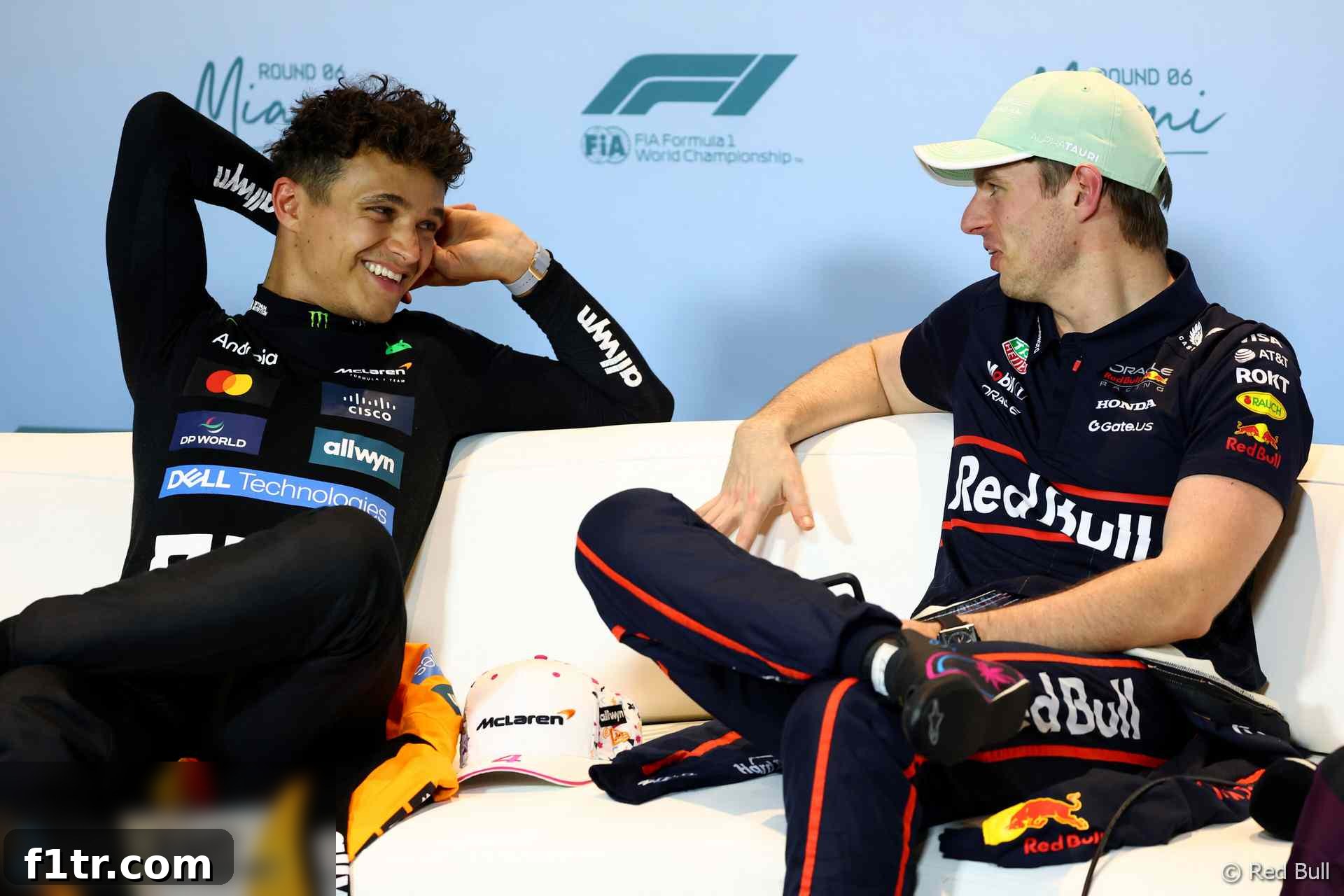
The competitive arena of Formula 1 consistently provides thrilling narratives, where the fine line between driver talent and machine capability is often blurred. At the recent Miami Grand Prix, Lando Norris of McLaren emerged not only as a formidable contender but also as a thoughtful voice challenging the widely accepted notion of Max Verstappen’s unparalleled car extraction. While Verstappen, the reigning world champion, secured his third pole position of the season in Miami, Norris, despite admitting to errors during his crucial Q3 laps, managed to line up alongside the Red Bull ace on the front row. This performance ignited a significant discussion within the F1 paddock about the true extent of car performance differences versus the raw skill of the driver.
Norris’s perspective on the matter is strikingly candid and insightful. He openly questioned the prevailing assumption that Verstappen is unequivocally extracting more performance from his Red Bull Racing car than Norris is from his McLaren. This viewpoint offered a subtle counter-narrative to comments made by his own team principal, Andrea Stella, who had light-heartedly remarked that McLaren “tend to let Max take pole position” when the qualifying times were exceptionally close. Norris, however, emphasized the inherent difficulty in precisely quantifying the performance gap between different constructors. He highlighted the considerable disparity often observed between Verstappen’s performance and that of his Red Bull teammate, Sergio Pérez, or even cars from sister teams like AlphaTauri (now RB) that utilize the same power unit package, suggesting that individual driver prowess can significantly influence perceived car capability.
Challenging the Champion: Driver Skill Versus Car Performance
“It’s impossible to know what car he’s got compared to us,” Norris stated, underscoring the complexities of Formula 1’s competitive landscape where direct comparisons are often speculative. His argument rests on a crucial premise: while Red Bull undeniably possesses a potent, championship-winning machine, McLaren benefits from having “two quick drivers” – a clear reference to himself and his highly rated teammate, Oscar Piastri – who are consistently pushing each other, and the car, to their absolute limits. This intense internal competition, Norris posits, could be a significant advantage, potentially implying that the McLaren car is becoming more versatile and forgiving, allowing both drivers to extract high levels of performance more consistently across various conditions and tracks.
The distinction Norris draws between Red Bull’s single dominant performer and McLaren’s strong, collaborative duo is a critical one in the fiercely competitive environment of modern Formula 1. While Verstappen undeniably exhibits exceptional talent and consistency, the frequent gap to his teammate often prompts deeper analysis: is the Red Bull car uniquely tailored to Verstappen’s driving style, or does its overall package truly possess such an overwhelming advantage over the rest of the grid? Norris’s observations suggest a growing belief within the McLaren camp that their car, particularly with recent strategic upgrades and a focused development trajectory, is steadily narrowing that gap. He implies that McLaren’s combined driver strength, fostering a competitive and data-rich environment, could prove to be a powerful asset against single-driver dominance, making the team a more potent and balanced threat.
Qualifying Close Call: A Testament to McLaren’s Progress
Norris’s journey to secure a front-row start in Miami was a compelling story of resilience and tangible progress. Following challenging qualifying performances in the two preceding Grands Prix, where he secured sixth and tenth positions respectively, his P2 start in Miami marked a significant leap forward. This improvement reflects both renewed confidence within the McLaren team and the effectiveness of their continuous development efforts. Despite openly admitting to making errors at Turn 17 on both of his critical Q3 laps – mistakes that he believes ultimately cost him a genuine opportunity for pole position – Norris expressed a profound sense of satisfaction with the overall outcome.
“I’m very happy with the end result,” he shared, reflecting on the qualifying session. “It’s just a shame when you miss out on pole, so that’s the only frustrating bit.” This sentiment perfectly encapsulates the ambitious standards that Norris sets for himself and his team. For a driver who has been relentlessly collaborating with his engineers to refine his driving approach and optimize the car’s setup, the improvement was not merely coincidental but a direct result of dedicated effort. He elaborated, “I’ve been trying different things with the team to try and work a bit more in this area and things have been taking a step forward, so I’m happy. Maybe we’re not quite there yet, but I’m happy with the progress.” This statement clearly highlights McLaren’s iterative development philosophy and Norris’s unwavering commitment to continuous improvement, both as an individual driver and as an integral part of the team’s collective ambition. The ability to rebound from previous mixed results and secure a front-row start on a demanding circuit like Miami is a powerful indicator of McLaren’s enhanced competitive potential and their upward trajectory in the championship.
Sprint Race Masterclass: Strategy, Skill, and the Role of Fortune
The Miami Grand Prix weekend kicked off with a thrilling sprint race, a format designed for high-octane action and unpredictable outcomes. Here, Lando Norris delivered a masterclass, demonstrating a compelling combination of strategic brilliance, exceptional driving skill, and a timely stroke of good fortune to claim a memorable victory. This triumph served to significantly bolster his confidence and, importantly, narrowed the points gap to teammate Oscar Piastri in the burgeoning championship standings. The race itself presented challenging conditions, predominantly dry but featuring a notably damp chicane section, which demanded impeccable car control and astute tire management from all competitors.
Norris meticulously shadowed his teammate, Piastri, for a substantial portion of the race before making a pivotal strategic decision: pitting for slick tires just one lap after Piastri. This perfectly timed call, executed flawlessly by the McLaren pit crew, combined with the subsequent deployment of a Safety Car, created an ideal scenario for Norris to leapfrog into the lead and secure a well-deserved win. While acknowledging the undeniable role of luck, particularly with the timing of the Safety Car, Norris was swift to emphasize the fundamental performance and strategic execution that laid the groundwork for his victory.
“The tyres were degrading a lot the last few laps,” he explained, detailing the demanding nature of the race. “It was pretty much dry for the most part, apart from the chicane section. But I think I just kept my tyres in a maybe slightly better condition and still had good pace. Obviously, then I had to do one more lap where I could push in the clean air and it was a strong lap again. So it was just good management, good pace throughout. The car was feeling very good, so I was happy.” This comprehensive account showcases his exceptional ability to preserve tire integrity under immense pressure and to capitalize decisively on unfolding opportunities. His post-pit lap, where he pushed aggressively in clean air, unequivocally demonstrated the raw pace and precision that define top-tier Formula 1 driving. The sprint race victory in Miami was far more than just a win; it was a compelling exhibition of McLaren’s strategic prowess and Norris’s growing maturity and strategic intelligence as a driver.
McLaren’s Ascent: A Team on the Rise in Formula 1
The impressive performances of Lando Norris throughout the Miami Grand Prix weekend are not isolated incidents but rather a clear indication of a broader, sustained resurgence within the McLaren Racing team. After navigating several challenging seasons, the iconic Woking-based outfit has been systematically climbing the ranks of the constructors’ championship, driven by significant technical upgrades, strategic organizational changes, and a renewed sense of collective purpose. The partnership between Norris and Piastri has proven to be exceptionally effective, with both drivers consistently pushing the boundaries of the car’s development and delivering strong, consistent results that validate the team’s direction. This internal, yet collaborative, competition, as frequently highlighted by Norris, is a crucial ingredient in McLaren’s current positive trajectory and their long-term ambitions.
Under the astute leadership of Team Principal Andrea Stella, McLaren has undergone a period of focused and strategic growth, meticulously optimizing every facet of their operation, from cutting-edge aerodynamic efficiency to lightning-fast pit stop execution. The palpable confidence exuded by Norris in Miami, evident both in his aggressive driving and his insightful assessments of the competitive landscape, is a direct reflection of this highly positive and empowering team environment. McLaren’s demonstrated ability to challenge the established dominance of Red Bull, even if intermittently, sends a powerful message to their rivals and ignites the fervent hopes of their vast and dedicated fanbase worldwide. Their progress extends beyond individual race results; it is about systematically building a robust and sustainable platform for future championship contention, firmly positioning themselves as a force to be reckoned with in the coming seasons.
As the Formula 1 season continues to unfold, the battle at the front of the grid promises to be exhilaratingly intense. Lando Norris’s standout performance in Miami, characterized by his fierce challenge to the reigning champion Max Verstappen and McLaren’s undeniable progress, firmly establishes him as a formidable force to be reckoned with. His refreshing willingness to question established narratives and consistently back up his assertions with impressive on-track results adds another captivating layer of intrigue to a championship that is quickly shaping up to be one of the most compelling and unpredictable in recent memory. The perennial question of which driver truly extracts the absolute maximum from their machinery remains open for debate, and Lando Norris is unequivocally determined to prove that he, along with the revitalized McLaren team, is right there in the thick of the fight for ultimate glory.