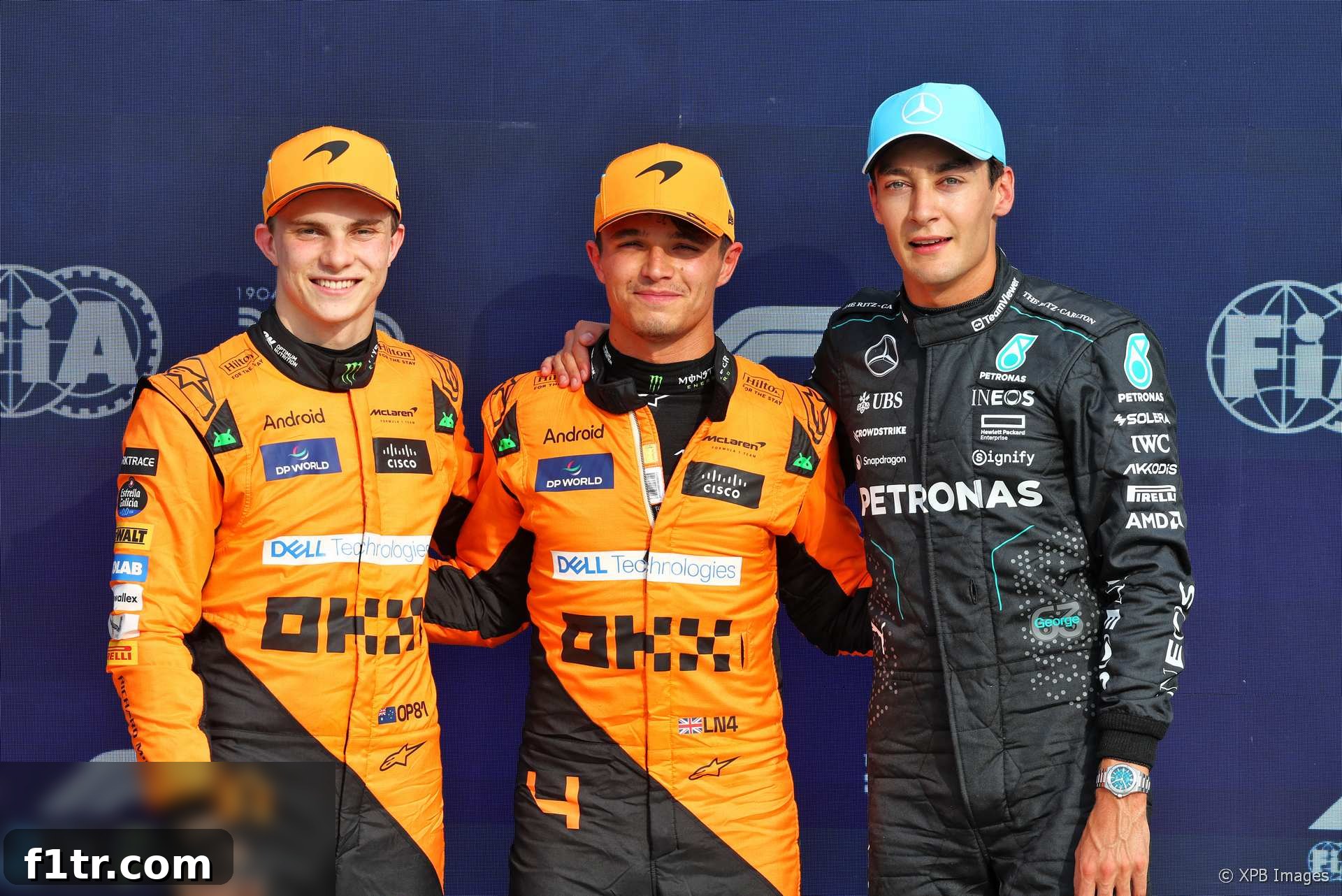
In a dramatic twist that would have seemed utterly inconceivable just months prior, McLaren stands on the cusp of an extraordinary achievement at Monza: potentially seizing the lead of the Constructors’ Championship by Sunday’s close. After a series of scintillating performances that have cemented their status as one of the grid’s fastest teams, McLaren’s Lando Norris and Oscar Piastri are set to line up on the front row, marking their second front-row lockout in the last four races.
The sight of two Papaya cars dominating the front row is no longer a surprise this season, a testament to McLaren’s remarkable resurgence. What truly sends shockwaves through the paddock, however, is the unexpected sight of reigning champions Red Bull starting from the fourth row. With no grid penalties or qualifying incidents to explain their unusually subdued performance, alarm bells are undoubtedly ringing loudly in Milton Keynes. The stark contrast in fortunes sets the stage for a potentially historic Italian Grand Prix.
The implications for the Constructors’ Championship are profound. Should McLaren convert their dominant qualifying display into a one-two finish, securing a formidable 43 points (even without the fastest lap bonus), and Red Bull endure a frustrating race, failing to significantly improve on their starting positions, McLaren could claim the top spot in the constructors’ standings. This would be a monumental moment, marking the first time in a decade that the Woking-based outfit has led the championship, a true indicator of their incredible turnaround.
Despite the grid advantage, the prospect of McLaren walking away with the championship lead still feels like an improbable outcome to many, including Lando Norris himself. The primary reason for this cautious optimism is the formidable presence of Max Verstappen. The reigning champion, starting from seventh, is renowned for his ability to carve through the field with surgical precision. Norris acknowledges that a repeat of his relatively unchallenged victory in the Netherlands a week prior is highly unlikely on Monza’s unique layout.
Reflecting on the recent Dutch Grand Prix, Norris commented, “I think when you look back to Zandvoort, you could say yes – there’s enough evidence that led us to believe we could have a very, very strong race.” However, he quickly tempered expectations for Monza: “Here, less so, just because it’s been so close. But we’re still first and second, which means we have a good car, and that normally translates well into a good race car.” This realistic assessment underscores the competitive nature of the field and the specific challenges Monza presents.
Irrespective of McLaren’s impressive race pace, Norris fully anticipates a fierce challenge from Verstappen, whose race performance often surpasses his qualifying efforts. The Dutchman’s ability to manage tyres and exploit Red Bull’s inherent speed on Sundays is legendary. Nevertheless, Norris remains acutely aware that he holds a “good opportunity” to significantly reduce Verstappen’s substantial 70-point lead in the Drivers’ Championship, making every lap a critical battle for valuable points.
“I expect him to come through and probably be behind us quite quickly,” Norris candidly stated, highlighting the perceived strength of the Red Bull package on race day. He elaborated on his observations from Friday practice: “Their race pace looked very strong on Friday. They were on the better side of the graining and the degradation, so I expect them to probably be a bit more hopeful tomorrow.” The data from long runs often provides a more accurate picture of true race potential, and Red Bull’s initial showings were strong.
Norris further pondered Red Bull’s qualifying struggles: “For some reason, they just didn’t seem to take those steps forward through qualifying. He still seemed quick – in Q2 he was right there and ended up quicker than me, even on a used tyre. And even his gap to Perez wasn’t as big as what it normally is. So I don’t know if he just struggled more with something or just didn’t put good enough laps in, but it’ll be for a reason, I’m sure. And we need to try and make the most of that.” This insightful analysis suggests that while Red Bull might have faced an unforeseen hurdle in qualifying, their underlying race pace remains a significant threat that McLaren must diligently counter.
The Monza Circuit: A Temple of Speed Reborn
Monza, often dubbed the “Temple of Speed,” is unique on the Formula 1 calendar. Characterized by long straights and fast chicanes, it demands a low-downforce setup, pushing cars to their absolute maximum speed. This year, however, the circuit presents a slightly altered challenge. Most of the track has been resurfaced since F1’s last visit a year ago, leading to higher natural grip but also increased tyre wear. This modification, coupled with subtle changes to kerbs and a slightly widened first chicane, means teams cannot rely solely on historical data for strategy. The resurfacing, in particular, will play a crucial role in tyre degradation and overall race dynamics, forcing teams to adapt their long-held strategies.
Weather Forecast: Sunshine and Tyre Management
The Italian Grand Prix weekend has been blessed with exceptionally clement weather, and Sunday is set to continue this trend. For the third consecutive day of on-track action, clear, sunny skies will bathe the circuit in warmth, with temperatures once again climbing into the low 30s Celsius. This consistent heat is a significant factor, impacting both car performance and tyre longevity.
The chance of rain is virtually non-existent, guaranteeing a dry race and eliminating one variable that can often upend strategies. Following the heavy winds that buffeted drivers during the previous event at Zandvoort, wind is expected to be a negligible factor in Monza. The only substantial weather-related challenge will be how the intense heat affects the new asphalt and, consequently, the tyres throughout the gruelling 53-lap race. Historically, Monza has been a one-stop race, but the combination of high temperatures and the fresh, more abrasive surface could introduce a new dimension to tyre management, potentially pushing teams towards alternative strategies.
The Start: Pole Position’s Perilous Sprint
The run from pole position to the apex of the Rettifilo chicane at Monza spans just over 600 metres, making it one of the longest starts on the Formula 1 calendar. Drivers at the very front will reach speeds of approximately 280 km/h before having to aggressively brake for the first corner – a notoriously tight and demanding sequence. The Rettifilo chicane has been the scene of numerous squeezes and accidents over the years, a true test of nerve and precision right from the off.
This year, however, there is a slightly reduced risk of first-lap chaos, thanks to the widening of the second part of the chicane. This modification should provide drivers with a bit more room to navigate safely through the crowded opening moments. Despite this improvement, the start at Monza remains a high-stakes affair, where positions can be gained or lost in an instant.
A recurring narrative surrounding Lando Norris whenever he starts from pole position is his consistent struggle to convert it into the lead of the race. Across his Formula 1 career, he has yet to maintain his pole advantage through the first corner. This pattern was observed again just last weekend in Zandvoort, where Max Verstappen swiftly overtook him. Given the long sprint down the pit straight at Monza, it would seem more probable that Norris might again relinquish his lead as the lights go out on Sunday. However, Norris insists he has learned “a couple of things” from his recent experiences.
“For sure, we of course reviewed things like we always do,” he affirmed. “I feel like we’ve made progress so far with our practice launches and stuff like that. So we’ll just crack on and do our best.” This proactive approach suggests that McLaren has been diligently working on optimizing their start procedures. Offering some comfort to Norris, statistics show that in the last ten Italian Grands Prix, the pole-sitter has failed to lead the first lap on only three occasions, indicating that pole at Monza is indeed a strong position from which to control the initial phase of the race.
Strategy: The Pirelli Puzzle at Monza
Traditionally, Monza’s strategic landscape has been straightforward. Boasting the highest average lap speed of any circuit, it also presents one of the largest pit deltas on the calendar, meaning the time lost in the pit lane is substantial. Consequently, a single pit stop has been the default strategy for many years, with teams aiming for maximum track time.
However, this year’s Monza is not entirely the same circuit teams have become accustomed to. Beyond the aforementioned subtle changes to kerbs and the slightly wider first chicane, the majority of the circuit has undergone a complete resurfacing since Formula 1’s last visit a year ago. As a direct result, natural grip levels are now higher, but crucially, so too is tyre wear and degradation. This, combined with the forecasted sunny and hot weather conditions, means that race strategy will be far from a simple one-stop affair, introducing an intriguing layer of complexity.
Pirelli’s motorsport director, Mario Isola, highlighted the critical role of temperatures in the upcoming race. “With conditions on Sunday forecast to be similar to Saturday’s, that definitely won’t help teams and drivers when it comes to tyre management,” Isola noted. He further elaborated on the potential challenges: “Graining could still be a factor, which could open the door to a possible two-stop strategy. That is why, apart from ensuring they have an additional option in the event of Safety Car or red flag, all the drivers, with the exception of Yuki Tsunoda, have chosen to keep two sets of hards for the race.” This strategic decision by the majority of the grid underscores the concerns over tyre degradation and the need for flexibility.
Even if tyre wear proves to be high, the inherent desire to avoid a second pit stop, which comes with significant time loss, may still outweigh the benefits. This will likely lead to intense tyre management throughout the race, with drivers carefully nursing their compounds. The key strategic dilemma will be whether to start on the more durable hard compound to ensure better longevity, or to opt for the softer compound for a stronger start and then save the harder tyres for the crucial second stint. For those starting at the front of the field, particularly the McLaren drivers, it is almost certain they will prioritize initial performance and opt for the softer compound to maximize their qualifying advantage.
Overtaking: The Art of the Slipstream
As the fastest circuit on the calendar, with an unparalleled amount of each lap spent at full throttle, Monza is inherently conducive to overtaking. The long straights and fast corners create abundant slipstream opportunities, making it a track where drivers can truly carve their way through the field. Over the past ten races at Monza, statistics show an average of 34 on-track overtakes during the 53-lap Grand Prix, highlighting its reputation as a circuit where genuine racing action is commonplace.
Naturally, the vast majority of these passes have occurred down the iconic pit straight, where the Drag Reduction System (DRS) provides a significant speed advantage for attacking cars heading into the Rettifilo chicane. However, Monza’s character allows for more than just DRS-assisted overtakes. Throughout its rich history, there have been numerous impressive moves executed without the aid of DRS, particularly into the Roggia chicane, and even daring manoeuvres through the challenging Lesmos corners. This blend of high-speed passes and technical overtakes makes Monza a perennial favourite for racing enthusiasts.
Adding another layer to the overtaking dynamic this year is the extension of the main DRS zone along the pit straight by just over 100 metres. This modification is designed to make overtaking even easier for cars on the attack, potentially leading to more intense battles and position changes. Whether this extension tips the scale too far in favour of those chasing, or strikes the perfect balance for thrilling racing, remains to be seen. The amplified DRS effect will certainly be a focal point of strategy and driver skill come race day.
Safety Cars: An Unpredictable Factor
Despite its high-speed nature and the inherent risks associated with it, Monza surprisingly boasts one of the lower historic Safety Car deployment rates among the circuits currently on the Formula 1 calendar. Over the last ten Italian Grands Prix, the full Safety Car has only been deployed on five occasions, meaning that half of those races ran entirely without intervention. This statistic often belies the track’s reputation for drama and close racing.
The current season has seen an unprecedented streak of green-flag racing, with no full Safety Car deployments since the Canadian Grand Prix. This means Formula 1 has enjoyed five consecutive Grands Prix running completely green from start to finish – a remarkable and almost unheard-of phenomenon in modern times. The historically robust reliability of the current generation of F1 cars has played a significant role in this trend. However, Monza, despite being the shortest race of the year in terms of duration, still demands a considerable amount from power units and other critical components, meaning mechanical failures are always a possibility, even if less frequent than in the past. An unexpected incident could still bring out the Safety Car, throwing carefully planned strategies into disarray and injecting an unpredictable element into the race.
One to Watch: Franco Colapinto’s Grand Prix Debut
It is a rare and special occasion when a driver makes their Formula 1 Grand Prix debut, and all eyes will be on Franco Colapinto as he takes to the grid for Williams. His appearance marks a significant moment, as he becomes the first Argentinian driver to start a Grand Prix since Gaston Mazzacane at the 2001 San Marino Grand Prix, which notably also marked Fernando Alonso’s fourth race in F1. This return of an Argentinian talent adds a touch of historical significance to an already exciting race weekend.
While qualifying 18th might, on the surface, seem like a typical performance for a Williams driver, it was, in truth, an underperformance given the true potential of his machinery. His teammate, Alexander Albon, admirably secured ‘best of the rest’ honours by qualifying ninth, demonstrating what the car is capable of. Colapinto is well aware that he has a car with the pace to move forward, and he will be eager to showcase his abilities in his very first Grand Prix.
Expressing his anticipation, Colapinto shared his thoughts: “Tomorrow is going to be a very special day, my first F1 race. It’s going to be an important moment of my career.” He also acknowledged the physical demands of a full-length Grand Prix: “I think my longest stint now was like eight laps – so tomorrow will be a long one running 57 or something. So I’m looking forward to tomorrow.” This humility and excitement underscore the immense challenge and opportunity that awaits the young Argentinian driver as he embarks on his Formula 1 journey.
Over to You: The Monza Verdict
As the grid lines up at the iconic Autodromo Nazionale Monza, the questions loom large: Will McLaren capitalize on their dominant front-row lockout for an easy victory, potentially leading to a historic Constructors’ Championship lead? Or will the formidable Max Verstappen, starting from an uncharacteristically low seventh, unleash his customary race pace to carve through the field and challenge for victory, thereby defending Red Bull’s championship advantage? Share your predictions, insights, and views on how the dramatic 2024 Italian Grand Prix will unfold in the comments below.