In the high-octane world of Formula 1, where every millisecond and every point can define a season, the inherent paradox of a two-driver team often manifests in moments of intense conflict. While drivers push the boundaries of speed and engineering, their ultimate ambition remains singular: to win. This individual pursuit collides sharply with team objectives, particularly when circumstances demand one driver concede victory to another. Such scenarios rarely unfold gracefully, leaving indelible marks on careers and relationships.
History is replete with examples of this agonizing dilemma. David Coulthard, a revered figure in the sport, twice yielded to Mika Hakkinen in consecutive races during the late nineties, a decision he later confessed to regretting. The psychological toll of such concessions is immense. Who can forget Felipe Massa’s visible dismay after the infamous “Fernando is faster than you” radio message at Hockenheim? Or the palpable awkwardness of the 2002 Austrian Grand Prix podium, where Rubens Barrichello reluctantly allowed Michael Schumacher past on the final lap, sparking widespread condemnation and a profound sense of injustice.
Conversely, when drivers defiantly prioritize personal glory over team directives, the repercussions can be equally seismic. Sebastian Vettel’s ‘Multi-21’ defiance against Mark Webber in Sepang etched itself into F1 lore as a stark example of internal rivalry boiling over. Decades earlier, Ayrton Senna’s refusal to honor a pre-race agreement with Alain Prost at Imola in 1989 further fractured their already strained relationship. And the 2007 Hungarian Grand Prix saw the irreparable breakdown between Lewis Hamilton and Fernando Alonso at McLaren, demonstrating the catastrophic potential of unchecked ambition.
McLaren, a team steeped in racing heritage, is no stranger to such internal flashpoints, having weathered numerous controversies involving their drivers throughout its storied past. This experience, though often painful, would prove an unexpected asset as they navigated a fresh, high-stakes internal challenge in 2024.
The 2024 Formula 1 season began somewhat quietly for McLaren, with their MCL38 initially struggling to match the front-runners. However, a significant upgrade package introduced at the Miami Grand Prix dramatically transformed their fortunes. Lando Norris seized this opportunity, claiming a spectacular victory in Miami that signaled McLaren’s return to championship contention. From that moment, the papaya-liveried cars demonstrated genuine winning pace, consistently challenging for podiums and victories, despite ceding the Austrian and British rounds to a resurgent Mercedes.
Heading into the Hungarian Grand Prix, anticipation was high. McLaren had secured their first front-row lock-out of the V6 hybrid turbo era, with Lando Norris on pole and Oscar Piastri alongside him, narrowly denying the formidable Max Verstappen. This presented McLaren with their strongest opportunity yet to join Red Bull, Ferrari, and Mercedes as a multi-win team in 2024. The strategy, as Piastri succinctly put it, was to simply “play it smart” on race day.
The race began with an immediate burst of drama. Both McLarens and Max Verstappen’s Red Bull opted for medium tyres, a common choice among the leading contenders for the hot and dry Hungarian conditions. Norris, starting from pole for the fifth time in his career (including sprint races), was acutely aware of his past failures to convert pole position into an opening lap lead. He was determined to break this trend at the Hungaroring.
As the lights extinguished, Norris instantly sensed the threat to his lead into Turn 1. He moved right to defend against Piastri, but his teammate’s car was already drawing alongside. Simultaneously, Verstappen, having benefited from Norris’s slipstream, darted left, creating an exhilarating three-wide charge into the braking zone. Norris had to hold his line, with Piastri hugging the inside. As the trio navigated the tight corner, Verstappen realized he had no room on the exit. Instinctively, he took to the escape road, crucially keeping his throttle pinned, allowing him to slingshot back onto the track ahead of Norris.
Verstappen’s audacious move, though effective, immediately came under scrutiny. Having seemingly ‘gained’ a position by going off track, he found himself under attack from Lewis Hamilton at Turn 2. The Mercedes driver attempted an ambitious pass around the outside but was rebuffed, momentarily impeding Hamilton and allowing Norris to sweep past into third place. The initial chaos settled, setting the stage for the inevitable radio lobbying. Norris vociferously argued that Verstappen should cede second place, while Verstappen countered that he had been unfairly forced off circuit. After a rapid review of the incident, Red Bull discreetly advised their champion to accept the situation and allow Norris back through. Verstappen complied, relinquishing the position at the exit of Turn 1 on lap four, his displeasure evident over the team radio.
With Verstappen’s penalty served, Oscar Piastri now held a lead of just over two seconds from his teammate, Lando Norris. Max Verstappen slotted into third, ahead of Lewis Hamilton, with the Ferraris of Charles Leclerc and Carlos Sainz Jnr occupying fourth and fifth. The race was widely predicted to be a two-stop affair, demanding meticulous tyre management even with the slightly cooler track temperatures. The leaders quickly settled into a rhythm, but the McLarens showcased superior pace, gradually extending their advantage over Verstappen, who frequently voiced complaints about the balance of his RB20.
The first significant strategic move among the front-runners came at the end of lap 16 when Hamilton pitted for hard tyres. McLaren reacted decisively, bringing Norris in on the very next lap to prevent any potential undercut from the Mercedes. With Norris safely covered, Piastri was then called in from the lead on lap 18, rejoining the track still comfortably ahead of his teammate. Red Bull and Ferrari opted for later stops, a decision that brought Piastri and Norris back to the front. However, Hamilton, thanks to his earlier stop and strong pace, had leapfrogged Verstappen, placing him as McLaren’s nearest challenger. Verstappen, visibly frustrated by losing track position to a fierce rival, channeled his anger into a relentless pursuit of the Mercedes.
For over ten nail-biting laps, Verstappen relentlessly chipped away at Hamilton’s lead, finally entering DRS range on lap 33. Two laps later, the Red Bull loomed large in Hamilton’s mirrors down the pit straight, applying immense pressure. Under this intense scrutiny, Hamilton locked up into Turn 1, momentarily gifting Verstappen a better exit. However, Verstappen’s ill-balanced Red Bull refused to turn into Turn 2, sending the world champion wide and allowing Hamilton to reclaim his position. This proved to be only a temporary reprieve for Hamilton, as Verstappen quickly regrouped and resumed his attack. Rather than asking their driver to continue defending against the relentless Red Bull, Mercedes made a bold strategic call, pitting Hamilton for a second set of hard tyres at the end of lap 40, leaving him with 30 challenging laps to cover in his final stint.
Mercedes’ aggressive strategy with Hamilton once again put McLaren on alert. Despite the Mercedes driver having dropped over 10 seconds behind Norris due to his earlier battle with Verstappen, Hamilton was now lapping over a second quicker than McLaren’s second-placed driver. The threat was undeniable. Norris, who had gradually fallen back from Piastri after their initial switch to hard tyres, suddenly closed the gap. A mistake from Piastri through Turn 11 on lap 33 saw him run wide, costing him two precious seconds of his lead. As if sensing an opportunity to apply pressure and challenge for the lead, Norris maintained a gap of under two seconds from that moment onwards. However, McLaren soon decided it was time to address the looming threat from Hamilton once more.
Despite Hamilton still being well over the 20-second window required for a successful undercut, McLaren controversially opted to pit Norris first, at the end of lap 45. They fitted him with a lightly-scrubbed set of medium tyres, as per their plan, and sent him out with a clear, albeit nuanced, instruction. “The aim here, again, is not to undercut Oscar,” Norris’s race engineer, Will Joseph, informed him. “We want to bring the tyres in to Hamilton who’s just leaving the final corner. Still a long way to go – 24 laps.” The initial rationale was to cover Hamilton, but the implications were far greater.
While the obvious move would have been to pit Piastri on the very next lap, the race leader was kept out for an additional lap. This extra time on older tyres, combined with a slightly delayed right-front wheel change during Piastri’s stop at the end of lap 47, proved pivotal. The two-second gap between the McLarens evaporated, and as Piastri exited the pit lane, he could only watch as his teammate’s car surged past him on track. In a matter of seconds, Oscar Piastri had, through no fault of his own, likely lost his maiden Grand Prix victory.
Facing the agonizing prospect of a catastrophic blow to team morale and a potential loss of trust from their talented second-year driver, McLaren found themselves in an unenviable position. Their only viable option to mitigate a major rupture in their intra-team dynamic was to issue the one instruction no Formula 1 driver ever wants to receive. “We’d like you to re-establish the order at your convenience,” Joseph calmly instructed Norris. The silence that followed from Norris’s end was ominous, a clear indication of the monumental decision weighing on his shoulders.
Piastri, fearing his dream win had slipped away, momentarily lost focus, running onto the gravel at the exit of Turn 12. Despite having tyres two laps younger and having comfortably led for the first 45 laps, Piastri seemed unable to close the gap to Norris and provide that “convenient” opportunity for a position swap. “I think the dirty air made a big difference,” Piastri later explained after the race. “I think, ultimately, I just wasn’t quite as quick as I needed to be in the last stint.” The psychological pressure on both drivers was immense.
As Norris continued to lead, he received increasingly urgent calls from Joseph to manage his tyres, far more than he was currently doing. The subtext was unmistakable: McLaren wanted him to slow down and let Piastri pass. But Norris, evidently grappling with the instruction, continued to run at his own pace. As the laps dwindled, Joseph’s pleas escalated, veering into what some might interpret as emotional blackmail, desperately trying to salvage the situation the team’s strategic calls had unwittingly created. Yet, Norris maintained his lead, his internal debate playing out on the world stage.
While the tension simmered at McLaren, it reached a boiling point in the battle for the final podium position between Lewis Hamilton and Max Verstappen. The championship leader had spent almost the entire race fuming over the handling characteristics of his upgraded Red Bull and what he perceived as suboptimal strategy calls from his team. Now, he was channeling that raw anger into reclaiming the position he had lost to Hamilton earlier in the race.
Verstappen had effortlessly dispatched Charles Leclerc, but Hamilton, determined to secure his monumental 200th Grand Prix podium, fought like it was his very first, forcing the Red Bull wide at Turn 2 once again. Verstappen’s next prime opportunity arose with DRS activated down the pit straight at the start of lap 63. The lapped Williams of Alexander Albon presented a tactical advantage for Verstappen, allowing him to surprise Hamilton into Turn 1. However, as the Mercedes turned into the corner, Verstappen locked up his tyres, his rear-left wheel making contact with Hamilton’s front-right, sending the Mercedes bouncing dramatically into the air. Miraculously, both cars continued, though the FIA informed Red Bull that Dr. Ian Roberts, the F1 medical delegate, would request to check Verstappen over after the race following his hard landing.
Back at McLaren, the psychological intervention might well be necessary if Norris continued to defy team orders to allow Piastri past before the chequered flag. By now, only a handful of laps remained, and Norris’s lead had inexplicably grown to over six seconds – a larger gap than Piastri had held over him in either of the first two stints. The pressure on Norris intensified with every passing second.
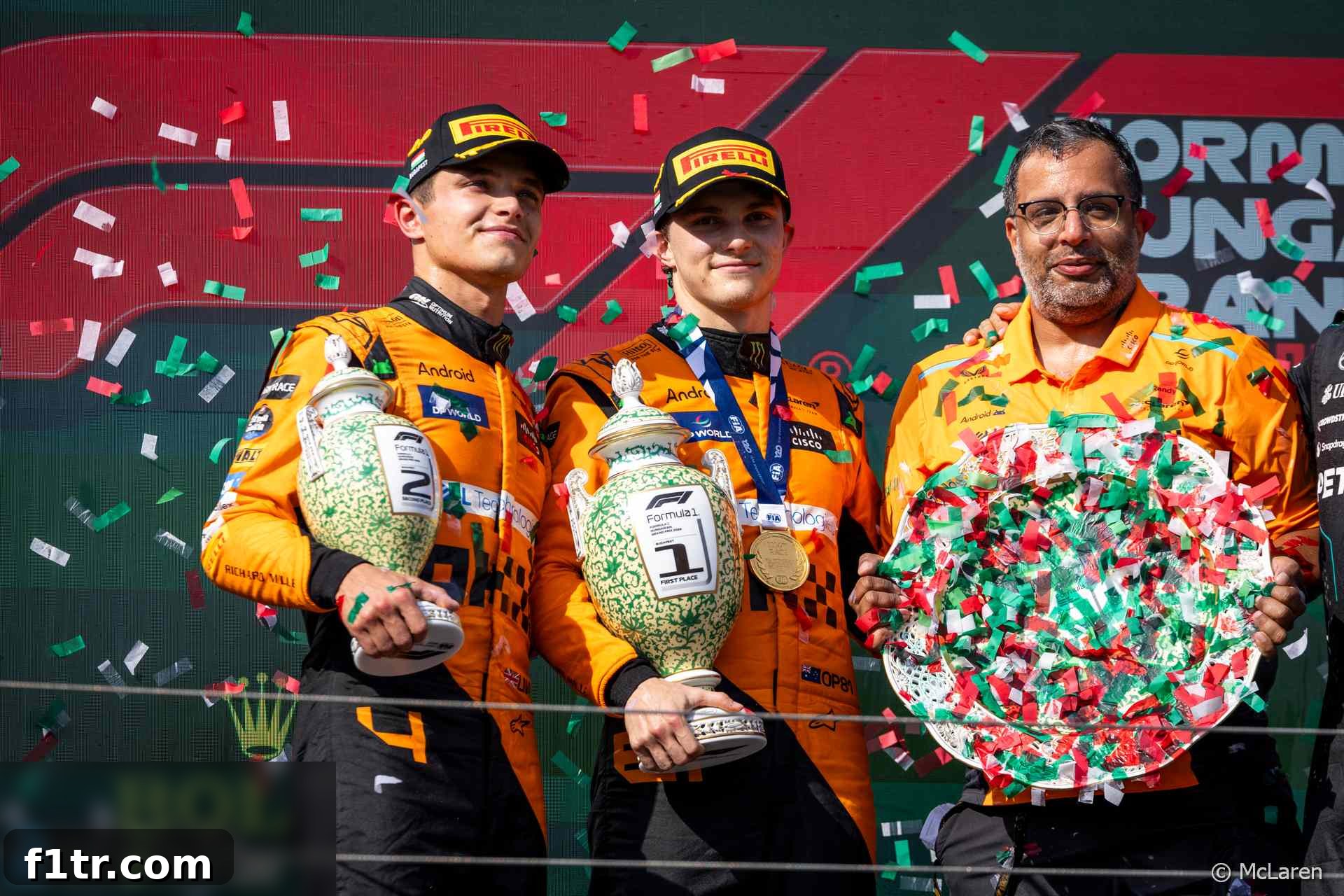
Norris had spent a grueling 20 laps deliberating the consequences of ignoring his team’s instructions versus the personal glory of a victory. Finally, at the end of the 67th lap, the decision was made. Norris began to ease off the throttle, and Piastri’s deficit dwindled. Putting the team’s needs and the sanctity of the internal dynamic before his own desires, Norris slowed to a cruising speed along the pit straight, allowing his teammate to reclaim the lead with just three laps remaining. It was a moment of profound sportsmanship, a difficult but ultimately unifying act.
The driver who had led the bulk of the race was now back in front. Just a year and a half into his Formula 1 career, Oscar Piastri was now on course for his maiden Grand Prix victory in his 35th start. The circumstances were far from the storybook ending he might have dreamt of, yet the achievement was no less significant. Piastri had, unequivocally, beaten his teammate to the first corner and maintained a strong lead through the critical first two stints. Now, as he rounded the final corner on the final lap, he was rewarded not just for the bold risk he took in signing with McLaren two years prior, but for all the countless sacrifices and tireless efforts he had poured into his lifelong Formula 1 ambitions.
“I said my first dream in my career was reaching F1. The second one is winning a race,” the ecstatic winner declared after the race. “I’m very, very happy and proud and not just of myself, but everybody that’s helped me get to this position. It took a lot of big decisions at a young age to chase the F1 dream. It’s very difficult to become an F1 driver by staying in Australia, so it meant some big decisions early in life. I’m very, very proud that those decisions have paid off and we’ve managed to make it worth it.” Piastri’s words underscored the profound personal significance of this milestone, despite the unusual path it took.
Norris’s delayed but ultimately decisive action saved McLaren from a potential crisis. He warmly congratulated his teammate on his victory after taking the flag, his demeanor in parc ferme demonstrating a mature understanding of the broader picture. “I shouldn’t have won today,” Norris candidly admitted. “I didn’t deserve to win because of my start and Oscar’s good start and that’s that. Of course that went through my mind, seven points that I’m going to lose. But I think the real fact is I shouldn’t have almost had them in the first place. So the team were right. And I stand by what they said.” This level of self-awareness and team loyalty is rare and commendable, solidifying his stature within the sport.
Norris’s decision was paramount for fostering enduring trust between the two teammates, a crucial factor as they prepare to intensify their challenge against Red Bull and Max Verstappen in the remaining races. He effectively ‘paid it forward’ to Piastri, setting a precedent that, should their roles be reversed in the future, his teammate will reciprocate. Whether Piastri will respond with quite the same delay remains an intriguing question for future race battles.
Lewis Hamilton, meanwhile, secured an unprecedented 200th Grand Prix podium, a testament to his extraordinary longevity and consistent performance. Despite some initial uncertainty over a potential penalty for his clash with Verstappen and the risk of losing his position to Charles Leclerc, a post-race investigation by the stewards resulted in no further action. The Mercedes driver thus completed his double century of podiums, with Leclerc picking up a solid fourth place after Verstappen rejoined the track following his collision.
Max Verstappen finished a distant fifth, 21 seconds adrift of the winner, visibly bitter and frustrated by a challenging race weekend. Carlos Sainz took a respectable sixth. Sergio Perez, starting from 16th, staged an impressive recovery drive to finish seventh, one place ahead of George Russell, who had started behind him. Yuki Tsunoda, after a heavy Q3 crash, bounced back to claim ninth, while Lance Stroll controversially secured the final point, seemingly refusing to honor his team’s instructions to allow Fernando Alonso back through after being granted an opportunity to challenge Tsunoda.
The Hungarian Grand Prix thus crowned Formula 1’s 115th Grand Prix winner – and McLaren’s second first-time winner of the season, following Norris’s earlier triumph. Yet, none of Piastri’s predecessors had secured their maiden victories under such awkward and emotionally charged circumstances. The strained conclusion to the race left McLaren with a peculiar sense of losing, even in their winning moment. However, amidst the agony of those final 20 laps and the eventual relief, it was crucial not to overlook the strategic significance of this result for the team.
Red Bull had arrived at the Hungaroring, marking the beginning of the second half of the championship, with a commanding 78-point advantage over McLaren in the Constructors’ standings. Leaving Hungary, that formidable gap had been significantly trimmed to 51 points. With 11 rounds still remaining and Red Bull’s hastily introduced upgrade package failing to prove the silver bullet they craved, McLaren now possessed a palpable momentum. This renewed energy and confidence position them perfectly to mount a serious challenge to the reigning world champions over the remainder of the season. Time alone will tell whether Lando Norris’s courageous sacrifice will ultimately prove to be crucial in their championship quest or, in hindsight, a costly missed opportunity for individual glory.
Become a RaceFans Supporter
RaceFans is run thanks in part to the generous support of its readers. By contributing £1 per month or £12 per year (or the same in whichever currency you use) you can help cover the costs of creating, hosting and developing RaceFans today and in the future.
Become a RaceFans Supporter today and browse the site ad-free. Sign up or find out more via the links below:
- Become a RaceFans Supporter
- RaceFans Supporter FAQ
2024 Hungarian Grand Prix Coverage
- Verstappen names Hungarian GP the most stressful moment of his title-winning year
- McLaren team orders “a new situation we’re inexperienced at handling” – Piastri
- Verstappen dismisses critics of “vocal” radio messages and late-night simracing
- Norris’ former McLaren team mates say he was right to give up win
- Mercedes surprised Hamilton’s car was “completely unscathed” in Verstappen clash
Browse all 2024 Hungarian Grand Prix articles
Latest F1 Race Reviews
- Antonelli lucks in for second win and becomes youngest F1 championship leader
- Emotional Antonelli grabs first Formula 1 victory in Chinese Grand Prix
- Russell sees off Ferrari threat to lead Mercedes one-two in Melbourne
- Norris clinches F1 title by two points as Verstappen wins finale at Yas Marina
- McLaren strategy blunder in Losail hands Verstappen crucial win and shot at title
Read all F1 race reviews